
English has many words that sound exactly alike but have completely different meanings. Throes vs throws is a good example.
When you hear them in a conversation, you cannot always tell which spelling the speaker means because both words are pronounced the same in standard English.
The confusion becomes greater because throws is a familiar verb form, while throes is a less common noun.
Many learners know “he throws the ball” but do not often see “in the throes of,” so the spelling is easy to mix up.
This difference matters in school writing, emails, and everyday messages at home and work.
A single spelling choice can change the meaning completely. “She throws the keys” describes an action. “She is in the throes of stress” describes a difficult or intense situation, so understanding the context matters.
The good news is that these two words follow very different patterns. Connect throws with throwing, and throes with a difficult or intense situation; the spelling becomes easier to remember.
You will also learn how to spot the correct word from the sentence around it, even when you only hear the word.
What Does “Throes” Mean?
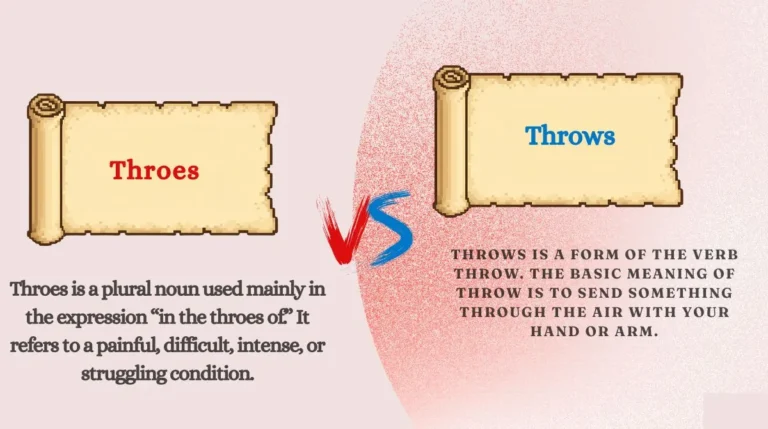
Throes is a plural noun used mainly in the expression “in the throes of.” It refers to a painful, difficult, intense, or struggling condition. Cambridge defines throes as a plural noun connected with experiencing or doing something difficult, unpleasant, or painful. Collins also describes it as a formal expression used when someone or something is deeply involved in something especially difficult or unpleasant.
You will often see it in phrases such as “in the throes of grief,” “in the throes of change,” “in the throes of a crisis,” and “in the death throes.” The word can describe physical pain, strong emotions, major change, or a difficult process.
The basic pattern is:
be + in + the throes of + noun / verb-ing
Examples:
- The company is in the throes of a major change.
- She was in the throes of grief after losing her friend.
- The country is in the throes of an economic crisis.
- We are in the throes of preparing for the final exam.
- The old system is in its final throes.
- The city was in the throes of a severe storm.
- He was in the throes of making a difficult decision.
- The project is in the throes of development.
Notice that throes does not describe someone physically throwing an object. It describes a state of struggle, difficulty, intense activity, or emotional pain.
The common phrase “in the throes of”
This is the most important expression to remember. “In the throes of” means being deeply involved in something, often something difficult, painful, or intense. Collins labels the phrase formal, so you may notice it more often in news reports, essays, formal writing, and serious conversations than in casual speech.
For example:
“Maria is in the throes of moving to a new city.”
This does not mean Maria is throwing anything. It means she is heavily involved in the stressful process of moving.
Another example is:
“The business was in the throes of bankruptcy.”
Here, throes describes a very difficult stage in the business’s situation.
The expression can also be used with a process rather than a clear problem:
- The team is in the throes of rebuilding.
- She is in the throes of making a big decision.
- The company is in the throes of expansion.
For a beginner, the safest meaning to remember is:
Throes = a difficult, painful, intense, or struggling situation.
And the pattern you should remember most is:
in the throes of
Common confusion with “throes”
A learner may hear:
“He’s in the throes of preparing for the exam.”
Because throes sounds exactly like throws, the learner may imagine a physical action. But grammar gives us a clue. The phrase “in the ___ of” needs a noun phrase, and “in the throes of” is a standard English expression.
So remember:
Throes = a difficult or intense state, usually in “in the throes of.”
What Does “Throws” Mean?
Throws is a form of the verb throw. The basic meaning of throw is to send something through the air with your hand or arm. Oxford lists throws as the present simple form used with he, she, or it. Cambridge also defines throw as sending something through the air and gives several other common uses of the verb.
For example:
- He throws the ball every afternoon.
- She throws the paper into the bin.
- My brother throws the keys onto the table.
- The player throws the ball to his teammate.
- The dog chases the stick when Ali throws it.
- Sara throws a quick glance at the clock.
- The child throws the toy on the floor.
- Our coach throws the ball across the field.
The grammar rule is simple:
I / you / we / they throw
He / she / it throws
The -s is added because throws is the third-person singular simple present form.
Throws can describe different actions
Most students first learn throw as a physical action, but English uses the verb in several ways.
You can throw something away:
“Please throw away the empty bottle.”
You can throw something on or down:
“Just throw your jacket on the chair.”
You can throw a party:
“We are throwing a small party on Saturday.”
You can even throw someone by confusing them:
“That tricky question threw me.”
You can also throw a look or glance:
“She threw a quick look at her phone.”
These meanings are different, but the spelling throws still follows the same grammar rule when the subject is singular in the present tense. Cambridge and Oxford both record a wide range of meanings and patterns for throw.
Important grammar point: do not use “throws” after does
This is a very common mistake.
Wrong:
“Does he throws the ball?”
Correct:
“Does he throw the ball?”
Why? Because does already carries the third-person singular grammar. The main verb returns to its base form.
The same rule applies in negative sentences:
Wrong:
“He doesn’t throws the ball.”
Correct:
“He doesn’t throw the ball.”
So:
He throws the ball.
but
Does he throw the ball?
and
He does not throw the ball.
This distinction is especially important for beginners because throws is correct in one sentence but incorrect in the question built from that same sentence.
Difference Between Throes and Throws
The easiest way to separate them is to look at their job in a sentence.
| Word | Part of speech | Basic meaning | Common pattern | Example |
|---|---|---|---|---|
| throes | plural noun | intense pain, struggle, or difficult involvement | in the throes of | The company is in the throes of change. |
| throws | verb | sends, tosses, or moves something; also other meanings of throw | he/she/it throws | She throws the ball. |
The key difference is meaning and grammar, not pronunciation.
1. Meaning difference
Throes is about a condition or intense situation.
Throws is about an action or a form of the verb throw.
Compare:
- The nation is in the throes of a crisis.
- The player throws the ball to the coach.
The first sentence talks about a difficult state. The second talks about an action.
2. Part-of-speech difference
Throes is a noun.
Throws is a verb form.
This is a very useful clue. In:
“She throws the ball.”
Throws is the action performed by the subject.
In:
“She is in the throes of fear.”
Throes is part of a noun phrase describing a state or experience.
3. Sentence-structure difference
With throws, you often have a subject followed by the verb and sometimes an object:
Subject + throws + object
- Tom throws the ball.
- The child throws the stone.
- She throws the towel onto the chair.
With throes, a common structure is:
Subject + be + in the throes of + noun/verb-ing
- The team is in the throes of rebuilding.
- He was in the throes of grief.
- The company is in the throes of change.
This sentence structure is one of the fastest ways to choose the correct spelling.
4. Pronunciation
In standard English, throes and throws are homophones. That means they have the same pronunciation but different spellings and meanings. Cambridge gives throes as /θroʊz/ in American English and /θrəʊz/ in British English. Oxford gives the third-person form throws with the corresponding pronunciation.
So listening alone may not tell you which spelling is correct. You need to understand the meaning and grammar.
5. Word-family clue
Think of:
throw → throws → threw → thrown → throwing
But:
throes → in the throes of
This grouping can help prevent spelling mistakes.
Grammar Rules You Must Remember
Rule 1: Use “throws” with he, she, or it in the simple present
When throw is used in the present simple with a third-person singular subject, add -s:
- He throws the ball.
- She throws the paper away.
- The machine throws out a warning message.
Do not use throws with I, you, we, or they:
- I throw the ball.
- They throw the bags in the corner.
Oxford specifically lists he/she/it throws as the present simple form of throw.
Rule 2: Use “throes” mainly in the phrase “in the throes of”
For everyday English, this is the pattern worth memorizing:
in the throes of + noun / verb-ing
Examples:
- She is in the throes of planning a wedding.
- We were in the throes of a difficult negotiation.
- The company is in the throes of change.
The phrase is established English usage and usually carries an idea of difficulty, intensity, or deep involvement.
Rule 3: After “does” or “doesn’t,” use “throw,” not “throws”
Correct:
- Does she throw the ball?
- He doesn’t throw it very far.
- Why does Tom throw his shoes there?
Incorrect:
- Does she throws the ball?
- He doesn’t throws it.
- Why does Tom throws his shoes there?
The helping verb does already marks the third-person singular.
Rule 4: Look at the meaning before choosing the spelling
Ask yourself one quick question:
Am I talking about an action involving throwing, or a difficult/intense situation?
If it is an action, you may need throw or throws.
If it is a difficult or intense condition, especially after “in the,” you probably need throes.
Compare:
- The coach throws the ball.
- The team is in the throes of a rebuild.
The spelling becomes much easier when you decide the meaning first.
Common Mistakes Students Make
Mistake 1: Writing “throws” in the fixed phrase
Wrong:
“The country is in the throws of a crisis.”
Correct:
“The country is in the throes of a crisis.”
The phrase is in the throes of, not “in the throws of.”
Mistake 2: Writing “throes” for a throwing action
Wrong:
“He throes the ball to me.”
Correct:
“He throws the ball to me.”
Here, the sentence needs a verb. The subject he requires the third-person singular form throws.
Mistake 3: Adding “-s” after “does”
Wrong:
“Does she throws the ball?”
Correct:
“Does she throw the ball?”
Remember: one -s is enough. It belongs to does, so the main verb stays throw.
Mistake 4: Confusing “throes” with “throws” in writing
This often happens in essays:
Wrong:
“The economy is in the throws of major changes.”
Correct:
“The economy is in the throes of major changes.”
The sentence is about a difficult period of change, not about throwing.
Easy correction tip
Look at the words around the confusing word.
If you see a pattern such as:
in the ___ of
check for throes.
If you see:
he/she/it ___ the ball
check for throws.
This is not a perfect rule for every sentence in English, but it is a strong beginner-friendly test for these two words.
Easy Trick to Remember the Difference
Here is a simple memory trick:
THROES = hard TIMES
THROWS = action
Think about the spelling of throes as belonging to a serious phrase:
the throes of trouble
the throes of change
the throes of grief
Now think about throws as belonging to an action:
throws a ball
throws a bag
throws a look
You can also use the word throw as your anchor.
If your sentence can talk about an object being sent, tossed, moved, or placed quickly, you probably need the verb family throw / throws.
If your sentence means someone or something is struggling through an intense, difficult, or painful situation, especially with in the, choose throes.
A quick mental test can help:
“Can someone throw it?”
If yes, think throws.
“Can someone be in it?”
If the answer is a difficult or intense situation, think throes.
For example:
“Sarah throws the ball.”
Can Sarah throw the ball? Yes. So the correct word is throws.
“Sarah is in the throes of exam week.”
Is this a difficult period she is going through? Yes. So the correct word is throes.
The more often you notice these patterns, the faster the correct spelling will come to you.
Daily Life Examples
Here are some simple examples showing how the two words work in real-life English.
Example 1
A: Who throws the ball first?
B: Jake throws it. He is usually very good at it.
Example 2
A: Why is Maria so busy?
B: She is in the throes of moving to a new apartment.
Example 3
A: Can you throw me the keys?
B: Sure. I’ll throw them over there.
Example 4
A: Is your team ready for the competition?
B: Not yet. We are in the throes of preparing for it.
Example 5
A: Why does your little brother throw his toys everywhere?
B: He gets excited and forgets to clean up.
Notice that does is followed by throw, not throws.
Example 6
A: The company looks very busy this month.
B: Yes. It is in the throes of launching a new product.
Example 7
A: Does Sara throw the ball far?
B: Yes, she throws it farther than I do.
Example 8
A: Why is the old system being replaced?
B: It is in the final throes of a long change process.
Example 9
A: Who threw this paper on the floor?
B: I don’t know, but Tom usually throws his rubbish away properly.
This example also shows that threw is the past tense of throw, while throws is the present simple form for he/she/it. Oxford lists threw as the past simple form and thrown as the past participle.
Example 10
A: Are you still working on that project?
B: Yes. We are in the throes of finishing the last stage.
Practice Section
Choose the correct word: throes or throws.
- The boy ___ the ball across the garden.
- The company is in the ___ of a major transition.
- Does your sister ___ the ball well?
- We were in the ___ of preparing for the ceremony.
- He ___ his jacket onto the sofa when he gets home.
Answers
- throws — “The boy” is singular, so the present simple form is throws.
- throes — The standard phrase is in the throes of.
- throw — After does, use the base form throw.
- throes — The sentence uses in the throes of, meaning deeply involved in an intense or difficult process.
- throws — “He” takes the third-person singular form throws.
FAQs About Throes vs Throws
What is the difference between throes and throws?
Throes is a plural noun usually used in “in the throes of” to describe a difficult, intense, or painful situation. Throws is a present-tense form of the verb throw, used with he, she, or it. The two words sound the same but have different meanings and grammatical roles.
Can we use “throws” in questions?
Yes, but not after does. You say, “Does he throw the ball?” not “Does he throws the ball?” You can use throws in questions when there is no helping verb taking the third-person ending, such as “Who throws the ball first?”
Can “throes” be used in a question?
Yes. For example, “Is the company in the throes of change?” is grammatically correct. However, the word is less common in casual conversation and is strongly associated with the phrase in the throes of.
Are throes and throws pronounced the same?
Yes. In standard English, they are homophones, meaning they have the same pronunciation but different spellings and meanings. This is a main reason learners confuse them in writing.
Is “throes” formal or informal?
Throes is relatively formal and is common in writing, news, serious discussion, and the fixed phrase in the throes of. In casual speech, people often choose simpler expressions such as “in the middle of,” “going through,” or “struggling with.”
Is “throes” always followed by “of”?
Not always in every possible use, but modern everyday use strongly favors phrases such as in the throes of and death throes. For learners, these patterns are the most useful ones to remember. If you are describing a physical or emotional action of throwing, use throw or throws instead.
Conclusion
Throes and throws are easy to confuse because they sound the same, but their jobs in a sentence are very different. Throws comes from the verb throw and is used with he, she, or it in the simple present: “She throws the ball.” Throes is a plural noun connected with struggle, intensity, pain, or a difficult process, especially in the phrase in the throes of: “They are in the throes of change.”
The best way to remember them is to connect each word with its sentence pattern. Think throws = action and throes = intense situation. Also remember the helpful grammar rule: after does or doesn’t, use throw, not throws.
Once you start noticing these words in real sentences, the difference becomes natural. A little practice with context and spelling will help you choose the right word confidently in writing and everyday conversation. You do not need to memorize a long list of rules.

Evan Rellmont is a writer who turns thoughtful ideas into meaningful words, creating stories and reflections that connect, inspire, and leave a lasting impression.