
Notable and noticeable look and sound very similar, so it is easy to use the wrong word.
Both words are connected with the idea of something getting attention, but they do not mean exactly the same thing.
The easiest way to see the difference is to think about why something gets your attention.
Notable usually describes a person, thing, event, achievement, feature, or change that is important, interesting, impressive, or worthy of attention.
Noticeable, on the other hand, describes something that is easy to see, hear, recognize, or become aware of.
For example, you might say, “She made a notable contribution to the project.” Her contribution is important and deserves attention.
But you could say, “There is a noticeable change in her voice.” The change is easy to hear.
These two words can sometimes appear with the same noun, such as difference, change, or improvement, which makes the confusion even greater.
The meaning, however, changes slightly depending on the word you choose.
Once you understand the basic idea behind each word, the difference becomes much easier.
You will also see why a famous person can be called notable, while a bright red shirt may simply be noticeable.
What Does “Notable” Mean?
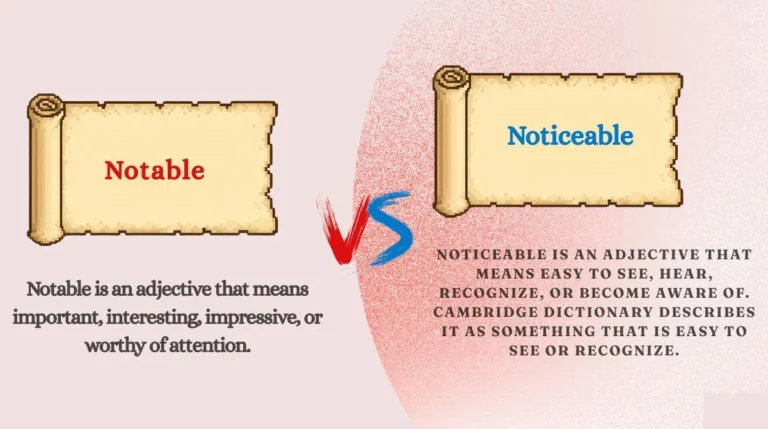
Notable is an adjective that means important, interesting, impressive, or worthy of attention.
When something is notable, people consider it worth talking about, remembering, or giving special attention to. Cambridge Dictionary defines notable as important and deserving attention, especially because something is very good or interesting.
Think of notable as meaning:
“This is special enough to deserve attention.”
When Do We Use “Notable”?
We commonly use notable for things such as:
- important achievements
- famous or respected people
- interesting events
- major changes
- impressive qualities
- special features
- important examples
- unusual facts
For example:
She had a notable career in science.
Her career was not simply something people could see. It was important or impressive.
Another example:
The school has produced several notable writers.
Here, notable means the writers are important, well-known, or distinguished.
Grammar Rule for “Notable”
Notable is an adjective. It can come before a noun:
a notable achievement
a notable person
a notable change
It can also come after a linking verb such as be, seem, become, or remain:
His success was notable.
The improvement became notable over time.
A common structure is:
notable + noun
For example:
notable achievement
notable difference
notable feature
notable contribution
The adverb form is notably.
She is notably successful in her field.
The two products are notably different.
8 Examples of “Notable”
- She made a notable contribution to the research project.
- The museum has a notable collection of old paintings.
- He became a notable figure in the technology industry.
- Winning the award was a notable achievement for the young athlete.
- There was a notable improvement in the student’s writing.
- The building is notable for its unusual design.
- Several notable scientists attended the conference.
- Her work had a notable effect on the local community.
Notice something important in these sentences. The word is not simply saying that something can be seen or noticed. It is saying that the thing is worth attention because of its importance, quality, interest, or distinction.
A Common Confusion With “Notable”
Many learners see notable and connect it directly with the verb notice. This can be misleading.
Although the two words are related in spelling and history, notable does not simply mean “easy to notice.”
For example:
The actor wore a bright green hat.
The hat may be very noticeable because it stands out.
But:
The actor gave a notable performance.
This means the performance was especially good, impressive, important, or worthy of attention.
That is the key difference.
What Does “Noticeable” Mean?
Noticeable is an adjective that means easy to see, hear, recognize, or become aware of. Cambridge Dictionary describes it as something that is easy to see or recognize.
Think of noticeable as meaning:
“You can easily notice this.”
The focus is on how easy it is to detect or observe something.
When Do We Use “Noticeable”?
We often use noticeable for:
- visible changes
- sounds
- physical differences
- movements
- smells
- colors
- behavior
- increases or decreases
- small or large changes that people can easily detect
For example:
There is a noticeable difference between the two photos.
This means the difference is easy to see.
Another example:
There was a noticeable change in his voice.
The change could easily be heard.
Grammar Rule for “Noticeable”
Like notable, noticeable is an adjective.
It can come before a noun:
a noticeable change
a noticeable difference
a noticeable improvement
It can also come after a linking verb:
The difference was noticeable.
Her accent became more noticeable.
The adverb form is noticeably:
The weather became noticeably colder.
He was noticeably nervous before the interview.
8 Examples of “Noticeable”
- There is a noticeable difference in the two pictures.
- Her new hairstyle is very noticeable.
- The temperature change was noticeable by the afternoon.
- There was a noticeable improvement in his pronunciation.
- The crack in the wall became more noticeable over time.
- His accent is noticeable when he speaks English.
- The noise outside was noticeable even with the windows closed.
- There was a noticeable change in her attitude after the meeting.
In all of these examples, the main idea is that the feature, change, or difference is easy to detect or recognize.
A Common Confusion With “Noticeable”
A learner may think:
noticeable = important
But that is not always true.
Something can be noticeable without being important.
For example:
Your new shoes are noticeable.
Perhaps they are bright yellow, so people can easily see them.
That does not mean the shoes are important or impressive.
Similarly:
There was a noticeable stain on the shirt.
The stain is easy to see, but it is certainly not something “important” in the sense normally expressed by notable.
Difference Between Notable and Noticeable
The main difference is very simple:
Notable = worthy of attention
Noticeable = easy to notice
This sounds like a small difference, but it changes the meaning of a sentence.
| Word | Main meaning | Main focus | Typical use |
|---|---|---|---|
| Notable | Important, impressive, interesting, or worthy of attention | Why something deserves attention | Achievements, people, events, qualities, contributions |
| Noticeable | Easy to see, hear, recognize, or become aware of | How easily something is detected | Changes, differences, sounds, appearances, behavior |
| Notably | In an important or especially clear way | Adds emphasis | “The prices were notably higher.” |
| Noticeably | In an easily observed way | Makes an observation stronger | “She was noticeably upset.” |
Usage Difference
Imagine a student wins a major academic award.
You can say:
She is a notable student.
This suggests she is distinguished or especially worthy of attention.
But you could also say:
She is a noticeable student.
This has a very different feel. It would suggest that she stands out or is easy to notice, perhaps because of her appearance, behavior, or some other visible quality. It does not naturally mean “excellent student.”
Now consider a change:
There was a notable change in the company.
This suggests the change was significant or important.
There was a noticeable change in the company.
This says the change was easy to observe or recognize.
Both sentences are possible, but the speaker’s focus is different.
Grammar Logic
Both words are adjectives, so they can modify nouns and appear after linking verbs.
Before a noun
a notable achievement
a noticeable improvement
After a linking verb
The achievement was notable.
The improvement was noticeable.
The grammar is similar, but the meaning is not.
When choosing between them, do not ask only:
“Can people notice it?”
Ask:
“Is it worthy of attention because it is important or special?”
If the answer is yes, notable may be the better choice.
If the main idea is easy to see, hear, or recognize, choose noticeable.
Sentence-Structure Difference
Both adjectives follow normal adjective patterns.
notable + noun
noticeable + noun
Examples:
a notable achievement
a noticeable achievement
The second phrase is grammatically possible, but its meaning is different. A noticeable achievement would be an achievement that stands out or can easily be observed. A notable achievement is one that deserves special recognition.
The same happens with difference:
a notable difference
This often means a difference that is meaningful or significant.
a noticeable difference
This often means a difference that is easy to see or recognize.
This is why these two words can be confusing even when they appear in exactly the same sentence pattern.
Meaning Comparison
Here is an easy pair to remember:
His scar is noticeable.
People can easily see it.
His scientific work is notable.
His work deserves attention because it is important or impressive.
One describes visibility. The other describes importance or distinction.
Grammar Rules You Must Remember
Rule 1: Use “Notable” for Something Worth Attention
Use notable when the thing is important, impressive, unusual, interesting, or deserving of recognition.
Her research was a notable achievement.
The research deserves special attention because of its value or importance.
Another example:
He made a notable contribution to the project.
His contribution was important or valuable.
A useful question is:
“Is this worth mentioning because it is special or important?”
When the answer is yes, notable is often the right choice.
Rule 2: Use “Noticeable” for Something Easy to Detect
Use noticeable when people can easily see, hear, recognize, or become aware of something.
There was a noticeable change in his voice.
You can detect the change by listening.
Another example:
The stain was noticeable from across the room.
The focus is on visibility.
Remember the simple idea:
Noticeable = easy to notice.
Rule 3: Both Words Can Describe a Difference or Change
This is one of the most important points because both words frequently appear with words such as difference, change, improvement, increase, decrease, effect, and decline.
Compare:
There was a noticeable improvement in her English.
Her English improved in a way that was easy to observe.
There was a notable improvement in her English.
The improvement was important, impressive, or significant.
The two sentences may describe the same situation, but they place attention on different aspects of it.
Rule 4: Do Not Choose “Notable” Just Because Something Can Be Noticed
This is a very common mistake.
Being visible does not automatically make something notable.
The red bag was noticeable.
Correct, because the bag stood out.
But:
The red bag was notable.
This would sound unusual unless the bag had some special importance, history, value, or interesting feature.
For example:
The red bag was notable because it had belonged to a famous designer.
Now notable makes sense because there is a reason the bag deserves special attention.
Common Mistakes Students Make
Students often confuse these words because they share the same beginning, and both can be connected with the idea of attention. The problem becomes worse when a dictionary translation gives a similar meaning for both.
Here are some common mistakes.
Mistake 1: Treating “Notable” as a Direct Synonym of “Noticeable”
Wrong:
His new haircut is notable.
This is not automatically wrong grammatically, but it may not express what you mean.
Better:
His new haircut is noticeable.
This clearly means people can easily see the haircut.
Use notable only when there is some reason the haircut deserves special attention.
His unusual haircut was notable for its historical style.
Now the adjective has a clear reason.
Mistake 2: Using “Noticeable” for Famous People
Wrong:
She is a noticeable scientist.
If you mean that she is respected or important, this is not the natural choice.
Better:
She is a notable scientist.
This means she is distinguished or worthy of attention.
Noticeable would work if you were talking about something that makes her stand out visually or behaviorally.
She is noticeable because of her bright red glasses.
That sentence focuses on what people can easily observe.
Mistake 3: Confusing “Notable Achievement” and “Noticeable Achievement”
Both can be grammatically formed, but they carry different meanings.
Notable achievement = an achievement worthy of recognition.
Noticeable achievement = an achievement that can easily be observed or that stands out.
In normal English, notable achievement is much more natural when talking about success or accomplishment.
Mistake 4: Assuming “Notable” Is Always Stronger Than “Noticeable”
It is better not to think of these words as simply weak and strong versions of the same adjective.
They describe different ideas.
Noticeable focuses on detection.
Notable focuses on importance or distinction.
A thing may be both:
The improvement was noticeable and notable.
It was easy to see, and it was also important.
Easy Correction Tip
Before choosing a word, ask yourself:
Can I easily see or hear it?
→ noticeable
Is it important, impressive, or worthy of attention?
→ notable
This simple test will solve most everyday cases.
Easy Trick to Remember the Difference
Here is a memory trick that works well for students.
NOTICEable = NOTICE
Look at the word noticeable.
It contains notice:
notice + able = noticeable
So think:
Noticeable = able to be noticed.
Something noticeable catches your eyes, ears, or attention easily.
Now think about notable:
Notable = worthy of note.
If something is notable, it is worth writing down, mentioning, remembering, or talking about.
Imagine a teacher giving you two comments.
“Your handwriting is noticeable.”
The teacher can easily see it.
“Your improvement is notable.”
Your improvement is important and deserves praise or attention.
That is the basic difference.
A useful classroom shortcut is:
Visible or detectable → noticeable
Important or impressive → notable
Keep those two ideas in your mind, and these words become much easier.
Daily Life Examples
Here are some natural examples you may hear in school, work, travel, or everyday conversation.
1. At School
Teacher: “You have made a noticeable improvement in your speaking.”
Student: “Thank you! I have been practicing every day.”
Here, the teacher can easily observe the improvement.
2. Talking About Success
Aisha: “Did Omar win the competition?”
Sara: “Yes. It was a notable achievement for him.”
The achievement is important and deserves recognition.
3. Talking About Clothing
Ali: “Is my new jacket too bright?”
Hamza: “It is definitely noticeable!”
The jacket stands out and is easy to see.
4. Talking About a Career
The professor had a notable career in medicine.
The person’s career was distinguished or important.
5. Talking About a Sound
There was a noticeable change in her voice during the call.
The change could easily be heard.
6. Talking About a Building
That old clock tower is notable for its beautiful design.
Its design is a special feature worth attention.
7. Talking About Behavior
His nervousness was noticeable during the interview.
People could easily observe that he was nervous.
8. Talking About Research
The scientist made a notable contribution to cancer research.
The contribution was important and worthy of recognition.
9. Talking About Weather
There was a noticeable drop in temperature last night.
People could clearly feel or observe the change.
10. Talking About a Difference
There is a noticeable difference between the two phones.
The difference is easy to recognize.
But:
There is a notable difference in their performance.
Here, the difference is important or meaningful.
Practice Section
Choose the correct word: notable or noticeable.
1. There was a ______ change in his accent after living abroad for five years.
2. She became a ______ leader in the education sector.
3. The scratch on the car was very ______.
4. Winning the scholarship was a ______ achievement.
5. There is a ______ difference in the quality of the two products.
Answers
1. noticeable — The change is easy to hear or recognize.
2. notable — She became important or distinguished in her field.
3. noticeable — The scratch is easy to see.
4. notable — The achievement is important and worthy of recognition.
5. noticeable — The difference can easily be seen or recognized.
Remember that in some situations both words can be grammatically possible, but the intended meaning changes.
FAQs About Notable vs Noticeable
What is the difference between notable and noticeable?
Notable means important, impressive, interesting, or worthy of attention. Noticeable means easy to see, hear, recognize, or become aware of.
For example, a scientist can be notable because of important work, while a bright shirt can be noticeable because it stands out.
Can “notable” and “noticeable” be used with “difference”?
Yes. Both can describe a difference, but the meaning is slightly different.
A noticeable difference is a difference that is easy to see or recognize.
A notable difference is a difference that is important, meaningful, or significant enough to deserve attention.
Is “notable” a formal word?
Notable is common in both everyday and formal English, although it is especially useful in writing about achievements, history, business, education, and important people or events.
For example, notable achievement, notable figure, and notable contribution are common phrases.
Is “noticeable” formal or informal?
Noticeable is a normal English adjective used in both conversation and writing.
It is very common when talking about changes, differences, appearance, sounds, behavior, and other things that people can easily observe.
For example: “There was a noticeable change in the weather.”
Can a person be noticeable?
Yes. A person can be noticeable when something about them makes them easy to see or recognize.
For example:
He was noticeable because he was wearing a bright yellow coat.
This does not necessarily mean the person is famous or important. It simply means the person stands out.
Can a person be notable?
Yes. Notable can describe a person who is important, famous, distinguished, or worthy of attention.
For example:
She is a notable writer.
This means her work or reputation makes her an important or distinguished writer.
What is the difference between notable improvement and noticeable improvement?
A noticeable improvement is an improvement that people can clearly see or recognize.
A notable improvement is an improvement that is significant, impressive, or worthy of attention.
For example, if a student’s pronunciation becomes easier to understand, the improvement may be noticeable. If the improvement is especially large or impressive, it may also be notable.
Conclusion
The difference between notable and noticeable becomes easy once you focus on the reason something gets attention.
Notable means important, impressive, interesting, or worthy of attention. It is often used for achievements, people, events, contributions, and significant changes.
Noticeable means easy to see, hear, recognize, or become aware of. It is often used for differences, changes, sounds, appearances, and behavior.
Remember this simple trick:
Noticeable = easy to notice.
Notable = worthy of note.
Sometimes the same noun can work with both words, but the meaning changes. A noticeable difference is easy to detect, while a notable difference is important or significant.
The best way to learn the difference is to use these adjectives in your own sentences. Once you start paying attention to them in books, conversations, schoolwork, and everyday English, the choice will feel much more natural.

Evan Rellmont is a writer who turns thoughtful ideas into meaningful words, creating stories and reflections that connect, inspire, and leave a lasting impression.