
English has many words that sound exactly the same but have completely different meanings. See and sea are two common examples.
When you hear them in a conversation, they sound identical, so it is easy for beginners and even experienced learners to mix them up when writing.
The word see is mainly connected with vision. We use it when we talk about looking at something, noticing something, meeting someone, or understanding an idea.
For example, you can say, “I can see a bird,” or “I see what you mean.”
The word sea, on the other hand, is a noun. It means a large area of salty water, usually connected to an ocean. For example, “The children played near the sea.”
The main reason this pair causes confusion is simple: see and sea are homophones.
They have the same pronunciation but different spellings and meanings. Knowing their meanings is not enough; you also need to understand how each word works in a sentence.
By the end of this guide, you will know when to use see, when to use sea, how their grammar differs, and how to remember them without confusion.
You will also see everyday examples that make the difference much easier to understand.
What Does “See” Mean?
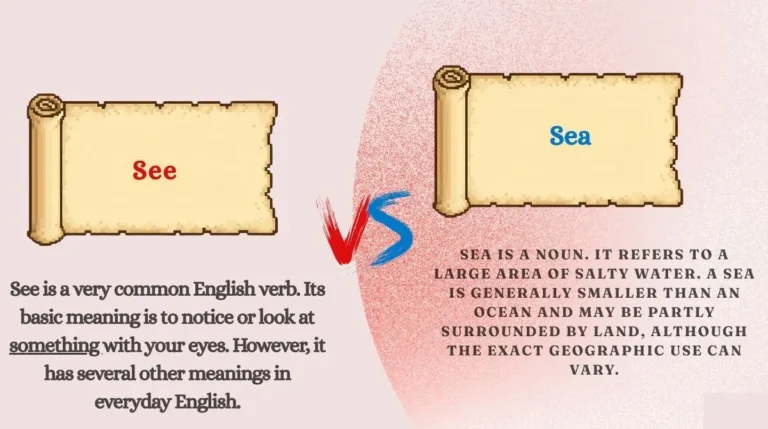
See is a very common English verb. Its basic meaning is to notice or look at something with your eyes. However, it has several other meanings in everyday English.
We use see to talk about vision, meeting people, watching things, understanding information, and discovering something.
The most basic use is physical vision:
I can see the moon.
Here, the speaker is talking about something visible.
See as a verb
The word see is normally a verb, so it describes an action, experience, or state.
Common forms of the verb are:
- see — present form
- saw — simple past
- seen — past participle
- seeing — -ing form
For example:
I see my neighbor every morning.
I saw him yesterday.
I have seen that movie before.
She is seeing her doctor today.
There is one important point for beginners: see is an irregular verb. You do not make the past tense by adding -ed. “Seed” is not the normal past form. The correct past tense is saw.
See can mean “look at”
We often use see when something comes into our view.
Can you see the mountains from here?
The speaker is asking whether the mountains are visible.
See can mean “understand”
In spoken English, see can also mean “understand.”
Oh, now I see your point.
This does not mean the person is using their eyes. It means they understand the idea.
See can mean “meet”
The word can also describe meeting someone.
I need to see my teacher after class.
Here, see means to meet or visit the teacher.
See can mean “watch”
Sometimes see means to watch or experience something, especially a film, show, event, or performance.
We went to see a movie last night.
Again, the exact meaning depends on the sentence.
Example sentences with “see”
- I can see a beautiful rainbow.
- Did you see my keys on the table?
- I see your point now.
- She sees her grandmother every Sunday.
- We saw a fox near the road yesterday.
- Have you seen this new restaurant?
- I am going to see my dentist tomorrow.
- Let’s see what happens next.
Common confusion with “see”
Learners often choose sea when they actually need the verb see, especially in informal writing or text messages.
For example:
❌ I can sea the bus.
✅ I can see the bus.
Another common mistake is writing see when talking about the ocean or a large body of salt water.
❌ We sat beside the see.
✅ We sat beside the sea.
A useful question to ask yourself is: Am I talking about vision, understanding, meeting, or watching? If yes, see is probably the right word.
What Does “Sea” Mean?
Sea is a noun. It refers to a large area of salty water. A sea is generally smaller than an ocean and may be partly surrounded by land, although the exact geographic use can vary.
You may see the word in phrases such as:
- the sea
- at sea
- by the sea
- across the sea
- sea water
- sea level
- sea life
Unlike see, the word sea does not describe an action. It names a thing or place.
Sea as a noun
Because sea is a noun, it can be used as the subject or object of a sentence.
The sea looks calm today.
Here, sea is the subject.
We watched the sea from the window.
Here, sea is the object of the verb watched.
It can also follow a preposition:
We walked along the sea.
The sea can be general
English often uses the sea when speaking about the sea as a general natural feature.
My grandparents live near the sea.
You may also hear at sea, which is a fixed expression meaning on a ship or in the open ocean, often away from land.
The sailors spent three weeks at sea.
Sea can appear in compound words
Sea is found in many useful words and expressions:
- seafood
- seaside
- seashore
- seaweed
- seagull
- sea turtle
- sea level
The word still carries the idea of salt water or something connected with it.
Example sentences with “sea”
- The sea is very calm this morning.
- We stayed in a hotel near the sea.
- Children love playing by the sea.
- The boat disappeared into the sea.
- Many fish live in the sea.
- The sea looked blue under the afternoon sun.
- They went fishing at sea.
- The village has a beautiful view of the sea.
Common confusion with “sea”
The biggest problem is pronunciation. When someone says sea, you hear the same sound as see.
That means you must use the meaning and grammar of the sentence to choose the spelling.
For example:
I can ___ the sea from my room.
The correct word is see because it describes what the person can do with their eyes.
The boat is in the ___.
The correct word is sea because the sentence needs a noun for a body of water.
Difference Between See and Sea
The easiest way to understand these words is to remember that they belong to different word classes and describe different ideas.
| Word | Part of Speech | Main Meaning | Example |
|---|---|---|---|
| see | Verb | To notice with your eyes; understand; meet; watch | I can see the stars. |
| sea | Noun | A large area of salty water | The sea is warm today. |
1. Their meanings are different
See is about an action, experience, or idea.
Sea is the name of a natural body of water.
Compare:
I can see the boat.
The boat is on the sea.
In the first sentence, see tells us what the person can do.
In the second sentence, sea tells us where the boat is.
2. Their grammar is different
This is one of the strongest ways to tell them apart.
See is a verb:
I see the car.
You can change its tense:
I saw the car yesterday.
I have seen the car before.
Sea is a noun:
The sea is cold.
You cannot use it like a verb:
❌ I sea the car.
That sentence is incorrect because sea does not mean “look at” or “notice.”
3. Sentence structure is different
A useful pattern for see is:
Subject + see + object
I see a dog.
She sees the teacher.
They saw a strange light.
You can also use see with other structures:
see + person
I need to see Ahmed.
see + object + verb
I saw him leave.
see + question word
I see why you are upset.
For sea, common structures include:
the + sea
The sea is rough.
near/by/beside + the sea
We live near the sea.
in/into/from + the sea
The swimmers jumped into the sea.
4. Their pronunciation is the same
Both words are normally pronounced /siː/.
That is why they are called homophones.
Other common English homophones include:
- right / write
- night / knight
- flour / flower
- pair / pear
- to / two / too
The sound alone cannot tell you which spelling is correct.
5. Their related words are different
Words related to see include:
- saw
- seen
- seeing
- sight
- sightseeing
Words related to sea include:
- seaside
- seafood
- seaweed
- seashore
- seafront
Looking at nearby words can often help you decide which spelling belongs in the sentence.
Grammar Rules You Must Remember
Rule 1: Use “see” when talking about vision or noticing something
When you are talking about using your eyes to notice something, use see.
I can see the moon.
Can you see that tall building?
The same rule works when something suddenly becomes visible:
I see a man standing outside.
Remember: see = notice with your eyes.
Rule 2: Use “sea” when you mean the large body of salty water
When you are talking about the sea itself, use sea.
The sea is beautiful at sunrise.
They sailed across the sea.
A simple replacement test can help. Ask yourself:
Could I replace the word with “ocean” or “salt water”?
If the answer is yes, you probably need sea.
The boat crossed the sea.
The boat crossed the ocean.
That makes sense.
Rule 3: “See” has different forms because it is a verb
Because see is a verb, it changes according to tense and subject.
I see him every day.
She sees him every day.
We saw him yesterday.
We have seen him before.
Notice that the forms change.
By contrast, sea is a noun:
The sea is cold.
The sea was cold.
The sea looked peaceful.
The verb changes, but the noun remains sea.
Rule 4: Listen for meaning, not just sound
When speaking, you cannot hear the difference between see and sea.
So when writing, think about the meaning first.
Did you see the fish?
Here, the person is asking about vision.
Did you swim in the sea?
Here, the person is asking about a body of water.
This rule is especially helpful during exams, dictation, writing practice, and online communication.
Common Mistakes Students Make
Because these two words sound the same, spelling mistakes are extremely common. The good news is that most errors are easy to fix once you understand the difference.
Mistake 1: Using “sea” as a verb
❌ I can sea the school from here.
✅ I can see the school from here.
Why is the first sentence wrong?
Because the word needed here is an action. The subject is noticing the school with their eyes, so the verb see is required.
Mistake 2: Using “see” for the ocean or sea
❌ We spent the afternoon beside the see.
✅ We spent the afternoon beside the sea.
Here, the sentence needs the name of a place or body of water. Therefore, sea is correct.
Mistake 3: Writing “sea” because it sounds right
A learner may hear:
I can see it.
Because the sound is /siː/, they may spell it as sea.
This is a spelling problem caused by pronunciation.
The solution is to connect the spelling with the meaning rather than the sound.
Mistake 4: Confusing “see” with “seen”
Another common problem is the verb form.
❌ I have see that movie.
✅ I have seen that movie.
After have, has, or had, you usually need the past participle seen.
Compare:
I see the movie poster.
I saw the movie yesterday.
I have seen the movie twice.
Mistake 5: Forgetting “sees” with he, she, and it
In the simple present tense:
❌ She see the mountains every day.
✅ She sees the mountains every day.
With he, she, or it, the correct form is sees.
Easy correction tips
When you are unsure, ask two quick questions:
1. Is this word an action?
Then use see.
2. Is this word a body of salty water?
Then use sea.
This tiny check can prevent most mistakes.
Easy Trick to Remember the Difference
Here is a simple memory trick:
See has “eyes” in its meaning. Sea has “water” in its meaning.
Think:
See = look 👀
Sea = water 🌊
You can also remember the spelling by connecting sea with words such as seafood, seaside, and seashore. All of them are related to the ocean or salty water.
For see, think of sentences you use every day:
I can see you.
I see the problem.
I see my friends on Friday.
There is also a very useful sentence pair:
I see the sea.
This short sentence contains both words.
- see = notice with your eyes
- sea = large body of salty water
Imagine standing on a beach. You see the sea.
That picture is easy to remember, and it connects the two spellings to their meanings.
Another helpful trick is to look at the letters:
SEE contains EE, like two little eyes.
This is only a memory aid, not a grammar rule, but it can help students recall the correct spelling quickly.
Daily Life Examples
These examples show how see and sea work in natural conversation.
Example 1
A: Can you see the bus?
B: Yes, it is coming now.
Here, see means notice with your eyes.
Example 2
A: Do you live near the sea?
B: Yes. It is only a five-minute walk from my house.
Here, sea means the large body of salty water.
Example 3
A: Did you see Sarah at the market?
B: Yes, I talked to her for a few minutes.
See means meet or notice Sarah.
Example 4
A: The sea looks beautiful today.
B: Yes, the water is very calm.
The word sea names the body of water.
Example 5
A: I can’t see anything in this room.
B: Turn on the light.
See is about vision.
Example 6
A: We went to the seaside last weekend.
B: That sounds fun.
The word seaside is connected with the sea.
Example 7
A: I saw dolphins in the sea yesterday.
B: Really? That must have been exciting.
This sentence uses both ideas naturally: saw is the past form of see, while sea is the body of water.
Example 8
A: Can you see those birds over there?
B: Yes, they are flying toward the sea.
Both words are correct because they have different jobs.
Example 9
A: I don’t see why he is angry.
B: Maybe he had a difficult day.
Here, see means understand.
Example 10
A: Do you want to walk by the sea tonight?
B: Sure. The weather is perfect.
Here, sea is a noun used after the preposition by.
Practice Section
Choose the correct word: see or sea.
1. I can ___ the stars clearly tonight.
Answer: see
The word is a verb because it describes what the person can do with their eyes.
2. The children are playing near the ___.
Answer: sea
The sentence refers to a large body of salty water.
3. Did you ___ my message?
Answer: see
Here, see means notice or read.
4. We watched the boats on the ___.
Answer: sea
The boats are on the body of water, so sea is correct.
5. I ___ your point now.
Answer: see
This is an expression meaning “I understand.”
A useful extra challenge is to create your own sentences with both words. Try writing one sentence about your eyes and another about the ocean. This helps connect spelling with meaning.
FAQs
What is the difference between see and sea?
See is usually a verb related to vision, understanding, meeting, or watching. Sea is a noun that means a large area of salty water. They sound the same but have different spellings, meanings, and grammar roles.
Are see and sea pronounced the same?
Yes. In standard English, see and sea are normally pronounced the same, with the /siː/ sound. They are called homophones because they have the same pronunciation but different meanings and spellings.
Can “see” be used in questions?
Yes. See is commonly used in questions.
For example:
Can you see the sign?
Did you see Ali?
Have you seen this movie?
The exact form changes depending on the tense and sentence structure.
Is sea a noun or a verb?
Sea is a noun. It names a large area of salty water. It does not function as the normal verb meaning “look at” or “notice.” For that meaning, use see.
Why do students confuse see and sea?
The main reason is pronunciation. Both words usually sound exactly the same, so learners cannot depend on sound to choose the spelling. The best solution is to understand the meaning and grammar of the sentence.
Is “I can sea you” correct?
No. The correct sentence is:
I can see you.
Here, see is the verb meaning notice or look at someone. Sea refers to salt water, so it cannot be used in this sentence.
Conclusion
The difference between see and sea is simple once you connect each word with its meaning. See is mainly a verb. It can mean to notice something with your eyes, understand an idea, meet someone, or watch something. Sea is a noun that refers to a large area of salty water.
The biggest challenge is pronunciation because both words usually sound exactly the same. That is why spelling can be confusing, especially when you are writing quickly.
Keep one easy idea in your mind: see is connected with looking, while sea is connected with water. The sentence “I see the sea” is a useful way to remember both.
With a little practice, this pair becomes very easy. Whenever you hear the /siː/ sound, stop for a moment and think about the meaning. That small habit will help you choose the right spelling in schoolwork, emails, messages, and everyday English writing.

Evan Rellmont is a writer who turns thoughtful ideas into meaningful words, creating stories and reflections that connect, inspire, and leave a lasting impression.