
Have you ever seen the words lede and lead and wondered whether one of them is simply a spelling mistake? You are not alone.
These two words look different, but when they are used in journalism, they can refer to the same part of a story.
The confusion becomes even bigger because lead has several other meanings. It can be a verb meaning “to guide,” a noun meaning an advantage in a competition, or a word for the chemical element lead.
What makes it tricky is that the same spelling can have different pronunciations and meanings.
Lede, on the other hand, has a much narrower job. It is mainly a journalism term for the opening sentence or opening paragraph of a news story.
Dictionaries list lede as an alternative spelling of the journalism sense of lead.
Understanding this small difference can help you read newspapers, websites, blogs, and journalism-related material with more confidence.
It also helps you avoid unnecessary spelling mistakes.
By the end, you will know exactly when to use lede, when to use lead, how to pronounce each meaning, and why journalists sometimes prefer the unusual spelling lede.
4. What Does “Lede” Mean?
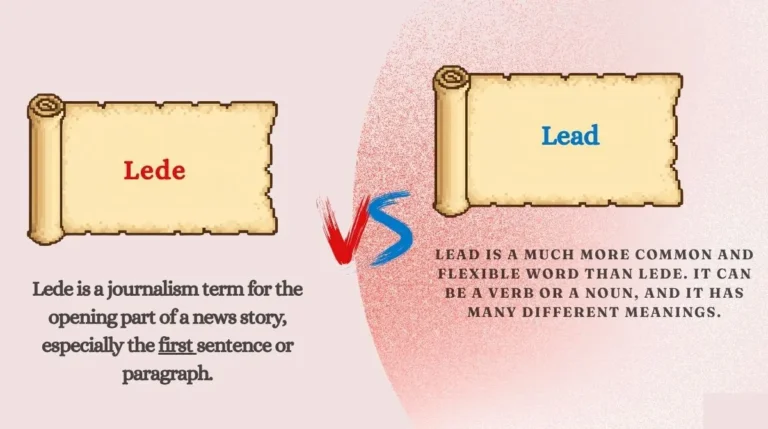
Lede is a journalism term for the opening part of a news story, especially the first sentence or paragraph. Its main job is to introduce the story and give readers the most important information or central idea.
For example, imagine a newspaper story about a major storm. The lede might immediately tell readers that the storm caused heavy flooding and forced hundreds of people to leave their homes.
A good lede gives the reader a reason to continue reading while making the main point clear.
When do you use “lede”?
Use lede mainly when talking about journalism, news writing, reporting, editing, or the opening of a news story.
You might see sentences such as:
- “The reporter wrote a strong lede.”
- “The lede explains what happened.”
- “The editor asked her to rewrite the lede.”
- “The article has an interesting lede.”
The word is especially common in American journalism, although lead is also widely used for the same meaning.
What is the grammar rule for “lede”?
Lede is a noun. It names a part of a written story.
The usual structure is:
determiner + lede
Examples:
- a lede
- the lede
- this lede
- an effective lede
- a weak lede
You generally do not use lede as a verb.
For instance, you would not normally say:
❌ “The reporter lede the story.”
Instead, say:
✅ “The reporter wrote the lede.”
8 examples of “lede”
- The lede gives readers the main point of the story.
- The editor liked the first draft of the lede.
- The reporter rewrote the lede before publication.
- A strong lede can make a news story easier to follow.
- The lede tells readers why the event matters.
- Her lede was short but very informative.
- The journalist placed the most important fact in the lede.
- The article had a powerful lede that caught my attention.
A common learner confusion
Many English learners think lede is a completely different word from lead. In journalism, that is not quite true.
Lede is an alternative spelling for the journalism meaning of lead. It is often used to make the word visually different from the other meanings of lead.
So, if a journalist says “the lede” and another writer says “the lead,” they may be talking about exactly the same thing: the opening of the story.
5. What Does “Lead” Mean?
Lead is a much more common and flexible word than lede. It can be a verb or a noun, and it has many different meanings.
One important meaning in journalism is the opening sentence or paragraph of a news story. In that sense, lead means the same thing as lede.
Cambridge also lists several everyday meanings of lead, including guiding people, directing something, being in front in a competition, and providing information that helps someone discover something.
When do you use “lead”?
Use lead whenever the meaning calls for that word. It is not limited to journalism.
For example:
- She will lead the team.
- This road leads to the city.
- Our team is in the lead.
- The police found a new lead.
- He has the lead role in the play.
- The article has a strong lead.
There is also another completely different lead that means the chemical element. That word is pronounced differently.
The two pronunciations of “lead”
This is one of the most important points.
Lead meaning “guide” is pronounced:
/liːd/ — like need or reed
Example:
She will lead the group.
The metal lead is pronounced:
/lɛd/ — like bed or red
Example:
The old pipes contained lead.
Cambridge gives the pronunciation /liːd/ for the verb lead and /lɛd/ for the metal.
The journalism word lead, when it means the opening of a story, is pronounced /liːd/, the same way as leed. Lede is pronounced the same way.
What are the grammar rules for “lead”?
Unlike lede, lead can be both a noun and a verb.
As a verb:
subject + lead + object
The editor will lead the meeting.
As a noun:
determiner + lead
The runner has the lead.
In journalism:
The lead summarizes the main point.
8 examples of “lead”
- She will lead the students into the hall.
- This path leads to the village.
- Our team has a five-point lead.
- The detective followed an important lead.
- He played the lead role in the movie.
- The newspaper gave the accident the lead story.
- The writer changed the lead before publishing the article.
- The article starts with a clear and useful lead.
Another common confusion
Learners sometimes think the spelling lead always has the same pronunciation.
That is not true.
Compare:
I will lead the team. — /liːd/
and:
The box contains lead. — /lɛd/
The spelling is identical, but the pronunciation and meaning are different.
This makes lead a classic example of a word that must be understood from context.
6. Difference Between Lede and Lead (Detailed)
The easiest way to understand lede vs lead is to remember that they overlap in journalism, but lead has many more meanings.
| Point | Lede | Lead |
|---|---|---|
| Main use | Journalism | Everyday English and journalism |
| Meaning in journalism | Opening sentence or paragraph | Opening sentence or paragraph |
| Part of speech | Noun | Noun or verb |
| Pronunciation in journalism | /liːd/ | /liːd/ |
| Can mean “guide”? | No | Yes |
| Can mean “advantage”? | No | Yes |
| Can mean a metal? | No | Yes |
| Common outside journalism | Less common | Very common |
| Typical audience | Journalists and readers of journalism | Everyone |
Usage difference
The biggest difference is range.
Lede is specialized. When you see it, you can usually expect a journalism or writing context.
Lead is broad. It may describe leadership, direction, an advantage, information, a role in entertainment, electrical connections, or the beginning of a news story.
Compare these:
The reporter wrote a strong lede.
This clearly points to journalism.
Now look at:
Sarah will lead the group.
Here, lead is a verb meaning guide or direct.
You cannot replace it with lede:
❌ Sarah will lede the group.
That is incorrect in normal English.
Grammar logic
The two words do not work in exactly the same grammatical way.
Lede is a noun:
The lede was excellent.
Lead can be a noun:
The lead was excellent.
Or a verb:
The reporter will lead the discussion.
That means learners should first ask, “What job is the word doing in the sentence?”
If it is an action such as guiding or directing, lead is the correct choice.
If it is the opening of a news story, lead or lede may be correct.
Sentence structure difference
Consider these examples:
The journalist wrote the lede.
The journalist wrote the lead.
Both can refer to the opening of a story.
But:
The journalist will lead the interview.
Here, lead is a verb.
The sentence needs an action word, so lede cannot be used.
Another example:
The team has the lead.
Here, lead is a noun meaning an advantage.
Again, lede would be wrong.
Meaning comparison
The key is not to think of lede as “the correct version” and lead as “the incorrect version.”
That would create a new mistake.
Instead, think of them this way:
Lede = specialized spelling for a journalism opening
Lead = common word with many meanings, including the journalism opening
Poynter notes that journalists and editors have long debated the preference for lede versus lead, and its discussion emphasizes that lead has been used for the opening of a news story as well.
Why does “lede” exist?
The spelling has an interesting history connected to journalism and printing.
One widely repeated explanation is that lede was used to distinguish the opening of a story from lead, the metal historically used in typesetting. Older printing practices made the distinction useful because lead could refer to a printing material. The exact history of the spelling is more complicated than that simple story, and journalism sources have debated when and why lede became common.
The important point for an English learner is much simpler: today, lede is a recognized journalism spelling, while lead remains the standard general word with many meanings.
7. Grammar Rules You Must Remember
Rule 1: Use “lede” mainly for the opening of a news story.
When you are specifically talking about journalism, lede can mean the introductory sentence or paragraph.
Example:
The reporter made the lede more direct.
A lede often gives readers the central point of the story early.
Rule 2: Use “lead” for everyday meanings such as guide or direct.
When lead is an action, it normally means to guide, direct, or be responsible for something.
Example:
Maria will lead the project.
You cannot substitute lede here.
Rule 3: “Lead” can be a noun or a verb, but “lede” is a noun.
This is a useful grammar test.
The article has a strong lead.
The article has a strong lede.
Both are nouns.
But:
The editor will lead the discussion.
Here, lead is a verb.
❌ The editor will lede the discussion.
Rule 4: Pay attention to pronunciation and context.
Journalism lead and lede are pronounced /liːd/.
The metal lead is pronounced /lɛd/.
Examples:
The story’s lead was clear. — /liːd/
The pipes were made of lead. — /lɛd/
Context tells you which meaning is intended.
8. Common Mistakes Students Make
Mistake 1: Thinking “lede” is simply a spelling mistake
You may see:
The reporter wrote a strong lede.
It can look strange because lede is not a common everyday word. But in journalism, it is an established term.
The important thing is to recognize it rather than automatically “correct” it to something else.
Mistake 2: Using “lede” as a verb
❌ She will lede the team.
✅ She will lead the team.
Remember: lead is the verb. Lede is mainly the journalism noun.
Mistake 3: Saying “lead” like the metal when talking about news
A learner may see:
The lead of the article is very strong.
Here, lead means the beginning of the article and is pronounced /liːd/.
Do not pronounce it like the metal.
Mistake 4: Believing “lead” has only one pronunciation
Compare:
They lead the class every Monday.
and:
The workers found lead in the old paint.
The first lead is pronounced /liːd/.
The second is pronounced /lɛd/.
The spelling alone does not tell you everything.
Mistake 5: Assuming “lede” must always be used in journalism
Not necessarily.
Lead is also widely used for the opening of a news story. Dictionaries recognize this journalism sense, and journalism professionals have different preferences about the two spellings.
So this is not a simple right-versus-wrong spelling fight.
Easy correction tips
When you are unsure, ask three questions:
1. Am I talking about a news story opening?
If yes, lead or lede may fit.
2. Am I talking about guiding or directing?
Use lead.
3. Am I talking about the metal?
Use lead, pronounced /lɛd/.
This quick check solves most mistakes.
9. Easy Trick to Remember the Difference
Here is a simple memory trick:
LEDE = LEad in a news storY.
The extra e can remind you that lede is the special journalism spelling.
You can also remember:
Lede = news beginning.
And:
Lead = many meanings.
Think of a reporter opening a newspaper story. That first important part is the lede.
Now think of a teacher walking into a classroom and saying:
“Follow me.”
The teacher can lead the students.
Or imagine a football match:
“Our team has the lead.”
Again, the correct word is lead.
And if someone asks about a dangerous metal:
“The old paint contained lead.”
It is still lead, but now the pronunciation changes.
This little mental picture is often easier than trying to memorize a long dictionary definition.
One more useful trick is to connect lead with the word leader.
A leader leads.
That helps you remember the verb:
leader → lead
For journalism:
lede → opening of the story
Once you connect each form with its usual job, the difference becomes much easier.
10. Daily Life Examples (Very Important)
Here are some simple conversation-style examples showing how the words work naturally.
Example 1: Talking about a newspaper
A: Did you read that news story?
B: Yes. The lede was very clear.
A: I understood the main point right away.
Example 2: Discussing an online article
A: What did you think of the article?
B: The lead was strong, but the middle was too long.
A: I agree. The opening got my attention.
Example 3: Talking about a team
A: Who will lead the meeting today?
B: James will lead it.
Here, lead is a verb.
Example 4: Talking about a road
A: Where does this road lead?
B: It leads to the train station.
Again, lead is a verb meaning to go toward or guide to a place.
Example 5: Talking about a competition
A: Who is in the lead?
B: Emma is in the lead by three points.
Here, lead means an advantage.
Example 6: Talking about information
A: Did the police find a lead?
B: Yes. They received useful information from a witness.
Here, lead means a clue or useful piece of information. Cambridge lists this as one of the noun meanings of lead.
Example 7: Talking about a movie
A: Who plays the lead?
B: Daniel plays the lead.
Here, lead means the main role or the person who plays it.
Example 8: Talking about the opening of a story
A: Should I use “lead” or “lede”?
B: Both can be used for the opening of a news story. Lede is more clearly marked as journalism language.
Example 9: Talking about metal
A: What is this old pipe made of?
B: It contains lead.
Here, lead is the metal and is pronounced /lɛd/.
Example 10: Talking like an editor
A: The story has too much background before the main point.
B: Then the writer may need to improve the lede.
This is a natural use of the specialized journalism term.
11. Practice Section
Choose the correct option in each sentence.
1.
The reporter rewrote the ___ before publishing the story.
a) lede
b) leaded
2.
Our captain will ___ the team onto the field.
a) lede
b) lead
3.
The runner has a ten-point ___.
a) lede
b) lead
4.
The old building was tested for ___.
a) lede
b) lead
5.
The newspaper’s ___ gives the main news first.
a) lead
b) lede
Answers
1. a) lede — This is the opening of a news story.
2. b) lead — Here, lead is a verb meaning guide.
3. b) lead — Here, lead means an advantage.
4. b) lead — Here, lead means the metal.
5. a) lead or b) lede — Both can refer to the opening of a news story. The spelling lede is especially associated with journalism.
12. FAQs
What is the difference between lede and lead?
Lede is mainly a journalism term for the opening sentence or paragraph of a news story. Lead has the same journalism meaning, but it also has many other meanings and can be a noun or a verb.
Is lede a real word?
Yes. Lede is a recognized word used in journalism. Dictionaries define it as an alternative spelling of the journalism sense of lead.
Can I use lead instead of lede?
Yes, when you mean the opening of a news story. Lead is an established spelling for this meaning, and many journalists use it. Lede is simply a more specialized journalism spelling.
How do you pronounce lede?
Lede is pronounced /liːd/, rhyming with words such as need and reed. Journalism lead has the same pronunciation.
Is lede formal or informal?
Lede is best thought of as specialized journalism vocabulary. It is common in newsrooms, journalism writing, and discussions about articles, but it is less common in everyday English.
Why do journalists write lede instead of lead?
The spelling lede has been associated with journalism and printing traditions, including the need to distinguish the story-opening sense of lead from other meanings of lead. The history is debated, so it is safer to treat this as an established journalism spelling rather than assume there is only one certain origin story.
Conclusion
The difference between lede vs lead is easier once you focus on meaning instead of spelling alone.
Lede is a specialized journalism word. It refers to the opening sentence or paragraph of a news story. Lead can also mean the opening of a story, so both forms may appear in journalism.
The bigger difference is that lead has many other uses. It can mean to guide someone, have an advantage, provide a clue, play the main role, or refer to the chemical element lead. It can also be pronounced differently depending on the meaning.
The easiest rule to remember is simple: lede is mainly for journalism, while lead is the wider everyday word.
When you read a news article and see “lede,” do not worry about the unusual spelling. Think, “This means the opening of the story.” With a little practice and attention to context, these two forms become much easier to use correctly.

Evan Rellmont is a writer who turns thoughtful ideas into meaningful words, creating stories and reflections that connect, inspire, and leave a lasting impression.