
English learners often see these three questions and wonder if they all mean the same thing: “Would you want?”, “Would you like?”, and “Do you want?” They all talk about wanting something, but they do not always sound the same or fit the same situation.
The confusion becomes even bigger because want and like can both be used when talking about choices, food, plans, activities, or things we hope to have.
A learner may know the basic meaning but still wonder which sentence sounds natural.
For example, should you say, “Do you want some tea?” or “Would you like some tea?” What about “Would you want some tea?”
These small differences matter in daily English. The wrong choice may not always be grammatically impossible, but it can make your sentence sound unusual, too direct, or more hypothetical than you intended.
The easiest way to understand them is to focus on the speaker’s purpose. Do you want usually asks about a present or direct desire.
Would you like is commonly used for polite offers, invitations, and polite statements of desire.
Would you want is often used when the question is more hypothetical, conditional, or about what someone would choose in an imagined situation.
Once you notice that difference, choosing the right expression becomes much easier.
What Does “Would You Want” Mean?
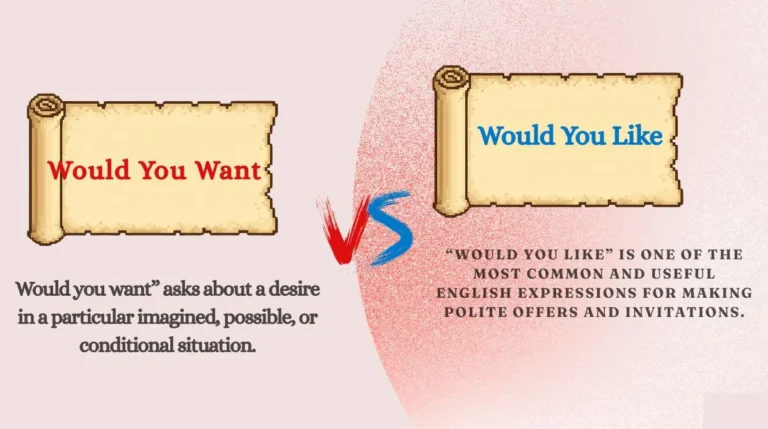
“Would you want” asks about a desire in a particular imagined, possible, or conditional situation. It contains would, which often signals that the speaker is thinking about a situation rather than simply asking about a person’s immediate desire.
For example:
Would you want to live in another country?
This can mean, “Suppose you had the chance. Would that be something you would want?”
That is different from a simple present question such as:
Do you want to live in another country?
The second question can sound like a direct question about the person’s actual plans or wishes. The first can sound more like a discussion of a possibility.
The grammar is:
Would + subject + want + noun/to-infinitive?
Examples include:
- Would you want a bigger house if you could afford one?
- Would you want to work from home every day?
- Would you want this job if the salary were higher?
- Would you want to travel alone?
- Would you want more time to finish the project?
- Would you want to move to a quieter city?
- Would you want me to join you if you went there?
- Would you want to try something completely new?
The important point is that would you want is not normally the first choice for a simple polite offer. For example, a waiter would normally say:
Would you like some water?
rather than:
Would you want some water?
“Would you want some water?” is grammatically understandable, but in an ordinary offer it can sound unusual or as though a special condition is being considered.
When Is “Would You Want” Natural?
This expression becomes much more natural when there is an imagined situation.
If you had enough money, would you want to buy a new car?
If you could choose any country, would you want to live in Japan?
Would you want to take the job if they offered you more flexible hours?
It is also possible in questions about hypothetical choices:
Would you want to be famous?
Here, the speaker is often not asking whether fame is part of your current plan. The question is about how you would feel about that situation if it happened or became possible.
This is why would matters. British Council grammar guidance explains that would is commonly used for hypotheses and imagined situations.
A Common Learner Problem
Students sometimes believe that would want is simply a more polite version of do you want. That is not always true.
Compare:
Do you want some coffee?
Would you like some coffee?
Would you want some coffee?
The first is direct and informal. The second is the standard polite offer. The third can sound as though there is some special condition or unusual situation behind the question.
So, do not automatically replace do you want with would you want. In many everyday situations, would you like is the more natural polite choice.
What Does “Would You Like” Mean?
“Would you like” is one of the most common and useful English expressions for making polite offers and invitations.
It can also be used to ask politely what someone wants.
For example:
Would you like some tea?
This usually means:
Do you want some tea?
But the two questions have a different tone. Would you like is more polite and is especially common in restaurants, shops, workplaces, formal conversations, and polite social situations. Cambridge Dictionary describes would you like as an expression used when offering something or inviting someone.
The grammar is:
Would + subject + like + noun?
or
Would + subject + like + to + base verb?
Examples:
- Would you like some coffee?
- Would you like a piece of cake?
- Would you like to sit here?
- Would you like to come with us?
- Would you like some more rice?
- Would you like to order now?
- Would you like me to help you?
- Would you like to watch a movie tonight?
When would like is followed by a verb, we use to + base verb:
Would you like to come?
Would you like to stay?
Would you like to join us?
Not:
Would you like come?
Cambridge’s grammar guidance specifically notes that verbs following would like use the to-infinitive.
“Would Like” Can Express Your Own Desire
It is not only for questions.
You can say:
I would like some water.
I’d like to speak to the manager.
I’d like a window seat.
These sentences politely tell another person what you want. I’d like is especially useful when ordering, requesting, asking for help, or speaking formally.
For example, at a restaurant:
I’d like the chicken sandwich, please.
At a hotel:
I’d like to check in.
At a shop:
I’d like a medium shirt, please.
“Would You Like” for Invitations
This expression is also very common when inviting someone.
Would you like to have dinner with us?
Would you like to come to my birthday party?
Would you like to go for a walk?
Cambridge identifies would you like as a standard form for invitations, while do you want is generally more informal.
This does not mean would you like is only for very formal situations. Friends can use it too.
Would you like to watch a movie tonight?
That sounds perfectly natural. The main difference is usually the tone and purpose, not simply whether the people are friends or strangers.
What Does “Do You Want” Mean?
“Do you want” is the direct, everyday way to ask about someone’s desire or choice.
It is extremely common in spoken English.
The basic grammar is:
Do + subject + want + noun?
or
Do + subject + want + to + base verb?
Examples:
- Do you want some water?
- Do you want a sandwich?
- Do you want to come with us?
- Do you want to watch TV?
- Do you want more time?
- Do you want to go outside?
- Do you want me to call him?
- Do you want to sit here?
Cambridge explains that want is used to talk about wishes and needs, and it can be followed by a noun, a pronoun, or a to-infinitive.
“Do You Want” Is Often Informal and Direct
At home, with close friends, or in casual conversation, do you want is very normal.
Do you want pizza?
Do you want to come over later?
Do you want some more?
It is not automatically rude. Tone, context, and relationship matter.
However, in a formal customer-service situation, Would you like often sounds more polished.
For example, a restaurant server would usually say:
Would you like anything else?
rather than:
Do you want anything else?
The second sentence is understandable, but the first is more typical for a polite service interaction.
Cambridge notes that do you want can be used for informal invitations, while would you like is the more formal and polite option.
Difference Between Would You Want, Would You Like, and Do You Want
Here is the easiest comparison:
| Expression | Main idea | Common use | Typical tone |
|---|---|---|---|
| Do you want…? | Directly asks about desire | Casual questions, immediate choices | Direct, informal |
| Would you like…? | Politely asks what someone would like | Offers, invitations, requests | Polite, friendly, often formal |
| Would you want…? | Asks about a hypothetical or conditional desire | Imagined situations and choices | Hypothetical, conditional |
1. “Do You Want?” Is Direct
Suppose your friend is standing beside you at a café.
Do you want coffee?
You are simply asking what the person wants now.
It can also be used for plans:
Do you want to go to the beach tomorrow?
Here, the question is fairly direct. You want to know the person’s actual choice about the plan.
2. “Would You Like?” Is Polite
Now imagine a waiter talking to a customer:
Would you like coffee?
This is an offer. The waiter is giving the customer a choice in a polite way.
The same idea works for invitations:
Would you like to join us?
It can be used with both nouns and actions:
Would you like some soup?
Would you like to try the soup?
The meaning is close to do you want, but the social tone is softer and more polite.
3. “Would You Want?” Often Adds a Hypothetical Feeling
Now change the sentence:
Would you want to live on an island?
This can mean, “Imagine that you had the opportunity. Would that be something you would choose?”
It is not normally the natural way to offer somebody an ordinary object.
Imagine a friend holding a cup of coffee:
Would you want some coffee?
This sounds less natural than:
Would you like some coffee?
But:
If you were staying here all day, would you want some coffee?
Now the phrase works much better because the question is connected to a situation being imagined.
The Same Idea in Three Forms
Look at these examples:
Do you want to travel to Canada?
This asks about the person’s actual desire or plan.
Would you like to travel to Canada?
This sounds polite and can be an invitation or a polite question about a possible desire.
Would you want to travel to Canada if you had the chance?
This clearly focuses on a hypothetical possibility.
The difference becomes easier when you stop translating every sentence word-for-word. Instead, ask yourself:
Am I asking about now, making a polite offer, or imagining a situation?
That question often gives you the answer.
Sentence Structure
The structures are also different.
Do you want + noun?
Do you want tea?
Do you want + to + verb?
Do you want to leave?
Would you like + noun?
Would you like tea?
Would you like + to + verb?
Would you like to leave?
Would you want + noun?
Would you want a larger room?
Would you want + to + verb?
Would you want to move?
A common grammar error is leaving out to before the verb.
Incorrect:
Would you like go with us?
Correct:
Would you like to go with us?
Incorrect:
Do you want go home?
Correct:
Do you want to go home?
Want and would like both take the to-infinitive when followed by another verb.
Grammar Rules You Must Remember
Rule 1: Use “Do You Want” for a Direct Question About Desire
When you want to know what someone wants, especially in everyday conversation, do you want is a natural choice.
Do you want some ice cream?
Do you want to come with me?
Think of it as a straightforward question about a person’s choice or desire.
Rule 2: Use “Would You Like” for Polite Offers and Invitations
When you offer something or invite someone, would you like is usually the safest and most natural polite form.
Would you like some tea?
Would you like to sit down?
Would you like to join us for dinner?
English-learning guidance from Cambridge and the British Council consistently uses would you like for polite offers and invitations.
Rule 3: Use “Would You Want” for Imagined or Conditional Situations
Use would you want when the question is connected to a possible, imagined, or conditional situation.
If you got a job overseas, would you want to move?
Would you want to live there if you could afford it?
The word would often signals that the speaker is considering something rather than asking about a simple present fact. British Council guidance explains that would is commonly used to talk about hypotheses and imagined situations.
Rule 4: After “Want” and “Would Like,” Use “To” Before a Verb
When another verb follows these expressions, use:
want + to + verb
I want to leave.
would like + to + verb
I’d like to leave.
would want + to + verb
I would want to leave.
Do not say:
I want leave.
I’d like leave.
I would want leave.
The word to is important because it introduces the infinitive.
Common Mistakes Students Make
Many mistakes happen because learners focus on the dictionary meaning of each word instead of the whole expression.
Mistake 1: Using “Would You Want” for Every Polite Offer
A student may think:
Do you want tea?
becomes:
Would you want tea?
That is not the usual polite replacement.
A more natural polite offer is:
Would you like some tea?
Easy tip: When you are offering food, drinks, help, or an invitation, remember would you like.
Mistake 2: Forgetting “To”
Incorrect:
Do you want go shopping?
Correct:
Do you want to go shopping?
Incorrect:
Would you like come with us?
Correct:
Would you like to come with us?
Incorrect:
Would you want live abroad?
Correct:
Would you want to live abroad?
Mistake 3: Thinking “Would You Like” Means “Do You Like”
These are not the same.
Do you like coffee?
This usually asks about a general preference.
Would you like coffee?
This usually offers coffee right now.
Cambridge specifically distinguishes Do you like…? for general likes and dislikes from Would you like…? for offers and invitations.
Compare:
Do you like dancing?
You are asking whether dancing is something the person generally enjoys.
Would you like to dance?
You are inviting the person to dance.
Mistake 4: Treating “Would” as a Simple Past Form of “Do”
Would does not simply mean “past do.”
In many sentences, would has a special function. It can make an idea hypothetical, or it can be part of a polite expression such as would you like.
If I had more money, I would travel more.
Here, would is connected to a hypothetical situation.
But:
Would you like some cake?
Here, would like is being used as a polite offer.
The word would can therefore have different jobs depending on the sentence.
Mistake 5: Assuming “Do You Want” Is Always Rude
This is another common misunderstanding.
Do you want to come over?
A friend may say this very naturally.
Do you want some pizza?
That is also normal in casual conversation.
The problem is not the phrase itself. It is mainly about context and tone. For formal or polite service situations, would you like is often a better choice.
Easy Trick to Remember the Difference
Here is a simple three-word memory trick:
DO = DIRECT
WOULD LIKE = POLITE
WOULD WANT = IMAGINE
Think about the three situations.
DO = DIRECT
You are asking a simple, real question:
Do you want coffee?
You want to know the person’s choice.
WOULD LIKE = POLITE
You are making an offer or invitation:
Would you like coffee?
You are giving the person a polite choice.
WOULD WANT = IMAGINE
You are thinking about a possibility:
Would you want coffee if we stopped somewhere?
Now the question is connected to an imagined situation.
Another helpful trick is to picture three places.
At home with a friend:
Do you want pizza?
At a restaurant:
Would you like pizza?
During a discussion about an imaginary future:
Would you want pizza if you had to eat one food for a year?
The grammar becomes easier when you connect each expression to a real situation instead of memorizing isolated rules.
Daily Life Examples
Here are natural examples you may hear in everyday English.
At Home
A: I’m making tea. Do you want some?
B: Yes, please. That would be great.
This is casual and natural between family members or friends.
At a Restaurant
Waiter: Would you like some water?
Customer: Yes, please.
Here, would you like is a polite offer.
Making Weekend Plans
A: Do you want to go shopping on Saturday?
B: Sure. What time?
The question is direct and casual.
Talking About a Dream
A: Would you want to live in another country?
B: Maybe. I’d love to experience a different culture.
This sounds hypothetical because the speaker is asking about a possible life choice.
Offering Help
A: Would you like me to carry that bag?
B: No, thanks. I can manage.
This is a polite offer to do something for another person.
Asking a Friend
A: Do you want to watch a movie tonight?
B: Yes. What should we watch?
This is common spoken English.
Talking About a Possible Job
A: If they offered you the position, would you want to take it?
B: I think I would.
The condition makes would you want very natural.
At a Coffee Shop
Server: Would you like anything else?
Customer: No, thank you. That’s all.
This is a standard polite service question.
Talking About Food
A: Do you want another piece of cake?
B: No, thanks. I’m full.
Because the conversation is casual, do you want sounds perfectly natural.
Imagining a Different Life
A: Would you want to be famous if you had the chance?
B: Probably not. I think I’d prefer a quiet life.
The question is about an imagined possibility, not a simple immediate choice.
Practice Section
Choose the best answer: would you want, would you like, or do you want.
1. You are offering your guest some coffee.
_____ some coffee?
a) Would you want
b) Would you like
c) Would you wanted
2. You are asking your friend about tonight.
_____ to watch a movie?
a) Do you want
b) Would you wanted
c) Would you want to if
3. You are discussing an imaginary situation.
If you could work anywhere, _____ to work from home?
a) do you want
b) would you want
c) would you like some
4. A waiter is asking politely about dessert.
_____ some dessert?
a) Do you want
b) Would you like
c) Would you want if
5. You are talking about a possible future choice.
If you got the chance, would you _____ to another country?
a) want move
b) want to move
c) like moving
Answers
1. b) Would you like
It is a polite offer.
2. a) Do you want
It is a casual question about a present or future plan.
3. b) Would you want
The phrase is connected to an imagined situation.
4. b) Would you like
A waiter normally uses a polite offer.
5. b) want to move
After would you want, use to + base verb.
FAQs
What is the difference between “would you want” and “would you like”?
Would you like is commonly used for polite offers, invitations, and polite questions about what someone wants. Would you want is more often used for hypothetical or conditional situations. For example, “Would you like some tea?” is a normal offer, while “Would you want to live abroad?” can ask about an imagined choice.
Is “would you want” grammatically correct?
Yes, would you want is grammatically correct. It is especially natural when the question involves a condition, possibility, or imagined situation. For example, “If you had the chance, would you want to study abroad?” sounds natural. It is not, however, the usual choice for every everyday offer.
Is “would you like” more polite than “do you want”?
Generally, yes. Would you like is commonly used as a polite form when offering something or inviting someone. Do you want is more direct and informal, although it is completely normal in friendly conversations. The choice depends on the situation and tone.
Can I use “do you want” in questions?
Yes. Do you want is one of the most common ways to ask about someone’s desire or choice. You can use it with a noun or with to + verb: “Do you want some water?” and “Do you want to come with us?” are both correct.
Is “would you like” formal or informal?
It can be used in both formal and everyday situations. It is especially common in restaurants, shops, workplaces, invitations, and polite conversations. Friends can also use it naturally, so it is not restricted to very formal English.
Can “would you want” and “would you like” mean the same thing?
Sometimes they can be close in meaning, especially when discussing a possible desire. However, they are not always interchangeable. Would you like is the normal expression for polite offers and invitations, while would you want often carries a hypothetical or conditional meaning.
Conclusion
Would you want, would you like, and do you want all talk about desire, but they serve different purposes in everyday English.
Use do you want when you are asking directly about someone’s choice or desire, especially in casual conversation. Use would you like when you are making a polite offer, invitation, or request. Use would you want mainly when the question involves an imagined, possible, or conditional situation.
The key is to look at the situation, not just the individual words. Ask yourself: Am I being direct? Am I making a polite offer? Or am I imagining a possibility?
With regular practice, the difference will start to feel natural. Listen to how native speakers use these expressions in conversations, and try making your own examples. A few minutes of practice each day can make these small grammar choices much easier.

Evan Rellmont is a writer who turns thoughtful ideas into meaningful words, creating stories and reflections that connect, inspire, and leave a lasting impression.