
Many English learners stop for a second when they have to choose between “you and I” and “you and me.” Both sound natural, and both are common in everyday speech.
The problem is that they are not used in the same grammatical position.
You may hear someone say, “You and I should talk,” and later hear, “The teacher called you and me.” A learner may wonder why the pronoun changes even though the people are the same.
The answer is actually simple. “You and I” is normally used when the phrase is the subject of a sentence. “You and me” is normally used when the phrase is the object of a verb or preposition.
The words describe the same two people, but their job in the sentence is different.
This small grammar point matters because it appears everywhere: conversations, emails, school writing, workplace English, social media, and formal documents.
It also connects to a bigger grammar lesson about subject pronouns and object pronouns.
By the end, you will know when to say “you and I,” when to say “you and me,” why expressions such as “between you and me” are correct, and how to avoid common mistakes without memorizing complicated grammar terms.
What Does “You and I” Mean?
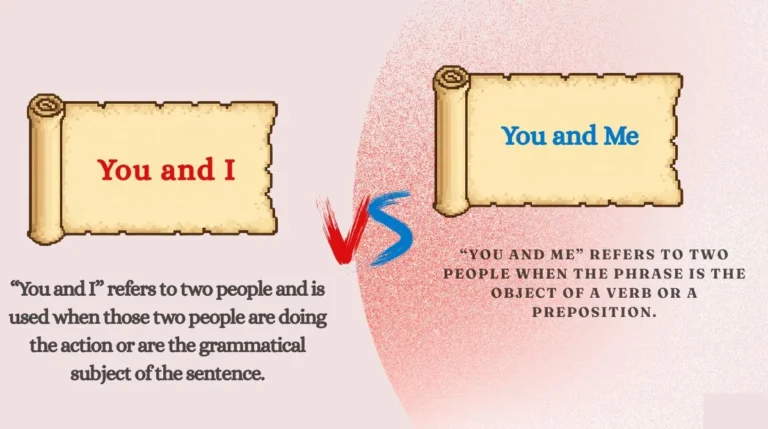
“You and I” refers to two people and is used when those two people are doing the action or are the grammatical subject of the sentence.
Think of it this way: “I” is a subject pronoun, while “me” is an object pronoun. The word “you” looks the same whether it is a subject or an object, so learners often focus only on the second pronoun.
Compare:
- I work here.
- You work here.
- You and I work here.
In the third sentence, “you and I” is the subject because both people are doing the action of working.
When should you use “you and I”?
Use “you and I” when the phrase comes before the main verb and acts as the subject.
For example:
- You and I need to talk.
- You and I are good friends.
- You and I can solve this problem.
- You and I should leave early.
- You and I have the same idea.
- You and I were in the same class.
- You and I will finish the project today.
- You and I understand what happened.
In each sentence, “you and I” are the people connected to the action or state.
The simple grammar rule
The traditional rule is:
Use “I” for a subject.
So when you + I are the subject of a sentence, use “you and I.”
For example:
You and I have a meeting at three.
The phrase is the subject of have.
A useful test is to remove the word “you.” Read the sentence again:
You and I have a meeting.
I have a meeting.
That sounds correct.
Now try:
You and me have a meeting.
Me have a meeting.
That clearly sounds wrong in standard English.
This little test is one of the easiest ways to choose the correct form.
Common learner confusion
The biggest problem is that people sometimes hear “you and me” used so often that they start using it everywhere.
For example, a learner may say:
You and me should study together.
You may hear this in casual speech, songs, movies, and informal conversation. However, in standard formal English, the subject form is “You and I should study together.”
This happens because English speakers sometimes use “me” in a coordinated phrase by habit, even when the phrase is functioning as a subject. Another reason is hypercorrection: people may use “I” simply because they have been told that “I” sounds more correct.
The right approach is not to choose the pronoun that sounds more formal. Choose the pronoun based on its job in the sentence.
What Does “You and Me” Mean?
“You and me” refers to two people when the phrase is the object of a verb or a preposition.
The word “me” is an object pronoun. It is used when something is being done to me, given to me, shown to me, or connected to me through a preposition.
Compare:
- She called me.
- She called you.
- She called you and me.
In the last sentence, “you and me” receives the action of the verb called, so the object form is correct.
When should you use “you and me”?
Use “you and me” when the phrase comes after a verb that takes an object or after a preposition.
Examples:
- The manager called you and me.
- She invited you and me to dinner.
- The teacher praised you and me.
- He gave the tickets to you and me.
- This problem affects you and me.
- The decision is between you and me.
- They sent an email to you and me.
- The coach spoke to you and me after the game.
Here, “you and me” are not doing the action as the grammatical subject. They are objects.
The grammar rule
The basic rule is:
Use “me” as an object.
For example:
The teacher helped you and me.
Remove “you”:
The teacher helped me.
That is correct.
Now try:
The teacher helped I.
That is incorrect in standard English.
The same test works in many sentences:
She invited you and me.
She invited me.
This is for you and me.
This is for me.
They spoke to you and me.
They spoke to me.
The sentence becomes much easier when you look at the role of the pronoun rather than the phrase as a whole.
Why “you and me” is so common
There is an important difference between grammar and everyday speech. Native speakers do not always speak according to formal grammar rules. Informal English contains many patterns that are familiar and widely heard.
You may hear:
“You and me are going to the store.”
That does not mean “you and me” is always correct. In standard English, when the phrase is the subject, “you and I” is the expected form:
“You and I are going to the store.”
At the same time, “you and me” is completely normal when the phrase is the object:
“She invited you and me to the store.”
So the goal is not to avoid “you and me.” The goal is to use it in the correct grammatical position.
Difference Between “You and I” and “You and Me”
The main difference is grammatical function.
“You and I” is normally a subject phrase.
“You and me” is normally an object phrase.
The meaning can involve exactly the same two people. What changes is their role in the sentence.
Comparison table
| Phrase | Grammatical role | Pronoun form | Typical position | Example |
|---|---|---|---|---|
| You and I | Subject | Subject pronoun | Usually before the verb | You and I need to talk. |
| You and me | Object | Object pronoun | After a verb or preposition | She called you and me. |
| I | Subject | Subject pronoun | Before the verb | I finished the work. |
| Me | Object | Object pronoun | After a verb/preposition | She helped me. |
Usage difference
Look at these two sentences:
You and I made the decision.
The manager spoke to you and me.
The people are the same, but the grammar is different.
In the first sentence, you and I perform the action of making the decision.
In the second, you and me receive the action of being spoken to.
This is why it is not enough to ask, “Which phrase sounds right?” You need to ask, “What is the phrase doing?”
Grammar logic
English has different forms of personal pronouns:
Subject forms: I, he, she, we, they
Object forms: me, him, her, us, them
“You” is unusual because its form does not change:
You called me.
I called you.
The word “you” stays the same in both roles.
But “I” changes to “me”:
I called you.
You called me.
When another person is added, the same rule still applies:
You and I called him.
He called you and me.
Adding “you and” does not change the grammatical job of the pronoun.
Sentence structure difference
A simple pattern can help:
Subject + verb
You and I + work here.
Verb + object
She + called + you and me.
Preposition + object
for + you and me
between + you and me
Once you recognize these structures, the choice becomes much more natural.
Meaning comparison
The two phrases usually do not have different basic meanings. Both refer to the speaker and the person being addressed.
The difference is grammatical rather than a difference in the people involved.
For example:
You and I should be careful.
and
The warning is for you and me.
Both phrases refer to the same two people. Their different forms simply show their different roles in the sentence.
Grammar Rules You Must Remember
Rule 1: Use “you and I” as the subject
When the phrase is doing the action, use “you and I.”
You and I need to finish this work.
Test it by removing “you”:
I need to finish this work.
That works, so “you and I” is correct.
Another example:
You and I were late.
Remove “you”:
I was late.
The structure is correct.
Rule 2: Use “you and me” as the object of a verb
When a verb acts on the two people, use “you and me.”
The teacher helped you and me.
Remove “you”:
The teacher helped me.
That is correct.
More examples:
The company hired you and me.
She invited you and me.
The coach congratulated you and me.
In each case, the phrase is receiving the action.
Rule 3: Use “you and me” after a preposition
Prepositions are another major clue.
Common prepositions include for, to, with, between, from, about, and beside.
After these prepositions, the object form is normally used:
This letter is for you and me.
She came with you and me.
The secret stays between you and me.
He bought a gift for you and me.
The teacher spoke to you and me.
A very common expression is:
Between you and me, I think we should wait.
Here, “you and me” is correct because it follows the preposition between.
Rule 4: Do not choose “I” just because it sounds formal
Some learners think “I” is always the more educated or polite choice. That is not how pronouns work.
For example:
The principal spoke to you and I.
This may sound formal to some learners, but “you and me” is the standard object form after to:
The principal spoke to you and me.
On the other hand:
You and I spoke to the principal.
Here, “you and I” is the subject.
The important lesson is simple: grammar role matters more than formality.
Common Mistakes Students Make
Mistake 1: “You and me” as the subject
A common error is:
❌ You and me should go now.
The standard form is:
✅ You and I should go now.
Why? Because the phrase is the subject of should go.
Try the pronoun test:
I should go now.
Not:
Me should go now.
That makes the answer clear.
Mistake 2: “You and I” after a preposition
Another common mistake is:
❌ This gift is for you and I.
The standard form is:
✅ This gift is for you and me.
Why? For is a preposition, so it takes an object.
The same pattern appears in:
✅ between you and me
✅ with you and me
✅ to you and me
✅ from you and me
Mistake 3: Changing “me” to “I” because it sounds fancy
This often happens when a learner has been corrected many times for saying “me” incorrectly.
They may think:
“I should use I because I is more correct.”
But this can create a new error.
For example:
❌ She invited you and I.
✅ She invited you and me.
The answer is not about sounding formal. It is about grammar.
Mistake 4: Looking only at the first person
A student may think:
“The sentence contains ‘you,’ so I should use ‘I.’”
That is not a rule.
Look at the entire phrase:
You and I
or
You and me
Then identify whether it is the subject or object.
An easy correction tip
When you are unsure, remove “you and.”
Ask yourself which one sounds correct:
I went home.
or
Me went home.
Usually, the answer becomes obvious.
Then do the same with an object:
She saw me.
or
She saw I.
Again, the correct form is clear.
This trick works because the coordination can hide the basic pronoun rule.
Easy Trick to Remember the Difference
Here is a simple classroom trick:
I do. Me receives.
When the person does the action, think I.
When the person receives the action, think me.
For example:
I called you.
I did the calling.
You called me.
I received the calling.
Now add “you”:
You and I called the teacher.
The teacher called you and me.
The same idea stays in place.
Another quick trick: Remove “you”
This may be the easiest method for beginners.
Say:
You and I are ready.
Remove “you”:
I am ready. ✅
Now:
You and me are ready.
Remove “you”:
Me am ready. ❌
So use “you and I.”
Now look at:
She invited you and me.
Remove “you”:
She invited me. ✅
Therefore:
She invited you and me.
This trick is especially useful when you are writing quickly.
Real-life logic
Imagine two simple sentences:
I am going.
She invited me.
Now add another person.
You and I are going.
She invited you and me.
Nothing mysterious has happened. You simply kept the correct form of I/me when another person was added.
That is the whole idea.
Daily Life Examples
These examples show how the phrases appear in normal conversations.
Example 1: Making plans
A: Are you free this evening?
B: Yes. You and I can go out for dinner.
The phrase is the subject of can go.
Example 2: Talking about work
A: Who should finish this report?
B: You and I should finish it together.
Both people are responsible for the action.
Example 3: Receiving an invitation
A: Who did Sarah invite?
B: She invited you and me.
The phrase is the object of invited.
Example 4: Asking someone to join
A: Who is coming with us?
B: The manager is coming with you and me.
The preposition with requires the object form.
Example 5: Giving information
A: Who did the teacher speak to?
B: She spoke to you and me after class.
The phrase follows the preposition to.
Example 6: A private comment
A: Do you think we should tell everyone?
B: Between you and me, I think we should wait.
This is a very common English expression.
Example 7: Working together
A: Who can solve this problem?
B: You and I can solve it.
The phrase is the subject of can solve.
Example 8: A shared responsibility
A: Who will the new rule affect?
B: It will affect you and me.
The phrase receives the action of affect.
Example 9: Talking about a relationship
A: Why are you smiling?
B: Because you and I have known each other for years.
The phrase is the subject.
Example 10: A gift
A: Who is this gift for?
B: It is for you and me.
The phrase follows for, so the object form is used.
Practice Section
Choose the correct option in each sentence.
1. _____ need to talk about the project.
A. You and me
B. You and I
2. The teacher called _____ after class.
A. you and I
B. you and me
3. This secret is between _____.
A. you and I
B. you and me
4. _____ are going to the meeting tomorrow.
A. You and I
B. You and me
5. The manager sent the message to _____.
A. you and I
B. you and me
Answers
1. B — You and I
The phrase is the subject of need.
2. B — you and me
The phrase is the object of called.
3. B — you and me
The phrase comes after the preposition between.
4. A — You and I
The phrase is the subject of are going.
5. B — you and me
The phrase comes after the preposition to.
A good way to improve is to explain the answer to yourself. Do not just memorize the letter. Ask, “Is this phrase doing the action or receiving it?”
FAQs
What is the difference between “you and I” and “you and me”?
“You and I” is normally used as the subject of a sentence, while “you and me” is normally used as the object of a verb or preposition.
For example, “You and I are friends” is correct. “She invited you and me” is also correct.
Can we use “you and me” in a sentence as the subject?
You may hear “you and me” used as a subject in casual speech, songs, and informal English. However, in standard formal English, “you and I” is preferred when the phrase is the subject.
For example: “You and I should leave now.”
Can we use “you and I” after a preposition?
In standard English, a preposition normally takes an object pronoun. So phrases such as “for you and me,” “with you and me,” and “between you and me” are standard.
For example: “This is between you and me.”
Is “between you and I” correct?
In standard edited English, “between you and me” is the usual form because between is a preposition and requires an object.
You may hear “between you and I” in informal speech, partly because of overcorrection. For formal writing, use “between you and me.”
Which is correct: “You and I are” or “You and me are”?
For standard English, “You and I are” is correct when the phrase is the subject.
For example: “You and I are working together.”
The form “you and me are” is common in some informal speech, but it is not the standard form expected in formal writing.
How can I quickly know whether to use “I” or “me”?
Remove the other person from the sentence.
If “I” works, use “you and I.” If “me” works, use “you and me.”
For example: “You and I went home” → “I went home.”
“She called you and me” → “She called me.”
Conclusion
The difference between “you and I” and “you and me” becomes much easier when you stop thinking about which phrase sounds better and start looking at its role in the sentence.
Use “you and I” when the phrase is the subject and does the action: “You and I need to talk.”
Use “you and me” when the phrase is the object of a verb or comes after a preposition: “She called you and me” or “This is between you and me.”
The simplest memory trick is “I do, me receives.” You can also remove “you and” and see whether I or me fits the sentence.
Once you practice this a few times, the choice will feel natural. Good grammar is often less about memorizing long rules and more about noticing how words work together. Keep checking the role of the pronoun, and you will quickly become more confident with both forms.

Evan Rellmont is a writer who turns thoughtful ideas into meaningful words, creating stories and reflections that connect, inspire, and leave a lasting impression.