
English has many words that look almost the same but have completely different meanings. Martin vs marten is a good example.
The two words differ by only one letter, so it is easy to type the wrong one, especially when you are writing quickly or hearing the word in conversation.
The confusion becomes even greater because Martin is commonly used as a person’s name, while marten is the name of a small wild mammal.
There is also another meaning of martin with a lowercase m: it can refer to a small bird related to swallows.
Cambridge lists Martin as a male name and martin as a type of bird, while marten refers to a small wild mammal found in Europe and North America.
So, these are not two different forms of the same word. Their meanings, uses, and even capitalization can be different.
By the end of this guide, you will know exactly when to write Martin, when to write martin, and when marten is the correct choice.
You will also see simple grammar rules, everyday examples, common mistakes, and an easy memory trick that can help you remember the difference for a long time.
What Does “Martin” Mean?
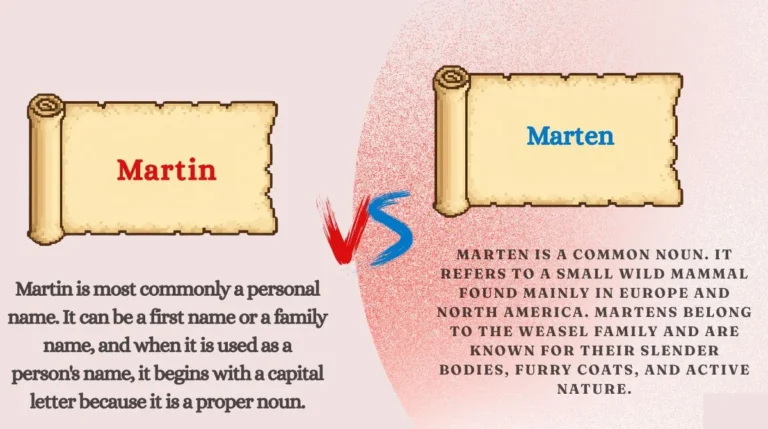
Martin is most commonly a personal name. It can be a first name or a family name, and when it is used as a person’s name, it begins with a capital letter because it is a proper noun. The Cambridge Learner’s Dictionary defines Martin as a male name. Martin is also used as a surname in English and several other languages.
For example:
- Martin is my new classmate.
- I met Martin at the library.
- Martin lives near our school.
- Have you spoken to Martin today?
- Martin called me last night.
- Mr. Martin teaches English.
- Sarah and Martin are good friends.
- I sent the message to Martin yesterday.
In all of these sentences, Martin is the name of a particular person. That is why the first letter is capitalized.
Martin as a Proper Noun
A proper noun is the special name of a particular person, place, organization, or other specific entity. English normally begins proper nouns with a capital letter.
Compare these examples:
- man → a general word for a person
- Martin → the specific name of one person
- teacher → a general job or role
- Mr. Martin → a specific person’s name
This difference is important for learners. You do not capitalize every noun in English. You capitalize a person’s specific name.
For example:
My brother is a teacher.
Here, brother and teacher are common nouns.
My brother’s name is Martin.
Here, Martin is a proper noun, so it begins with a capital M.
Martin as a Family Name
Martin can also be a surname or family name. For instance:
My teacher is Mrs. Martin.
Here, Martin is the person’s family name.
You can also use the plural form when talking about a family:
The Martins invited us to dinner.
The apostrophe is not normally needed simply to make the family name plural. The name becomes Martins, not Martin’s, when you mean more than one member of the family.
Martin and Articles
When Martin is a person’s first name, we normally do not put a, an, or the before it.
We say:
Martin is outside.
Not:
The Martin is outside.
We also say:
I called Martin.
Not:
I called the Martin.
There can be special situations where a person’s name is used differently, but ordinary personal-name use does not normally take an article. Cambridge’s explanation of proper nouns notes that most proper nouns do not take a determiner.
Another Meaning: “martin” as a Bird
There is one more important detail. martin, written with a lowercase m, is also an English noun for a small bird related to swallows. Cambridge describes a martin as a small bird like a swallow with a shorter tail. Collins also lists martin for several swallow-like birds.
For example:
- We saw a martin near the house.
- A martin flew over the garden.
- The farmer noticed several martins in the field.
- The house martin built a nest under the roof.
So the sentence itself matters.
Martin is my cousin.
Here, Martin is a person’s name.
A martin flew across the garden.
Here, martin is a bird.
This is one reason learners may find the word confusing.
What Does “Marten” Mean?
Marten is a common noun. It refers to a small wild mammal found mainly in Europe and North America. Martens belong to the weasel family and are known for their slender bodies, furry coats, and active nature. Cambridge defines marten as a small wild mammal found in Europe and North America, sometimes hunted for its fur.
The word is usually written with a lowercase m unless it appears at the beginning of a sentence or as part of a proper name.
Examples:
- We saw a marten in the forest.
- The marten quickly climbed the tree.
- A marten was hiding under the rocks.
- The guide told us about the local marten population.
- Martens are excellent climbers.
- A young marten appeared near the cabin.
- The wildlife team studied several martens.
- The marten disappeared into the woods.
Marten Is a Common Noun
Unlike the personal name Martin, marten does not normally identify one particular person. It describes a type of animal.
That makes it a common noun.
Compare:
Martin is in the classroom.
Martin = a specific person’s name.
A marten is in the forest.
marten = a kind of animal.
This simple difference can help you choose the right word.
Singular and Plural Forms
Marten is countable when you are talking about individual animals.
You can say:
a marten
one marten
two martens
several martens
The most common plural form is martens. Cambridge also notes that marten can itself be used as a plural in some contexts, although martens is the regular plural form.
For everyday English, it is safest for learners to use:
one marten
two martens
Use Articles with “Marten”
Because marten is a common countable noun, it can be used with articles and other determiners.
Examples:
I saw a marten in the woods.
The marten climbed the tree.
We photographed one marten.
Several martens were moving through the forest.
This is different from the usual use of a person’s name:
I saw Martin.
Not:
I saw a Martin.
The grammar changes because the words have different functions and meanings.
Difference Between Martin and marten
The easiest way to understand Martin vs marten is to look at their meaning, capitalization, and grammar side by side.
| Feature | Martin | marten |
|---|---|---|
| Main meaning | A person’s name | A small wild mammal |
| Word type | Proper noun when used as a name | Common noun |
| Capital letter | Yes, for the name | No, unless starting a sentence |
| Typical article | Usually no article before a personal name | Can use a/an/the |
| Plural form | Martins when referring to a family or people with the name | Martens |
| Example | Martin called me. | A marten climbed the tree. |
| Main idea | A specific name | A type of animal |
There is also a second meaning of lowercase martin:
| Word | Meaning |
|---|---|
| Martin | A person’s name |
| martin | A small bird like a swallow |
| marten | A small wild mammal |
The capital letter makes a real difference in many contexts. English uses capitalization to show proper nouns such as people’s names.
Usage Difference
Use Martin when you are talking about a person named Martin.
Martin is coming to my house.
Use marten when you are talking about the animal.
The marten lives in forested areas.
Use martin when you are talking about the bird.
A martin was flying above the house.
Grammar Logic
The grammar is based on the type of noun.
Martin as a name is a proper noun.
Martin works here.
Marten is a common countable noun.
A marten lives in the forest.
The first sentence names a particular person. The second refers to one animal of a particular kind.
Sentence Structure Difference
With a personal name, the name can often appear directly after the verb or preposition without an article:
I called Martin.
I spoke to Martin.
Martin arrived early.
With marten, a singular countable noun usually needs a determiner:
I saw a marten.
The marten ran away.
That marten was very small.
This is a useful grammar clue. When you see a singular noun and it refers to one animal, a, an, the, or another determiner is often needed.
Meaning Comparison
Consider these three sentences:
Martin is waiting outside.
This means a person named Martin is waiting.
A martin is waiting near the nest.
This means a bird is near a nest.
A marten is waiting near the tree.
This means a wild mammal is near the tree.
The words are visually similar, but they point to completely different things.
Grammar Rules You Must Remember
Rule 1: Capitalize “Martin” When It Is a Person’s Name
When Martin is used as a person’s first name or surname, use a capital M.
Correct:
Martin lives in Lahore.
Incorrect:
martin lives in Lahore.
This follows the normal English rule for proper nouns. Names of particular people begin with capital letters.
Rule 2: Use Lowercase “marten” for the Animal
When you mean the mammal, write marten with a lowercase m, except when the word begins a sentence.
Correct:
We saw a marten in the forest.
Correct:
Martens are active animals.
The second sentence begins with a capital letter only because it is the first word of the sentence.
Rule 3: Singular “Marten” Usually Needs a Determiner
Because marten is a countable common noun, a singular example normally uses a, the, this, that, one, or another determiner.
Correct:
I saw a marten.
Correct:
The marten ran away.
Correct:
That marten was sitting on a rock.
Avoid a bare singular noun in ordinary sentences such as:
I saw marten.
A natural sentence would be:
I saw a marten.
Rule 4: Do Not Change the Spelling Based on Pronunciation
Martin and marten can sound very similar in some accents. That does not make their spellings interchangeable. Cambridge gives pronunciation forms for both words that can sound close depending on the variety of English being spoken.
If you are writing about a person named Martin, remember:
Martin
If you are writing about the mammal, remember:
marten
If you are writing about the swallow-like bird, remember:
martin
Common Mistakes Students Make
The biggest mistake is assuming that Martin and marten are simply different spellings of the same word. They are not.
Mistake 1: Writing “Marten” for a Person
A student may write:
I spoke to Marten yesterday.
If the person’s actual name is Martin, this spelling is incorrect.
Correct:
I spoke to Martin yesterday.
Names are especially important because one small spelling change can turn a person’s name into a different word.
Mistake 2: Writing “Martin” for the Animal
A learner may write:
We saw a Martin in the forest.
When referring to the animal, the usual spelling is:
We saw a marten in the forest.
Here, using a capital M also makes the sentence look as though Martin is a person’s name.
Mistake 3: Forgetting the “e” in Marten
Because the pronunciation can be similar to Martin, learners sometimes write:
I saw a martin in the woods.
If they mean the mammal, the correct word is:
I saw a marten in the woods.
A quick visual check helps: marten has e.
Mistake 4: Using “the Martin” for a Person
Students sometimes transfer the article rule for common nouns to personal names.
They might write:
The Martin called me.
For normal personal-name use, say:
Martin called me.
However, the Martin can appear in special contexts, such as a family reference, a title, or when a name is being used in a special descriptive way. The ordinary rule for a person’s name is to use the name directly.
Mistake 5: Confusing “martin” the Bird with “marten” the Mammal
These two words are especially easy to mix up.
A martin flew over the lake.
This refers to a bird.
A marten ran through the forest.
This refers to a mammal.
Cambridge specifically distinguishes these dictionary entries: martin is a bird, while marten is a mammal.
Easy Correction Tip
Before choosing the word, ask yourself one question:
Am I talking about a person, a bird, or a mammal?
Person → Martin
Bird → martin
Mammal → marten
That single question can prevent most mistakes.
Easy Trick to Remember the Difference
Here is a very simple memory trick.
Martin = Man
Think:
Martin → person
The name Martin contains the sound and shape you can connect with a person’s name.
For example:
Martin is my friend.
Marten = Animal
Think:
Marten → animal
The extra e can remind you that you are talking about a wild animal, not a person’s name.
The marten climbed the tree.
You can also remember the three-word pattern:
Martin = person
martin = bird
marten = mammal
Notice the small changes:
MARTIN → name
martin → bird
marten → mammal
The middle two are especially easy to confuse, so focus on the vowel.
martin → i
marten → e
When you read the sentence, think about the meaning before thinking about the spelling.
Ask:
Is someone named Martin doing something?
Then use Martin.
Ask:
Is a bird flying?
Then use martin.
Ask:
Is a small wild mammal running or climbing?
Then use marten.
This approach is much more useful than trying to memorize three spellings without understanding them.
Daily Life Examples
Here are simple conversation-style examples showing how the words work naturally.
1. Talking about a Person
A: Who called you?
B: Martin called me.
Here, Martin is a person’s name.
2. Asking About a Person
A: Is Martin coming to the party?
B: Yes, he said he would come.
Again, Martin is a proper name.
3. Talking About the Animal
A: What did you see in the forest?
B: I saw a marten near the trees.
The word refers to the mammal.
4. Talking About More Than One Animal
A: Are martens dangerous?
B: They are wild animals, so it is best to keep your distance.
Martens is the plural of marten.
5. Talking About a Bird
A: What is that bird near the roof?
B: It looks like a martin.
Here, martin refers to the bird.
6. Talking About a Friend
A: Who is your new classmate?
B: His name is Martin.
The capital M is required because it is a personal name.
7. Reading About Wildlife
The researchers watched a marten moving through the forest.
Here, the context makes the meaning clear.
8. Reading About Birds
Several martins were flying around the house.
Here, martins means several birds.
9. A Name and an Animal in One Sentence
Martin took a photograph of a marten.
This sentence is an excellent way to remember the difference.
Martin = person
marten = animal
10. A Name, Bird, and Animal Together
Martin watched a martin fly past a tree where a marten was hiding.
It looks funny at first, but the meanings are different:
- Martin = person
- martin = bird
- marten = mammal
This is why context matters so much in English.
Practice Section
Choose the correct word: Martin, martin, or marten.
1. _____ is my English teacher.
A. Martin
B. marten
C. martin
2. We saw a _____ climbing a tree in the forest.
A. Martin
B. marten
C. martyn
3. A _____ flew over the garden.
A. Martin
B. marten
C. martin
4. I spoke to _____ after class.
A. marten
B. martin
C. Martin
5. Several _____ were moving through the woods.
A. Martins
B. martens
C. martin
Answers
1. Martin — It is a person’s name.
2. marten — It is the wild mammal.
3. martin — It is the bird.
4. Martin — It is the person’s name.
5. martens — This is the regular plural form of marten.
FAQs
What is the difference between Martin and marten?
Martin is commonly a person’s first name or surname and is capitalized when used as a proper name. Marten is a common noun for a small wild mammal. There is also lowercase martin, which is a type of bird related to swallows.
Can we use Martin in questions?
Yes. When Martin is a person’s name, you can use it naturally in questions.
For example:
Is Martin at home?
Did Martin call you?
Where is Martin going?
The name keeps its capital letter because it is a proper noun.
Is marten a formal or informal word?
Marten is a standard English noun used for the animal. It is neither simply a formal nor an informal word. You can find it in wildlife writing, dictionaries, educational texts, and ordinary descriptions of nature.
Should I write Martin or martin for the bird?
When referring to the bird, the dictionary form is martin, with a lowercase m, unless the word begins a sentence or appears in a context where a particular style requires different capitalization. Cambridge lists martin as a common noun for a small bird.
Is marten the plural of martin?
No. They are different words with different meanings. The plural of martin as the bird is martins. The regular plural of marten as the mammal is martens.
For example:
Three martins flew above the house.
Three martens moved through the forest.
Why do Martin and marten sound so similar?
Their pronunciations can be very close in some varieties of English. Cambridge gives slightly different UK and US pronunciations for the words, but learners may still hear them as almost the same. That is why spelling from sound alone can be difficult.
The safest approach is to focus on meaning and spelling rather than sound alone.
Is “Marten” also a name?
It can occur as a personal name or surname in some languages and naming traditions, but marten in ordinary English wildlife vocabulary means the mammal. When the word is someone’s actual name, capitalization follows the person’s chosen proper name. The main English learning distinction is therefore context: Martin is a very common personal name, while marten is the animal word.
Conclusion
Understanding Martin vs marten becomes much easier when you stop looking only at the spelling and start with the meaning.
Martin is commonly a person’s name, so it begins with a capital M. Marten is a small wild mammal and is normally written with a lowercase m. There is also martin, a lowercase word for a small bird similar to a swallow.
A simple way to remember the difference is:
Martin = person
martin = bird
marten = mammal
When you are unsure, look at the sentence and ask what you are talking about. Is it a person’s name? Is it a flying bird? Or is it a wild animal?
A little practice will make these words much easier to recognize. Once the meaning becomes clear, choosing the right spelling becomes almost automatic.

Evan Rellmont is a writer who turns thoughtful ideas into meaningful words, creating stories and reflections that connect, inspire, and leave a lasting impression.