
Have you ever seen the words flammable and inflammable and thought they meant opposite things? That is a very natural mistake.
The word inflammable looks as if the prefix in- should make it negative, just as it does in some words such as incomplete or inaccurate. So, many English learners assume that flammable means “easy to burn,” while inflammable means “not easy to burn.”
But that assumption is wrong.
Flammable and inflammable actually have the same meaning when they describe fire. Both words describe something that can catch fire or burn easily.
Major English dictionaries list inflammable as a synonym of flammable.
This small difference in appearance can cause big confusion, especially when you are reading safety labels, instructions, signs, school science materials, or everyday English.
You might see “highly flammable liquid” on a container, while an older or British source may use “highly inflammable.”
The good news is that the rule is simple once you understand the history of the word. Inflammable does not mean “unable to catch fire.” It means “able to catch fire easily.”
By the end of this guide, you will know exactly when to use each word, why inflammable looks confusing, which word is usually clearer, and how to avoid common mistakes in writing and speaking.
4. What Does “Flammable” Mean?
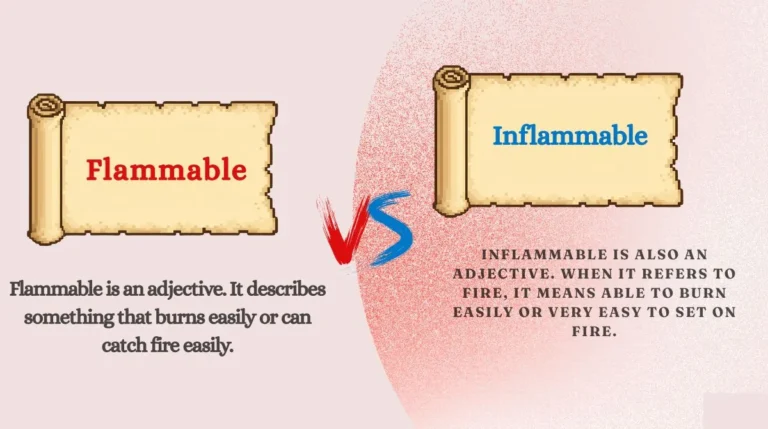
Flammable is an adjective. It describes something that burns easily or can catch fire easily. Cambridge defines flammable as something that burns easily, while Oxford gives the simple meaning “that can burn easily.”
You often see this word when talking about liquids, gases, chemicals, clothing, building materials, fuel, or other objects that can catch fire.
For example:
- Gasoline is highly flammable.
- Keep this flammable liquid away from heat.
- The warning says the material is flammable.
- Some cleaning products are flammable.
- Do not store flammable chemicals near a flame.
- The factory keeps flammable materials in a special area.
- This spray is extremely flammable.
- Dry leaves can become highly flammable during hot weather.
In these sentences, flammable tells us something about the ability of a substance or material to catch fire.
When Should You Use “Flammable”?
Use flammable when you want to say that something can catch fire easily.
It is especially common in:
- safety instructions
- warning signs
- product labels
- science writing
- workplace instructions
- everyday descriptions
For example, a person might say:
“Be careful with that bottle. It’s flammable.”
That sentence simply means the substance can catch fire easily.
Grammar Rule for “Flammable”
Because flammable is an adjective, it usually comes before a noun or after a linking verb.
Before a noun:
- flammable material
- flammable gas
- flammable liquid
- flammable clothing
After a linking verb:
- The liquid is flammable.
- This material seems flammable.
- The gas is highly flammable.
You can also use adverbs such as highly, very, extremely, and easily depending on the sentence.
For example:
- highly flammable
- extremely flammable
- very flammable
Oxford lists combinations such as highly flammable liquids and notes that flammable has non-flammable as its opposite.
Common Learner Confusion
The biggest confusion is not about grammar. It is about the meaning of the word itself.
Some learners see:
flammable
and think:
“It can burn.”
Then they see:
inflammable
and think:
“It cannot burn.”
That is not correct.
The two words can both describe something that catches fire easily. The important thing to remember is that inflammable is not the negative form of flammable.
5. What Does “Inflammable” Mean?
Inflammable is also an adjective. When it refers to fire, it means able to burn easily or very easy to set on fire. Cambridge gives “burning very easily” as its meaning and lists flammable as the equivalent word.
Here are some examples:
- This gas is highly inflammable.
- The warehouse contained inflammable materials.
- Keep inflammable liquids away from open flames.
- The fabric is inflammable and should be stored carefully.
- Petrol is an inflammable substance.
- The warning label says the contents are inflammable.
- Some old houses contain inflammable materials.
- The workers were trained to handle inflammable chemicals safely.
The meaning in these examples is the same basic idea as flammable.
When Should You Use “Inflammable”?
You can use inflammable when describing something that catches fire easily. The word is perfectly valid English; it is not a misspelling of flammable.
However, flammable is generally the clearer choice for modern writing, because inflammable can look like it means “not flammable.” Oxford specifically notes that flammable is much more frequent and carries less risk of confusion.
So, if you are writing for students, customers, the public, or a wide international audience, flammable is often the safer and clearer word.
Grammar Rule for “Inflammable”
Just like flammable, inflammable is an adjective.
It can appear before a noun:
- inflammable material
- inflammable gas
- inflammable liquid
Or after a linking verb:
- The material is inflammable.
- The liquid is highly inflammable.
- These chemicals are inflammable.
The grammar is therefore almost exactly the same as with flammable.
Another Meaning of “Inflammable”
There is one more interesting point. Inflammable can also have a figurative meaning that has nothing to do with physical fire. Cambridge records a meaning for something, such as a situation, that can quickly become angry or violent.
For example:
- The political situation was highly inflammable.
- The region was considered inflammable because tensions were high.
Here, inflammable means something like likely to become angry, violent, or explosive in an emotional sense.
This meaning is less important for beginners, but it explains why you may sometimes see inflammable in news, history, or formal writing.
6. Difference Between Flammable and Inflammable
The most important fact is simple:
When talking about fire, flammable and inflammable mean the same thing.
Both describe something that can burn or catch fire easily. Cambridge lists inflammable as a synonym of flammable, and Oxford explicitly says the two words have the same meaning.
Comparison Table
| Point | Flammable | Inflammable |
|---|---|---|
| Part of speech | Adjective | Adjective |
| Main fire-related meaning | Can burn easily | Can burn easily |
| Meaning | Same | Same |
| Opposite | Non-flammable / nonflammable | Non-flammable / nonflammable |
| Common use | Very common | Less common |
| Clarity | Usually clearer | Can cause confusion |
| Typical example | flammable liquid | inflammable liquid |
| Modern preference | Often preferred | Still correct |
Usage Difference
The main difference is not meaning. It is mostly about clarity and frequency.
For example:
This liquid is flammable.
and
This liquid is inflammable.
Both sentences tell us that the liquid can catch fire easily.
Oxford notes that inflammable is especially associated with British English, while flammable is the more frequent form in both British and North American English.
So, a learner who writes flammable is making a clear and widely understood choice.
Grammar Logic
Both words function as adjectives.
You can use them:
Before a noun
- a flammable gas
- an inflammable gas
After “be”
- The gas is flammable.
- The gas is inflammable.
With degree adverbs
- highly flammable
- highly inflammable
- extremely flammable
- extremely inflammable
The grammar does not change simply because one word contains in-.
Sentence Structure Difference
There is almost no sentence-structure difference between them.
Compare:
This material is highly flammable.
This material is highly inflammable.
Both follow this pattern:
Subject + linking verb + adjective
Likewise:
Store flammable chemicals carefully.
Store inflammable chemicals carefully.
Both follow:
Verb + adjective + noun + adverb
The real issue is word choice and clarity, not sentence structure.
Meaning Comparison
A common mistake is to read inflammable as:
in + flammable = not flammable
But English prefixes do not always work that way.
The in- in inflammable comes from the historical development of the word and is connected with the Latin idea of “into”, as in inflame or inflammare, rather than simply meaning “not.” Oxford gives the origin as Latin inflammare, from in- “into” + flamma “flame.”
That is why the word does not have the negative meaning students may expect.
The actual opposite is non-flammable or nonflammable, not inflammable. Oxford lists nonflammable as the opposite of both forms.
7. Grammar Rules You Must Remember
Rule #1: Both Words Are Adjectives
Flammable and inflammable describe nouns, so they are adjectives.
Examples:
- a flammable substance
- an inflammable substance
- flammable gases
- inflammable gases
You can also put them after linking verbs:
- The substance is flammable.
- The substance is inflammable.
Do not treat them as verbs or nouns in these basic structures.
Rule #2: Do Not Assume “In-” Means “Not”
This is the rule that solves most of the confusion.
In some English words, in- can create a negative meaning:
- accurate → inaccurate
- complete → incomplete
- visible → invisible
But prefixes do not always behave the same way in every word.
In inflammable, the historical in- is connected to the idea of causing something to come into flames, not “not.” Oxford traces it to Latin inflammare.
So:
inflammable ≠ not flammable
Instead:
inflammable = flammable
Rule #3: Use “Nonflammable” for the Opposite
When you need to say that something does not easily catch fire, use nonflammable or non-flammable.
For example:
- This fabric is nonflammable.
- The container is made from a nonflammable material.
- We need non-flammable clothing for this task.
Do not use inflammable to mean “safe from fire.”
That is one of the most important errors to avoid.
Rule #4: “Flammable” Is Usually the Clearest Modern Choice
Both words are correct when they mean “able to burn easily,” but flammable is usually easier to understand immediately. Oxford specifically recommends its greater clarity because inflammable may be misunderstood.
For a modern learner, this is a useful rule:
Choose flammable when you simply mean something can catch fire easily.
You will be understood clearly, and you avoid the false idea that inflammable means “not flammable.”
8. Common Mistakes Students Make
Mistake 1: Thinking “Inflammable” Means “Not Flammable”
This is the most common mistake.
❌ Inflammable means something cannot burn.
✅ Inflammable means something can burn easily.
The visual form of the word causes the problem. Students often apply a familiar prefix rule without checking the word’s actual meaning.
Mistake 2: Calling “Inflammable” a Wrong Word
Some learners believe:
❌ Inflammable is incorrect.
That is also wrong.
✅ Inflammable is a real English word.
Dictionaries such as Cambridge and Oxford include it and define its fire-related meaning as essentially the same as flammable.
Mistake 3: Using “Inflammable” for the Opposite
For example:
❌ This material is inflammable, so it will not burn.
This sentence gives the wrong meaning.
✅ This material is nonflammable, so it is designed not to burn easily.
The prefix non- clearly gives the negative meaning here.
Mistake 4: Thinking the Grammar Is Different
Some learners think inflammable needs a different sentence pattern.
It does not.
Compare:
- This liquid is flammable.
- This liquid is inflammable.
Both are grammatically correct.
Mistake 5: Changing the Meaning of “Highly”
Notice this pair:
- highly flammable
- highly inflammable
Highly does not make one word negative. In both expressions, it strengthens the meaning.
So highly flammable means something is very easy to ignite, and highly inflammable communicates essentially the same idea. Cambridge gives examples of both kinds of usage.
Easy Correction Tip
Whenever you see inflammable, mentally replace it with flammable.
If the sentence still makes sense, you have probably understood it correctly.
For example:
“Keep away from inflammable materials.”
Think:
“Keep away from flammable materials.”
Now the meaning is immediately clear.
9. Easy Trick to Remember the Difference
Here is a simple memory trick:
Flammable = Flame easily
Look at the beginning:
FLAMMABLE → FLAME
Think:
“Flammable things catch flame easily.”
Now deal with the confusing word:
Inflammable does not mean “not flammable.”
Imagine the word as being connected to flame going into something, rather than the English negative prefix in-.
You do not need to remember the Latin history every time you use the word. Just remember this classroom rule:
Flammable = can burn easily.
Inflammable = can burn easily.
Nonflammable = does not easily burn.
That three-line rule is enough for everyday English.
There is another useful trick: when you see a safety warning, prefer the word flammable in your own writing. It is more common and less likely to be misunderstood. Oxford makes this same clarity point.
Think of it this way:
flammable → fire
inflammable → also fire
nonflammable → not easily burned
Once you memorize this pattern, the confusion becomes much easier to avoid.
10. Daily Life Examples
These examples show how the words can appear naturally in real conversations.
Example 1: At a Gas Station
A: Can I leave this fuel container in the car?
B: I wouldn’t. It contains a flammable liquid.
Here, flammable describes the fuel.
Example 2: Reading a Label
A: What does this warning mean?
B: It means the spray is highly flammable, so keep it away from heat.
The word is common on safety labels because the meaning is direct and easy to understand.
Example 3: At Work
A: Where should I put these chemicals?
B: Put them in the cabinet for flammable materials.
The phrase flammable materials is very natural in workplace English.
Example 4: Talking About Old Language
A: I found the word “inflammable” in an old book.
B: That’s okay. It can mean the same thing as “flammable.”
This is a useful way to handle the less familiar form.
Example 5: Talking About Fabric
A: Is this clothing safe near a fire?
B: No. The material is flammable.
The adjective describes the material’s ability to catch fire.
Example 6: A Safety Instruction
A: Why can’t we smoke here?
B: Because there are flammable chemicals nearby.
This explains the reason for the warning.
Example 7: Reading British English
A: The sign says “highly inflammable.” What does that mean?
B: It means the material can catch fire very easily.
The word may appear in British or older writing, but it does not carry the opposite meaning.
Example 8: Talking About Storage
A: Should we store these bottles in the kitchen?
B: No. They contain flammable liquids.
This is a natural everyday use.
Example 9: Using the Negative Form
A: What kind of material is this?
B: It’s nonflammable, so it is designed to resist catching fire easily.
Here, nonflammable is the word that expresses the opposite idea.
Example 10: A Figurative Meaning
A: Why was the situation described as inflammable?
B: Because tensions were so high that it could quickly become violent.
Here, inflammable is being used figuratively, not to describe a physical material. Cambridge records this separate meaning for situations that may quickly become angry or violent.
11. Practice Section
Choose the correct option in each sentence.
1. This chemical is highly ______.
A. flammable
B. nonflammable
2. The old label says “______ liquid.”
A. inflammable
B. not inflammable
3. We need a ______ material for this product.
A. nonflammable
B. inflammable, meaning impossible to burn
4. Which sentence is correct?
A. Inflammable means unable to catch fire.
B. Inflammable can mean able to catch fire easily.
5. Which word is usually clearer for modern general use?
A. flammable
B. inflammable
Answers
1. A — flammable
The chemical can catch fire easily.
2. A — inflammable
Inflammable is a valid word and can have the same fire-related meaning as flammable.
3. A — nonflammable
Nonflammable gives the opposite meaning and is used when something is not easily burned.
4. B — Inflammable can mean able to catch fire easily.
This is the key fact to remember.
5. A — flammable
Both are correct for the fire-related meaning, but flammable is generally more frequent and less confusing.
12. FAQs
What is the difference between flammable and inflammable?
When they refer to fire, flammable and inflammable have the same meaning. Both describe something that can burn or catch fire easily. Flammable is generally the more common and clearer choice in modern English.
Does inflammable mean “not flammable”?
No. This is a common misunderstanding. Inflammable does not mean “not flammable.” It can mean something that catches fire easily, just like flammable. The true opposite is nonflammable or non-flammable.
Is flammable or inflammable more correct?
Both words are correct when they describe something that burns easily. However, flammable is usually preferred for clarity, because inflammable can look like a negative word to readers who do not know its history. Oxford specifically notes this risk of confusion.
Can we use flammable and inflammable in questions?
Yes. Both can be used in questions because they are adjectives.
For example:
“Is this liquid flammable?”
You could also say:
“Is this liquid inflammable?”
The first version is generally more natural and immediately clear to modern readers.
Is inflammable formal or informal?
Inflammable is not simply a formal or informal version of flammable. It is a valid dictionary word and is especially associated with British English in some dictionaries. It is less frequent than flammable, however, so flammable is usually the clearer everyday choice.
Why does inflammable mean the same as flammable?
The confusion comes from the appearance of in-. In inflammable, the historical prefix is connected with the idea of bringing something into flame, not the negative meaning “not.” Oxford traces it to Latin inflammare, related to flame.
Conclusion
The difference between flammable and inflammable is much easier once you stop treating in- as a simple negative prefix.
Both words can mean able to catch fire or burn easily. So, a flammable liquid and an inflammable liquid are both liquids that can catch fire easily. Cambridge and Oxford both support this meaning.
The real difference is mainly about clarity and frequency. Flammable is the more common modern choice and is less likely to confuse readers. Inflammable is still correct, especially in British English and some older or formal contexts.
Most importantly, remember the opposite:
flammable = can burn easily
inflammable = can burn easily
nonflammable = not easily burned
Once this simple pattern becomes familiar, you will not be caught by the misleading appearance of inflammable again. Keep noticing these confusing word pairs in real English, and your vocabulary will become much stronger with practice.

Evan Rellmont is a writer who turns thoughtful ideas into meaningful words, creating stories and reflections that connect, inspire, and leave a lasting impression.