
Have you ever wanted to describe a feeling or action that happens without your full attention, but you were not sure whether to use subconscious or unconscious? These words are easy to mix up because both can refer to things happening outside normal awareness.
The confusion gets even stronger because unconscious has another common meaning: not awake or not aware of your surroundings.
That extra meaning is the main reason learners need to be careful. You can say someone was knocked unconscious after an accident, but not normally “knocked subconscious.” A person can also subconsciously choose a habit or reaction while fully awake.
Cambridge defines the subconscious as a part of the mind that can notice and remember information without active effort and influence behavior without the person realizing it.
Dictionaries also use unconscious for both loss of awareness and thoughts or feelings a person does not know they have.
There is one more useful fact: the mental meanings overlap. Harvard Health notes that unconscious is generally preferred in professional writing about mental functioning, while subconscious remains common in everyday and popular English.
What Does “Subconscious” Mean?
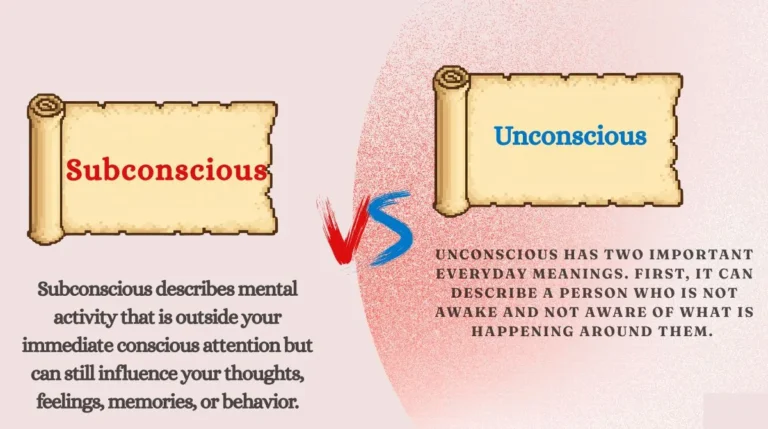
Subconscious describes mental activity that is outside your immediate conscious attention but can still influence your thoughts, feelings, memories, or behavior. In simple English, it means something is happening in your mind without you actively thinking about it. Cambridge and Oxford both describe this connection between the subconscious and behavior outside awareness.
Think of it as something working quietly in the background. You may be awake, alert, and speaking normally, yet a memory, habit, preference, or feeling can still affect what you do.
When should you use “subconscious”?
Use subconscious when you are talking about hidden or background mental influences. It commonly appears before nouns such as mind, thoughts, fears, desires, memories, feelings, and level.
Examples:
- She had a subconscious fear of dogs.
- His subconscious mind was still working on the problem.
- I made a subconscious choice to sit near the door.
- The song created a subconscious feeling of comfort.
- She was subconsciously copying her teacher’s gestures.
- He subconsciously checked his phone during the meeting.
- The smell brought back a subconscious memory of childhood.
- Subconsciously, I knew something was wrong.
The word subconsciously is the adverb form. It describes an action or thought that happens without conscious attention. Cambridge and Oxford both list this use.
Grammar rule for “subconscious”
As an adjective, subconscious usually comes before a noun:
subconscious + noun
Examples include subconscious fear, subconscious thoughts, and subconscious desire.
It can also be a noun:
- The memory stayed in my subconscious.
- My subconscious noticed the pattern before I did.
Cambridge recognizes both adjective and noun uses.
A common mistake is thinking subconscious means “almost unconscious” or “half awake.” It does not normally describe a person who has fainted. A fully awake person can act subconsciously.
What Does “Unconscious” Mean?
Unconscious has two important everyday meanings. First, it can describe a person who is not awake and not aware of what is happening around them. This often happens because of an injury, illness, fainting, or another physical cause. Second, it can describe a thought, feeling, desire, or action that a person is not aware of.
So the basic idea is:
Unconscious = not conscious or not aware.
When should you use “unconscious”?
Use unconscious for a physical loss of awareness:
- He was knocked unconscious.
- She was found unconscious on the floor.
- The patient remained unconscious.
Use it for mental meanings too:
- an unconscious fear
- an unconscious desire
- an unconscious reaction
In psychology, the unconscious can also mean the part of the mind containing thoughts and feelings outside awareness.
Examples:
- The player was knocked unconscious after the fall.
- She was unconscious for several minutes.
- The doctors found him unconscious but breathing.
- He made an unconscious movement toward the door.
- She had an unconscious desire to please everyone.
- His unconscious fear affected his decisions.
- The mistake may have come from an unconscious habit.
- The unconscious can influence behavior in some psychological theories.
Notice how different examples 1 and 5 are. In example 1, unconscious describes a physical state. In example 5, it describes a feeling outside awareness.
Grammar rule for “unconscious”
Unconscious is an adjective and can appear before a noun:
- unconscious patient
- unconscious thought
- unconscious fear
- unconscious reaction
It also works after a linking verb:
- He is unconscious.
- She became unconscious.
Another useful pattern is unconscious of + noun, meaning “not aware of something”:
- He was unconscious of the danger.
- She was unconscious of how loud she was.
Oxford specifically lists this structure.
The adverb is unconsciously:
- He unconsciously copied his brother.
- She unconsciously smiled when she heard the name.
Cambridge defines unconsciously as doing something without being aware of what you are doing.
Difference Between Subconscious and Unconscious
The biggest difference is context. Subconscious commonly describes background mental activity. Unconscious can also describe mental activity, but it additionally describes a loss of awareness.
| Point | Subconscious | Unconscious |
|---|---|---|
| Basic idea | Below immediate conscious attention | Not conscious or not aware |
| Physical state | Normally not used for being knocked out | Commonly used |
| Mental use | Thoughts, feelings, memories, or influences outside active awareness | Thoughts, feelings, actions, or desires outside awareness |
| Noun form | the subconscious | the unconscious |
| Adverb | subconsciously | unconsciously |
| Example | She subconsciously avoided the topic. | She was unconscious after the accident. |
Usage difference
Compare these two sentences:
She subconsciously moved closer to her friend.
She is awake. The movement happens without deliberate planning.
She was unconscious after the accident.
She has lost awareness and is not awake or responsive in the ordinary sense. Cambridge and Oxford both recognize this physical meaning.
This is the easiest difference for beginners to remember.
Grammar logic
Both words can describe mental thoughts:
- subconscious thoughts
- unconscious thoughts
That does not mean they are always interchangeable. In ordinary English, subconscious thoughts often suggests mental activity outside your immediate attention. Unconscious thoughts can simply mean thoughts the person is not aware of and is also common in psychological discussion. Cambridge gives unconscious thought or feeling exactly this kind of meaning.
Because of this overlap, avoid learning an overly strict rule such as “subconscious is slightly hidden, but unconscious is always deeply hidden.” Real English use is less tidy.
Sentence-structure difference
The most important sentence pattern is the physical use of unconscious:
- He was knocked unconscious.
- They found her unconscious.
- She became unconscious.
Do not replace that adjective with subconscious.
For mental or behavioral situations, adverbs are often useful:
- He subconsciously chose the blue shirt.
- She unconsciously copied her friend.
- I subconsciously remembered the route.
The choice depends on what you want to emphasize: background mental activity or simple lack of awareness.
Meaning comparison
A useful learning picture is:
Conscious: “I am aware of this right now.”
Subconscious: “Something is working in the background without my active attention.”
Unconscious: “I am not conscious or aware.”
This is a learning tool, not a scientific map of the brain. The mental meanings overlap, and professional writing often uses unconscious as the broader term.
Why psychology makes the difference harder
The history of psychology adds another layer. Harvard Health explains that Freud eventually preferred unconscious to subconscious, and professional literature generally favors unconscious for mental functioning.
For an English learner, the practical point is simple: subconscious is not wrong. It is a normal English word, especially in everyday English.
Grammar Rules You Must Remember
Rule 1: Use “unconscious” for loss of awareness
When someone has fainted, been knocked out, or is not awake and aware, use unconscious.
Correct:
The man was knocked unconscious in the accident.
Wrong for this meaning:
The man was knocked subconscious in the accident.
This is the most important rule for beginners.
Rule 2: Use “subconsciously” for background actions
When a person is awake but does something without consciously planning it, subconsciously is often natural.
Example:
She subconsciously touched her necklace when she felt nervous.
She is aware of her surroundings, but she is not deliberately planning each movement.
Rule 3: “Unconscious” can also describe hidden thoughts
Do not think that unconscious is only a medical term.
Example:
He had an unconscious fear of failure.
Here, the person is not knocked out. The word describes a feeling he does not recognize clearly.
Rule 4: Context decides the best word
Sometimes both words can work:
He had a subconscious desire to succeed.
He had an unconscious desire to succeed.
Both can express a desire outside active awareness. In professional psychological writing, unconscious is generally more common, while subconscious remains common in everyday English.
So do not force a difference when the context naturally allows overlap.
Common Mistakes Students Make
Mistake 1: Using “subconscious” for fainting
Wrong:
My brother was subconscious after the accident.
Correct:
My brother was unconscious after the accident.
The sentence is about a physical loss of awareness.
Mistake 2: Believing the words are exact synonyms
They overlap in mental contexts, but unconscious has the special physical meaning of “not awake or aware.”
Compare:
She subconsciously smiled.
She was awake and did not deliberately plan the smile.
She was unconscious.
She was not awake or aware.
Mistake 3: Using the adjective when you need an adverb
Wrong:
I chose the seat unconscious.
Better:
I chose the seat unconsciously.
Also natural:
I subconsciously chose the seat.
When you describe how an action happened, the adverb often fits better.
Mistake 4: Adding “subconscious” to every automatic action
Not every automatic action needs a psychology word.
I automatically checked the time is often clearer than I subconsciously checked the time when you simply mean “without thinking.”
Use subconsciously or unconsciously when the lack of awareness is actually important to your meaning.
Easy correction tip
Ask yourself:
Is the person awake and acting without active awareness?
Use subconsciously or, where the context fits, unconsciously.
Has the person lost awareness or become unresponsive?
Use unconscious.
Easy Trick to Remember the Difference
Look at the prefixes.
Sub- often means under or below, like submarine. This gives you a useful picture:
subconscious = below the surface of conscious attention
Now look at un-. It often gives a negative meaning:
unconscious = not conscious
So imagine two situations.
You are in a meeting. You are awake and listening. Without noticing, you copy the speaker’s hand movement. You might say:
I subconsciously copied him.
Now imagine you faint and do not know what is happening around you. You are:
unconscious.
The shortcut is:
Subconscious → background mental activity.
Unconscious → not conscious; sometimes not awake.
This is a learning trick, not a rule that separates two exact scientific layers of the mind.
Daily Life Examples
1. A nervous habit
A: Why do you keep checking your phone?
B: I think I subconsciously do it when I’m nervous.
The person is awake, but the habit is not fully planned.
2. Choosing a familiar option
I subconsciously picked the same color I always choose.
The choice may be influenced by a preference the speaker did not consciously consider.
3. A hidden feeling
She had a subconscious fear of public speaking.
The fear affected her behavior even though she did not always notice it.
4. Copying another person
I was unconsciously copying the way my friend talked.
The speaker did not intentionally decide to imitate the friend.
5. A physical loss of awareness
The runner collapsed and was unconscious for a few seconds.
This is the medical or physical meaning of unconscious.
6. Not knowing about something
He was unconscious of the danger behind him.
Here, unconscious of means “not aware of.”
7. A hidden reaction
She subconsciously moved closer when she heard the noise.
The movement was not deliberately planned.
8. A psychological desire
He had an unconscious desire to be accepted by the group.
This describes a desire outside the person’s awareness.
9. A natural smile
I unconsciously smiled when I saw my old teacher.
The smile happened without deliberate planning.
10. A memory triggered by a smell
That smell brought back a subconscious memory of my childhood.
The memory was not the main focus of the speaker’s mind, but the smell brought it back.
Practice Section
Choose the better option.
1.
After the fall, the cyclist was ______ for two minutes.
A. subconscious
B. unconscious
2.
I ______ started humming the song because I had heard it so many times.
A. subconsciously
B. unconscious
3.
She had a ______ fear of being alone.
A. subconscious
B. unconscious
4.
He was completely ______ after the blow to his head.
A. unconscious
B. subconscious
5.
She ______ copied her sister’s hand movements.
A. subconsciously
B. unconscious
Answers
1. B — unconscious: The cyclist lost physical awareness.
2. A — subconsciously: Humming happened without active planning.
3. A — subconscious: This is a common everyday way to describe a hidden feeling. Unconscious could also work in a psychological context.
4. A — unconscious: The person is not awake or aware.
5. A — subconsciously: The action was not consciously planned.
FAQs
What is the difference between subconscious and unconscious?
Subconscious commonly refers to mental activity outside immediate conscious awareness. Unconscious can have a similar mental meaning, but it also means not awake or not aware of your surroundings.
Can we use “subconscious” in questions?
Yes. You can ask, “Did you do that subconsciously?” or “Do you think your subconscious affects your choices?” These questions are natural when discussing habits, feelings, memories, and mental influences.
Is “subconscious” formal or informal?
It is a normal English word, but it is especially common in everyday speech and popular writing about the mind. Professional literature about mental functioning generally uses unconscious more often.
Can “unconscious” mean “subconscious”?
Sometimes. In mental or psychological contexts, the meanings can overlap. But unconscious also has the separate meaning of being not awake or not aware, so the words are not interchangeable everywhere.
Is it correct to say “I was unconscious of the mistake”?
Yes. Unconscious of + noun means “not aware of something.”
For example: “She was unconscious of the effect her words had.” Oxford lists this as a standard use.
Which word should I use in psychology: subconscious or unconscious?
For general professional psychological writing, unconscious is usually the safer standard term. Subconscious is still common in everyday English, and the best choice can depend on the specific theory or context.
Conclusion
Subconscious vs unconscious is confusing because the two words share a mental meaning, but unconscious has an additional everyday meaning that subconscious does not normally have. Subconscious usually describes thoughts, feelings, memories, or influences working outside your immediate conscious attention. Unconscious can describe similar mental activity, but it can also mean that a person is not awake or aware, such as after fainting or an injury.
The easiest memory trick is to think subconscious = below conscious attention and unconscious = not conscious. Still, do not imagine that every use fits into two perfectly separate boxes. Mental meanings overlap, and professional psychological writing often prefers unconscious.
Practice with real situations: habits, feelings, choices, and physical states. Soon, these two words will feel much more natural.

Evan Rellmont is a writer who turns thoughtful ideas into meaningful words, creating stories and reflections that connect, inspire, and leave a lasting impression.