
Have you ever written “tide” when you meant “tied”? You are not alone.
These two words sound exactly the same when we say them aloud, so many English learners mix them up. However, their meanings are completely different.
Tide is usually connected with the sea. It describes the regular rise and fall of ocean or sea water. You may hear expressions such as high tide, low tide, the tide is coming in, or the tide is going out.
The word can also be used in a more figurative way, such as “a tide of public opinion.”
Tied, on the other hand, is the past tense and past participle of the verb tie. It means that something was fastened, connected, or secured with a knot, string, rope, or similar material. It can also describe a situation where two people or teams have the same score.
The tricky part is pronunciation. Both tide and tied are pronounced /taɪd/. That means you cannot always tell which word someone means just by listening.
You have to understand the context and choose the correct spelling when writing.
Once you understand what each word means and how it works in a sentence, the difference becomes very easy.
This guide will help you understand tide vs tied, remember the correct spelling, avoid common mistakes, and use both words naturally in everyday English.
What Does “Tide” Mean?
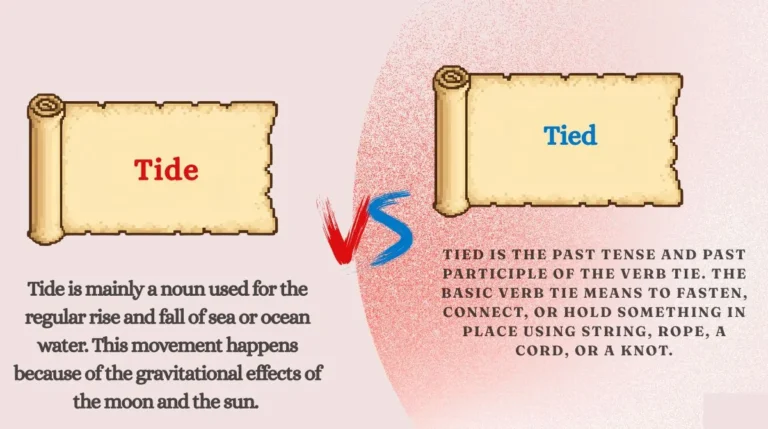
Tide is mainly a noun used for the regular rise and fall of sea or ocean water. This movement happens because of the gravitational effects of the moon and the sun. Dictionaries commonly describe tide as the rise and fall of the sea or ocean.
You often hear tide when people talk about beaches, boats, fishing, swimming, coastal weather, or ocean conditions.
For example, someone might say:
“We should leave the beach before the tide comes in.”
Here, tide refers to the movement of the sea toward a higher level.
The word is also used in common expressions such as high tide and low tide. When the water reaches a higher level, it is high tide. When the water is at a lower level, it is low tide.
Another common expression is the tide is in or the tide is out. These phrases describe the current position of the sea. Cambridge Dictionary gives examples such as “The tide is out” and “The tide comes in very quickly here.”
When Should You Use “Tide”?
Use tide when your sentence is about the sea, ocean water, or the rise and fall of water.
For example:
- The tide is coming in.
- We arrived at the beach during high tide.
- The boat was carried away by the tide.
- The children waited for the tide to go out.
- We checked the tide before going fishing.
- The tide was unusually high this morning.
- The rocks were hidden under the tide.
- They returned to shore before the tide changed.
In these examples, tide is related to water movement.
“Tide” Can Have a Figurative Meaning
There is another use that learners should know. Tide can describe a large or noticeable change in a situation, especially when something is increasing or when public opinion is moving in a particular direction. Oxford gives examples such as a “tide of opinion” and a “rising tide” of something.
For example:
The tide of public opinion began to change.
This sentence is not about seawater. It means that public opinion was starting to move in another direction.
You may also hear the expression:
turn the tide
This means to change a situation, especially when things have been going badly.
Example:
The team scored twice and turned the tide of the game.
Grammar Rule for “Tide”
In its common use, tide is a noun.
It can appear with articles and adjectives:
- the tide
- a tide
- high tide
- low tide
- the incoming tide
Examples:
The tide is high.
We waited for the low tide.
The incoming tide covered the sand.
There is also a less common verb tide, mainly seen in the expression tide someone over. This means to help someone survive or manage a difficult period until conditions improve.
Example:
This small amount of money will tide me over until payday.
So, although tide is most familiar as a noun, it can also be a verb in specific expressions.
What Does “Tied” Mean?
Tied is the past tense and past participle of the verb tie. The basic verb tie means to fasten, connect, or hold something in place using string, rope, a cord, or a knot. Oxford lists tied as both the past simple and past participle form of tie.
The simplest way to understand it is this:
tie → tied
For example:
I tie my shoes every morning.
Past tense:
I tied my shoes before leaving home.
The action happened in the past, so tied is used.
When Should You Use “Tied”?
Use tied when you are talking about something that was fastened, connected, or secured.
For example:
- She tied her hair with a ribbon.
- He tied the package with string.
- I tied my shoes before the race.
- They tied the boat to the dock.
- She tied a scarf around her neck.
- He tied the rope to a tree.
- We tied the boxes together.
- The dog was tied to a post.
In every example, tied comes from the verb tie.
“Tied” Can Also Mean Equal in a Competition
There is another important meaning of tied.
When two people, teams, or players have the same score, the game or competition can be tied.
For example:
The two teams are tied at 2–2.
This means both teams have two goals.
You can also say:
The game was tied at halftime.
Here, tied does not mean attached with string. It means the scores were equal.
This use is especially common in sports and competitions.
Grammar Rule for “Tied”
Because tied is a form of the verb tie, it is commonly used when describing a completed action.
The basic forms are:
tie → tied → tied
Examples:
She ties her hair every morning.
She tied her hair yesterday.
She has tied her hair already.
Notice that the spelling changes from tie to tied. It does not become tide.
Another useful point is that tied can work like an adjective in some sentences.
For example:
The two runners are tied for first place.
Here, tied describes their equal position.
Difference Between Tide and Tied
The easiest way to remember the difference is to focus on meaning, not pronunciation.
Both words sound the same, but they are different words with different spellings and grammatical functions. Oxford specifically identifies tide and tied as homophones.
| Word | Meaning | Common Grammar | Example |
|---|---|---|---|
| tide | The rise and fall of sea or ocean water | Mostly noun | The tide is coming in. |
| tied | Fastened or connected; past form of tie | Verb/adjective | She tied her shoes. |
| tide | A large change or movement in a situation | Noun | The tide of opinion changed. |
| tied | Equal in a competition | Verb/adjective | The teams are tied. |
Usage Difference
Use tide when the idea is related to water or a changing movement.
The tide is low today.
Use tied when something has been fastened or when people or teams have equal scores.
I tied the rope to the fence.
The teams are tied.
The meaning of the whole sentence usually makes the correct spelling clear.
Grammar Logic
The two words come from different word families.
Tide is generally a noun:
The tide is rising.
Tied comes from the verb tie:
She tied the ribbon.
This difference is very useful when you are unsure which spelling to choose. Ask yourself:
“Am I talking about the sea, or am I talking about tying something?”
If the answer is sea or ocean water, the word is probably tide.
If the answer is fastening, connecting, or equal scores, use tied.
Sentence Structure Difference
Look at these two sentences:
The tide is coming in.
She tied her shoes.
In the first sentence, tide is the subject and acts as a noun.
In the second sentence, tied is the verb describing an action that happened in the past.
Another pair makes the difference even clearer:
We waited for the tide to go out.
We tied the boat to the dock.
The first sentence is about water movement.
The second sentence is about fastening something.
Meaning Comparison
Think about two simple pictures in your mind.
For tide, imagine ocean water moving toward or away from the beach.
For tied, imagine someone making a knot in a shoelace.
Those two mental pictures are completely different. That is the main difference between these words.
Grammar Rules You Must Remember
Rule 1: Use “tide” for the rise and fall of sea water
When your sentence is about the ocean or sea moving in and out, use tide.
Example:
The tide is coming in, so we should move our chairs.
You may also see phrases such as high tide, low tide, incoming tide, and outgoing tide.
Rule 2: Use “tied” as the past form of “tie”
When someone fastened or connected something in the past, use tied.
Example:
She tied the package with a piece of string.
Remember:
Today I tie it.
Yesterday I tied it.
Rule 3: Use “tied” for equal scores
When two sides have the same score, tied is correct.
Example:
The match is tied at 1–1.
This use has nothing to do with the sea.
Rule 4: Listen for meaning, not just sound
Because tide and tied are pronounced the same, hearing the word alone may not tell you the spelling.
Example:
“I heard the word /taɪd/.”
You still need context.
Was the person talking about the ocean? Tide.
Were they talking about shoes, ropes, or a competition? Tied.
That simple question can save you from many spelling mistakes.
Common Mistakes Students Make
The biggest reason students confuse these words is that they sound exactly the same. English has many homophones, and tide/tied is one of them.
Another reason is that the spelling can look strange to learners. Some students see tide and connect it with the verb tie, but these are separate words.
Mistake 1: Using “tide” for the past of “tie”
Incorrect:
She tide her hair before school.
Correct:
She tied her hair before school.
Why? Because tied is the past form of tie.
Mistake 2: Using “tied” when talking about the sea
Incorrect:
The tied is coming in.
Correct:
The tide is coming in.
Here, the sentence is about ocean water, so tide is needed.
Mistake 3: Forgetting the sports meaning of “tied”
Incorrect:
The game is tide at 3–3.
Correct:
The game is tied at 3–3.
The score is equal, so we use tied.
Mistake 4: Choosing by sound alone
A student may think:
“They sound the same, so either spelling should work.”
That is not true.
English spelling often gives us different words with identical pronunciation. Context decides the meaning, and meaning decides the spelling.
Easy Correction Tip
Before writing the word, ask:
“What does this word mean here?”
If it means ocean water or a change that moves like a wave, think tide.
If it means fastened or equal in a contest, think tied.
Easy Trick to Remember the Difference
Here is a simple classroom trick:
TIDE = Water
Think of tide as something you see at the seaside.
TIDE → SEA
Imagine standing on a beach and watching the water come in and go out.
TIED = Tie
Look at the word:
TIED
It begins with TIE.
That gives you a strong memory clue:
TIE → TIED
For example:
I tie my shoes.
I tied my shoes yesterday.
There is also a very useful visual trick.
When you see tide, imagine a wave.
When you see tied, imagine a knot.
A wave = tide.
A knot = tied.
And for sports, imagine two teams standing side by side with the same score:
tied = equal.
So you can remember three ideas:
tide = sea
tied = fastened
tied = equal score
Once these three ideas become familiar, the spelling is much easier.
Daily Life Examples
These examples show how tide and tied sound the same but work differently in real conversations.
Conversation 1: At the beach
A: Should we stay here for another hour?
B: Maybe not. The tide is coming in.
Here, tide means the sea water is moving inward.
Conversation 2: Getting ready
A: Are you ready to leave?
B: Almost. I haven’t tied my shoes yet.
Here, tied comes from tie.
Conversation 3: Fishing
A: Why are you checking your phone?
B: I want to check the tide before we go fishing.
The person is checking ocean conditions.
Conversation 4: Packing a box
A: Is the package ready?
B: Yes. I tied it with some strong string.
The string has been fastened around the package.
Conversation 5: Watching a match
A: What’s the score?
B: It’s tied at 2–2.
Both teams have the same score.
Conversation 6: Walking by the sea
A: Why is the beach getting smaller?
B: The tide is coming in.
Again, the sentence is about sea water.
Conversation 7: Fixing a balloon
A: The balloon is flying away!
B: Don’t worry. I tied it to the chair.
Here, tied means fastened.
Conversation 8: A close game
A: Who is winning?
B: Nobody right now. The teams are tied.
The scores are equal.
Conversation 9: Leaving the beach
A: Can we walk across the rocks?
B: Not now. The tide is too high.
This use is about the level of the sea.
Conversation 10: Getting ready for work
A: Why are you still in the bedroom?
B: I’m looking for my shoes. I tied one, but I can’t find the other.
The word tied refers to tying shoes.
Practice Section
Choose the correct word: tide or tied.
1. The ______ is coming in quickly.
2. She ______ her hair before going outside.
3. The two teams are ______ at 4–4.
4. We waited for the ______ to go out before walking along the beach.
5. He ______ the boat to the wooden post.
Answers
1. tide — The sentence is about sea water.
2. tied — This is the past form of tie.
3. tied — The teams have equal scores.
4. tide — The sentence is about the sea.
5. tied — The boat was fastened to the post.
A useful habit is to explain why your answer is correct, not just choose the spelling. That helps you remember the difference much longer.
FAQs
1. What is the difference between tide and tied?
Tide usually means the regular rise and fall of sea or ocean water. Tied is the past tense and past participle of tie, meaning fastened or connected. Tied can also mean that two people or teams have the same score.
2. Do tide and tied sound the same?
Yes. Tide and tied are homophones, which means they have the same pronunciation but different meanings and spellings. Both are pronounced /taɪd/. Context is therefore very important when you hear these words.
3. Is “tied” the past tense of “tie”?
Yes. The main verb forms are tie, tied, and tied. For example, “I tie my shoes” is present tense, while “I tied my shoes” is past tense. The past participle is also tied, as in “She has tied the ribbon.”
4. Can “tide” be a verb?
Yes, although the verb is less common than the noun. One familiar use is tide someone over, which means to help someone manage until a difficult period ends. For example, “This money will tide me over until Friday.”
5. Is “tied” used only for ropes and knots?
No. Tied has several uses. It can describe something that was fastened, such as “She tied the ribbon.” It can also describe equal scores, such as “The game is tied.” In some contexts, tied works as an adjective as well.
6. How can I remember whether to use tide or tied?
Use a simple memory trick: tide = sea, while tied = tie. Think of a wave when you see tide and a knot when you see tied. For sports, remember that two teams with the same score are tied.
Conclusion
The difference between tide vs tied becomes much easier when you stop focusing on how the words sound and start focusing on what they mean.
Tide is mainly connected with the sea, especially the regular rise and fall of ocean water. You can use it in phrases such as high tide, low tide, the tide is in, and the tide is going out. It can also have figurative meanings related to a strong movement or change.
Tied comes from the verb tie. Use it when something has been fastened or connected, such as shoes, ropes, boxes, or boats. It can also mean that two competitors have the same score.
Remember the easy trick: tide = sea, tied = tie. A little practice will make these two words feel natural in both writing and conversation. When you are unsure, look at the meaning of the sentence first. The correct spelling will usually become clear.

Evan Rellmont is a writer who turns thoughtful ideas into meaningful words, creating stories and reflections that connect, inspire, and leave a lasting impression.