
“Tased” and “tazed” look almost the same, and they sound nearly identical when spoken. That is exactly why many English learners are unsure about which spelling to use.
You may see one form in a news story and the other in an online post, which can make the confusion even worse.
The word comes from Taser, the name of an electronic control device. English speakers later began using tase as a verb, meaning to use a Taser on someone.
Cambridge Dictionary lists taser as a verb and also gives tase as a form of the verb. Collins lists tase with the past forms tased and the pronunciation /teɪz/.
But there is an important detail that many simple explanations miss: tazed is also recorded as an alternative form in the American Heritage Dictionary. So it is not quite accurate to say that tazed never exists.
For most learners and writers, tased is the clearest form to use, especially when you want to follow the spelling of the base verb tase.
By the end of this guide, you will understand the meaning, grammar, spelling, pronunciation, and everyday use of both forms.
What Does “Tased” Mean?
Tased is the past tense and past participle of the verb tase. It means that someone was subjected to a Taser or similar electronic control device.
Cambridge defines Taser as a brand name for a device that gives a person a small electric shock and can temporarily stop movement. It also lists taser as a verb, meaning to use a Taser on a person.
Simple definition
Tased = used a Taser on someone, or was affected by a Taser.
The word is normally used when talking about an action that already happened.
When do we use “tased”?
Use tased when the action happened in the past.
For example:
- The officer tased the man.
- The suspect was tased during the arrest.
- She said that she had been tased.
- The dog was not tased during the incident.
It can also be used after has, have, or had because it is the past participle of tase.
Grammar rule for “tased”
The base verb is:
tase → tased
Because tase ends in the letter e, we normally add -d to make the simple past form.
This is similar to:
- bake → baked
- save → saved
- close → closed
- use → used
- tase → tased
Notice something important: the spelling keeps the letter s.
Example sentences with “tased”
- The officer tased the man after he refused to stop.
- The man said he was tased during the incident.
- Several officers arrived after the person had been tased.
- The report says that the suspect was tased before being arrested.
- The officer explained why he tased the individual.
- She was surprised to hear that someone had been tased outside the building.
- The police confirmed that the man had been tased during the struggle.
- He claimed that officers tased him without enough warning.
These examples show that tased can be used in both active and passive sentences.
A common confusion about “tased”
Many people think the spelling should be tazed because the word sounds like it has a z sound.
That is understandable. In pronunciation, tased is commonly pronounced /teɪzd/, so the middle sound is like the z sound in raised or used. Collins gives the verb tase the pronunciation /teɪz/.
However, English spelling does not always match pronunciation letter for letter.
That is why:
tased is spelled with s, even though the sound is voiced like z.
What Does “Tazed” Mean?
Tazed is an alternative spelling of the past tense and past participle of taze.
This is where the topic becomes more interesting.
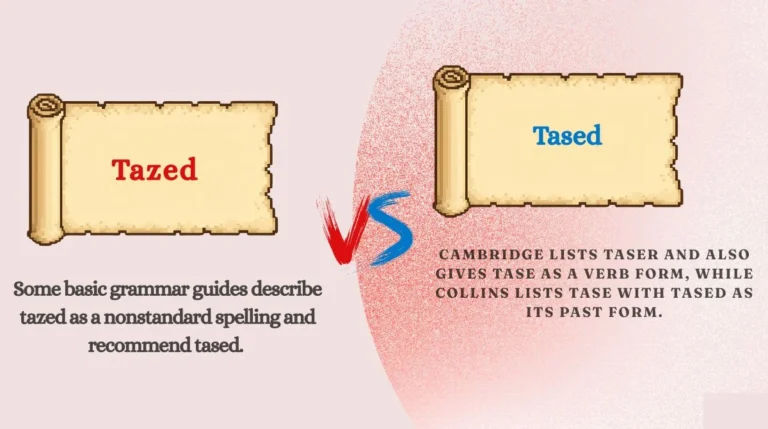
Some basic grammar guides describe tazed as a nonstandard spelling and recommend tased. However, the American Heritage Dictionary actually records tase also taze and gives tased and tazed as past forms.
So, unlike a simple spelling mistake such as writing taked instead of took, tazed has dictionary recognition as an alternative form.
Simple definition
Tazed = an alternative spelling of tased, meaning affected by or subjected to a Taser or similar stun device.
The form comes from taze, which is an alternative form of tase.
When do we use “tazed”?
You may encounter tazed in informal writing, online content, and some dictionaries or sources that recognize it as an alternative form.
For example:
- The man was tazed by police.
- The officer tazed the suspect.
- He said he had been tazed.
- Several people reported that the man was tazed.
The meaning is essentially the same as tased.
Grammar rule for “tazed”
The spelling tazed comes from the verb taze:
taze → tazed
This follows the normal pattern of adding -d to a verb ending in silent e.
Compare:
- amaze → amazed
- gaze → gazed
- graze → grazed
- taze → tazed
So, from a spelling point of view, tazed makes sense if the base verb is written as taze.
Example sentences with “tazed”
- The report said the man was tazed during the arrest.
- The officer tazed the suspect after a struggle.
- He claimed he had been tazed without warning.
- Witnesses said that the man was tazed outside the store.
- The security guard threatened to taze the intruder.
- The report described how the individual had been tazed.
- Several online comments used the word tazed instead of tased.
- The officer explained when he decided to taze the person.
Common learner confusion
The main problem is that learners often think tazed and tased must have completely different meanings. They do not.
In dictionaries that recognize taze as an alternative spelling of tase, the difference is mainly about the spelling of the base verb.
So:
tase → tased
and
taze → tazed
refer to the same basic action.
Difference Between Tased and Tazed
The biggest difference is not meaning. It is the spelling of the base verb.
| Feature | Tased | Tazed |
|---|---|---|
| Base verb | tase | taze |
| Basic meaning | Used a Taser | Used a Taser |
| Past tense | tased | tazed |
| Past participle | tased | tazed |
| Pronunciation | /teɪzd/ | /teɪzd/ |
| Dictionary status | Commonly listed | Listed as an alternative in American Heritage |
| Best choice for learners | Clear and widely used | Less common alternative |
| Main difference | Spelling | Spelling |
Cambridge lists taser and also gives tase as a verb form, while Collins lists tase with tased as its past form.
At the same time, American Heritage records taze as an alternative form and tazed among its past forms.
Usage difference
In practical writing, you will often see tased because it follows the form of the verb tase.
For example:
The officer tased the suspect.
This is straightforward:
tase → tased
If a writer chooses the alternative verb taze, the corresponding past form is:
The officer tazed the suspect.
So the two forms do not normally describe two different actions.
Grammar logic
English often creates past-tense forms by adding -d or -ed.
The important question is: What is the base verb?
With tase:
tase + d = tased
With taze:
taze + d = tazed
This makes the spelling easier to understand.
The real confusion happens because the two base verbs are pronounced alike. Both are pronounced like “tayz.” American Heritage records tase and taze as alternative forms, while Collins gives the pronunciation of tase as /teɪz/.
Sentence-structure difference
There is no important sentence-structure difference between the two forms.
You can use either one in an active sentence:
The officer tased the man.
The officer tazed the man.
You can also use either one in a passive sentence:
The man was tased.
The man was tazed.
The grammar remains the same.
Meaning comparison
In sources that recognize taze as an alternative to tase, there is no major meaning difference.
Both describe using an electrical control device on a person.
So you should not think:
“Tased means one type of shock, while tazed means another.”
That is not how the distinction works.
The difference is mainly a spelling choice connected with the base forms tase and taze.
Grammar Rules You Must Remember
Rule 1: Tased comes from “tase”
When you use tase as the base verb, its past form is tased.
Example:
The officer tased the suspect.
This is the form many learners will see in dictionaries and general English writing. Cambridge lists tase as a form related to taser, and Collins lists tased as its past form.
Rule 2: Tazed comes from “taze”
When a source or writer uses the alternative base verb taze, the past form can be tazed.
Example:
The officer tazed the suspect.
American Heritage explicitly records taze as an alternative to tase and includes tazed among its past forms.
Rule 3: The pronunciation can cause the spelling mistake
Both forms have a z sound.
That can make learners believe the word must contain the letter z.
Compare:
tased → sounds like “tayzd”
tazed → also sounds like “tayzd”
This is why listening alone may not help you decide which spelling a writer has used.
A similar problem appears in words such as:
- raised
- used
- closed
- pleased
The letter s can represent a z sound in English.
Rule 4: Choose the form that matches your base verb
Do not mix the two patterns.
Write:
tase → tased
or:
taze → tazed
Do not create forms such as tazed from tase while trying to follow the spelling of tase, or tased from taze without understanding the source form.
For ordinary learner writing, tase → tased is the simplest pattern to remember.
Common Mistakes Students Make
Mistake 1: Thinking “tazed” is always wrong
This is a common oversimplification.
You may find websites saying that tazed is simply incorrect. However, the American Heritage Dictionary records taze as an alternative spelling and tazed as a corresponding past form.
So it is better to say:
Tased is the common form based on tase, while tazed is an alternative form based on taze.
That is more accurate than calling every use of tazed a spelling error.
Mistake 2: Assuming tased and tazed have different meanings
They generally refer to the same action.
❌ Tased means a small shock, but tazed means a stronger shock.
That is not a standard grammar distinction.
✅ The main difference is the spelling of the base verb.
Mistake 3: Changing “s” to “z” because of pronunciation
Students often think:
“I hear a z sound, so I should write z.”
English does not work that way.
The word tased contains s, but it is pronounced with a voiced /z/ sound. Collins gives tase as /teɪz/.
Mistake 4: Confusing “Taser” with “tased”
These words have different grammatical jobs.
Taser is the device or the name used for it.
Tase is the verb.
Tased is the past form of the verb.
For example:
The officer carried a Taser.
The officer decided to tase the suspect.
The officer tased the suspect.
This simple three-step pattern makes the grammar much easier to understand.
Easy correction tip
Whenever you are unsure, first ask yourself:
What is my base verb?
If you mean tase, write tased.
If the source is deliberately using the alternative verb taze, then tazed follows naturally.
Easy Trick to Remember the Difference
Here is a simple memory trick:
TASE → TASED
Think:
“Keep the S.”
The base verb is tase, so the past form is:
tase + d = tased
Do not change the s just because the word sounds like it contains a z.
You can remember it with this little pattern:
Tase → Tased
Taze → Tazed
That is all you really need.
Another helpful trick is to connect the verb with its noun:
Taser → tase → tased
When you see the word tased, remember that it comes from tase.
Because tased is the form most directly connected with the commonly listed verb tase, it is a useful default for English learners. Cambridge and Collins both provide support for the tase/tased pattern.
Daily Life Examples
Here are some simple conversation-style examples showing how these words may appear in real English.
Example 1
A: Why was the police car outside the store?
B: There was an incident, and someone was tased.
Example 2
A: Did the report say what happened?
B: Yes. It said the officer tased the man after a struggle.
Example 3
A: I saw the word “tazed” online. Is that a different word?
B: Not necessarily. Tazed is used as an alternative spelling of tased.
Example 4
A: Which one should I use in my school assignment?
B: Tased is the simpler choice because it follows the verb tase.
Example 5
A: How do you spell it?
B: T-A-S-E-D: tased.
Example 6
A: Why does “tased” sound like it has a Z?
B: Because the s is pronounced like a z sound in this word.
Example 7
A: Is “tazed” completely meaningless?
B: No. Some dictionaries recognize taze as an alternative form of tase, with tazed as its past form.
Example 8
A: Was the person tased?
B: According to the report, yes.
Example 9
A: I always forget which spelling to use.
B: Remember: tase becomes tased.
Example 10
A: Is this sentence correct: “The officer tased the suspect”?
B: Yes. Tased is the past tense of tase.
Practice Section
Choose the form that best completes each sentence.
1. The officer ______ the man during the incident.
a) tazed
b) tased
2. He said he had been ______ by police.
a) tased
b) tasd
3. The base verb is ______.
a) tase
b) tased
4. Which spelling is an alternative form recorded by the American Heritage Dictionary?
a) taze
b) tasee
5. Which pair follows the regular spelling pattern correctly?
a) tase → tased
b) tase → tazed
Answers
1. b) tased
The sentence uses the past tense of tase.
2. a) tased
After had been, we use the past participle: had been tased.
3. a) tase
Tased is the past form, while tase is the base verb.
4. a) taze
American Heritage records taze as an alternative form of tase.
5. a) tase → tased
This is the most straightforward spelling pattern for learners.
FAQs
What is the difference between tased and tazed?
Both forms can refer to the same action. Tased comes from tase, while tazed comes from the alternative spelling taze. American Heritage recognizes both forms, although tased is the more straightforward form for learners.
Is “tased” the correct spelling?
Yes. Tased is the past tense and past participle of tase. Cambridge and Collins both support the tase/tased form.
Is “tazed” a real word?
It can be, depending on the dictionary and usage standard being followed. The American Heritage Dictionary lists taze as an alternative form of tase and gives tazed as a past form.
Can I use “tazed” in a sentence?
Yes, especially when following the taze → tazed spelling pattern. However, many learners will find tased easier and more consistent with dictionaries that list tase as the main verb form.
Why does “tased” sound like “tazed”?
The s in tased is pronounced with a voiced z sound. This happens in English in several words, so spelling cannot always be predicted directly from pronunciation. Collins gives tase the pronunciation /teɪz/.
What is the past tense of tase?
The past tense of tase is tased. The word can also be used as a past participle, as in “He was tased.” Collins lists the verb with tased as its past form.
Conclusion
The spelling question “tased or tazed?” looks simple, but there is a small detail that is worth knowing. Tased is the past tense and past participle of tase, and this is the clearest form for most English learners to remember. Cambridge and Collins both support the tase/tased pattern.
At the same time, tazed is not simply a meaningless spelling. The American Heritage Dictionary records taze as an alternative form of tase, with tazed as its past form.
The easiest memory trick is:
Tase → Tased
Taze → Tazed
So, when you are writing and want the simplest standard form to remember, tased is a practical choice. Most importantly, understand why the two forms exist instead of relying only on how the word sounds. A little practice with tase, tased, taze, and tazed will make this confusing spelling much easier to handle.

Evan Rellmont is a writer who turns thoughtful ideas into meaningful words, creating stories and reflections that connect, inspire, and leave a lasting impression.