
Have you ever written traveler and then wondered whether you should have written traveller instead? You are not alone.
Many English learners find these two words confusing because they look almost exactly the same, sound the same, and have the same basic meaning.
The only obvious difference is one letter: traveler has one l, while traveller has two.
The good news is that neither spelling is simply “wrong.” The difference mainly comes from British English and American English spelling conventions. Cambridge Dictionary lists traveler as the US spelling and traveller as the UK spelling.
Oxford also gives traveller as the British form and traveler as the American form.
Both words mean a person who travels or who often travels. For example, you can describe someone as a frequent traveler or a frequent traveller.
The meaning does not normally change because of the extra l.
The main thing to learn is which form belongs to the variety of English you are using. American English normally uses traveler, while British English normally uses traveller.
Canadian English also commonly uses the British-style traveller, according to Oxford.
Once you understand this pattern, the spelling becomes much easier to remember.
You will also see the same difference in related words such as traveling/travelling and traveled/travelled.
What Does “Traveler” Mean?
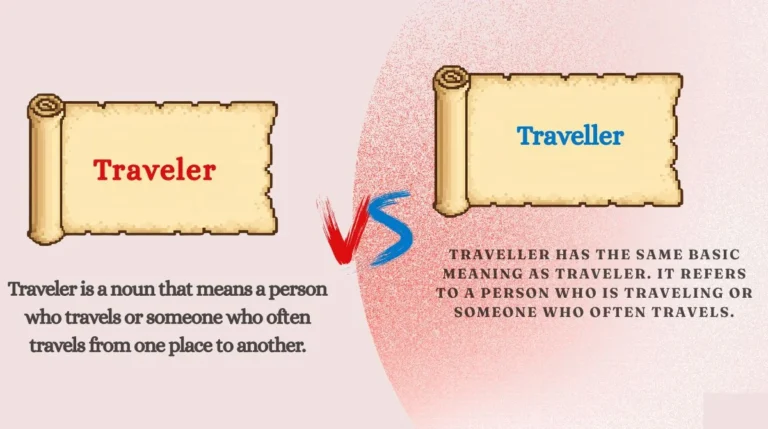
Traveler is a noun that means a person who travels or someone who often travels from one place to another.
This spelling is especially associated with American English. Cambridge Dictionary labels traveler as the US spelling of traveller, while Oxford’s American dictionary gives traveler as the standard American form.
You can use traveler when talking about people who travel for holidays, work, study, business, adventure, or other reasons.
For example:
- A traveler may spend several hours at an airport.
- A business traveler may visit several cities in one month.
- A frequent traveler often knows how to pack efficiently.
When Should You Use “Traveler”?
Use traveler when your writing follows American English spelling.
This is especially useful when writing for an American audience, studying American English, or following an American company’s style guide.
For instance, these are natural American English sentences:
- The traveler showed his passport at the airport.
- She is an experienced traveler who has visited many countries.
- Every traveler must check the departure time.
- The hotel offers free Wi-Fi to every traveler.
- He became a frequent traveler because of his job.
- The young traveler asked for directions.
- Business travelers often carry laptops.
- The airport was crowded with travelers.
The word can be used with many common adjectives, including frequent traveler, business traveler, international traveler, independent traveler, and seasoned traveler.
Grammar Rule for “Traveler”
Traveler is a countable noun. This means you can talk about one person or more than one person.
Singular:
She is a traveler.
Plural:
They are travelers.
To make the plural, simply add -s:
traveler → travelers
The apostrophe form may also appear when something belongs to a traveler:
The traveler’s passport was in his bag.
For more than one traveler, you can use:
The travelers’ bags were checked.
Common Confusion About “Traveler”
The most common problem is seeing traveller in British English and assuming it must be a spelling mistake.
It is not.
Traveler is correct in American English, while traveller is the usual British English form. The difference is a spelling convention rather than a difference in meaning.
So, remember:
American English → traveler
What Does “Traveller” Mean?
Traveller has the same basic meaning as traveler. It refers to a person who is traveling or someone who often travels.
The important difference is spelling.
Traveller is the standard British English spelling. Cambridge Dictionary identifies it as the UK spelling of traveler, and Oxford lists it as the British form.
For example:
- She is a frequent traveller.
- The hotel welcomes international travellers.
- Many business travellers prefer early flights.
When Should You Use “Traveller”?
Use traveller when following British English spelling.
This is common in the United Kingdom and in writing that follows British spelling conventions. The spelling is also commonly used in Canadian English; Oxford notes that Canadian English usually uses traveller.
Here are some examples:
- The traveller arrived at the station early.
- She is a very experienced traveller.
- The hotel is popular with foreign travellers.
- Every traveller should carry identification.
- The young traveller asked where the bus stopped.
- Business travellers often book flights in advance.
- The railway station was full of travellers.
- A careful traveller always checks the weather.
Grammar Rule for “Traveller”
Like traveler, traveller is a countable noun.
Singular:
He is a traveller.
Plural:
They are travellers.
The plural adds -s:
traveller → travellers
For possession:
The traveller’s suitcase was heavy.
For possession by several travellers:
The travellers’ luggage was checked.
The grammar does not change because of the extra l. Only the spelling convention changes.
A Special British-English Meaning
There is another use worth knowing. In British English, Traveller can also refer to a member of a traveling community, including groups such as Irish Travellers or Romani people. Oxford identifies this as a specific British English use.
This special use is different from simply calling someone a person who travels.
For example:
The community includes several Irish Travellers.
When the word is used in this cultural or community sense, the capital letter may be used depending on the context and the name of the group.
For everyday grammar questions, however, the most important point is still:
British English → traveller
Difference Between Traveler and Traveller
The difference between traveler and traveller is mainly about regional spelling.
Both words describe a person who travels. They have the same basic pronunciation and the same general grammatical role as nouns. Cambridge directly treats one as the US spelling of the other.
Comparison Table
| Feature | Traveler | Traveller |
|---|---|---|
| Main English variety | American English | British English |
| Meaning | A person who travels | A person who travels |
| Part of speech | Noun | Noun |
| Singular | traveler | traveller |
| Plural | travelers | travellers |
| Extra letter | One “l” | Two “l”s |
| Common adjective forms | frequent traveler, business traveler | frequent traveller, business traveller |
| Basic meaning difference | None | None |
| Canadian English | Less usual | Usually used |
| Standard British spelling | No | Yes |
| Standard American spelling | Yes | No |
The clearest distinction is therefore not meaning but spelling.
Usage Difference
Imagine two people writing the same sentence.
An American writer might say:
She is a frequent traveler.
A British writer might say:
She is a frequent traveller.
Both sentences communicate the same idea.
You should not change the meaning of the sentence based on the number of ls.
Grammar Logic
Both words are nouns. They can work as the subject or object of a sentence.
Subject:
The traveler arrived early.
The traveller arrived early.
Object:
I met a traveler at the station.
I met a traveller at the station.
After a linking verb:
She is a traveler.
She is a traveller.
The grammar stays the same.
Sentence Structure
There is no special sentence structure for one spelling and another structure for the other.
Both can be used with:
a/an + traveler/traveller
a traveler
a traveller
Both can be modified by adjectives:
a young traveler
an experienced traveller
a frequent traveler
a professional traveller
Both can be made plural:
travelers
travellers
The only difference is the spelling of the noun.
Meaning Comparison
For the ordinary meaning, there is no important meaning difference.
Cambridge defines both forms as referring to someone who travels. Oxford similarly defines traveller as a person who is traveling or who often travels.
So the easiest rule is:
Traveler and traveller mean the same thing, but they belong to different spelling traditions.
Grammar Rules You Must Remember
Rule 1: Use “Traveler” in American English
American English normally spells the word with one l:
traveler
Examples:
He is a frequent traveler.
Many American travelers prefer direct flights.
Cambridge labels traveler as the US spelling.
Rule 2: Use “Traveller” in British English
British English normally uses two ls:
traveller
Examples:
She is an experienced traveller.
The airport was crowded with travellers.
Cambridge and Oxford both identify traveller as the British form.
Rule 3: Keep Related Spellings Consistent
The difference does not stop at this one noun.
The verb travel also changes spelling in the same general British-American pattern.
American English:
- travel
- traveler
- traveled
- traveling
British English:
- travel
- traveller
- travelled
- travelling
Cambridge specifically lists travelling as the UK spelling of traveling.
For example:
American:
She is traveling tomorrow.
British:
She is travelling tomorrow.
Try to keep your spelling consistent throughout a piece of writing.
Rule 4: Choose One English Variety for Formal Writing
If you are writing an essay, website, application, school project, or professional document, it is helpful to follow one spelling system.
For American English, write:
traveler, traveled, traveling
For British English, write:
traveller, travelled, travelling
Mixing the two is not always a serious grammar error, but consistent spelling makes your writing look more polished.
Common Mistakes Students Make
Many learners make mistakes with these words because they assume that one of them must be incorrect.
Mistake 1: Thinking “Traveller” Is Always Wrong
A student may write:
❌ Traveller is wrong.
That is not correct.
The word traveller is the normal British spelling.
Correct:
✅ British English: traveller
Mistake 2: Thinking “Traveler” Is Always Wrong
Another learner may believe that the double l must always be used.
But American English normally uses:
✅ traveler
Cambridge explicitly gives this as the US form.
So do not automatically add a second l.
Mistake 3: Mixing Spellings in the Same Paragraph
Consider:
❌ The traveller was traveling across the country and later became a frequent traveler.
The reader can understand this sentence, but the spelling switches between British and American forms.
A more consistent British version is:
✅ The traveller was travelling across the country and later became a frequent traveller.
A consistent American version is:
✅ The traveler was traveling across the country and later became a frequent traveler.
Mistake 4: Changing the Word to “Travaller”
Some learners know there are two ls but put them in the wrong place.
❌ travaller
The correct British spelling is:
✅ traveller
The correct American spelling is:
✅ traveler
It is traveller, not travaller.
Mistake 5: Confusing Spelling With Pronunciation
The two forms are generally pronounced the same way in the relevant English varieties. Cambridge provides pronunciation information for both forms.
So adding the second l does not mean you should create a different pronunciation.
Think of the extra l as a spelling difference, not a new sound.
Easy Trick to Remember the Difference
Here is a simple memory trick:
America = One L
Britain = Two Ls
Think:
Traveler → American English
Traveller → British English
You can also connect the spelling to related words.
American English usually writes:
traveling
traveled
traveler
British English usually writes:
travelling
travelled
traveller
Notice the extra l in the British forms. Cambridge confirms the related travelling/traveling distinction.
A useful sentence to remember is:
American travelers travel with one L; British travellers travel with two.
It is not a grammar law for every word in English, but it gives you a quick way to remember this particular spelling pattern.
Another helpful tip is to think about your audience.
Writing for an American school or American website?
Use traveler.
Writing for a British school, British publication, or British audience?
Use traveller.
The most important thing is not to worry that one form is “bad English.” Both are established spellings in standard English varieties.
Daily Life Examples
The best way to remember a confusing word is to see it in normal conversation.
Example 1: At the Airport
A: Are you a frequent traveler?
B: Yes. I travel for work almost every month.
In British English, traveller would normally be used instead.
Example 2: Talking About a Friend
A: Your brother has visited many countries.
B: Yes, he is a very experienced traveler.
British version:
He is a very experienced traveller.
Example 3: At a Hotel
Receptionist: Are you checking in?
Guest: Yes. I am a traveler from Chicago.
Example 4: Discussing Business
A: Does your job require much travel?
B: Yes, I am a business traveler.
British English:
Yes, I am a business traveller.
Example 5: Asking for Advice
A: Is this hotel good for international travelers?
B: Yes. It has an airport shuttle and multilingual staff.
Example 6: Talking About Holidays
A: What kind of traveller are you?
B: I like quiet places and small towns.
This spelling fits naturally in British English.
Example 7: Talking About Experience
She is a seasoned traveller, so she knows how to pack light.
Here, seasoned traveller means a person with plenty of travel experience.
Example 8: At a Railway Station
The station was full of travellers waiting for the morning train.
For American English:
The station was full of travelers waiting for the morning train.
Example 9: Giving General Advice
Every traveler should keep important documents in a safe place.
The British version is:
Every traveller should keep important documents in a safe place.
Example 10: Talking About Future Travel
A: Are you traveling next month?
B: Yes. I am becoming quite the traveler these days.
In British spelling:
I am becoming quite the traveller these days.
These examples show why context matters more than the meaning of the word. The sentence works with either spelling; you simply choose the form that matches your English variety.
Practice Section
Choose the correct word for the English variety mentioned in each sentence.
1. American English
She is a frequent ______ who travels for work.
A. traveler
B. traveller
2. British English
The hotel welcomes international ______ throughout the year.
A. travelers
B. travellers
3. American English
Many business ______ prefer morning flights.
A. travelers
B. travellers
4. British English
A careful ______ always checks the train schedule.
A. traveler
B. traveller
5. General meaning
Which statement is correct?
A. Traveler and traveller have different meanings.
B. Traveler and traveller normally have the same meaning but different regional spellings.
Answers
1. A — traveler
American English normally uses traveler.
2. B — travellers
British English normally uses travellers.
3. A — travelers
The American spelling has one l.
4. B — traveller
The British spelling has two ls.
5. B
The ordinary meaning is the same. The main difference is the spelling tradition.
FAQs
What is the difference between traveler and traveller?
The main difference is spelling and regional English usage. Traveler is the standard American English spelling, while traveller is the standard British English spelling. Both normally mean a person who travels.
Can we use traveler in British English?
You may see traveler in British contexts, especially when quoting, referring to American usage, or following an American style. However, traveller is the usual British spelling. For British-style writing, use traveller for consistency.
Is traveller formal or informal?
Traveller is neither simply formal nor informal. It is the normal British spelling of the noun. It can appear in everyday speech, newspapers, books, business writing, and formal documents.
Is traveler the American spelling?
Yes. Traveler is the standard American English spelling. Cambridge labels it as the US spelling of traveller, and Oxford’s American dictionary gives traveler as the American form.
Is traveller the Canadian spelling?
Canadian English often uses traveller. Oxford specifically notes that Canadian English usually uses the spelling traveller. Canadian spelling can contain both British and American influences, so individual style guides may differ.
Are traveler and traveller pronounced differently?
The spelling is different, but the words have essentially the same pronunciation in ordinary use. Cambridge provides pronunciation entries for traveler and traveller showing the forms used in American and British pronunciation systems.
Conclusion
Traveler vs traveller is a spelling difference that confuses many English learners, but the rule is quite simple once you connect each form with its regional English variety.
Use traveler in American English. Use traveller in British English. The two words normally have the same meaning: a person who travels or someone who often travels. Cambridge and Oxford both recognize these as regional spelling forms rather than two completely different words.
You can also remember the related pattern: American English commonly uses traveling and traveled, while British English commonly uses travelling and travelled.
The key is consistency. Choose the spelling that matches your audience and keep the same English variety throughout your writing.
Once you remember one L for American English and two Ls for British English, this common spelling problem becomes much easier.
Keep practicing these small differences. They may look minor, but knowing them can make your English writing clearer and more confident.

Evan Rellmont is a writer who turns thoughtful ideas into meaningful words, creating stories and reflections that connect, inspire, and leave a lasting impression.