
Has or have is one of those small grammar points that can cause big problems for English learners.
Both words come from the verb “to have,” and both can talk about ownership, relationships, experiences, actions, and conditions.
The confusing part is knowing which one belongs with a particular subject.
For example, we say “She has a car,” but “They have a car.” We also say “He has finished his work,” while “They have finished their work.” The meaning can be very similar, but the grammar changes because the subject changes.
This difference is important in everyday English. You will hear and use has and have in conversations, emails, school writing, questions, and almost every level of English.
A small mistake can make a sentence sound unnatural or incorrect.
The good news is that the basic rule is quite simple. Has is mainly used with he, she, it, and singular nouns. Have is mainly used with I, you, we, they, and plural nouns.
Once you understand the subject and how English verbs agree with it, choosing between these two words becomes much easier.
You will also learn how has and have work in questions, negative sentences, the present perfect tense, and common expressions.
What Does “Has” Mean?
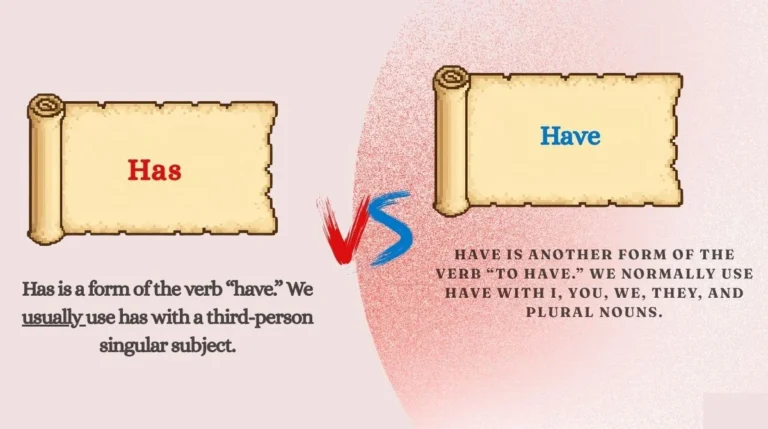
Has is a form of the verb “have.” We usually use has with a third-person singular subject.
That means we commonly use has with:
- He
- She
- It
- A singular person or thing, such as Ali, my sister, the dog, the teacher, the company
The word has can show possession. It can also talk about relationships, conditions, features, experiences, and completed actions when used as part of the present perfect tense.
Simple meaning of “has”
In many sentences, has means that someone or something possesses, owns, contains, or experiences something.
For example:
She has a new phone.
This means the phone belongs to her.
The house has three bedrooms.
This means the house contains three bedrooms.
However, has does not always mean ownership. Look at this sentence:
He has a cold.
Here, has describes a health condition.
It can also be part of another verb form:
She has finished her homework.
Here, has is helping to form the present perfect tense.
When should you use “has”?
Use has when the subject is singular and third person.
The easiest pattern is:
He + has
She + has
It + has
Singular noun + has
Examples:
- He has a beautiful house.
- She has two brothers.
- It has a broken window.
- My father has a busy job.
- Sarah has a new laptop.
- The cat has blue eyes.
- The school has a large library.
- My teacher has explained the rule.
Notice how the subjects are singular. That is the key point.
“Has” with singular nouns
A common mistake is to focus only on pronouns such as he and she. But singular nouns also take has.
Compare:
The boy has a bicycle.
The boys have bicycles.
The first sentence has a singular subject, so we use has. The second has a plural subject, so we use have.
Another example:
My mother has a car.
But:
My parents have a car.
The subject decides the verb.
“Has” in the present perfect tense
Has is also used as a helping verb with he, she, it, and singular nouns in the present perfect tense.
Examples:
He has finished his lunch.
She has gone to school.
The baby has fallen asleep.
John has completed the project.
In these sentences, has is followed by the past participle of another verb, such as finished, gone, fallen, or completed.
This is different from ordinary possession.
Compare:
She has a car.
Here, has is the main verb.
She has bought a car.
Here, has is a helping verb, and bought is the main verb in its past participle form.
Common confusion with “has”
Many students know that he and she use has, but they forget that questions and negative sentences often use does instead.
For example:
Incorrect: Does she has a car?
Correct: Does she have a car?
Why? Because after does, we use the base form have, not has.
The same thing happens in negative sentences:
Incorrect: She doesn’t has a car.
Correct: She doesn’t have a car.
This is one of the most important details to remember.
What Does “Have” Mean?
Have is another form of the verb “to have.” We normally use have with I, you, we, they, and plural nouns.
The basic pattern is:
I + have
You + have
We + have
They + have
Plural noun + have
Like has, the word have can show ownership, relationships, conditions, experiences, and actions.
Simple meaning of “have”
In a sentence such as:
I have a new bag.
“Have” shows possession.
But it can also describe other things:
We have a meeting at ten.
They have two children.
You have a good idea.
I have a headache.
In each case, the meaning depends on the context.
When should you use “have”?
Use have with I, you, we, they, and plural subjects.
Examples:
- I have a lot of homework.
- You have a beautiful smile.
- We have three dogs.
- They have a new teacher.
- My friends have tickets.
- The students have an exam today.
- My parents have a small business.
- I have finished my work.
The subject is what tells you which form to choose.
“Have” with plural nouns
Plural nouns usually take have.
For example:
The students have books.
The children have toys.
My brothers have jobs.
The houses have large gardens.
A useful comparison is:
The child has a toy.
The children have toys.
The noun changes from singular to plural, and the verb changes from has to have.
“Have” with “I” and “you”
Two subjects deserve special attention because they do not follow the third-person singular rule.
We say:
I have a question.
Not:
I has a question.
We also say:
You have a problem.
Not:
You has a problem.
This remains true even when you refers to one person.
For example:
You have a nice car.
Even though “you” may mean only one person, the correct form is still have.
“Have” in the present perfect tense
Just like has, have can be used as a helping verb in the present perfect tense.
Examples:
I have finished my homework.
We have seen that movie.
They have visited London.
You have done a great job.
Again, the subject decides whether we use has or have.
Compare:
She has finished.
They have finished.
The action is similar, but the subject changes the helping verb.
Difference Between Has and Have
The biggest difference between has and have is not their basic meaning. Both come from the same verb and can express many of the same ideas.
The main difference is the subject they agree with.
Has vs Have comparison table
| Point | Has | Have |
|---|---|---|
| Basic verb | Have | Have |
| Used with | He, she, it | I, you, we, they |
| Singular noun | Yes | No |
| Plural noun | No | Yes |
| Shows possession | Yes | Yes |
| Used in present perfect | Yes | Yes |
| Used after “does” | No | Yes |
| Used after “do” | No | Yes |
Usage difference
Consider these examples:
He has a bicycle.
They have bicycles.
The meaning is related, but he is singular and takes has, while they is plural and takes have.
Now look at singular and plural nouns:
The student has a book.
The students have books.
Again, the subject controls the verb.
Grammar logic
English verbs often change depending on the subject. This is called subject-verb agreement.
With the verb have, the most important present-tense pattern is:
I have
You have
He has
She has
It has
We have
They have
You can think of has as the special form used mainly for third-person singular subjects.
Everything else in this basic pattern uses have.
Sentence structure difference
The sentence structure can be very similar:
She has a new dress.
They have new dresses.
The only major change is the subject and the form of the verb.
However, structure becomes especially important in questions.
We say:
Does he have a car?
Not:
Does he has a car?
But with “they”:
Do they have a car?
The same base form, have, appears after do and does.
Meaning comparison
In basic sentences, has and have can carry the same general meaning.
She has a headache.
I have a headache.
Both sentences describe a headache. The only difference is the subject.
Another example:
The company has ten employees.
The companies have ten employees each.
The meaning is still related to possession or having something, but the grammatical form changes.
So the main question is not usually, “What does has mean compared with have?” Instead, ask:
“Who or what is doing the having?”
Then choose the correct form.
Grammar Rules You Must Remember
Rule 1: Use “has” with he, she, and it
This is the first rule most learners should memorize.
Examples:
He has a new job.
She has a blue dress.
It has four legs.
You can also use has with names and singular nouns:
Ahmed has a bicycle.
The car has a problem.
A quick test is to replace the noun with he, she, or it. If that works, has may be the correct choice.
Rule 2: Use “have” with I, you, we, and they
These four subjects normally take have.
Examples:
I have a question.
You have enough time.
We have a meeting.
They have a new house.
Remember that you always takes have in this structure, whether you are speaking to one person or several people.
Rule 3: Plural nouns usually take “have”
When the subject is plural, use have.
Examples:
The boys have new shoes.
My sisters have jobs.
The dogs have food.
The teachers have a meeting.
But do not be fooled by words that come after the subject.
For example:
The box of toys has a handle.
The subject is box, which is singular. “Of toys” does not change the subject.
So the correct sentence is:
The box of toys has a handle.
Rule 4: After “do” and “does,” use “have”
This rule solves many common mistakes.
In questions:
Do you have a pen?
Does she have a pen?
Do they have enough money?
Not:
Does she has a pen?
In negative sentences:
I don’t have a car.
He doesn’t have a car.
She doesn’t have time.
The reason is simple: do/does already carries the present-tense grammar, so the main verb stays in its base form: have.
This same idea works with many verbs:
Does he go?
Not Does he goes?
And:
Does she have…?
Not Does she has…?
Once you understand this pattern, many grammar questions become easier.
Common Mistakes Students Make
Many errors with has and have happen because learners memorize only one small rule. They may remember “he uses has” but forget what happens after does or in more complicated sentences.
Mistake 1: Using “has” with “I”
Incorrect:
I has a new phone.
Correct:
I have a new phone.
The subject I always takes have in this structure.
Mistake 2: Using “have” with “she”
Incorrect:
She have a beautiful voice.
Correct:
She has a beautiful voice.
Because she is third-person singular, the correct form is has.
Mistake 3: Using “has” after “does”
Incorrect:
Does he has a car?
Correct:
Does he have a car?
After does, use the base form have.
The same applies to negative sentences:
Incorrect:
He doesn’t has a car.
Correct:
He doesn’t have a car.
Mistake 4: Looking at the nearest noun
This causes trouble in longer sentences.
Incorrect:
The list of names have been updated.
Correct:
The list of names has been updated.
Why? The subject is list, not names.
A good correction tip is to identify the main subject before choosing the verb.
Mistake 5: Forgetting that “you” uses “have”
Some learners think a singular person should take has.
Incorrect:
You has a nice jacket.
Correct:
You have a nice jacket.
The pronoun you uses have, even when you are talking to one person.
Mistake 6: Confusing the main verb with the helping verb
Consider:
She has a car.
Here, has is the main verb.
But:
She has bought a car.
Here, has is helping another verb, bought.
Both are correct, but the grammar job is different.
Easy correction method
When you are unsure, take three steps:
First, find the subject.
Second, decide whether the subject is I/you/we/they, a plural noun, or he/she/it, a singular noun.
Third, check whether do or does is already in the sentence.
This simple habit prevents many mistakes.
Easy Trick to Remember the Difference
Here is a quick memory trick:
HAS = He, She, It
The word HAS goes with the three common third-person singular pronouns:
He → has
She → has
It → has
Then remember:
HAVE = I, You, We, They
So your basic pattern becomes:
I have
You have
He has
She has
It has
We have
They have
You can say this pattern aloud a few times. It is short, and it is easy to remember.
A second memory trick
Think of has as the “special singular” form.
Most subjects use have:
I, you, we, they → have
Only he, she, it and singular nouns usually switch to has.
Real-life logic
Imagine three people are standing in front of you.
You say:
I have a phone.
You speak to another person:
You have a phone.
Then you talk about your friend:
He has a phone.
The object does not change the rule. The subject does.
That is the easiest way to make the difference feel natural instead of trying to memorize dozens of separate examples.
Daily Life Examples
The best way to learn has and have is to see them in normal conversations.
Example 1: Talking about a family
A: Does your sister have a car?
B: Yes, she has a small car.
Notice the question uses have after does, but the answer uses has with she.
Example 2: Talking about work
A: Do you have a meeting today?
B: Yes, I have a meeting at two.
The subject is you, so the question uses have.
Example 3: Talking about a friend
A: Where is Daniel?
B: He has a class this afternoon.
“Daniel” is one person, so has is correct.
Example 4: Talking about children
A: Do your children have school today?
B: Yes, they have school until three.
“Children” is plural, so we use have.
Example 5: Talking about a problem
A: What’s wrong with your laptop?
B: It has a battery problem.
“It” is singular, so use has.
Example 6: Talking about experience
A: Have you ever visited Turkey?
B: Yes, I have visited Turkey twice.
Because the subject is I, the present perfect uses have.
Example 7: Talking about another person
A: Has Maria finished her homework?
B: Yes, she has finished it.
With Maria/she, use has in the present perfect.
Example 8: Talking about possessions
A: Do they have enough chairs?
B: Yes, they have enough chairs for everyone.
“Do” is already helping with the question, so the verb stays have.
Example 9: Talking about time
A: Do you have time for coffee?
B: Sorry, I don’t have much time today.
Again, have follows do/don’t.
Example 10: Talking about a building
A: Does the hotel have a swimming pool?
B: Yes, it has a large swimming pool.
The question uses have after does. The answer uses has because the subject is it.
These examples show an important pattern: the choice between has and have can change inside the same conversation depending on the subject and sentence structure.
Practice Section
Choose the correct option in each sentence.
1. She ___ a new computer.
A. have
B. has
2. They ___ two children.
A. have
B. has
3. Does he ___ a passport?
A. have
B. has
4. My brother ___ finished his homework.
A. have
B. has
5. We ___ enough food for everyone.
A. has
B. have
Answers
1. B — has
“She” is third-person singular.
2. A — have
“They” takes have.
3. A — have
After “does,” use the base form have.
4. B — has
“My brother” is singular.
5. B — have
“We” takes have.
A useful exercise is to make your own sentences with each subject: I, you, he, she, it, we, and they. Once you can use each one naturally, the difference becomes much easier.
FAQs About Has or Have
What is the difference between has and have?
Both has and have are forms of the verb to have. The main difference is the subject they are used with.
Use has with he, she, it, and singular nouns. Use have with I, you, we, they, and plural nouns.
Can we use “have” in questions?
Yes. In many present-tense questions, have is used after do or does.
Examples include “Do you have a car?” and “Does she have a brother?”
Even with he, she, or it, use have after does.
Why do we say “Does she have” instead of “Does she has”?
The word does already marks the present tense and third-person singular form. Therefore, the main verb returns to its base form.
So we say “Does she have a car?”, not “Does she has a car?”
Is “has” formal or informal?
Has is neither simply formal nor informal. It is a normal grammatical form of have and is used in both spoken and written English.
You will find it in everyday conversation, schoolwork, business writing, books, and formal documents.
Can “has” and “have” show possession?
Yes. Both can show that someone or something owns or possesses something.
For example, “She has a new bag” and “They have a new bag” both show possession. The correct form depends on the subject.
Which is correct: “He have” or “He has”?
The correct form is “He has.”
For example:
He has a new job.
However, after does, we say:
Does he have a new job?
That small change is important in English grammar.
Conclusion
Understanding has or have is much easier when you stop thinking of them as completely different words. They are both forms of the verb “to have,” and the main difference is the subject and the sentence structure.
Use has with he, she, it, and singular nouns. Use have with I, you, we, they, and plural nouns. One especially important rule is that after do or does, you use the base form have. That is why we say “Does she have a car?” rather than “Does she has a car?”
The best way to remember these rules is to practice them in simple sentences and everyday conversations. Try making a few examples about your family, work, school, friends, or daily routine. With regular practice, choosing between has and have will become natural.
Grammar becomes easier when you notice the pattern instead of memorizing every sentence. Keep practicing, and this small but important grammar difference will soon feel simple.

Evan Rellmont is a writer who turns thoughtful ideas into meaningful words, creating stories and reflections that connect, inspire, and leave a lasting impression.