
Unorganized or disorganized can both describe something that does not have good order or planning, so it is easy for English learners to wonder which word they should use.
The two adjectives are closely related, and in many everyday sentences they can be used in the same general way.
However, there is a small but useful difference in how they are normally used.
Disorganized is the more common choice when you are talking about a person, a plan, an event, a workplace, or a situation that is badly planned or lacks order.
Oxford lists unorganized as a less frequent alternative to disorganized for this meaning.
Unorganized, on the other hand, can have a more direct meaning: something has not been organized, arranged, or put into a system.
For example, we can talk about unorganized data. It also has special meanings in contexts such as workers who are not represented by a labor union.
That small difference matters because choosing the more natural word can make your English sound clearer and more fluent.
What Does “Unorganized” Mean?
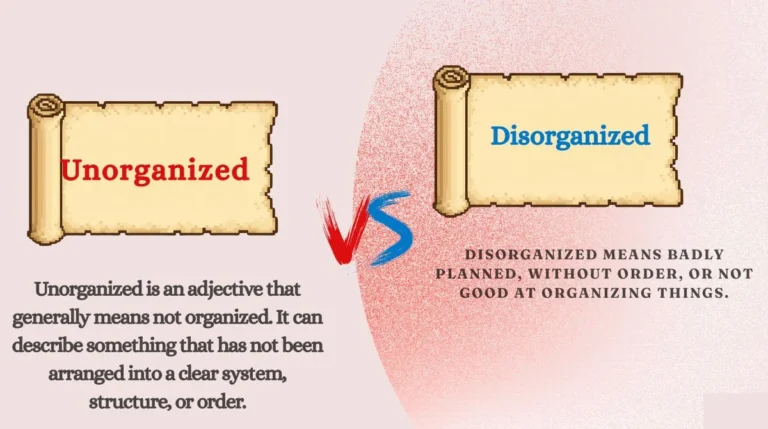
Unorganized is an adjective that generally means not organized. It can describe something that has not been arranged into a clear system, structure, or order.
For example:
The files are still unorganized.
This means the files have not been properly arranged.
Oxford gives several meanings for unorganized. It can mean “not having been organized,” as in unorganized data, and it can also describe something that is badly planned. Oxford also notes that disorganized is more frequent for the “badly planned” meaning.
When should you use “unorganized”?
Use unorganized when your main idea is that something has not been organized or is not arranged into a proper system.
It is especially useful for things such as:
- data
- records
- information
- materials
- groups
- notes
- files
- collections
For example:
The survey data is unorganized.
The idea here is that the data has not been put into a clear system.
You can also use unorganized to describe a person or situation, especially when you mean that planning or organization is weak. However, disorganized is often more natural in this situation.
Grammar rule for “unorganized”
Unorganized is an adjective. It can come before a noun or after a linking verb such as be, seem, look, or become.
Examples:
- We have unorganized files on the computer.
- The information is unorganized.
- Her notes were unorganized.
- The data remains unorganized.
- They found an unorganized collection of documents.
- The old records are completely unorganized.
- His ideas seemed unorganized during the presentation.
- The material was still unorganized when the teacher arrived.
Notice that the adjective can describe both a thing and, in some contexts, a person.
Common learner confusion with “unorganized”
A common mistake is to assume that un- automatically makes the exact opposite of an adjective in every situation.
English does use un- to create negative words, but word formation is not always as simple as adding a prefix.
For example, unorganized is a real and correct word. It does not mean that the word is wrong simply because disorganized is more common in some situations.
The important point is context.
When something has not been arranged or organized, unorganized can be a very direct choice.
For example:
The spreadsheet contains unorganized data.
But when you are talking about a person who constantly forgets appointments and loses papers, disorganized sounds more natural:
My manager is very disorganized.
What Does “Disorganized” Mean?
Disorganized means badly planned, without order, or not good at organizing things.
Cambridge gives two main everyday meanings: something can be badly planned and without order, or a person can be poor at planning and organizing.
This word is extremely common in everyday English.
You can use disorganized to describe:
- a person
- a room
- an office
- a business
- a meeting
- an event
- a project
- a schedule
- a system
- a situation
When should you use “disorganized”?
Use disorganized when you want to emphasize lack of order, poor planning, confusion, or mess.
For example:
She is very disorganized.
This usually means she has trouble keeping things in order, planning her work, or managing tasks.
You might also say:
The meeting was disorganized.
This suggests that the meeting was not planned or managed properly.
Oxford lists disorganized as the more frequent word for the meaning “badly planned; not able to plan or organize well.”
Grammar rule for “disorganized”
Like unorganized, disorganized is an adjective.
It can appear before a noun:
a disorganized office
Or after a linking verb:
The office is disorganized.
Examples:
- She is very disorganized.
- The meeting was disorganized.
- His desk looks disorganized.
- We had a disorganized schedule.
- The event became disorganized.
- Their records are badly disorganized.
- He seems disorganized today.
- The whole project was disorganized from the beginning.
Why is “disorganized” so common?
Part of the reason is simple everyday usage. English speakers often use this word when they want to describe a person or situation that lacks a clear system.
Think about a student who has homework papers everywhere, forgets deadlines, and cannot find a notebook. A natural sentence would be:
Tom is disorganized.
You could say Tom is unorganized, and the meaning would usually be understood, but disorganized is the more usual choice for this personal quality. Oxford specifically marks unorganized as less frequent for this sense.
Difference Between Unorganized and Disorganized
The biggest point to remember is that both words can mean a lack of organization, but they do not always sound equally natural in every sentence.
A useful way to think about them is this:
Unorganized often focuses on the fact that something has not been organized.
Disorganized often focuses on the condition of being poorly organized, messy, confusing, or badly planned.
Oxford confirms the overlap while identifying disorganized as the more frequent word for the “badly planned” sense.
Comparison Table
| Feature | Unorganized | Disorganized |
|---|---|---|
| Part of speech | Adjective | Adjective |
| Basic meaning | Not organized | Poorly organized or without order |
| Common with data/files | Yes | Yes |
| Common for people | Possible | Very common |
| Common for poorly planned events | Possible | Very common |
| Suggests mess/confusion | Sometimes | Often |
| Frequency in everyday “badly planned” sense | Less frequent | More frequent |
| Special meaning | Can describe workers without a union | No such general meaning |
| British spelling | unorganised | disorganised |
The final distinction in the table is important. Oxford notes that unorganized can describe workers who do not have a trade union or similar organization representing them.
Usage difference
Consider these two sentences:
The data is unorganized.
This sounds like the data has not been arranged into a useful structure.
Now compare:
The department is disorganized.
This suggests more than simple absence of organization. It may mean there is confusion, poor planning, unclear procedures, or a general lack of order.
Grammar logic
Both words are adjectives formed from organize.
- organize → organized
- organize → unorganized
- organize → disorganized
But their prefixes create slightly different ideas.
Un- often gives the basic meaning of “not.”
So:
unorganized = not organized
Dis- often carries the idea of separation, reversal, or lack of proper order.
So:
disorganized = not properly organized
This is a helpful learning idea rather than a rule that works perfectly for every English word. English prefixes can have different meanings in different words.
Sentence-structure difference
There is no major grammatical difference between the two.
Both can be used:
Before a noun:
unorganized notes
disorganized notes
After “be”:
The notes are unorganized.
The notes are disorganized.
After other linking verbs:
The files seem unorganized.
The files seem disorganized.
The main difference is not grammar. It is meaning and natural usage.
Meaning comparison
Compare:
The papers are unorganized.
This can simply mean the papers have not been sorted or arranged.
The papers are disorganized.
This more strongly suggests that the papers are scattered, confusing, or badly arranged.
There is a lot of overlap, but disorganized often paints a stronger picture of disorder.
Grammar Rules You Must Remember
Rule 1: Both words are adjectives
Both unorganized and disorganized describe nouns or people.
Examples:
We found some unorganized documents.
We found some disorganized documents.
The words do not act as verbs.
You would not say:
She disorganized her homework.
That is a different use of disorganize as a verb.
Rule 2: Use “disorganized” freely for people
When someone is poor at planning, managing tasks, or keeping things in order, disorganized is usually the natural choice.
Example:
Sarah is very disorganized.
This is exactly the kind of personal-quality meaning Oxford and Cambridge describe.
You can encounter unorganized too, but it is less frequent in this sense.
Rule 3: “Unorganized” can mean simply “not organized”
When the main point is that something has not yet been arranged into a system, unorganized can work very well.
Example:
The research data is still unorganized.
The sentence does not necessarily suggest that anyone has created a confusing mess. It can simply mean the information has not been sorted or structured yet.
Oxford specifically gives unorganized data as an example of this meaning.
Rule 4: Choose based on meaning, not spelling
Do not choose a word just because one prefix looks more logical.
Ask yourself:
Am I saying that something has not been organized?
Use unorganized when that is the main idea.
Am I describing poor planning, disorder, or a person who lacks organization?
Use disorganized in most everyday cases.
Example:
The files are unorganized.
The files have not been arranged.
The office is disorganized.
The office lacks order and probably has a messy or inefficient system.
Common Mistakes Students Make
Many mistakes happen because learners think the two words are completely interchangeable. They are close, but English speakers have preferences about which word sounds natural in a particular context.
Mistake 1: Using “unorganized” for every situation
A student may say:
My teacher is very unorganized.
This sentence is understandable, but disorganized is usually more natural when describing a person’s poor planning or organization.
Better:
My teacher is very disorganized.
Mistake 2: Thinking “unorganized” is incorrect
Some learners see disorganized more often and assume unorganized must be wrong.
That is not true.
Unorganized is a real English adjective. Oxford lists it and gives multiple meanings for it.
For example:
The data is unorganized.
This is perfectly acceptable.
Mistake 3: Thinking the two words have completely different meanings
The other extreme is also a problem.
Some learners try to create a huge difference between the words, as if they could never be used in similar sentences.
That is not accurate either.
Dictionaries show clear overlap. Oxford directly says unorganized can have the meaning of disorganized, while Cambridge defines disorganized in terms of poor planning and lack of order.
Wrong and Correct Examples
Wrong:
The whole event was unorganized, and nobody knew what to do.
More natural:
The whole event was disorganized, and nobody knew what to do.
Why? The sentence focuses on poor planning and confusion.
Wrong idea:
“Unorganized” is never correct.
Correct:
The database contains unorganized data.
Here, the focus is on data that has not been arranged into a system.
Less natural:
He is an unorganized person.
More natural:
He is a disorganized person.
Again, the second sentence is more common for a personal habit or quality.
Easy correction tip
When talking about a person, event, schedule, meeting, or workplace, your first choice will often be disorganized.
When talking about data, records, information, or something that has simply not been arranged, unorganized may fit especially well.
This is not an absolute rule, but it is a helpful guide for learners.
Easy Trick to Remember the Difference
Here is a simple memory trick:
“Unorganized” = Not organized
Think:
UN = NOT
So:
unorganized = not organized
Imagine a box of papers that nobody has sorted yet. The papers are simply unorganized.
“Disorganized” = Poorly organized
Think:
DIS = disorder
This is not a perfect prefix rule for all English words, but it is a useful memory aid here.
Imagine an office where papers are everywhere, meetings are badly planned, people do not know their tasks, and nobody can find important documents.
That office is disorganized.
So remember:
Unorganized → not arranged
Disorganized → badly arranged or poorly planned
There is still some overlap, so do not worry if you see unorganized used where you expected disorganized. Both words are recognized in English. Oxford specifically notes their overlap and identifies disorganized as the more frequent choice for the “badly planned” meaning.
Daily Life Examples
Here are natural examples you may hear or use in everyday English.
1. Talking about a student
A: Why can’t Ali find his homework?
B: His desk is so disorganized.
The speaker means the desk is messy or lacks order.
2. Talking about computer data
A: Why is this spreadsheet difficult to use?
B: The data is completely unorganized.
Here, the information has not been arranged properly.
3. Talking about a meeting
A: How was the staff meeting?
B: It was really disorganized. Nobody knew when to speak.
The problem is poor planning and a lack of order.
4. Talking about notes
My class notes are unorganized, so I need to sort them before the exam.
The notes have not been arranged clearly.
5. Talking about a person
My brother is very disorganized. He always forgets where he puts his keys.
The word describes his habit of failing to keep things in order.
6. Talking about an office
Their office looks disorganized, but they know where everything is.
This shows that disorganized often describes the appearance or structure of a place.
7. Talking about a project
The first part of the project was disorganized, so we had to make a new plan.
The emphasis is on poor planning.
8. Talking about information
We have a lot of unorganized information in these files.
The information has not been sorted into a clear system.
9. Talking about a schedule
My schedule is so disorganized this week.
The speaker means the schedule is difficult to manage or poorly arranged.
10. Talking about research
The researchers collected a large amount of unorganized data.
The information exists, but it still needs to be sorted or structured.
These examples show why context matters more than simply memorizing one word.
Practice Section
Choose the more natural answer in each sentence.
1. My manager is very ________. She often forgets meetings.
A. unorganized
B. disorganized
2. The computer contains a lot of ________ data.
A. unorganized
B. disorganized
3. The wedding ceremony was completely ________. Nobody knew what was happening.
A. unorganized
B. disorganized
4. I need to sort these ________ papers before I start studying.
A. unorganized
B. disorganized
5. His room is always ________, with clothes and books everywhere.
A. unorganized
B. disorganized
Answers
1. B — disorganized
This describes a person’s poor organization.
2. A — unorganized
The focus is on data that has not been arranged.
3. B — disorganized
The sentence emphasizes poor planning and confusion.
4. A — unorganized
The papers have not been sorted or arranged.
5. B — disorganized
The room is messy and lacks order.
Remember, these answers show the more natural choice, not that the other word is always impossible. Context can allow some overlap.
FAQs
What is the difference between unorganized and disorganized?
Both words can describe a lack of organization. Unorganized often means simply “not organized” or “not arranged,” while disorganized commonly suggests poor planning, disorder, or confusion.
Oxford notes that unorganized can also mean disorganized, but disorganized is more frequent for the “badly planned” meaning.
Is “unorganized” a correct English word?
Yes. Unorganized is a correct English adjective.
It can mean not having been organized, and Oxford gives unorganized data as an example. It can also be used in other contexts, including workers who are not represented by a labor union.
Is “disorganized” more common than “unorganized”?
For the everyday meaning of being badly planned or not good at organizing, disorganized is generally more frequent.
Oxford explicitly describes unorganized as “also more frequent disorganized” for that sense and lists disorganized as the main entry for it.
Can I say “I am unorganized”?
Yes, people can understand this sentence, and the word is not grammatically wrong.
However, when you mean that you are bad at planning, lose things, forget tasks, or have trouble keeping your life in order, “I am disorganized” is usually the more natural everyday choice.
Can I use “disorganized” for data and files?
Yes. Disorganized can describe data, files, records, papers, and other things that lack order.
However, unorganized can be especially direct when you simply mean that the material has not yet been organized into a system. Both forms can therefore appear with information and records.
Is “disorganized” formal or informal?
Disorganized is a normal, standard English adjective used in both everyday and formal contexts.
You can use it in conversation, school writing, workplace communication, and many other settings. The exact word you choose should depend on the meaning and context.
Conclusion
The difference between unorganized and disorganized is small, but understanding it can make your English sound more natural.
Both adjectives are correct and can overlap in meaning. Unorganized usually gives the simple idea of something being not organized or not yet arranged. It is especially useful with things such as data, files, notes, and information. Disorganized is often the more natural choice when you are describing poor planning, confusion, disorder, or a person who has difficulty keeping things organized. Oxford and Cambridge both support this distinction, with Oxford noting that disorganized is the more frequent choice for the “badly planned” meaning.
A simple memory trick is:
Unorganized = not organized.
Disorganized = poorly organized.
The best way to remember the difference is to notice how native speakers use these words in real situations. Try making a few sentences of your own about your room, schedule, notes, files, or daily routine. With a little practice, choosing the right word will become much easier.

Evan Rellmont is a writer who turns thoughtful ideas into meaningful words, creating stories and reflections that connect, inspire, and leave a lasting impression.