
Have you ever written vender when you meant vendor, or stopped to wonder whether both spellings are correct? You are not alone.
These two words look almost exactly the same, and they have the same pronunciation in normal English. That makes the spelling difference easy to miss, especially for beginners and non-native English speakers.
The good news is that the meaning is also very close. Vendor is the usual spelling used in modern English for a person or business that sells something. Vender is also a real English word, but it is much less common.
Dictionary.com lists vender as an American noun meaning “vendor,” while major learner dictionaries give vendor as the standard entry for a person or company that sells goods or products.
This small spelling difference matters because you want your writing to look natural and familiar to readers.
In everyday writing, business communication, school work, websites, and professional documents, vendor is the spelling you will see most often.
By the end of this guide, you will know what both forms mean, when each can be used, how their grammar works, why vendor is normally the safer choice, and how to remember the difference without memorizing a difficult rule.
What Does “Vender” Mean?
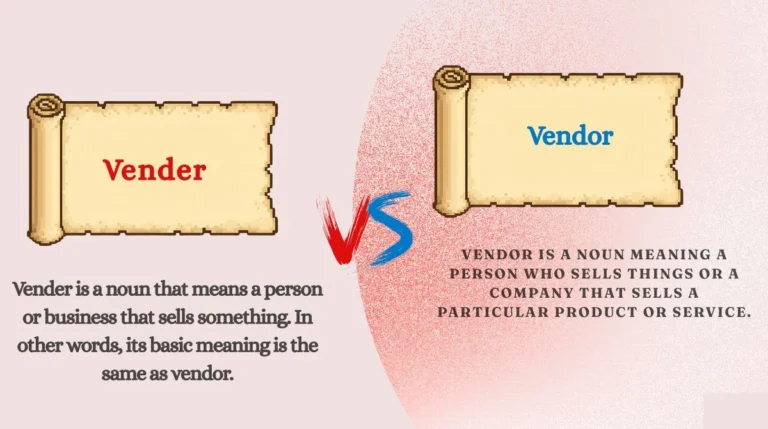
Vender is a noun that means a person or business that sells something. In other words, its basic meaning is the same as vendor.
Dictionary.com identifies vender as an American word and defines it simply as another form of vendor. Its listed history goes back to the late 16th century, formed from vend + -er.
So, grammatically, vender is a countable noun when you use it to talk about a person or business.
For example:
- a vender
- the vender
- one vender
- several venders
You can use it before a noun as a modifier too:
- a street vender
- a food vender
- a local vender
- a software vender
However, there is an important practical point here: although the spelling vender is legitimate, it is not the spelling most readers expect. That is why many writers choose vendor instead.
When Should You Use “Vender”?
You can use vender when you mean someone who sells goods or services. It is especially recognized in American English as a variant spelling.
For instance, these sentences are grammatically understandable:
- The fruit vender stood near the bus station.
- We spoke to a local vender about the price.
- The food vender sold fresh sandwiches.
- A street vender offered us handmade bracelets.
- The company became a major software vender.
- The market has several small venders.
- We contacted the vender about the damaged product.
- The vender asked us to pay in cash.
None of these sentences changes meaning simply because vender is used instead of vendor.
Still, many readers may consider vendor the more familiar spelling. That is one reason learners often see vender marked as unusual or may wonder whether it is a spelling mistake.
Grammar Rule for “Vender”
The word vender is normally used as a noun.
It refers to someone or something that sells. Like other countable nouns, it can take an article or plural ending:
- a vender
- the vender
- two venders
- many venders
For example:
We found a vender outside the stadium.
Here, vender refers to one person selling something.
The plural is formed in the normal way:
There were many venders at the fair.
Even though this plural form is grammatically possible, you are much more likely to see vendors in modern writing.
Common Learner Confusion About “Vender”
The biggest problem is not really grammar. It is spelling and frequency.
English has many pairs where one form is much more common than another. Vender belongs to that group. It is a genuine word, but vendor is the form most learners should recognize and normally use.
Another reason for confusion is the verb vend, which means to sell. The nouns vendor and vender are both related to this idea. Oxford lists vend as a formal verb meaning “to sell something.”
So if you see:
The machine vends snacks.
the related noun can be vendor or the less common vender.
What Does “Vendor” Mean?
Vendor is a noun meaning a person who sells things or a company that sells a particular product or service.
This is the spelling you will encounter much more often in modern English.
Oxford Learner’s Dictionary gives several common meanings. A vendor can be a person who sells things such as food or newspapers, often outside on the street. It can also mean a company that sells a particular product, such as software. In legal contexts, it can refer to a person selling a house or other property.
That wider business meaning makes vendor especially common in professional English.
When Should You Use “Vendor”?
Use vendor when talking about a person, company, or organization that sells or supplies something.
Consider these examples:
- The street vendor sells fresh fruit.
- We bought lunch from a food vendor.
- The company is looking for a new software vendor.
- Please contact the vendor for more information.
- Several vendors are selling clothes at the market.
- The vendor delivered the equipment on time.
- Our office works with local vendors.
- The property vendor signed the agreement.
Notice that the meaning can change slightly depending on context.
A street vendor may sell food, flowers, clothes, or small goods.
A software vendor is usually a business that sells software.
A property vendor is someone selling property in a legal or real-estate context.
Grammar Rule for “Vendor”
Vendor is usually a countable noun.
Singular:
The vendor is waiting outside.
Plural:
The vendors are waiting outside.
With an article:
We met a vendor at the market.
With a determiner:
The vendor gave us a receipt.
You can also use it as part of a noun phrase:
- food vendor
- street vendor
- market vendor
- online vendor
- software vendor
- technology vendor
- retail vendor
- third-party vendor
The plural form is vendors, which is extremely common in business and everyday English.
Common Learner Confusion About “Vendor”
Some learners think vendor only means a person selling things in the street.
That is not correct.
The word can certainly describe a street seller. Oxford gives this as one of its main meanings. But it is also used for companies that sell specialized products or services.
For example:
Microsoft is a software vendor.
The word vendor here does not mean a person standing on a sidewalk. It describes a company that sells software.
Another common confusion is between vendor and seller. These words overlap, but they are not always used in exactly the same way. A seller is simply a person who sells something, while vendor is often used for a person or business that supplies goods, products, or services, especially in commercial settings. Oxford lists seller as someone who sells something and compares it with vendor.
Difference Between Vender and Vendor
The central point is very simple:
Vender and vendor have the same basic meaning, but vendor is the much more common spelling.
| Feature | Vender | Vendor |
|---|---|---|
| Part of speech | Noun | Noun |
| Basic meaning | A person or business that sells | A person or business that sells |
| Pronunciation | Usually the same | Usually the same |
| Spelling | Less common | Standard/common modern spelling |
| Usage | Mainly recognized as a variant | Common in everyday and professional English |
| Plural | venders | vendors |
| Business writing | Possible, but uncommon | Very common |
| Beginner-friendly choice | Less familiar | Recommended for normal writing |
Dictionary.com directly defines vender as vendor, while Oxford’s main learner-dictionary entry is vendor.
Usage Difference
There is no major difference in the core meaning.
Compare:
The fruit vender sells fresh oranges.
and
The fruit vendor sells fresh oranges.
Both mean that a person sells fruit.
The real difference is usage frequency and familiarity. Modern readers are more likely to expect vendor, especially in business, technology, shopping, and formal writing.
That means a sentence using vender can look unusual even when it is technically valid.
Grammar Logic
Both forms work as nouns.
You can say:
a vendor
or
a vender
You can also make them plural:
vendors
or
venders
The grammar does not create a special rule separating the two. The important distinction is the spelling preference that has developed in modern usage.
Sentence Structure Difference
There is essentially no sentence-structure difference between the two words because they perform the same grammatical job.
For example:
The vendor sells flowers.
The noun vendor is the subject.
You could replace it with vender:
The vender sells flowers.
The structure remains:
Subject + verb + object
The vendor + sells + flowers.
Because the grammatical role stays the same, the choice is mostly about word form and usage.
Meaning Comparison
The meaning is also nearly identical.
A vendor can be:
- a street seller
- a food seller
- a market seller
- an online supplier
- a software company
- a technology provider
- a person selling property in legal language
Vender can refer to the same kind of seller, but the spelling is less common.
This is why the safest everyday sentence is:
We bought snacks from a street vendor.
rather than:
We bought snacks from a street vender.
The second sentence is understandable, but the first looks more natural to most modern readers.
Grammar Rules You Must Remember
Rule 1: Both “Vender” and “Vendor” Can Be Nouns
Both words can refer to a person or business that sells something.
The vendor sells handmade bags.
The vender sells handmade bags.
The meaning remains essentially the same.
However, vendor is far more familiar in modern English.
Rule 2: “Vendor” Is the Normal Choice in Most Writing
When you are writing an essay, website article, email, report, business document, or school assignment, vendor is usually the clearer choice.
For example:
Please contact the vendor for support.
This wording is very natural in professional English.
You are much less likely to see:
Please contact the vender for support.
Even though it can be understood.
Rule 3: The Plural Forms Are “Vendors” and “Venders”
Because these are countable nouns, you can use plural forms.
Examples:
The vendors opened their stalls early.
Several venders were waiting outside.
Again, vendors is the form you should expect to see most often.
Rule 4: Do Not Confuse “Vendor” With the Verb “Vend”
Vendor is a noun.
Vend is a verb meaning to sell, usually in formal language. Oxford lists vend as a formal verb meaning to sell something.
Examples:
The company vends its products online.
The machine vends drinks and snacks.
You should not normally use vendor as though it were the verb.
Incorrect:
The company vendor its products.
Correct:
The company vends its products.
Or, in more natural everyday English:
The company sells its products.
Common Mistakes Students Make
Mistake 1: Thinking “Vender” Is Always Wrong
This is one of the most common misunderstandings.
Vender is not simply a random misspelling. It is a real word listed in dictionaries as a form meaning vendor. Dictionary.com specifically labels it as an American noun and gives its definition as “vendor.”
So this idea is too strong:
“Vender is never a word.”
A better understanding is:
“Vender is a valid but less common spelling; vendor is the usual modern form.”
That distinction helps you write more accurately.
Mistake 2: Using “Vender” in Professional Writing Without Realizing It Looks Unusual
Imagine you are writing a business email:
We need to contact the software vender.
A reader will probably understand you, but software vendor is the normal expression:
We need to contact the software vendor.
The second version looks more natural and polished.
Mistake 3: Thinking Vendor Means Only a Street Seller
A vendor can absolutely be a street seller, but it can also be a company.
For example:
The software vendor released a new update.
Here, vendor refers to a business, not a person selling food on the street.
Mistake 4: Confusing Vendor and Seller
Both words refer to people or businesses involved in selling, but vendor is especially common in commercial, supply, technology, and business contexts.
For a simple sentence, both may work:
The seller gave me a receipt.
The vendor gave me a receipt.
But phrases such as software vendor, technology vendor, and third-party vendor are standard business expressions.
Easy Correction Tip
When you are unsure, choose vendor.
It is the spelling that will look familiar to the widest number of English readers.
Think of it this way:
Vender = valid variant
Vendor = common choice
This is not a rule saying the other spelling is impossible. It is a practical writing tip.
Easy Trick to Remember the Difference
Here is a simple memory trick:
VENDOR has “OR” at the end
Think:
Vend + or = vendor
The ending -or may help you remember the form you are most likely to see in modern English.
You can connect it with the word vendor in common phrases:
- food vendor
- street vendor
- software vendor
- market vendor
- online vendor
- technology vendor
When your brain remembers one or two common phrases, the spelling becomes easier.
Another useful trick is to remember the verb:
vend = sell
Then think:
vendor = one who sells
A vendor is someone or a business connected with selling.
You can also use a real-life picture in your mind. Imagine a person at a market selling fruit. Call that person a vendor. Then imagine a technology company selling software. That company is also a vendor.
The word covers both situations.
And what about vender?
Remember that it is a variant, not a completely different word with a different meaning.
So there is no need to learn two separate definitions. You mainly need to remember which spelling is more common.
Daily Life Examples
These examples show how vendor appears naturally in everyday and professional English.
1. At a street market
A: Where did you buy those mangoes?
B: From a vendor near the entrance.
Here, vendor means a person selling goods at a market.
2. Buying lunch
A: Is there anywhere to get something to eat?
B: Yes, there is a food vendor outside the building.
A food vendor sells prepared food.
3. Shopping online
A: Who sold you this phone?
B: An online vendor.
Here, the seller may be a person or business operating through an online platform.
4. Talking about software
A: Which company provides your accounting software?
B: We use a local software vendor.
This is a business meaning of vendor.
5. Office supplies
A: Did the printer paper arrive?
B: Yes. The vendor delivered it this morning.
The company supplying the goods is the vendor.
6. Comparing prices
A: Did you check other companies?
B: Yes. I asked three vendors for prices.
The plural vendors refers to multiple sellers or suppliers.
7. At a festival
A: There are so many food stalls here.
B: Yes, and each vendor has a different menu.
Each seller is a vendor.
8. A business problem
A: The machine stopped working.
B: Contact the vendor and ask for help.
In this setting, the vendor is the company that supplied the machine.
9. Property sale
A: Who is responsible for selling the property?
B: The vendor is handling the transaction.
In legal or property language, vendor can refer to the person selling property. Oxford specifically includes this legal meaning.
10. Comparing the spellings
A: Is “vender” wrong?
B: Not exactly. It is a variant, but vendor is much more common.
That is the key point to remember.
Practice Section
Choose the correct option for each sentence.
1. We contacted the software ______ about the problem.
A. vender
B. vendor
2. A street ______ was selling flowers.
A. vendor
B. vender
3. The company works with several local ______.
A. vendors
B. venders
4. Is “vender” a real English word?
A. Yes
B. No
5. Which spelling is normally preferred in modern business writing?
A. Vender
B. Vendor
Answers
1. B — vendor
“Software vendor” is the common business expression.
2. A — vendor
“Street vendor” is a very common phrase.
3. A — vendors
The plural form vendors is much more common than venders.
4. A — Yes
Vender is a real word and is listed as a variant of vendor.
5. B — Vendor
For most modern writing, vendor is the safer and more familiar spelling.
FAQs
What is the difference between vender and vendor?
Vender and vendor have essentially the same meaning: a person or business that sells something. The main difference is usage. Vendor is the much more common spelling in modern English, while vender is recognized as a less common American variant.
Is “vender” a correct spelling?
Yes. Vender is a legitimate English word. Dictionary.com lists it as an American noun meaning vendor. However, it is much less common than vendor, so learners should normally use vendor in everyday and professional writing.
Is “vendor” formal or informal?
Vendor can be used in both ordinary and formal English. It is common when discussing markets, suppliers, companies, software, technology, and business relationships. Oxford also uses it for legal and commercial contexts.
Can I use “vender” in a sentence?
Yes, you can. For example: “The fruit vender was standing near the station.” The sentence is understandable and grammatically possible. Still, most readers will find “fruit vendor” more familiar and natural.
Is vendor the same as seller?
The meanings overlap, but they are not always used in exactly the same way. Seller is a broad word for someone who sells something. Vendor is also a seller, but it is especially common for commercial suppliers, businesses, street sellers, and specialized companies.
What is the plural of vendor?
The plural of vendor is vendors.
For example:
The vendors opened their shops early.
The plural of vender is venders, but this form is much less common.
Conclusion
The difference between vender and vendor is easier than it first appears. Both words can refer to a person or business that sells something, and both are grammatically usable as nouns. The important point is that they are not equally common.
Vender is a real word, and dictionaries recognize it as a variant of vendor. Vendor, however, is the normal spelling you will see in modern English, especially in business, technology, shopping, and professional writing.
So, when you are writing and you are unsure which spelling to choose, remember one simple tip: use vendor.
A little practice will make the spelling feel natural. Try making your own sentences with phrases such as food vendor, street vendor, software vendor, and online vendor. Once these common expressions become familiar, this confusing word pair will be much easier to remember.

Evan Rellmont is a writer who turns thoughtful ideas into meaningful words, creating stories and reflections that connect, inspire, and leave a lasting impression.