
English has many words that look almost correct even when one small spelling mistake changes everything. Training vs trainning is a good example.
You may see both spellings while reading messages, searching online, writing schoolwork, or filling out a form.
The problem is that only one of them is the standard English spelling.
The correct word is training. The spelling trainning is a misspelling and should not be used in standard English writing.
This confusion usually happens because learners know the word train and then try to add -ing. They may think the final n should be doubled before adding the ending.
English spelling rules, however, do not work that way in this word.
The word training is very common in everyday English. We use it when talking about learning a skill, preparing for a job, exercising for a sport, or teaching someone how to do something properly.
You might hear phrases such as “employee training,” “football training,” “teacher training,” or “job training” almost every day.
By the end of this guide, you will clearly understand why training is correct, why trainning is wrong, how the spelling is formed, and how to avoid this mistake in your own writing.
What Does “Training” Mean?
Training is the correct English spelling.
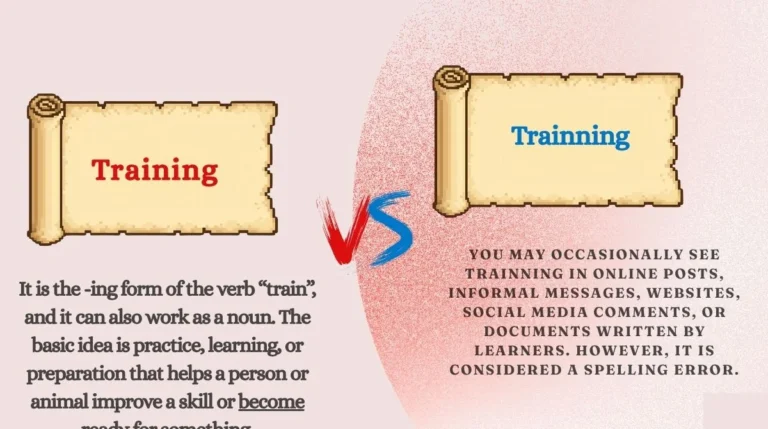
It is the -ing form of the verb “train”, and it can also work as a noun. The basic idea is practice, learning, or preparation that helps a person or animal improve a skill or become ready for something.
Simple definition
Training means the process of learning, practicing, or preparing for a particular skill, job, activity, or task.
For example, when a new worker learns how to use company software, that person may receive training. When a runner practices every day before a race, that is also training.
When do we use “training”?
We use training in several common situations.
It can describe learning for a job:
- The new employees are receiving safety training.
- I have computer training this week.
It can describe sports practice:
- Our team has football training every morning.
- She missed her training yesterday.
It can describe preparation for a special activity:
- The police officer completed special training.
- The dog needs more training.
It can also describe education that prepares someone for a profession:
- She is taking teacher training.
- He received medical training abroad.
Grammar rule for “training”
The word training is formed by adding -ing to the verb train:
train + ing = training
Notice what happens at the end of the word. We do not add another n.
So:
train → training
Not:
train → trainning
This is an important spelling point. The verb train already ends with in, and when -ing is added, the spelling remains:
t-r-a-i-n-i-n-g
“Training” as a verb form
Training can be part of the present continuous tense.
For example:
- I am training for a marathon.
- She is training new employees.
- They are training every evening.
- We are training for the competition.
Here, training describes an action that is happening around the present time.
“Training” as a noun
The same word can also be a noun.
For example:
- The training was very useful.
- Our company provides excellent training.
- He completed his training last month.
- The job requires special training.
In these sentences, training is the name of an activity or process.
8 example sentences with “training”
- I am training for a long-distance race.
- My brother started job training last week.
- The company gives safety training to all workers.
- She is training to become a nurse.
- Our coach has football training at 6 p.m.
- The dog needs more training.
- They completed their professional training in June.
- His training helped him perform the job correctly.
Common learner confusion
Many learners write trainning because they think the last consonant should be doubled before -ing.
For example, they know these forms:
- run → running
- sit → sitting
- swim → swimming
So they may incorrectly assume:
- train → trainning
But this does not follow the spelling rule.
The correct form is simply:
train → training
That single spelling difference is important, especially in formal writing, school assignments, resumes, reports, and professional emails.
What Does “Trainning” Mean?
Trainning is not the standard spelling of the English word.
You may occasionally see trainning in online posts, informal messages, websites, social media comments, or documents written by learners. However, it is considered a spelling error.
There is no separate standard English meaning for “trainning.” In most cases, when someone writes trainning, they intend to write training.
Why does “trainning” look correct to some learners?
The main reason is that English has a real spelling pattern in which some short words double their final consonant before an ending such as -ing.
For example:
- run → running
- sit → sitting
- stop → stopping
- swim → swimming
Because learners see this pattern, they sometimes apply it to train.
But train does not follow that same doubling pattern.
The correct spelling is:
train + ing = training
Is “trainning” ever correct?
In standard modern English, trainning is not the accepted spelling of the word meaning instruction, practice, or preparation.
So when you need to write the word in a school assignment, professional document, website, email, application, or exam, use:
training
Do not use:
trainning
Why the extra “n” is wrong
Look closely:
Training: t-r-a-i-n-i-n-g
Trainning: t-r-a-i-n-n-i-n-g
The second form has an extra n.
English spelling does not normally double the final n in train before -ing. The word remains easy to recognize and pronounce without the extra consonant.
Common learner confusion
The confusion usually comes from comparing train with verbs such as run, sit, and stop.
Compare these:
- run → running
- sit → sitting
- stop → stopping
- train → training
The first three double the final consonant. Train does not.
This is why memorizing the correct form is useful:
train + ing = training
Difference Between Training and Trainning
The difference is very simple: training is correct, while trainning is a misspelling.
There is no difference in meaning because trainning is not a standard alternative form. When people write it, they normally mean training.
Comparison table
| Feature | Training | Trainning |
|---|---|---|
| Spelling | Correct | Incorrect |
| Standard English | Yes | No |
| Meaning | Learning, practice, or preparation | No separate standard meaning |
| Grammar | Noun or present participle | Incorrect form |
| Correct word in formal writing | Yes | No |
| Example | Employee training starts Monday. | Employee trainning starts Monday. ❌ |
Usage difference
There is actually no normal usage difference between these two spellings.
If you want to talk about education, practice, or preparation, use training.
Correct:
The staff received safety training.
Incorrect:
The staff received safety trainning.
If you are talking about a present action, the same rule applies.
Correct:
She is training for the race.
Incorrect:
She is trainning for the race.
Grammar logic
The spelling becomes easier when you look at the original verb.
The verb is:
train
Add the ending:
-ing
The result is:
training
There is no spelling change that requires doubling the final consonant.
The same pattern appears in words such as:
- rain → raining
- wait → waiting
- paint → painting
- explain → explaining
- clean → cleaning
These words keep their final consonant when -ing is added.
Sentence structure difference
Because training is the correct form, it can be used in several sentence structures.
As an action:
The coach is training the players.
As preparation:
He is training for the competition.
As a noun:
The training was difficult.
After a possessive or adjective:
Her professional training was excellent.
The form trainning cannot correctly fill these positions because it is simply a spelling error.
Meaning comparison
Training can mean:
- learning a skill
- practicing for an event
- preparing for a job
- teaching a person or animal
- professional instruction
- physical or athletic preparation
For example:
The company offers safety training.
She is training for the Olympics.
The puppy needs obedience training.
There is no separate meaning for trainning.
Grammar Rules You Must Remember
Rule 1: Add “-ing” to “train” without doubling the “n”
The most important rule is simple:
train + ing = training
Do not write:
train + ing = trainning
Example:
I am training for a new job.
The base verb is train, and adding -ing gives training.
Rule 2: Do not automatically double the final consonant
English does have consonant-doubling rules, but they do not apply to every verb.
For some short verbs, the final consonant is doubled:
- run → running
- sit → sitting
- plan → planning
But train does not work this way:
- train → training
Example:
The athletes are training every morning.
Not:
The athletes are trainning every morning.
Rule 3: “Training” can be a noun or part of a verb tense
The word is not limited to one grammar job.
As a noun:
The training starts tomorrow.
As part of the present continuous:
They are training now.
Learning this helps you recognize the correct spelling in many different sentences.
Rule 4: Use “training” in formal and informal English
Whether you are writing an email to a friend or a formal report for work, the spelling stays the same.
Examples:
I have training this afternoon.
The company scheduled employee training.
My football training was canceled.
The context can change, but the spelling does not.
Common Mistakes Students Make
Mistake 1: Writing “trainning”
This is the most common problem.
Wrong:
We have trainning tomorrow.
Correct:
We have training tomorrow.
The reason is simple: train does not double its final n before -ing.
Mistake 2: Thinking every short verb doubles its last letter
Learners often remember a rule such as “double the last consonant before -ing” but forget that there are conditions and exceptions.
For example:
run → running
does not mean:
train → trainning
The structure and spelling of the base word matter.
Mistake 3: Adding an extra “n” because of pronunciation
When people say training quickly, the sounds can seem close together. A learner may hear something that feels like “train-ning.”
But spelling should be based on the written form of the word, not only on how it sounds in fast conversation.
Correct:
training
Mistake 4: Using “trainning” on resumes or applications
Spelling errors are especially noticeable in formal documents.
Wrong:
Completed customer service trainning.
Correct:
Completed customer service training.
A simple spelling mistake can make professional writing look less polished, so it is worth checking carefully.
Mistake 5: Confusing “train” with words that really double
Compare:
- plan → planning
- begin → beginning
- run → running
- train → training
These examples show why you should learn the spelling of common forms rather than applying one rule to every verb.
Easy correction tip
Whenever you are unsure, mentally break the word into two parts:
train + ing
Then write them together:
training
This is often easier than trying to remember a complicated spelling rule.
Easy Trick to Remember the Difference
Here is a very simple memory trick:
Think: “TRAIN is already complete.”
The word train ends in n, but it does not need another n before -ing.
Picture it like this:
TRAIN + ING = TRAINING
There is only one n at the joining point.
You can also connect the word with a familiar phrase:
train today → training today
For example:
I train every day.
I am training every day.
The base word still keeps its normal spelling.
A second memory trick
Remember this little pair:
run → running
train → training
When you see run, the vowel pattern and spelling rule lead to a doubled n.
But when you see train, simply add -ing.
Another useful comparison is:
- rain → raining
- train → training
Since rain becomes raining, you can remember that train behaves in the same way:
rain + ing = raining
train + ing = training
No extra consonant is added.
Real-life logic
Imagine writing the word on a whiteboard:
TRAIN
Now add:
ING
You get:
TRAINING
The spelling is already complete. There is no need to insert another N.
The more often you see and use the correct form, the more natural it will become.
Daily Life Examples
Real conversations make spelling rules easier to remember. Here are some simple examples using training naturally.
1. At work
A: Why are you leaving early today?
B: I have employee training at three o’clock.
2. At the gym
A: Are you going to the gym tonight?
B: Yes. I have strength training after work.
3. In sports
A: Why isn’t Ali here?
B: He is at football training.
4. For a new job
A: When do you start your new position?
B: Next Monday. I have two weeks of training first.
5. Learning a skill
A: How did you learn to use that software?
B: The company gave me proper training.
6. Preparing for a race
A: Are you ready for the marathon?
B: Almost. I’m still training every morning.
7. Talking about a pet
A: Your dog is very well behaved.
B: Thanks. We spent months on his training.
8. At school
Teacher: Why were you absent yesterday?
Student: I had teacher training at another school.
9. Workplace safety
Manager: Have you completed the safety training?
Employee: Yes, I finished it this morning.
10. Personal improvement
A: Why do you practice speaking English every day?
B: I’m training myself to speak more confidently.
These examples show that training is a very common word in ordinary English. It can relate to jobs, sports, education, pets, fitness, and personal skills.
Practice Section
Choose the correct spelling in each sentence.
1. The company provides safety ________ for all employees.
a) training
b) trainning
2. She is ________ for the tennis competition.
a) training
b) trainning
3. My football ________ starts at 5 p.m.
a) training
b) trainning
4. He completed his professional ________ last year.
a) training
b) trainning
5. The puppy needs more ________.
a) training
b) trainning
Answers
- a) training
- a) training
- a) training
- a) training
- a) training
A quick check can help you remember the pattern:
train + ing = training
FAQs
What is the difference between training and trainning?
Training is the correct spelling. It can be a noun meaning learning, practice, or preparation, or it can be the -ing form of the verb train. Trainning is a spelling mistake and is not the standard form.
Is trainning a correct English word?
No. Trainning is not the standard spelling used in modern English. In normal writing, replace it with training. This applies to schoolwork, emails, websites, resumes, reports, and other formal or informal writing.
Why is training not spelled trainning?
The word is formed by adding -ing to train:
train + ing = training
The spelling rule that doubles the final consonant in words such as run → running does not apply to train. Therefore, only one n appears before the i.
Can training be used as a noun?
Yes. Training is very often used as a noun. For example, “The training was useful” means the learning or instruction was useful. It can refer to job training, sports training, professional training, safety training, and many other types of preparation.
Can training be used in questions?
Yes. You can use training naturally in questions.
Examples include:
When is your training?
Are you training for the race?
Have you completed your training?
The correct spelling remains training in every question.
Is training formal or informal?
Training is a normal English word used in both formal and informal situations. You can use it in everyday conversations as well as professional documents. Examples include employee training, teacher training, sports training, and job training.
Conclusion
The spelling choice is clear: training is the correct form, while trainning is a misspelling.
The word training comes from the verb train plus the ending -ing:
train + ing = training
You do not double the final n. Although some English verbs such as run, sit, and stop double their final consonant before -ing, train does not follow that pattern.
Remembering this small difference can prevent mistakes in school assignments, work emails, resumes, applications, and everyday writing. The easiest trick is to think of the word as two parts: train + ing.
Try using the correct spelling in your own sentences. Write it, say it, and read it several times. With a little practice, training will quickly become the spelling that feels natural every time you use it.

Evan Rellmont is a writer who turns thoughtful ideas into meaningful words, creating stories and reflections that connect, inspire, and leave a lasting impression.