
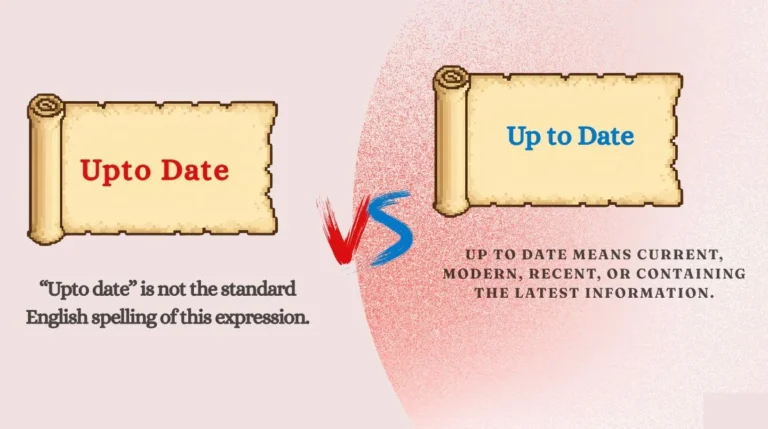
English has many small expressions that look simple but cause problems for learners. Upto date vs up to date is one of them.
You may see people write “upto date” in emails, social media posts, messages, or even websites.
At the same time, you may find “up to date” in dictionaries, books, news, and professional writing. This can make you wonder which version is actually correct.
The good news is that the rule is much easier than it first appears.
“Up to date” is the standard form when the phrase comes after a verb, while “up-to-date” is commonly used before a noun. “Upto date” is not the standard spelling in English. Major dictionaries such as Cambridge and Oxford list the expression as up to date and up-to-date.
This phrase is important in everyday English because we often talk about current information, modern technology, recent news, updated records, and new ideas.
You might need to say that your phone is current, your notes contain the latest information, or your records have been updated.
By the end of this guide, you will know exactly why upto date is wrong, when to use up to date, when to use up-to-date, and how to avoid this common spelling mistake in school, work, and daily communication.
What Does “Upto Date” Mean?
The first thing to understand is simple:
“Upto date” is not the standard English spelling of this expression.
The correct form is:
- up to date
- up-to-date
The single word “upto” is generally treated as a misspelling of “up to” in standard English.
This means that “upto date” does not have a separate standard meaning that you should learn as a normal English phrase. Instead, it usually appears when someone has accidentally joined the words “up” and “to.”
For example:
❌ My information is upto date.
✅ My information is up to date.
The mistake is very common because English contains many combined words. Learners may naturally think that “up to” should also become one word. However, it does not work that way here.
Why do people write “upto”?
One reason is everyday typing. People often shorten or join words when writing quickly. In some varieties of informal English, especially online or in regional usage, “upto” can appear frequently. That does not make it the preferred standard spelling for formal English.
Think of it as a spelling habit rather than a useful alternative.
When writing an essay, school assignment, CV, business email, article, report, or website, choose up to, not upto.
What should you write instead?
Use up to date when the phrase stands after a verb:
The information is up to date.
Use up-to-date when it comes directly before a noun:
We need up-to-date information.
The meaning is closely connected in both cases. The important difference is mainly the position of the phrase in the sentence.
Examples
Here are some examples that show the correct form:
- ❌ Please make sure the records are upto date.
✅ Please make sure the records are up to date. - ❌ Is your software upto date?
✅ Is your software up to date? - ❌ We need upto date information.
✅ We need up-to-date information. - ❌ The website is not upto date.
✅ The website is not up to date. - ❌ She always keeps her notes upto date.
✅ She always keeps her notes up to date. - ❌ I need an upto date report.
✅ I need an up-to-date report. - ❌ The database should be upto date.
✅ The database should be up to date. - ❌ We use upto date technology.
✅ We use up-to-date technology.
Common learner confusion
Many students think the choice is simply between two spellings:
upto date vs up to date
But there is actually a third form that is important:
up-to-date
So the real question is often not only about spelling. It is also about where the adjective appears in the sentence.
That is the part that makes this topic useful.
What Does “Up to Date” Mean?
Up to date means current, modern, recent, or containing the latest information.
Cambridge defines the phrase as meaning modern, recent, or containing the latest information. Oxford also gives meanings connected with being modern and having the most recent information.
In simple English, when something is up to date, it is not old or missing important recent changes.
For example:
My contact information is up to date.
This means the information is current and correct.
You can use up to date for information, records, knowledge, software, equipment, websites, news, skills, and even people who know the latest developments.
When should you use “up to date”?
You normally use up to date after a verb such as:
- be
- keep
- stay
- bring
- get
- remain
Examples:
The records are up to date.
Please keep your profile up to date.
I like to stay up to date with technology.
She is up to date on the latest news.
This phrase is especially common with keep, stay, and bring.
For example:
We need to keep our records up to date.
He reads the news every morning to stay up to date.
The meeting helped bring me up to date on the project.
Grammar rule
When up to date comes after the verb and describes the subject or object, it is normally written as three separate words.
For example:
The information is up to date.
Here, “up to date” describes “the information.”
Another example:
Keep your details up to date.
Here, it describes the condition of “your details.”
8 example sentences
- Please check that your address is up to date.
- The company’s records are up to date.
- Is this information up to date?
- I try to stay up to date with current events.
- We need to bring the report up to date.
- Her knowledge of computer technology is up to date.
- The app is fully up to date now.
- Make sure your payment information stays up to date.
Common confusion
Learners sometimes write:
My records are up-to-date.
In many contexts, especially following a linking verb such as are, the conventional form is up to date without hyphens:
My records are up to date.
The hyphenated version is especially useful when the phrase appears before a noun:
I checked the up-to-date records.
Dictionary examples reflect this distinction: Cambridge gives up to date after the noun or verb structure and up-to-date information before a noun.
Difference Between Upto Date and Up to Date
The biggest difference is simple:
“Upto date” is not the standard form. “Up to date” is correct.
There is also an important related form:
“Up-to-date” is the hyphenated form commonly used before a noun.
Comparison table
| Form | Correct? | Main use | Example |
|---|---|---|---|
| upto date | ❌ No, in standard English | Avoid this spelling | ❌ The records are upto date. |
| up to date | ✅ Yes | Usually after a verb / as a predicate phrase | The records are up to date. |
| up-to-date | ✅ Yes | Commonly before a noun | We need up-to-date records. |
1. Usage difference
Upto date should generally not be used in standard English.
Up to date is used when you describe something as current.
The website is up to date.
Up-to-date is often used directly before a noun.
The website contains up-to-date information.
Notice how the meaning does not really change. The grammatical position changes.
2. Grammar logic
Compare these two sentences:
The information is up to date.
We have up-to-date information.
In the first sentence, the phrase comes after the verb is and describes the information.
In the second sentence, up-to-date directly describes the noun information.
This is a common pattern in English. Hyphens are often used in compound adjectives before a noun to make the words work together as one clear description.
3. Sentence structure difference
A useful pattern is:
Subject + be + up to date
The file is up to date.
Another pattern is:
up-to-date + noun
an up-to-date file
You can also use the phrase with verbs such as keep, stay, and bring:
Keep the file up to date.
Stay up to date with the latest changes.
Bring the file up to date.
4. Meaning comparison
The meaning behind these correct forms is similar:
up to date = current or containing the latest information
up-to-date = current, modern, or containing the latest information
upto date = nonstandard spelling that should normally be corrected to one of the forms above.
Oxford and Cambridge both recognize the adjective and give examples involving modern equipment, recent information, records, and staying current.
Grammar Rules You Must Remember
Rule 1: Never normally write “upto” in standard English
Treat up to as two separate words.
Correct:
The price is up to $100.
Correct:
The records are up to date.
Incorrect:
The records are upto date.
This rule becomes especially important in academic and professional writing. The phrase up to is written separately.
Rule 2: Use “up to date” after a linking verb
When the phrase describes the condition of something after be, seem, remain, and similar verbs, use up to date.
Examples:
The software is up to date.
Her records are up to date.
The website seems up to date.
Our information remains up to date.
The phrase tells us that something is current.
Rule 3: Use “up-to-date” before a noun when it acts as a compound adjective
When the phrase directly describes a noun, the hyphenated form is commonly used.
Examples:
We need up-to-date information.
He uses up-to-date technology.
I bought an up-to-date computer.
The teacher gave us up-to-date statistics.
This pattern helps the reader understand that all three words belong together as one description.
Rule 4: Use “up to date” with keep, stay, and bring
These combinations are especially common:
keep something up to date
Please keep your records up to date.
stay up to date
I read regularly to stay up to date.
bring something up to date
We need to bring the website up to date.
Cambridge and Oxford both show these patterns as common ways to use the expression.
Common Mistakes Students Make
Students usually make this mistake for one of three reasons.
First, they hear the phrase spoken quickly. “Up to” can sound almost like one unit in normal speech.
Second, they may see upto in informal writing and assume it is correct.
Third, English has many single-word forms, so learners may expect “up to” to behave in the same way.
The easiest solution is to memorize the phrase as a fixed expression.
Mistake 1: Writing “upto”
❌ The website is upto date.
✅ The website is up to date.
Remember: up to stays as two words.
Mistake 2: Forgetting the hyphen before a noun
You may see:
We need up to date information.
This can sometimes be understood, and usage varies by style, but the conventional compound-adjective form before the noun is:
We need up-to-date information.
The hyphen makes the modifier easier to read as one unit.
Mistake 3: Adding hyphens everywhere
Some students learn “up-to-date” and then use it in every sentence.
For example:
❌ The information is up-to-date.
A cleaner standard choice is:
✅ The information is up to date.
But:
✅ The information is up-to-date.
is appropriate when the phrase directly modifies a following noun.
Compare:
The records are up to date.
We checked the up-to-date records.
That small difference is worth remembering.
Mistake 4: Confusing “up to date” with “update”
The word update is different.
Update can be a verb or a noun:
Please update the file.
I installed the latest update.
Up to date is an adjective phrase:
The file is up to date.
These forms are related in meaning, but they do not work in the same grammatical position.
Easy correction tip
Whenever you type upto, stop and ask:
“Can I split this into ‘up to’?”
In standard English, the answer is yes for this expression.
Then check what comes next.
If a noun comes immediately after the phrase, up-to-date is often the best choice:
up-to-date information
If the phrase comes after a verb, use up to date:
The information is up to date.
That quick check can prevent most mistakes.
Easy Trick to Remember the Difference
Here is a very simple memory trick:
UP + TO = TWO WORDS
Think of the phrase as a small staircase:
UP → TO → DATE
There are three separate words:
up | to | date
Never squash up + to together as upto in standard writing.
Now remember the second trick:
Before a noun? Use the hyphens.
For example:
up-to-date news
up-to-date records
up-to-date software
The hyphens show that the words are working together before the noun.
After a verb:
The news is up to date.
The records are up to date.
The software is up to date.
So you can remember the whole rule in one line:
“Up to date” after the verb; “up-to-date” before a noun; never “upto date.”
That simple sentence is enough to handle most situations.
Real-life logic
Imagine your friend asks:
“Is your phone software up to date?”
You are describing the condition of the software, so you write:
My phone software is up to date.
Now imagine you are describing the software itself:
I installed the latest up-to-date software.
The idea is the same. The sentence structure changes.
Daily Life Examples
These examples show how native and fluent English speakers naturally use the expression in everyday situations.
1. Talking about a phone
A: Is your phone software up to date?
B: Yes, I installed the latest update yesterday.
2. Talking about school notes
A: Did you add the new lesson to your notes?
B: Yes. My notes are completely up to date now.
3. Talking about a website
A: Can I trust the information on that page?
B: Yes, the page seems up to date.
4. Talking about news
A: Do you know what happened at the meeting?
B: Not yet. I need to get up to date on the latest news.
5. Talking about records
A: Have you checked the customer records?
B: Yes, they are all up to date.
6. Talking about technology
Our company needs up-to-date technology to keep its systems running smoothly.
7. Talking about a report
A: Is the report ready?
B: Almost. I just need to bring a few numbers up to date.
8. Talking about personal information
Please make sure your address and phone number are up to date.
9. Talking about skills
She takes online courses to stay up to date with new software.
10. Talking about information
We need up-to-date information before making a final decision.
Notice that these examples use both forms naturally. The spelling depends on the grammatical position, not on a different basic meaning.
Practice Section
Choose the correct option in each sentence.
1. Please make sure your contact information is ______.
A. upto date
B. up to date
C. up-to-date
2. We need ______ information before the meeting.
A. upto date
B. up to date
C. up-to-date
3. Is your antivirus software ______?
A. upto date
B. up to date
C. up-to-date
4. The company provides ______ technology for its employees.
A. upto date
B. up to date
C. up-to-date
5. I try to stay ______ with the latest developments.
A. upto date
B. up to date
C. up-to-date
Answers
1. B — up to date
The phrase comes after is and describes the condition of the information.
2. C — up-to-date
The phrase comes directly before the noun information.
3. B — up to date
It follows is, so the three words are normally written separately.
4. C — up-to-date
It directly describes the noun technology.
5. B — up to date
The normal expression is stay up to date.
FAQs
What is the difference between “upto date” and “up to date”?
Up to date is the correct standard expression. It means current, modern, or containing the latest information.
Upto date is generally a spelling mistake and should be avoided in standard English writing.
Is “upto date” correct English?
No. Upto date is not the standard spelling used in formal English.
Write up to date instead, or up-to-date when the phrase functions as a compound adjective before a noun.
Should I write “up to date” or “up-to-date”?
Both are correct, but they are commonly used in different positions.
Use up to date after a verb:
The records are up to date.
Use up-to-date before a noun:
We need up-to-date records.
Can I use “up to date” in questions?
Yes. It is very common in questions.
Examples:
Is your information up to date?
Are these records up to date?
Do you have up-to-date information?
The choice depends on where the phrase appears in the sentence.
Is “up-to-date” formal or informal?
Up-to-date is standard English and is perfectly suitable for formal writing, including business, academic, and professional contexts.
You can use it for information, technology, records, equipment, reports, and many other nouns.
Why do people write “upto”?
The spelling upto usually comes from treating up to as though it were one word. It may appear in informal or regional writing, but standard English keeps up and to separate.
For careful writing, use up to, not upto.
Conclusion
The difference between upto date vs up to date becomes easy once you remember one basic rule: “upto” is not the standard spelling. The correct expression is up to date, which means current, modern, or containing the latest information.
You will also see up-to-date when the phrase comes directly before a noun. For example, “The records are up to date” is correct, while “We checked the up-to-date records” uses the hyphenated form correctly.
The best habit is to remember the expression as three words: up + to + date. Then look at its position in the sentence. After a verb, use up to date. Before a noun, use up-to-date.
Once you start noticing this pattern in emails, websites, news, and everyday conversations, it will feel natural. A little practice will help you use the correct form without having to think about it every time.

Evan Rellmont is a writer who turns thoughtful ideas into meaningful words, creating stories and reflections that connect, inspire, and leave a lasting impression.