
Many English learners confuse suppose and supposed because the two words look almost the same and are closely related.
The difference is only one small ending, but that ending can change the grammar and meaning of a sentence.
For example, you may hear someone say, “Suppose we miss the bus.” Here, suppose means “imagine” or “consider this possibility.”
But in the sentence “We are supposed to leave at eight,” supposed to means that something is expected, planned, or required.
This difference is very important in everyday English. You will hear both forms in conversations, classrooms, workplaces, travel situations, and casual messages.
Learners often make mistakes such as saying “I suppose to call him” instead of “I am supposed to call him,” or using “supposed” when they really mean “suppose.”
The good news is that the rule is easier than it first seems. Once you understand how each word works in a sentence, choosing the correct form becomes much more natural.
By the end of this guide, you will understand the meaning, grammar, sentence structure, common mistakes, and everyday use of suppose and supposed.
You will also learn a simple trick to remember the difference.
What Does “Suppose” Mean?
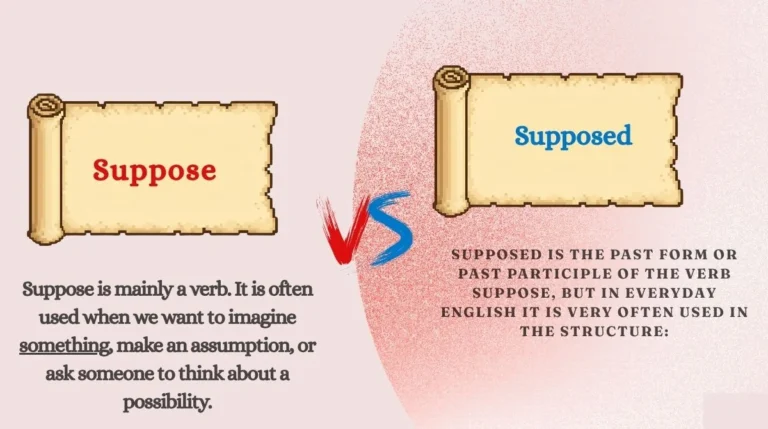
Suppose is mainly a verb. It is often used when we want to imagine something, make an assumption, or ask someone to think about a possibility.
In simple English, suppose can often mean:
- imagine
- assume
- consider something as possible
When Do We Use “Suppose”?
One common use is to introduce an imaginary or possible situation.
For example:
“Suppose you find a wallet on the road.”
This means:
“Imagine you find a wallet on the road.”
We can also use suppose when we think something is probably true, although we are not completely sure.
“I suppose he is busy.”
Here, the speaker thinks he is probably busy.
Another common use is in questions or suggestions.
“Suppose we take a taxi?”
This means:
“What if we take a taxi?” or “How about taking a taxi?”
Grammar Rule for “Suppose”
Because suppose is a verb, it can be used with a subject and other parts of a sentence.
Common patterns include:
Suppose + subject + verb
Suppose we arrive late.
Suppose + that + subject + verb
I suppose that she is right.
The word that is often optional.
I suppose he forgot.
and
I suppose that he forgot.
Both are correct.
Examples of “Suppose”
- Suppose we miss the train. What should we do?
- I suppose you are right.
- Suppose your friend needs help. What would you do?
- I suppose she will come later.
- Suppose we order pizza tonight.
- I suppose they have already left.
- Suppose it rains tomorrow. We can stay home.
- What do you suppose he meant?
A Common Confusion
Learners sometimes think suppose and supposed are interchangeable because they come from the same word.
They are not.
For example:
❌ I suppose to finish my homework today.
✅ I am supposed to finish my homework today.
The first sentence is incomplete because suppose to is not the normal structure for expressing a duty or expectation. We need be supposed to.
There is also another important difference:
“I suppose he is coming.”
= I think he is probably coming.
“He is supposed to come.”
= He is expected or planned to come.
The meaning is very different even though the words look similar.
What Does “Supposed” Mean?
Supposed is the past form or past participle of the verb suppose, but in everyday English it is very often used in the structure:
be supposed to + verb
This structure is extremely common.
What Does “Be Supposed To” Mean?
Be supposed to usually means that something is:
- expected
- planned
- required
- considered the correct thing to do
For example:
“You are supposed to wear a seat belt.”
This means wearing a seat belt is expected or required.
Another example:
“The meeting is supposed to start at 10.”
This means the meeting is planned or expected to start at 10.
Grammar Rule for “Supposed”
The most important pattern is:
Subject + be + supposed to + base verb
The form of be changes according to the subject and tense.
I am supposed to go.
She is supposed to study.
They are supposed to arrive soon.
We were supposed to meet yesterday.
Notice that after supposed to, we use the base form of the verb.
✅ He is supposed to call me.
❌ He is supposed to calls me.
✅ They are supposed to leave.
❌ They are supposed to leaving.
Examples of “Supposed”
- I am supposed to finish this work today.
- You are supposed to be here at nine.
- She is supposed to call her mother.
- We are supposed to bring our books.
- They were supposed to arrive yesterday.
- The bus is supposed to leave at six.
- Am I supposed to wait here?
- He was supposed to help us.
“Supposed” Can Also Mean “Assumed” or “Claimed”
There is another use of supposed that learners should know.
Sometimes supposed means something is believed, claimed, or described as being true, without saying that it is definitely true.
For example:
“The supposed expert gave us bad advice.”
Here, supposed expert means a person who is called or believed to be an expert, but the speaker may doubt it.
Another example:
“They found the supposed cause of the problem.”
This means the cause is believed to be the cause, but the speaker is not completely certain.
This use is less common in beginner conversation than be supposed to, but it is useful when reading English.
Difference Between “Suppose” and “Supposed”
The easiest way to understand the difference is to remember that suppose is normally a verb used to express an idea or possibility, while supposed is commonly used in the fixed structure be supposed to.
| Word or Structure | Main Meaning | Common Grammar Pattern | Example |
|---|---|---|---|
| suppose | imagine, assume, think | suppose + clause | Suppose we leave now. |
| suppose | think/probably believe | I suppose + clause | I suppose he is busy. |
| supposed to | expected or required | be + supposed to + verb | You are supposed to listen. |
| was/were supposed to | was/were expected or planned | was/were + supposed to + verb | We were supposed to meet. |
| supposed | believed or claimed | supposed + noun | The supposed expert was wrong. |
Usage Difference
Consider these two sentences:
“Suppose we take the train.”
This is an idea or suggestion. You are asking someone to imagine or consider taking the train.
Now compare:
“We are supposed to take the train.”
This means there is already an expectation, plan, instruction, or arrangement to take the train.
That one extra -d is not just a spelling difference. It is part of a different grammatical structure.
Grammar Logic
With suppose, the speaker is often introducing a thought.
Suppose it rains.
The speaker asks you to imagine the situation.
With supposed to, the speaker is talking about what someone should do, is expected to do, or was planned to do.
You are supposed to bring an umbrella.
This suggests an expectation or instruction.
Sentence Structure Difference
Look at these patterns carefully.
Suppose + subject + verb
Suppose you lose your phone.
But:
Subject + be + supposed to + base verb
You are supposed to carry your phone with you.
You cannot normally remove the verb be from the second structure.
❌ You supposed to bring your ID.
✅ You are supposed to bring your ID.
The same is true in the past:
❌ We supposed to meet at seven.
✅ We were supposed to meet at seven.
Meaning Comparison
Here is another useful pair:
“I suppose she knows the answer.”
This means:
“I think she probably knows the answer.”
But:
“She is supposed to know the answer.”
This means she is expected to know the answer, perhaps because she studied it or because it is her responsibility.
So, suppose often expresses the speaker’s belief or imagination, while supposed to often expresses an expectation, plan, rule, or duty.
Grammar Rules You Must Remember
Rule 1: Use “Suppose” as a Verb for an Idea, Assumption, or Possibility
When you want to say “imagine”, “assume”, or “consider this possibility,” use suppose.
Example:
“Suppose you win the competition. What will you do?”
Here, suppose asks the listener to imagine a possible situation.
You can also use it with that:
“I suppose that he is tired.”
In normal conversation, the that can often be left out:
“I suppose he is tired.”
Both are grammatically correct.
Rule 2: Use “Be Supposed To” for Expectations, Duties, and Plans
When someone is expected or required to do something, use:
am/is/are/was/were + supposed to + base verb
Example:
“Students are supposed to submit their homework on Friday.”
This means the students are expected to submit it on Friday.
More examples:
I am supposed to call my teacher.
She is supposed to arrive at noon.
They were supposed to clean the room.
Remember: the form of be is essential.
Rule 3: After “Supposed To,” Use the Base Form of the Verb
A very common mistake is changing the verb after supposed to.
Correct:
He is supposed to study.
Incorrect:
He is supposed to studies.
Correct:
We are supposed to leave.
Incorrect:
We are supposed to leaving.
The rule is simple:
supposed to + base verb
Examples of base verbs:
go, come, study, work, call, eat, write, bring
So we say:
She is supposed to call.
Not:
She is supposed to calls.
Rule 4: Use “Was/Were Supposed To” for Past Expectations or Plans
When something was expected or planned in the past, use:
was/were supposed to + base verb
For example:
“I was supposed to meet Ali yesterday.”
This means the plan or expectation was for me to meet Ali.
Often, the action did not happen:
“I was supposed to call you, but I forgot.”
Likewise:
“They were supposed to arrive at 5 p.m., but their flight was delayed.”
This structure is very useful because it clearly shows a past plan or expectation.
Common Mistakes Students Make
The biggest mistakes happen because learners hear suppose and supposed pronounced in similar ways. They may also forget that supposed to needs a form of be.
Mistake 1: Leaving Out “Be”
❌ I supposed to study tonight.
✅ I am supposed to study tonight.
The phrase for expectation or duty is be supposed to, not simply supposed to.
Mistake 2: Using “Suppose” Instead of “Supposed”
❌ You are suppose to listen to the teacher.
✅ You are supposed to listen to the teacher.
Here, you need the participle supposed after are.
Mistake 3: Adding “-s” After “To”
❌ She is supposed to goes home.
✅ She is supposed to go home.
After to, use the base verb.
Mistake 4: Using the Wrong Past Form
❌ They was supposed to come.
✅ They were supposed to come.
Remember that they takes were, not was.
Mistake 5: Confusing Belief With Expectation
Compare:
“I suppose he is angry.”
This means:
I think he is probably angry.
Now:
“He is supposed to be angry.”
This suggests that people expect him to be angry or that he is said to be angry.
The speaker’s meaning changes, so choosing the correct structure matters.
Easy Correction Tips
When you write a sentence, ask yourself one question:
Am I saying “imagine/assume,” or am I saying “expected/required/planned”?
If the meaning is imagine or assume, use suppose.
If the meaning is expected, required, or planned, use be supposed to.
Also check for am, is, are, was, or were when using supposed to.
Easy Trick to Remember the Difference
Here is a simple memory trick:
Suppose = Think or Imagine
Think of suppose as a word that creates an idea in your mind.
Suppose it snows tomorrow.
You are asking someone to imagine a situation.
I suppose she is busy.
You are saying what you think is probably true.
So remember:
SUPPOSE = IMAGINE / ASSUME / THINK
Supposed To = Expected To
Think of supposed to as something that should happen because of a rule, plan, promise, schedule, or expectation.
I am supposed to wake up at 7.
You are supposed to wear a uniform.
The train was supposed to arrive at 8.
So remember:
SUPPOSED TO = EXPECTED TO / REQUIRED TO / PLANNED TO
A very quick classroom trick is:
Suppose = What if?
Supposed to = What should happen?
For example:
Suppose we go by bus.
= What if we go by bus?
We are supposed to go by bus.
= We are expected or planned to go by bus.
That small question can help you choose the correct form quickly.
Daily Life Examples
These examples show how suppose and supposed to sound in real conversations.
1. At Home
Mom: You are supposed to clean your room today.
Son: I know. I’ll do it after lunch.
Here, cleaning the room is an expected task.
2. Talking About a Possibility
Sara: Suppose it rains tonight.
Mina: Then we can watch a movie at home.
Here, suppose means “imagine if.”
3. Talking About a Plan
John: What time are you supposed to arrive?
Mike: Around six o’clock.
The question asks about an expected arrival time.
4. Giving an Opinion
A: Do you think James knows about the meeting?
B: I suppose he does.
Here, suppose means “I think” or “I believe.”
5. School
Teacher: You are supposed to bring your notebook tomorrow.
Student: Okay, I won’t forget.
The student has a clear school requirement.
6. A Missed Plan
A: Why didn’t you come yesterday?
B: I was supposed to come, but I got sick.
The meeting or visit was planned, but it did not happen.
7. Making a Suggestion
A: What should we do this weekend?
B: Suppose we go to the park.
Here, suppose introduces a suggestion.
8. Asking About a Rule
A: Am I supposed to remove my shoes?
B: Yes, please.
The speaker is asking what is expected.
9. Talking About an Assumption
A: Where is David?
B: I suppose he is at work.
The speaker is making a guess.
10. Talking About a Schedule
A: When is the package supposed to arrive?
B: It is supposed to arrive tomorrow.
The arrival is expected according to a schedule or plan.
Practice Section
Choose the correct option: suppose or supposed.
1. I am ______ to finish this project today.
a) suppose
b) supposed
2. ______ we take a different road?
a) Suppose
b) Supposed
3. She is ______ to call me after work.
a) suppose
b) supposed
4. I ______ he already knows the answer.
a) suppose
b) supposed
5. They were ______ to arrive at eight.
a) suppose
b) supposed
Answers
1. b) supposed
The structure is am supposed to + verb.
2. a) Suppose
Here, suppose introduces an idea or suggestion.
3. b) supposed
The correct structure is is supposed to call.
4. a) suppose
Here, suppose means “I think” or “I believe.”
5. b) supposed
For a past plan or expectation, use were supposed to + verb.
FAQs About Suppose or Supposed
1. What is the difference between suppose and supposed?
Suppose is usually a verb meaning “imagine,” “assume,” or “think.”
Supposed is commonly used in be supposed to, meaning “expected,” “required,” or “planned.”
For example, “Suppose we leave now” is different from “We are supposed to leave now.”
2. Can we use “suppose” in questions?
Yes. Suppose can be used in questions and suggestions.
For example, “Suppose we try again?” means “What if we try again?”
You can also ask, “What do you suppose he means?”
3. Is “supposed to” formal or informal?
Supposed to is common in both spoken and written English.
It is especially common when talking about rules, responsibilities, schedules, and expectations.
Examples include “You are supposed to wait here” and “The train is supposed to arrive at six.”
4. Is “I suppose” the same as “I am supposed to”?
No. “I suppose” usually means “I think” or “I assume.”
“I am supposed to” means “I am expected or required to.”
For example, “I suppose he is busy” is an opinion, while “I am supposed to call him” describes a duty or plan.
5. Why do we say “I am supposed to” instead of “I suppose to”?
Because supposed to is a grammatical structure that needs a form of the verb be before it.
The correct forms are am supposed to, is supposed to, are supposed to, was supposed to, and were supposed to.
So, say “I am supposed to go,” not “I suppose to go.”
6. Can “supposed to” talk about something that did not happen?
Yes. The past form was/were supposed to is often used for a plan or expectation that failed to happen.
For example, “We were supposed to meet at noon, but she never came.”
The structure shows what was expected or planned, even when reality was different.
Conclusion
The difference between suppose and supposed becomes much easier once you focus on their jobs in a sentence. Suppose is a verb commonly used for an idea, assumption, possibility, or suggestion. It can often mean “imagine,” “assume,” or “I think.”
Supposed is most commonly seen in be supposed to, which expresses an expectation, duty, rule, arrangement, or plan. The important pattern is be + supposed to + base verb.
Compare “Suppose we stay home” with “We are supposed to stay home.” The first introduces an idea. The second describes an expectation or instruction.
Try using both forms in your daily conversations. Once you connect suppose with “imagine” and supposed to with “expected to,” the difference will feel much more natural. A little practice with real sentences can make this common English confusion disappear.

Evan Rellmont is a writer who turns thoughtful ideas into meaningful words, creating stories and reflections that connect, inspire, and leave a lasting impression.