
“Than” and “then” are two small English words that cause a surprisingly large number of mistakes.
They look almost the same, sound somewhat similar in fast speech, and appear in everyday sentences all the time.
That is why even students who know many English words sometimes type one when they actually need the other.
The good news is that the two words have very different jobs. Than is mainly used when you compare two people, things, actions, amounts, or ideas.
Then is mainly connected with time, order, or a result. Once you understand what each word does, choosing the correct spelling becomes much easier.
Cambridge Dictionary describes than as a word used to join two parts of a comparison, while then can mean “at that time,” “next,” or “in that case.”
This difference matters in daily English. You will see these words in school writing, emails, text messages, conversations, exams, and online posts.
For example:
- Sara is taller than Anna.
- Finish your homework, then watch TV.
The first sentence compares Sara and Anna. The second shows what happens next.
By the end of this guide, you will know exactly when to use than and then, how their sentence structures work, what common mistakes to avoid, and how to remember the difference without memorizing a difficult grammar rule.
What Does “Than” Mean?
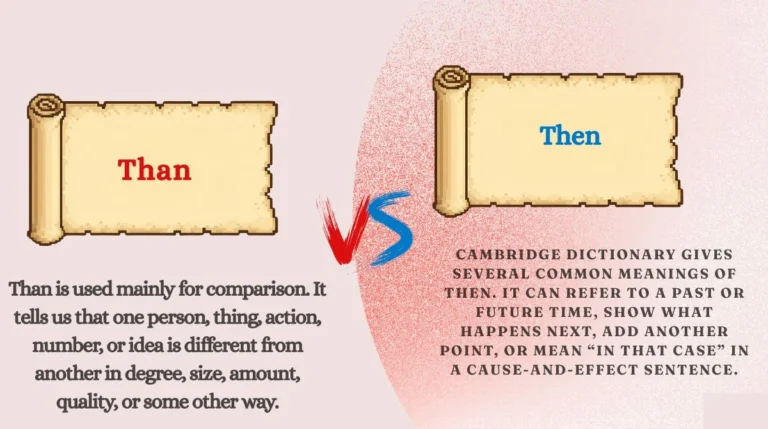
Than is used mainly for comparison. It tells us that one person, thing, action, number, or idea is different from another in degree, size, amount, quality, or some other way.
A simple way to think about it is:
Than = used when comparing.
For example:
- My car is faster than yours.
- This book is more interesting than that one.
- Ali works harder than his brother.
- We have less time than we expected.
Cambridge Dictionary lists than as a preposition and conjunction and explains that it joins two parts of a comparison. It is also commonly used with words such as more and less to compare amounts or numbers.
When Should You Use “Than”?
Use than when you are showing a comparison.
You can compare:
People
- Tom is younger than Mike.
- Emma is taller than her sister.
Things
- This phone is cheaper than that phone.
- Winter is colder than autumn.
Actions
- She runs faster than I do.
- He speaks more clearly than his friend.
Amounts
- I have more money than you.
- She drank less water than usual.
Ideas or choices
- Health is more important than money.
- I would rather stay home than go out.
The key question is: Am I comparing two things?
If the answer is yes, than is usually the correct word.
Grammar Rule for “Than”
The basic pattern is:
comparative word + than + person/thing
Examples:
- bigger than
- smaller than
- faster than
- slower than
- better than
- worse than
- more useful than
- less expensive than
Look at these sentences:
- My new laptop is faster than my old one.
- This road is wider than the other road.
- Your answer is better than mine.
- This bag is more expensive than that bag.
- I have less free time than my brother.
- She has more experience than me.
- The blue dress is cheaper than the red one.
- He arrived earlier than I expected.
In each sentence, than introduces the second part of a comparison.
A Common Confusion About “Than”
Many learners accidentally write then because the words look alike.
For example:
❌ My house is bigger then yours.
✅ My house is bigger than yours.
The mistake often happens because people remember the sound more than the spelling. In quick speech, than can have a weak pronunciation, which makes it easier to confuse with other words.
When you see more, less, better, worse, taller, shorter, faster, slower, or another comparison, stop for a second and check the word after it.
Very often, the answer is than.
What Does “Then” Mean?
Then is mainly connected with time, order, or result.
A simple way to remember it is:
Then = at that time, next, or as a result.
Cambridge Dictionary gives several common meanings of then. It can refer to a past or future time, show what happens next, add another point, or mean “in that case” in a cause-and-effect sentence.
For example:
- I lived there then.
- Finish your work then go outside.
- We had dinner and then watched a movie.
- If it rains, then we will stay home.
Unlike than, this word does not compare two things.
Meaning 1: “At That Time”
Use then to talk about a particular time in the past or future.
Examples:
- I was a student then.
- She was living in Lahore then.
- I will call you then.
- What will you be doing then?
- We did not have smartphones then.
In these sentences, then means something like “at that time.”
Cambridge notes that then can refer to either the past or the future.
Meaning 2: “Next” or “After That”
This is another very common use.
Examples:
- First, wash your hands; then eat.
- Open the box and then read the instructions.
- I took a shower and then went to bed.
- We had breakfast and then left the house.
- Finish this page, then start the next one.
Here, then shows the order of actions.
It tells the reader or listener:
This happens first → then the next thing happens.
Meaning 3: “In That Case” or “As a Result”
You can also use then when one situation leads to another.
Examples:
- If you study hard, then you may pass the exam.
- If you are tired, then take a break.
- If nobody wants the last piece, then I’ll have it.
- If the shop is closed, then we will come back tomorrow.
This use is especially common in sentences with if. Cambridge describes this use as “in that case” or as a result.
Meaning 4: “In Addition”
In spoken English, then can sometimes add another item or point.
For example:
- There is the hotel bill, and then there is the food.
- She is a teacher, and then she also writes books.
This meaning is less important for beginners, but it is useful to recognize when you hear natural English conversations.
Eight Easy Examples of “Then”
- I was much younger then.
- We finished dinner and then went home.
- Call me then.
- First, read the question; then choose the answer.
- I will see you then.
- If you are ready, then we can leave.
- She smiled and then walked away.
- Back then, we did not use the internet very much.
Notice that none of these sentences compares two things. That is one of the easiest clues.
Difference Between Than and Then
The main difference is simple:
Than = comparison
Then = time, order, or result
Once this basic idea becomes familiar, the spelling problem becomes much easier.
Comparison Table
| Word | Main Use | Basic Meaning | Example |
|---|---|---|---|
| Than | Comparison | used to compare | Ali is taller than Ahmed. |
| Then | Time | at that time | I lived there then. |
| Then | Order | next / after that | Eat breakfast, then leave. |
| Then | Result | in that case | If you are tired, then rest. |
Usage Difference
Use than when two things are being compared.
This test is easier than the last one.
Use then when one event happens after another.
I finished the test and then checked my answers.
These sentences look similar because both words often appear between two parts of a sentence, but their meanings are completely different.
Compare These Examples
Example 1
- My sister is older than me.
This is a comparison. We are comparing ages.
Example 2
- My sister called me, and then she left.
This shows order. Calling happened first; leaving happened afterward.
Grammar Logic
A useful grammar clue is the word before the blank.
Look for comparative expressions such as:
- more
- less
- better
- worse
- bigger
- smaller
- older
- younger
- faster
- slower
- taller
- shorter
- earlier
- later
These often take than.
Examples:
- better than
- more useful than
- less expensive than
- faster than
On the other hand, if the sentence talks about what happens next, what happened at a certain time, or what follows from a condition, use then.
Examples:
- First study, then sleep.
- I was happy then.
- If you agree, then we can start.
Sentence Structure Difference
A common comparison structure is:
Subject + comparative adjective/adverb + than + second person/thing
Examples:
- John is taller than Peter.
- This car runs faster than mine.
- She sings better than I do.
Another common pattern is:
Subject + more/less + noun/adjective + than + second item
Examples:
- I have more books than you.
- This task requires less time than the first one.
- The job is more difficult than I expected.
For then, the structure is different.
A common order structure is:
Action 1 + then + Action 2
Examples:
- Brush your teeth, then go to bed.
- We ate dinner and then watched TV.
- She opened the door and then smiled.
For a condition, you can use:
If + condition, then + result
Example:
- If you work hard, then you can improve.
So the grammar itself gives you a strong clue.
Grammar Rules You Must Remember
Rule 1: Use “Than” for Comparisons
Whenever you compare two things, people, actions, numbers, or ideas, choose than.
Examples:
- My bag is heavier than yours.
- This lesson is easier than the previous one.
- He earns more than his brother.
- I would rather walk than wait.
Ask yourself:
“Am I comparing?”
If yes, use than.
Rule 2: Use “Then” for the Next Action
Use then when you mean next or after that.
Examples:
- First, make the tea; then add sugar.
- Finish your homework, then play.
- She packed her bag and then left.
- We went to the market and then came home.
A simple timeline can help:
First → Next → Then
That makes this use of then very easy to spot.
Rule 3: Use “Then” for a Time Reference
When then means “at that time,” it can talk about the past or future.
Examples:
- I was living with my parents then.
- She was only ten then.
- I will be busy then.
- We can discuss it then.
You can often replace then with at that time.
For example:
I was a student then.
means:
I was a student at that time.
That replacement test is very helpful.
Rule 4: “Than” and “Then” Are Not Interchangeable
Even though they look similar, you cannot swap them.
Compare:
✅ The blue car is faster than the red car.
❌ The blue car is faster then the red car.
And:
✅ Finish your work, then go home.
❌ Finish your work, than go home.
One tiny letter changes the meaning and makes the sentence grammatically wrong.
Common Mistakes Students Make
The most common problem is writing then when the sentence needs than.
Mistake 1: Using “Then” After a Comparative
❌ This book is better then that one.
✅ This book is better than that one.
Why does this happen? The writer knows that both words sound close, so they choose the more familiar spelling by accident.
Tip: Learn common pairs as chunks:
- better than
- more than
- less than
- taller than
- faster than
- older than
Seeing these combinations again and again will make the correct spelling feel natural.
Mistake 2: Using “Than” for Sequence
❌ First eat breakfast, than go to school.
✅ First eat breakfast, then go to school.
Here, there is no comparison. One action simply comes after another.
Tip: Ask:
“What happens next?”
If the answer is “next” or “after that,” use then.
Mistake 3: Confusing “More Than” With “More Then”
❌ I have more then you.
✅ I have more than you.
The phrase more than is one of the most common comparison structures in English.
Examples:
- She has more experience than I do.
- The trip costs more than we expected.
- He waited more than an hour.
Mistake 4: Forgetting the “Then” in a Sequence
Some students know the difference but still leave out then in longer sentences.
For example:
First, open the file, check the details, save the changes, and send it.
This sentence is possible, but adding then can make the order clearer:
First, open the file, then check the details, save the changes, and send it.
In instructions and spoken English, then can make the order easier to follow.
Easy Trick to Remember the Difference
Here is one of the easiest memory tricks:
ThAN = compArisoN
Both contain the sound of A.
You can connect A with amount, age, or comparison.
For example:
- more than
- less than
- older than
- younger than
For then, think about time.
A simple memory line is:
Then = Time
So:
- back then = at that time
- then go = next
- if that happens, then do this = result
Another practical trick is to replace the word.
Test for “Than”
Try replacing it with compared with.
My car is faster than yours.
You can understand the idea as:
My car is faster compared with yours.
That tells you than is correct.
Test for “Then”
Try replacing it with:
- next
- after that
- at that time
- in that case
For example:
Finish your homework, then call me.
Replace it with “after that”:
Finish your homework, after that call me.
The meaning still works, so then is correct.
This little replacement trick is especially useful when you are writing quickly.
Daily Life Examples
These examples show how native and natural everyday English uses the two words.
At Home
Mom: Your room looks cleaner than yesterday.
Ali: I cleaned it this morning.
Here, than introduces a comparison.
Planning the Morning
Dad: First eat breakfast, then get ready for school.
Son: Okay, I’ll be ready in ten minutes.
Here, then means “next.”
Talking About Prices
Customer: Is this laptop cheaper than the other one?
Shopkeeper: Yes, it is.
Again, this is a comparison.
Talking About the Past
Friend: Did you live here before?
Sara: Yes, I lived here then.
Here, then means “at that time.”
Talking About Food
A: Which do you like more, tea or coffee?
B: I like tea more than coffee.
This is clearly a comparison.
Giving Instructions
Teacher: Read the question first, then write your answer.
Student: Got it.
Then shows the order of actions.
Talking About a Result
A: What happens if the bus is late?
B: Then we’ll take a taxi.
Here, then means “in that case.”
Comparing Abilities
A: Can you run faster than your brother?
B: Yes, I think so.
The word belongs to the comparison.
Making Plans
A: I’ll finish my meeting at six.
B: Okay. Call me then.
Here, then refers to that future time.
Everyday Comparison
A: This road is longer than I thought.
B: Yes, it takes about thirty minutes.
The speaker is comparing the road with what they expected.
Practice Section
Choose the correct word: than or then.
1. My brother is taller _____ me.
2. Finish your lunch, _____ go back to work.
3. This test was easier _____ I expected.
4. I lived there _____.
5. She has more books _____ her sister.
Answers
1. than
“My brother is taller than me.”
This is a comparison of height.
2. then
“Finish your lunch, then go back to work.”
This shows the next action.
3. than
“This test was easier than I expected.”
The sentence compares the test with the speaker’s expectation.
4. then
“I lived there then.”
Here, then means “at that time.”
5. than
“She has more books than her sister.”
This compares the number of books.
A useful habit is to explain your answer instead of only choosing it. When you can say why the word is correct, you are much more likely to remember it.
FAQs
What is the difference between than and then?
Than is mainly used for comparisons, such as “better than,” “older than,” and “more than.” Then usually relates to time, order, or a result. For example, “She is taller than me” compares two people, while “Eat dinner, then sleep” shows sequence.
Can “then” be used in questions?
Yes. Then can be used in questions when it refers to a time or follows naturally from a conversation.
Examples:
- What were you doing then?
- Where will you be then?
- You are leaving at five, then?
The exact meaning depends on the sentence and context.
Is “than” used only with adjectives?
No. Than can be used with comparisons involving adjectives, adverbs, nouns, amounts, numbers, and other structures.
Examples include:
- faster than
- more money than
- less time than
- more than 100 people
Cambridge specifically notes its use with more and less when comparing numbers or amounts.
Is “then” formal or informal?
Then is a normal, everyday English word. It is common in both speaking and writing. It can show time, sequence, a result, or another point in a conversation. Some uses, especially sentence-ending uses such as “Okay then,” are particularly natural in spoken English.
Is “more then” correct?
Usually, no. When you mean a comparison, the correct phrase is more than.
Correct:
- She is more careful than her brother.
- The box weighs more than ten kilos.
Then is used for time, order, or result, not for ordinary comparisons.
How can I remember than vs then easily?
Use this simple rule:
Than = comparison.
Then = time or next.
Ask yourself two questions:
“Am I comparing?” → than
“Am I talking about what happens next or at a certain time?” → then
This quick check solves most everyday mistakes.
Conclusion
The difference between than and then is much easier once you focus on meaning instead of spelling.
Use than when you compare two people, things, actions, amounts, or ideas:
This book is better than that one.
Use then when you mean at that time, next, after that, or in that case:
Finish the book, then take a break.
The most useful memory rule is simple: than = comparison, while then = time or sequence.
Do not worry if you still make the mistake sometimes. These two words are easy to mix up, especially when writing quickly. The best way to improve is to notice them in real English and practice using them in your own sentences.
After a little practice, phrases such as more than, better than, back then, and then go will start to feel automatic. Keep an eye on the meaning of the sentence, and choosing the correct word will become much easier.

Evan Rellmont is a writer who turns thoughtful ideas into meaningful words, creating stories and reflections that connect, inspire, and leave a lasting impression.