
Choosing between is and are looks easy at first. Both words are forms of the verb “to be,” and both are used all the time in English.
Yet many learners still stop and think when they see a sentence such as “She is happy” or “They are happy.”
The confusion becomes even greater when a sentence has a long subject, a question, or words such as and, or, everyone, people, or a pair of.
The good news is that the basic idea is much simpler than it may seem.
The main thing to remember is that is usually goes with a singular subject, while are usually goes with a plural subject.
Once you can identify the subject of a sentence, choosing the right verb becomes much easier.
This small grammar difference matters in everyday English. You use these forms when talking about people, places, objects, feelings, jobs, ages, conditions, and much more.
You also need them when making questions, describing things, and writing correctly.
By the end of this guide, you will know when to use is, when to use are, how they work in questions and negative sentences, which common mistakes to avoid, and how to choose the correct form quickly without overthinking every sentence.
What Does “Is” Mean?
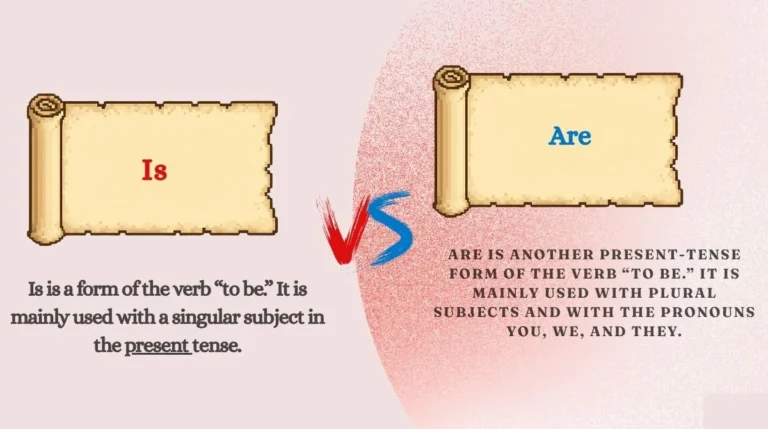
Is is a form of the verb “to be.” It is mainly used with a singular subject in the present tense.
You normally use is with:
- he
- she
- it
- one person
- one place
- one object
- one idea or thing
For example:
- He is my brother.
- She is a teacher.
- The car is outside.
- My phone is broken.
The word is can connect a subject to information about that subject. The information may describe a person or thing, identify it, show its condition, or tell where it is.
Basic grammar rule for “is”
Use:
Singular subject + is + information
Examples:
- The boy is tired.
- My mother is at home.
- This book is interesting.
- The weather is cold today.
Here, each subject is singular. We are talking about one boy, one mother, one book, and one condition of the weather.
When do we use “is”?
We use is in many common situations.
1. To describe someone or something
- Maria is kind.
- The house is beautiful.
- My dog is friendly.
- The soup is hot.
2. To identify a person or thing
- He is my cousin.
- This is my bag.
- That is the new manager.
- The red car is my uncle’s.
3. To talk about location
- Ali is in the kitchen.
- The book is on the table.
- My school is near the park.
- The doctor is in the office.
4. To talk about age or condition
- She is sixteen years old.
- The baby is asleep.
- My computer is very slow.
- The door is open.
“Is” in negative sentences
To make a negative sentence, add not after is.
Subject + is not + information
Examples:
- He is not ready.
- She is not angry.
- The shop is not open.
- It is not difficult.
In everyday speech, is not is often shortened to isn’t.
- He isn’t ready.
- She isn’t at home.
- It isn’t mine.
“Is” in questions
For questions, is usually comes before the subject.
Is + subject + …?
Examples:
- Is he your brother?
- Is she at work?
- Is the food ready?
- Is this your pen?
- Is the bus late?
A common mistake is keeping the normal statement order when asking a question. For example, “She is tired?” may sound possible in some situations as a surprised reaction, but the normal question is “Is she tired?”
Common learner confusion with “is”
Many students choose is simply because the sentence sounds natural to them. This becomes a problem when the subject is actually plural.
For example:
- The students is ready. ❌
- The students are ready. ✅
The word students tells us that more than one student is involved. That is why are is needed.
A useful habit is to look at the subject before choosing the verb. Do not choose the verb only because of the word directly next to it.
What Does “Are” Mean?
Are is another present-tense form of the verb “to be.” It is mainly used with plural subjects and with the pronouns you, we, and they.
You normally use are with:
- you
- we
- they
- two or more people
- two or more things
- plural nouns
Examples:
- You are right.
- We are busy.
- They are happy.
- The children are outside.
Basic grammar rule for “are”
Use:
Plural subject + are + information
Examples:
- The boys are tired.
- My friends are here.
- These shoes are expensive.
- The flowers are beautiful.
The subject is plural in each example, so are is the correct form.
“Are” with “you”
One important point for learners is that are is used with you, even when you are talking to one person.
For example:
- You are very kind.
- You are late.
- Are you okay?
It does not matter whether you means one person or several people. The correct form is still are.
This is one reason students sometimes find this verb pattern unusual. In many other languages, the form changes differently. In English, just remember:
You + are
“Are” in negative sentences
Use are not to make a negative sentence.
Examples:
- We are not ready.
- They are not here.
- You are not wrong.
- The children are not asleep.
In everyday English, are not is often shortened to aren’t.
- We aren’t ready.
- They aren’t home.
- You aren’t late.
“Are” in questions
In questions, are comes before the subject.
Examples:
- Are you hungry?
- Are they at school?
- Are we late?
- Are the children okay?
- Are these your keys?
This word order is important. Compare:
- They are busy.
- Are they busy?
The words are almost the same, but their order changes because one sentence is a statement and the other is a question.
Common learner confusion with “are”
One common mistake is using is with plural subjects because the noun closest to the verb is singular.
For example:
- My brother and sister is at home. ❌
- My brother and sister are at home. ✅
The subject contains two people, so it is plural.
Another mistake is forgetting that you takes are:
- You is my best friend. ❌
- You are my best friend. ✅
This is true whether you are speaking to one person or a group.
Difference Between Is and Are
The easiest way to understand the difference is to look at the subject.
Is is generally used with singular subjects, while are is generally used with plural subjects and with you.
| Subject | Correct form | Example |
|---|---|---|
| He | is | He is tired. |
| She | is | She is happy. |
| It | is | It is cold. |
| One person | is | John is here. |
| One thing | is | The book is new. |
| You | are | You are early. |
| We | are | We are ready. |
| They | are | They are busy. |
| Two or more people | are | Tom and Sara are friends. |
| Two or more things | are | The books are new. |
Usage difference
The biggest difference is the number of the subject.
Use is when the subject is normally singular:
- The cat is hungry.
- My sister is sleeping.
- The restaurant is crowded.
Use are when the subject is normally plural:
- The cats are hungry.
- My sisters are sleeping.
- The restaurants are crowded.
Grammar logic
Think of is as the partner of one, and are as the partner of more than one.
One → is
More than one → are
There is one special group to remember:
You → are
Even when “you” refers to only one person, English uses are.
Sentence structure difference
For statements:
Singular subject + is + complement
- The room is clean.
Plural subject + are + complement
- The rooms are clean.
For questions:
Is + singular subject + complement?
- Is the room clean?
Are + plural subject + complement?
- Are the rooms clean?
For negative sentences:
Singular subject + is not + complement
- The room is not clean.
Plural subject + are not + complement
- The rooms are not clean.
Meaning comparison
The choice between is and are usually does not change the main idea of the sentence. It shows whether the subject is singular or plural.
Compare:
- The apple is red.
- The apples are red.
Both sentences describe color. The first talks about one apple. The second talks about multiple apples.
Another example:
- My friend is busy.
- My friends are busy.
The basic meaning is similar, but the number of people changes.
Be careful with long subjects
A sentence can have many words before the verb, but the subject still controls whether you need is or are.
For example:
- The box of old photographs is under the bed. ✅
The noun photographs is plural, but it is not the main subject. The main subject is box, which is singular.
Now compare:
- The photographs in the box are old. ✅
Here, photographs is the subject, so are is correct.
This is a very common source of mistakes.
Grammar Rules You Must Remember
Rule 1: Use “is” with singular nouns
When the subject refers to one person, place, animal, object, or idea, use is.
Examples:
- The child is asleep.
- My teacher is helpful.
- The computer is expensive.
- This idea is useful.
A singular noun usually does not represent more than one thing.
Rule 2: Use “are” with plural nouns
When the subject refers to two or more people or things, use are.
Examples:
- The children are playing.
- My friends are outside.
- The windows are open.
- These lessons are useful.
Look carefully at the noun. Words such as children, friends, windows, and lessons are plural.
Rule 3: “You” always takes “are”
This is an important rule because you can mean one person or more than one person.
Examples:
- You are my friend.
- You are very helpful.
- You are late.
- Are you ready?
Avoid:
- You is kind. ❌
Correct:
- You are kind. ✅
It is best to memorize this as one small pattern:
You are
Rule 4: The real subject controls the verb
Do not choose is or are based only on the noun closest to the verb.
Look for the main subject.
Compare:
- The box of toys is heavy. ✅
- The toys in the box are heavy. ✅
In the first sentence, the subject is box.
In the second sentence, the subject is toys.
This rule is especially useful in longer sentences.
Common Mistakes Students Make
Students often make these mistakes because they focus on a nearby word instead of the real subject. Another reason is that spoken English can move quickly, so learners choose a verb without checking the noun first.
Here are some common errors.
Mistake 1: Using “is” with a plural subject
Wrong:
- The boys is playing football.
Correct:
- The boys are playing football.
Why? Boys means more than one boy.
Mistake 2: Using “are” with a singular subject
Wrong:
- My sister are a nurse.
Correct:
- My sister is a nurse.
There is only one sister in the sentence, so use is.
Mistake 3: Using “is” with “you”
Wrong:
- You is very nice.
Correct:
- You are very nice.
Remember the special rule: you + are.
Mistake 4: Getting distracted by another noun
Wrong:
- The box of books are on the floor.
Correct:
- The box of books is on the floor.
The noun books is plural, but the subject is box.
Ask yourself: “What is on the floor?” The answer is the box, not the books.
Mistake 5: Forgetting “and” usually makes the subject plural
Wrong:
- Sarah and John is here.
Correct:
- Sarah and John are here.
There are two people, so use are.
Mistake 6: Using the wrong form in questions
Wrong:
- Is they ready? ❌
Correct:
- Are they ready? ✅
Wrong:
- Are she at home? ❌
Correct:
- Is she at home? ✅
The same subject rule applies in questions.
Easy correction tip
Before choosing the verb, ask:
“Who or what is the subject?”
Then count it.
If it is one person or thing, use is.
If it is more than one, use are.
For you, use are.
That simple check can prevent many mistakes.
Easy Trick to Remember the Difference
Here is a simple classroom trick:
One = IS
Many = ARE
YOU = ARE
Imagine one apple on a table:
The apple is red.
Now imagine three apples:
The apples are red.
The idea becomes easy because the verb changes when the number changes.
You can also memorize these three groups:
He / She / It → IS
You / We / They → ARE
This is useful because these six pronouns appear constantly in everyday English.
Try saying them aloud:
He is. She is. It is.
You are. We are. They are.
After enough practice, the patterns start to feel natural.
Another helpful trick is to picture is as a “one-person verb” and are as a “group verb.” It is not a perfect description for every grammatical situation, but it is a very useful beginner memory aid.
When you see a sentence, do not rush. Find the subject first. That one habit is more useful than trying to memorize hundreds of separate sentences.
Daily Life Examples
The best way to understand these forms is to hear how people actually use them in normal conversations.
Example 1: Talking about a friend
A: Where is Ahmed?
B: He is at work.
The subject he is singular, so we use is.
Example 2: Talking to someone
A: Are you hungry?
B: Yes, I am.
The question uses are because the subject is you.
Example 3: Talking about a family
A: Where are your parents?
B: They are at home.
The subject they refers to more than one person.
Example 4: Talking about an object
A: Is your phone new?
B: No, it is quite old.
The subject it is singular.
Example 5: Talking about friends
A: Are your friends here?
B: Yes, they are in the garden.
The noun friends is plural.
Example 6: Talking about a place
A: Is the supermarket open?
B: Yes, it is open until midnight.
The subject supermarket is singular.
Example 7: Talking about several things
A: Where are my keys?
B: They are on the table.
Keys is plural, so are is needed.
Example 8: Talking about a pair
A: Where is my pair of shoes?
B: It is near the door.
Notice that the subject is pair, which is singular.
Example 9: Talking about two people
A: Where are Ali and Hamza?
B: They are in the classroom.
Two names joined by and usually give us a plural subject.
Example 10: Talking about school
Teacher: Are the students ready?
Student: Yes, they are ready.
The word students is plural, so are is correct.
These examples show that the choice is not about what sounds longer or more natural. It depends mainly on the subject.
Practice Section
Choose the correct answer in each sentence.
1. My brother ___ at school.
a) is
b) are
2. The children ___ playing outside.
a) is
b) are
3. You ___ very helpful.
a) is
b) are
4. The box of pencils ___ on the desk.
a) is
b) are
5. Sarah and Emma ___ best friends.
a) is
b) are
Answers
1. is — “My brother” is singular.
2. are — “Children” is plural.
3. are — “You” always takes are in the present tense of “to be.”
4. is — The subject is “box,” not “pencils.”
5. are — Two people are joined by and, so the subject is plural.
A good way to practice is to create your own sentences using things around you. Look around the room and say:
“The chair is brown.”
“The chairs are brown.”
“This book is interesting.”
“These books are interesting.”
Simple practice like this can make the rule automatic.
Frequently Asked Questions
What is the difference between “is” and “are”?
Is is generally used with singular subjects, such as he, she, it, or one noun. Are is used with plural subjects and with you, we, and they.
For example, “The boy is happy,” but “The boys are happy.”
Can we use “is” and “are” in questions?
Yes. Both can be used in questions.
Use is with singular subjects: “Is she ready?”
Use are with plural subjects or you: “Are they ready?” and “Are you ready?”
Is “are” used for one person?
Yes, when the subject is you.
You can speak to one person and still say, “You are my friend.” This is a standard English grammar rule.
The form does not change to “you is.”
Should I say “The team is” or “The team are”?
In standard English, team is usually treated as a singular collective noun in American English, so “The team is ready” is common. British English can sometimes use plural agreement with collective nouns depending on the meaning and context.
For beginners, use the team is when treating the team as one unit.
Is “There is” or “There are” correct?
Both are correct, but the noun after them usually determines the choice.
Use there is with a singular noun:
“There is a problem.”
Use there are with a plural noun:
“There are two problems.”
This is another situation where checking the real noun helps.
Which is correct: “There is many people” or “There are many people”?
The standard form is “There are many people.”
The noun people is plural, so are is needed.
Correct: “There are many people outside.”
Not standard: “There is many people outside.”
Conclusion
Understanding is and are becomes much easier when you stop trying to memorize every sentence separately. The key is to find the subject and decide whether it is singular or plural.
Use is with singular subjects such as he, she, it, and one person or thing. Use are with plural subjects such as we, they, and plural nouns. Remember one special point: you always takes are in the present tense of “to be.”
Also, do not let a nearby noun confuse you. In a sentence like “The box of books is heavy,” the subject is box, not books.
The more you read, speak, and write simple English sentences, the more natural these forms will become. Practice with everyday objects, people, and questions around you. Soon, choosing between is and are will feel easy and automatic.

Evan Rellmont is a writer who turns thoughtful ideas into meaningful words, creating stories and reflections that connect, inspire, and leave a lasting impression.