
English spelling can be confusing, especially when a word sounds different from the way it is written. Tweek or tweak is a good example.
When people hear the word tweak, they often think it should be spelled tweek because the pronunciation contains a long “ee” sound.
This is a very natural mistake for English learners.
The correct spelling for the common English word is tweak. It can be used as both a verb and a noun.
As a verb, tweak usually means to make a small change or adjustment to something so that it works better, looks better, or becomes more suitable.
It can also mean to pull or twist something with a small, quick movement. As a noun, tweak can mean a small change or adjustment.
The spelling tweek is usually not the form you should use when you mean “make a small change.” It commonly appears because people spell the word the way they think it sounds.
Wiktionary also records tweek as a misspelling of tweak in this ordinary English use, while noting a separate, very rare noun sense in a technical context.
Understanding this small spelling difference can help you write more accurately in school, work, emails, websites, and everyday English.
Once you learn the simple rule behind it, tweek or tweak becomes much easier to remember.
What Does “Tweek” Mean?
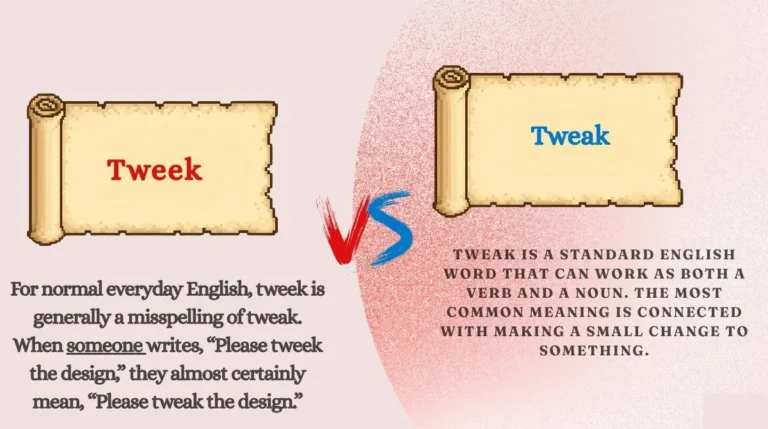
For normal everyday English, tweek is generally a misspelling of tweak. When someone writes, “Please tweek the design,” they almost certainly mean, “Please tweak the design.”
This mistake happens mainly because tweak is pronounced /twiːk/, which sounds very close to what a learner might naturally spell as “tweek.” Cambridge and Oxford list tweak as the standard English word, not tweek, for the meanings discussed here.
For example:
- Incorrect: Please tweek this paragraph.
- Correct: Please tweak this paragraph.
- Incorrect: I need to tweek the settings.
- Correct: I need to tweak the settings.
- Incorrect: She tweeked the recipe.
- Correct: She tweaked the recipe.
Why do people write “tweek”?
The biggest reason is pronunciation. The word tweak contains the long “ee” sound, the same general vowel sound heard in words such as week, seek, and speak. Because of this, spelling it with ee may seem logical.
But English spelling does not always match pronunciation in a simple way.
Compare these words:
- tweak
- week
- speak
- clean
- dream
They can contain a similar long “ee” sound, but their spellings are not identical. So hearing the sound of a word is not always enough to know how to spell it.
Another reason is simple typing. When someone writes quickly, they may automatically type tweek because it looks familiar. Once a spelling mistake becomes common online, other people may copy it.
Does “tweek” ever appear as something else?
There is a small exception worth knowing. Wiktionary records tweek as a rare noun for a type of radio interference and also lists tweek as a misspelling of tweak. This technical noun is very uncommon and is not the meaning English learners normally need in everyday writing.
So, for school assignments, general writing, conversations, workplace communication, blogs, and ordinary English, remember this:
Use “tweak,” not “tweek,” when you mean a small change or adjustment.
What Does “Tweak” Mean?
Tweak is a standard English word that can work as both a verb and a noun. The most common meaning is connected with making a small change to something.
Tweak as a verb
As a verb, tweak means to make a small change or adjustment, usually to improve something or make it more suitable.
Cambridge defines it as changing something slightly, especially to make it more correct, effective, or suitable. Oxford similarly gives the sense of making slight changes to a machine or system to improve it.
Here are some easy examples:
- I need to tweak my presentation before the meeting.
- She tweaked the recipe by adding a little more salt.
- The designer tweaked the color of the logo.
- We need to tweak the website before it goes live.
- He tweaked the settings on his phone.
- The teacher tweaked the lesson plan for younger students.
- They tweaked the plan after receiving feedback.
- I made a few changes and tweaked the final paragraph.
In these examples, the changes are usually small, not complete transformations.
Tweak as a noun
Tweak can also be a noun. In this form, it means a small change or adjustment.
For example:
- The website needs a few tweaks.
- I made a small tweak to the design.
- The new version has several useful tweaks.
- One little tweak made the instructions much clearer.
Cambridge lists the noun tweak as a slight change, while Oxford describes it as a slight change made to something to improve it.
Tweak can also mean a small pull or twist
There is another dictionary meaning that is useful to know. Tweak can describe a small, quick pull or twist. Oxford gives examples such as tweaking someone’s ear, while Cambridge describes it as pulling and twisting something with a small sudden movement.
For example:
- The child tweaked his father’s ear.
- She gave her brother’s nose a playful tweak.
- He tweaked a loose wire carefully.
This meaning is less common for beginners than the “small adjustment” meaning, but it is still a real use of the word.
Common learner confusion
Learners often confuse tweak with change, edit, or fix. These words are related, but they are not always identical.
Change is a broad word. It can describe something small or something very large.
Edit usually means changing written, recorded, or digital material.
Fix often means correcting a problem.
Tweak usually suggests a small adjustment, often made to improve something that is already mostly working.
For example:
- I changed the website.
This could mean a small or major change. - I redesigned the website.
This suggests a much larger change. - I tweaked the website.
This suggests a few small adjustments.
That small idea is the key to using tweak naturally.
Difference Between Tweek and Tweak
The main difference is spelling and standard usage.
| Word | Standard everyday spelling? | Meaning | Common use |
|---|---|---|---|
| Tweak | Yes | Make a small change; a small adjustment; a small pull or twist | Writing, technology, business, conversation |
| Tweek | Generally no for this meaning | Usually a misspelling of tweak | Common spelling error |
| Tweaked | Yes | Past tense/past participle of tweak | He tweaked the design |
| Tweaking | Yes | -ing form of tweak | She is tweaking the settings |
| Tweaks | Yes | Third-person verb or plural noun | He tweaks the plan / small tweaks |
The important point is that tweak is the standard spelling used by major learner dictionaries. Cambridge gives tweak as a verb and noun, and Oxford lists its verb forms as tweak, tweaks, tweaked, and tweaking.
Usage difference
In ordinary English, there is not a normal meaning difference such as there is between two separate words. Instead, tweek is generally what happens when someone spells tweak incorrectly.
For example:
Wrong:
I need to tweek the settings.
Correct:
I need to tweak the settings.
The sentence meaning does not change. The spelling changes from an incorrect form to the standard form.
Grammar logic
Tweak is a normal verb, so it follows common English verb patterns.
Present:
I tweak the design.
Third-person singular:
She tweaks the design.
Past:
She tweaked the design.
Present participle:
She is tweaking the design.
As a noun, it can appear with an article or as a plural:
I made a tweak.
We made several tweaks.
These forms are confirmed by Oxford’s dictionary entry for the verb.
Sentence structure difference
As a verb, tweak normally takes an object when it means making a small adjustment.
Subject + tweak + object
Examples:
- I tweaked the settings.
- She tweaked the recipe.
- They tweaked the schedule.
As a noun, the structure can be:
Subject + make + a tweak + to + object
Examples:
- I made a tweak to the settings.
- She made a small tweak to the recipe.
- They made a few tweaks to the schedule.
This distinction is useful because learners sometimes write tweak in the wrong grammatical position.
Meaning comparison
Think about these three sentences:
I changed the plan.
A general statement. The size of the change is not clear.
I edited the plan.
The plan was revised, perhaps by changing its wording or details.
I tweaked the plan.
Only small adjustments were made.
That is why tweak is especially common when talking about settings, designs, recipes, websites, documents, systems, schedules, and other things that need small improvements. Cambridge specifically gives examples involving software, paragraphs, menus, and other minor adjustments.
Grammar Rules You Must Remember
Rule 1: Use “tweak” for a small adjustment
When you want to say that you changed something slightly to improve it, tweak is the standard word.
Example:
I need to tweak the final paragraph.
This means the paragraph is already mostly fine, but it needs a small improvement.
Rule 2: The past tense is “tweaked”
Do not write tweeked when you mean the past tense of tweak.
Correct:
She tweaked the design yesterday.
Incorrect:
She tweeked the design yesterday.
Oxford lists tweaked as the past simple and past participle form.
Rule #3: The -ing form is “tweaking”
When using the continuous form, write tweaking.
Correct:
He is tweaking the settings.
Incorrect:
He is tweeking the settings.
Remember that the spelling comes from tweak + ing, giving tweaking. Cambridge lists tweaking as the present participle of tweak.
Rule 4: Use “tweak” as a noun for a small change
When you are talking about the change itself rather than the action, tweak can be a noun.
Example:
The website looks good, but it needs a few tweaks.
Here, tweaks means small changes.
You can also say:
I made one small tweak to the headline.
This is a very natural structure in modern English. Cambridge and Oxford both recognize this noun use.
Common Mistakes Students Make
Mistake 1: Writing “tweek” because it sounds right
This is probably the most common problem.
Wrong:
Please tweek this sentence.
Correct:
Please tweak this sentence.
The pronunciation can make the incorrect spelling seem reasonable. But pronunciation and spelling are not always a perfect match in English.
Easy tip:
Remember that the correct spelling is t-w-e-a-k.
Mistake 2: Writing “tweeked”
Learners may add -ed to the wrong spelling.
Wrong:
I tweeked the document.
Correct:
I tweaked the document.
First remember the base form tweak. Then add -ed:
tweak → tweaked
Mistake 3: Writing “tweeking”
The same problem happens with the -ing form.
Wrong:
We are tweeking the design.
Correct:
We are tweaking the design.
The correct form is:
tweak → tweaking
Mistake 4: Thinking “tweak” means any kind of change
Tweak usually suggests something small or slight.
For example:
I tweaked the recipe.
This suggests that you made a few minor changes.
But:
I completely changed the recipe.
This suggests a much bigger change.
That difference helps you choose the right word.
Mistake 5: Assuming “tweek” is a British spelling
English has some British and American spelling differences. For example, colour and color are both standard spellings.
Tweak and tweek are not like that.
The standard spelling tweak is used in both British and American English. Cambridge’s UK and US entries use tweak.
Mistake 6: Using “tweak” when “redesign” is needed
Imagine someone completely rebuilds a website from the ground up.
Saying:
We tweaked the whole website.
may sound too weak because tweak usually suggests smaller adjustments.
You could instead say:
We redesigned the whole website.
But if only the button size, spacing, or wording changed, tweaked would fit well.
Easy Trick to Remember the Difference
Here is a simple trick that works well for students:
Think: “Tweak = a little change.”
The word tweak is connected in your mind with something small.
Imagine your teacher looks at your homework and says:
“It is good. Just tweak a few sentences.”
The teacher is not asking you to write everything again. You only need to make small adjustments.
Now focus on the spelling:
T W E A K
The middle has ea, not ee.
You can remember it with this little sentence:
“Make a small tweak, not a big change.”
Whenever you are about to write tweek, stop and ask:
“Am I talking about a small change?”
If the answer is yes, write tweak.
Another useful method is to memorize the family of forms together:
tweak → tweaks → tweaked → tweaking
Seeing the correct forms as a group makes the spelling easier to remember.
A sound trick
The pronunciation is /twiːk/.
The spelling may surprise you because the long “ee” sound is written with ea.
So do not rely only on the sound. When writing, remember:
tweak = T + WEAK
The letters are not exactly a separate compound in meaning, but this visual trick can help you remember the spelling:
T + WEAK = TWEAK
That makes tweek easier to catch as a spelling mistake.
Daily Life Examples
Tweak is useful in many normal situations. You may hear it at work, at school, while using technology, or during everyday conversations.
1. At school
Teacher: Your essay is good, but you need to tweak the introduction.
Student: Sure. I will change a few sentences.
Here, tweak means make small improvements.
2. While cooking
Sara: How does the soup taste?
Ali: It is good, but maybe tweak the seasoning a little.
The cook does not need to make a completely new soup. Only a small adjustment is needed.
3. Using a phone
Friend: Why is your screen so dark?
You: I need to tweak the brightness settings.
The settings only need a small adjustment.
4. Working on a website
Designer: The page is almost ready.
Manager: Great. Just tweak the headline and spacing.
The website does not need a complete redesign.
5. Preparing for a meeting
Coworker: Have you finished the presentation?
You: Almost. I just need to tweak two slides.
This tells the listener that only minor changes remain.
6. Changing a plan
Friend: Are we still meeting at six?
You: Yes, but we may need to tweak the time a little.
The speaker is suggesting a small adjustment, not a completely different plan.
7. Writing an email
Manager: The email looks fine.
Employee: Should I tweak the last sentence?
This is a natural way to ask whether a small wording change is needed.
8. Adjusting a machine
Technician: The machine is working, but we need to tweak one setting.
Here, tweak refers to a small technical adjustment.
9. Improving a daily routine
Friend: You seem more organized lately.
You: I just tweaked my morning routine.
The speaker has made a few small changes rather than completely changing their lifestyle.
10. Editing a photo
Friend: Did you edit this picture?
You: Yes, I tweaked the brightness and contrast.
Again, only minor adjustments were made.
Practice Section
Choose the correct option in each sentence.
1. I need to ___ the settings before I use the app.
A. tweek
B. tweak
2. She ___ the recipe after trying it once.
A. tweaked
B. tweeked
3. We are ___ the final version of the report.
A. tweeking
B. tweaking
4. The designer made a small ___ to the logo.
A. tweak
B. tweek
5. The plan is good, but it needs a few ___.
A. tweaks
B. tweeks
Answers
1. B — tweak
The correct base form is tweak.
2. A — tweaked
The correct past tense is tweaked.
3. B — tweaking
The correct -ing form is tweaking.
4. A — tweak
As a noun, tweak means a small change.
5. A — tweaks
The plural noun is tweaks.
A useful way to practice is to write the whole word family several times:
tweak → tweaks → tweaked → tweaking
This helps your brain remember the correct spelling instead of trying to rebuild it from pronunciation every time.
FAQs
What is the difference between tweek and tweak?
For ordinary English, tweak is the standard spelling. It means to make a small change or adjustment, or it can mean a small pull or twist. Tweek is generally used as a misspelling of tweak.
Is tweek a correct spelling?
Usually, no. If you mean “make a small adjustment,” the correct spelling is tweak. Although Wiktionary records a rare technical noun spelled tweek, that is not the ordinary word English learners use for a small change.
Can I use tweak in a formal sentence?
Yes. Tweak is a standard English word and is used in professional, technical, business, and everyday contexts. Cambridge and Oxford both list it as a normal English verb and noun.
Is tweak a verb or a noun?
It can be both. As a verb, tweak means to make a small adjustment. As a noun, a tweak means a small change or adjustment. For example, “I tweaked the design” is a verb, while “I made a tweak to the design” uses the noun form.
What is the past tense of tweak?
The past tense is tweaked. For example: “We tweaked the schedule yesterday.” The past participle is also tweaked. Oxford lists tweaked as the past simple and past participle form.
How do you spell tweaking?
The correct spelling is tweaking, not tweeking. The word follows the base form tweak and takes the -ing ending. Cambridge lists tweaking as the present participle of tweak.
Conclusion
The spelling confusion between tweek or tweak is easy to understand because both forms may seem similar when spoken. However, for normal English writing, the word you need is tweak. It is a standard English verb and noun used for small changes, adjustments, or improvements. It can also describe a small pull or twist.
Remember the main forms: tweak, tweaks, tweaked, and tweaking. Avoid tweek, tweeked, and tweeking when you mean the common English word.
The easiest memory trick is to connect tweak with a small adjustment. You can think, “Just make a small tweak.” Once you start seeing and using the correct spelling in sentences, it will feel natural.
English spelling takes practice, and getting one word wrong does not mean you are a weak learner. Keep noticing confusing words, check their forms, and use them in your own sentences. A few minutes of practice can make a big difference in clear, confident English writing.

Evan Rellmont is a writer who turns thoughtful ideas into meaningful words, creating stories and reflections that connect, inspire, and leave a lasting impression.