
Have you ever wanted to write an expression of surprise and stopped because you were not sure whether to write “Whoa!” or “Woah!”? You are not alone.
These two spellings look almost identical, sound the same in normal speech, and are often used in the same situations.
The confusion becomes even greater when you see both forms online.
You may find whoa in a dictionary, while social media posts, text messages, songs, and casual conversations often use woah. So, which one should you choose?
The good news is that the difference is much simpler than it first appears.
Whoa is the older and more standard spelling, while woah is a recognized variant spelling that is especially common in informal writing.
Major dictionaries, including Cambridge and Collins, list woah as a variant of whoa.
Both forms can express surprise, excitement, or amazement. They can also be used to tell someone to stop or slow down.
The main difference is not meaning but spelling preference and level of formality.
By the end of this guide, you will know what whoa and woah mean, how they work in sentences, which spelling is safer for formal writing, and how to remember the difference easily.
What Does “Whoa” Mean?
Whoa is an interjection used to express a strong reaction. It can show surprise, excitement, amazement, or sudden concern. It can also be used as a command telling someone or an animal to stop or slow down.
The traditional use of whoa is connected with horses. A rider may say “Whoa!” to tell a horse to stop or slow down. The word is also commonly used with people when someone is moving too quickly, speaking too quickly, or going too far. Cambridge defines it as an exclamation used to tell a horse to stop, to tell a person to stop or slow down, or to show surprise or interest.
In modern everyday English, whoa is often similar to wow, especially when someone sees something surprising or impressive.
When Should You Use “Whoa”?
You can use whoa in several common situations.
First, use it as a command to stop or slow down:
Whoa! The horse is moving too fast.
Second, use it when you want a person to slow down:
Whoa, slow down. I cannot follow what you are saying.
Third, use it as an expression of surprise:
Whoa! That is an amazing view.
Fourth, use it to show that something is impressive:
Whoa, your new car looks great!
Because whoa is an interjection, it often appears by itself. It can also come before a larger sentence.
Grammar Rule for “Whoa”
Whoa is normally classified as an interjection or exclamation. It does not need a subject or verb to work as a complete expression.
For example:
Whoa!
That single word can stand on its own.
It can also appear at the beginning of a sentence:
Whoa, that was close.
Or inside a sentence:
I was, whoa, completely shocked by the result.
In normal writing, a comma or exclamation mark can help show the speaker’s pause or strong emotion.
Examples of “Whoa”
- Whoa! That was a close call.
- Whoa, your bicycle is really fast.
- Whoa! I did not expect to see you here.
- The rider shouted, “Whoa!”
- Whoa, slow down and listen to me.
- Whoa! Look at that beautiful mountain.
- Whoa, you have grown so much!
- Whoa! That movie was intense.
Common Learner Confusion
Many learners see whoa and think it is related to the question word who because of the letters at the beginning. It is not.
Whoa is an interjection. It is not a form of who, and it has nothing to do with asking about a person.
Compare:
Who is your teacher?
Here, who asks about a person.
Whoa! That was surprising.
Here, whoa expresses a reaction.
They look somewhat similar, but they have completely different jobs in English.
Another common problem is pronunciation. Most speakers pronounce whoa like woah, so learners may write the sound they hear instead of the standard spelling they have learned.
What Does “Woah” Mean?
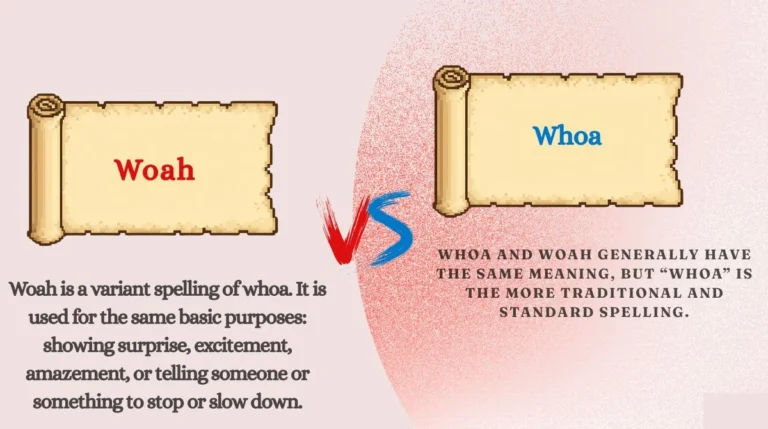
Woah is a variant spelling of whoa. It is used for the same basic purposes: showing surprise, excitement, amazement, or telling someone or something to stop or slow down.
Cambridge lists woah, along with whoah and woa, as alternative forms of whoa. Collins specifically describes woah as a variant spelling of whoa.
This means that woah is not a completely different word with a separate meaning. In most modern usage, it is simply another way of spelling the same interjection.
When Should You Use “Woah”?
You will often see woah in informal communication. It is common in text messages, social media, online comments, casual conversations written down, and other relaxed forms of writing.
For example:
Woah! That was amazing.
Or:
Woah, wait a minute!
The meaning is clear, and most English speakers will understand it immediately.
However, when you are writing something formal, such as a school assignment, professional document, academic paper, or carefully edited article, whoa is generally the better choice because it is the more established standard spelling. Dictionary.com describes whoa as the standard spelling and woah as a newer alternate form that is more often found in informal contexts.
Grammar Rule for “Woah”
Just like whoa, woah works as an interjection.
It can stand alone:
Woah!
It can begin a sentence:
Woah, that is a huge dog.
It can be repeated:
Woah, woah, woah! Calm down.
Because it is an interjection, its grammar is flexible. The important point is that it adds emotion or signals a reaction rather than performing the role of a normal noun, verb, or adjective.
Examples of “Woah”
- Woah! That is a beautiful painting.
- Woah, I did not see that coming.
- Woah! You finished already?
- Woah, slow down for a second.
- Woah! That roller coaster is huge.
- She looked at the price and said, “Woah!”
- Woah, this place is crowded.
- Woah! What just happened?
Common Learner Confusion
The biggest confusion is thinking that woah and whoa have different meanings. In most cases, they do not.
You can usually replace one with the other without changing the basic message:
Whoa! That is incredible.
Woah! That is incredible.
Both express surprise or excitement.
The real difference is spelling preference and style. Whoa is the safer standard form, while woah has a more informal feel.
Difference Between Whoa and Woah
The most important thing to remember is this:
Whoa and woah generally have the same meaning, but “whoa” is the more traditional and standard spelling. “Woah” is a recognized variant and is more associated with informal writing.
Here is a simple comparison.
| Feature | Whoa | Woah |
|---|---|---|
| Meaning | Surprise, excitement, stop, or slow down | Same |
| Part of speech | Interjection | Interjection |
| Pronunciation | Usually the same as “woah” | Usually the same as “whoa” |
| Standard spelling | More established | Variant spelling |
| Formal writing | Better choice | Usually less preferred |
| Casual writing | Common | Very common |
| Social media/texts | Common | Common |
| Horse command | Yes | Yes |
| Expression of surprise | Yes | Yes |
Usage Difference
There is no major difference in basic meaning.
When someone says:
Whoa! That’s expensive.
They are surprised by the price.
When someone says:
Woah! That’s expensive.
They are expressing essentially the same reaction.
The distinction comes from how the spelling is perceived. Whoa is generally the safer choice when you want your writing to look conventional and polished. Woah can feel more casual, conversational, or expressive.
Grammar Logic
Both words are interjections.
An interjection is a word or short expression that communicates a sudden emotion, reaction, or response. Other common interjections include:
- Wow!
- Oh!
- Ouch!
- Hey!
- Ah!
- Oops!
Whoa and woah work in a similar way.
You do not normally change them into different grammatical forms. You do not write:
whoas
or
woahing
when using the ordinary interjection.
Instead, you use them as short emotional expressions.
Sentence Structure Difference
Both can appear in the same sentence positions.
At the beginning:
Whoa, that was fast.
Woah, that was fast.
As a standalone expression:
Whoa!
Woah!
Before an instruction:
Whoa, slow down.
Woah, slow down.
Repeated for emphasis:
Whoa, whoa, wait!
Woah, woah, wait!
There is no important sentence-structure difference between them.
Meaning Comparison
The meanings can include:
1. Stop or slow down
Whoa! The horse is running too fast.
2. Ask a person to pause
Whoa, hold on. I need more information.
3. Surprise
Whoa! I wasn’t expecting that.
4. Amazement
Whoa, this view is incredible.
5. Strong reaction
Whoa! That was intense.
Both spellings can express these ideas.
Grammar Rules You Must Remember
Rule 1: “Whoa” and “Woah” are Interjections
Do not treat them like ordinary nouns or verbs. They are mainly used as emotional expressions or commands.
Example:
Whoa! That was loud.
Here, whoa expresses a reaction.
Rule 2: Use “Whoa” for the Safer Standard Spelling
When you are unsure which spelling to choose, whoa is the better default.
It is the older and more established spelling, while woah is a variant form.
Example:
Whoa! What a beautiful house!
This is a good choice for general writing.
Rule 3: Both Can Express Surprise or Amazement
You can use either form in casual writing when showing strong emotion.
Example:
Whoa! You actually won the race!
or
Woah! You actually won the race!
The meaning stays the same.
Rule 4: Use “Whoa” When Telling Someone to Stop or Slow Down
The word has a long history as a command associated with stopping or slowing a horse, and that use continues today.
It can also be used with people.
Example:
Whoa, slow down! You’re talking too quickly.
You may also see woah in the same kind of informal sentence.
Common Mistakes Students Make
Learners often make mistakes with this pair because pronunciation does not clearly tell you which letters to write.
Mistake 1: Thinking “Woah” Is Completely Wrong
It is too simple to say that woah is always wrong. Major dictionaries recognize it as a variant spelling of whoa.
Better understanding:
Whoa = standard, established spelling
Woah = recognized variant, often informal
So, do not panic when you see woah online.
Mistake 2: Thinking the Two Words Have Different Meanings
Some learners believe that one means surprise while the other means stopping.
That is not the normal distinction.
Both can express surprise, and both may be used to tell someone to stop or slow down.
Compare:
Whoa! Look at that!
Woah! Look at that!
Both show surprise.
Mistake 3: Using “Who” Instead of “Whoa”
Because whoa begins with “who,” learners sometimes leave out the final letters.
Wrong:
Who! That is amazing.
Correct:
Whoa! That is amazing.
Who and whoa are completely different words.
Mistake 4: Using “Whoa” in Every Formal Sentence
Although whoa is the standard spelling, it is still an informal interjection. It may not fit a formal academic sentence.
For example, instead of writing:
Whoa! The results are unbelievable!
in a formal research report, a better choice might be:
The results are surprising.
The issue here is not spelling. It is tone.
Mistake 5: Assuming Pronunciation Changes
In most everyday English, whoa and woah are pronounced essentially the same. That is one major reason learners have trouble choosing the spelling.
So, do not rely only on what you hear. Remember the spelling preference.
Easy Trick to Remember the Difference
Here is a very easy trick:
H Comes Before O in “Whoa”
Think about a horse.
When you want a horse to stop, you say:
Whoa!
Now connect the H in horse with the H in whoa.
Horse → Whoa
This can help you remember that whoa is the traditional spelling.
You can also use this simple memory sentence:
“Whoa” is the one I know for a horse to stop.
Then remember that woah is the alternative spelling you are likely to see in casual online writing.
Another useful trick is:
W-H-O-A = the standard choice.
When you are writing an email, school assignment, website article, or other carefully edited text, choose whoa unless you have a reason to copy a deliberately informal style.
Daily Life Examples
These examples show how native and fluent English speakers may use the expression in everyday situations.
Example 1: Seeing Something Beautiful
Ali: Look at that sunset!
Sara: Whoa! It’s beautiful.
Here, whoa shows surprise and admiration.
Example 2: Asking Someone to Slow Down
John: I have ten things to tell you.
Mike: Whoa, slow down! One thing at a time.
Here, whoa means “wait” or “slow down.”
Example 3: Seeing a High Price
Customer: How much is this laptop?
Clerk: It’s $2,000.
Customer: Woah! That’s expensive.
Here, woah expresses surprise. It sounds natural in casual speech and informal writing.
Example 4: A Fast Car
Tom: Did you see how fast that car was?
Ben: Whoa! It was flying.
The word shows amazement.
Example 5: Stopping a Horse
Rider: Whoa, boy! Easy.
The rider is telling the horse to slow down or stop. This is the traditional use of the expression.
Example 6: Hearing Unexpected News
Emma: I got the job!
Lily: Whoa! Really?
Here, whoa shows surprise and excitement.
Example 7: Stopping an Argument
Father: You never listen to me!
Son: Woah, wait. I am listening.
The expression asks the other person to pause and calm down.
Example 8: Seeing a Huge Animal
Sam: Look at the size of that dog!
David: Whoa! I’ve never seen one that big.
Again, the word expresses surprise.
Example 9: A Surprising Result
Teacher: You got every question right.
Student: Woah! Seriously?
The spelling woah gives this casual conversation a relaxed feeling.
Example 10: Asking Someone to Stop
Mia: I’m going to tell everyone your secret.
Nina: Whoa, hold on!
Here, whoa tells the speaker to stop and wait before continuing.
Practice Section
Choose the better answer for each sentence.
1. ______! That roller coaster is huge.
A. Who
B. Whoa
C. Whom
2. ______, slow down. You’re going too fast.
A. Whoa
B. Whose
C. Who
3. ______! I can’t believe we won.
A. Woah
B. Who
C. Whom
4. Which spelling is the safer choice for formal or carefully edited writing?
A. Woah
B. Whoa
5. Which statement is correct?
A. Whoa and woah usually have the same basic meaning.
B. Whoa is a noun and woah is a verb.
C. They have completely different meanings.
Answers
- B. Whoa
- A. Whoa
- A. Woah
- B. Whoa
- A. Whoa and woah usually have the same basic meaning.
The third answer shows an important point: woah can be perfectly understandable and acceptable as a variant, especially in informal writing. However, whoa remains the safer standard spelling.
FAQs
What is the difference between whoa and woah?
Whoa and woah generally have the same meaning. Both can express surprise, excitement, amazement, or a request to stop or slow down.
The main difference is spelling and style. Whoa is the more established standard spelling, while woah is a recognized variant that is especially common in informal writing.
Is “woah” a correct spelling?
Yes, woah is a recognized variant spelling of whoa. Cambridge lists it as an alternative form, and Collins describes it directly as a variant spelling.
Still, whoa is the better choice when you want the more standard and conventional spelling.
Is “whoa” formal or informal?
Whoa is an informal interjection, even though it is the more standard spelling of the two. It is natural in conversation, dialogue, fiction, and casual communication.
In very formal writing, you may want to replace it with a more direct phrase such as “That is surprising” or “Please slow down.”
Can we use “whoa” in questions?
Yes. You can use whoa before or inside a question when you want to show surprise.
For example:
Whoa, did you really do that?
It can also appear by itself before a question:
Whoa! What happened?
The expression adds emotion to the question.
Can “whoa” mean “stop”?
Yes. Whoa has traditionally been used as a command telling a horse to stop or slow down. It is also used with people when you want them to stop, pause, or slow down.
For example:
Whoa! Stop right there.
Which is better: whoa or woah?
When you are unsure, choose whoa.
It is the older and more established spelling and is generally the safer option in standard or carefully edited English. Woah is a recognized variant and works well in informal communication, including casual online writing.
Conclusion
The difference between whoa and woah is easier than it looks. Both are used as interjections, and both can express surprise, excitement, amazement, or a request to stop or slow down. In most everyday situations, they communicate the same idea.
The main point to remember is spelling preference. Whoa is the older and more established form, so it is usually the best choice for standard and carefully edited English. Woah is a recognized variant spelling and is especially common in informal writing, such as social media posts and casual messages.
So, when you are writing and cannot decide, use whoa. It is the safest option. When you see woah, remember that it is not a completely different word. It is simply another spelling of the same expressive sound. A little practice will make this pair easy to handle.

Evan Rellmont is a writer who turns thoughtful ideas into meaningful words, creating stories and reflections that connect, inspire, and leave a lasting impression.