
Passed and past are two English words that confuse many learners. They sound almost the same when spoken, but they do not have the same meaning or grammar use.
A small difference in spelling can completely change a sentence.
For example, we can say, “She passed the exam.” Here, passed is a verb. But in “She walked past the school,” past is not the same kind of word. It tells us about movement and location.
The confusion becomes even greater because both words can be connected with time.
You may hear someone say, “The time passed quickly,” while another person says, “We drove past the old house.” Both sentences are correct, but the words work in different ways.
Understanding this difference is important because these words appear often in everyday English.
You may use them when talking about exams, driving, walking, time, deadlines, places, events, or things that happened before now.
The good news is that the difference is quite easy once you understand the basic rule.
Passed is mainly the past form of the verb pass, while past usually talks about an earlier time, a position beyond something, or movement from one place to another.
By the end, you should be able to choose the correct word confidently in both writing and conversation.
What Does “Passed” Mean?
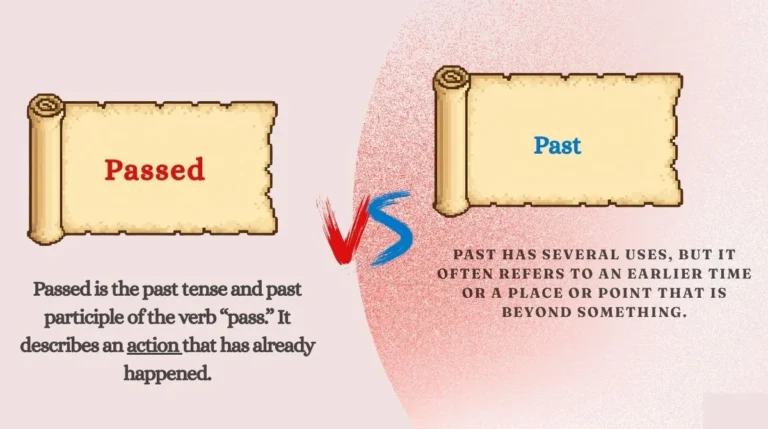
Passed is the past tense and past participle of the verb “pass.” It describes an action that has already happened.
The verb pass has several meanings. You can pass a test, pass someone on the road, pass an object to another person, pass through a place, or pass by a location.
When we change the verb into the past, pass becomes passed.
Pass → Passed
For example:
- I pass the library every morning.
- I passed the library yesterday.
The word passed is a verb, so it normally describes an action.
When Should You Use “Passed”?
Use passed when you are talking about an action related to the verb pass.
One very common use is talking about success in a test or exam.
Examples:
- I passed my driving test yesterday.
- She passed the English exam on her first try.
- Tom passed the ball to his brother.
- The car passed us on the highway.
- We passed several shops on our way home.
- He passed through the security gate quickly.
- Three hours passed before the doctor arrived.
- The teacher passed the books around the classroom.
Notice that passed describes something that happened or changed.
In “She passed the exam,” the person succeeded.
In “The car passed us,” the car moved ahead of us.
In “Three hours passed,” time moved forward.
Grammar Rule for “Passed”
Because passed is a verb form, it can appear where a verb is needed.
It can be used:
- after a subject: He passed the test.
- with a helping verb: She has passed the test.
- in a past action: We passed the store.
- as part of a verb phrase: The message was passed to everyone.
A useful test is to ask:
“Can I replace this word with another action verb?”
For example:
She passed the exam.
You can replace passed with completed, finished, or cleared depending on the meaning. That shows that passed is functioning as a verb.
A Common Confusion About “Passed”
Learners sometimes use passed simply because the sentence talks about an earlier time.
That does not always work.
For example:
❌ We walked passed the house.
✅ We walked past the house.
Why? Because the sentence needs a word that shows the house was beside or beyond the walkers. Here, past is correct.
Another common error is:
❌ In the past year, I passed very busy.
That sentence does not make sense because passed is an action verb and cannot replace a time expression.
The key idea is simple: passed describes an action; it does not simply mean “before now.”
What Does “Past” Mean?
Past has several uses, but it often refers to an earlier time or a place or point that is beyond something.
Unlike passed, past is not normally a verb.
It can work as:
- a noun
- an adjective
- a preposition
- an adverb
That is one major reason learners get confused.
“Past” for Earlier Time
When past refers to time, it means a period that has already happened.
Examples:
- We learned a lot from the past.
- She was happier in the past.
- I do not want to repeat my past mistakes.
- The past few weeks have been very busy.
- He often talks about his past experiences.
- In the past, people traveled much more slowly.
- My past job taught me many useful skills.
- We cannot change the past.
In these sentences, past refers to something that happened before the present time.
“Past” for Movement or Location
Past can also describe movement beyond a person, place, or object.
Examples:
- We walked past the bank.
- She drove past my house.
- A man ran past us.
- The bus went past the school.
Here, past often means by and beyond.
In “The bus went past the school,” the bus moved beyond the school.
“Past” for Time on a Clock
You may also hear past when talking about the time.
For example:
- It is ten past three.
- It is twenty past six.
- It was five past nine.
Here, past means that a certain number of minutes have gone beyond the hour.
Grammar Rule for “Past”
Because past can have different grammar roles, its position in a sentence can change.
As a preposition:
We walked past the station.
As an adjective:
This is a story from my past life.
As a noun:
You cannot change the past.
As an adverb:
The train moved past.
This is very different from passed, which is a form of the verb pass.
Difference Between Passed and Past
The easiest way to understand these words is to remember that they belong to different grammar categories.
| Word | Main Grammar Role | Basic Meaning | Example |
|---|---|---|---|
| Passed | Verb | Completed an action or moved beyond something | She passed the exam. |
| Past | Noun, adjective, preposition, adverb | Earlier time or beyond a point/place | We walked past the store. |
Usage Difference
Use passed when you need an action.
He passed the ball.
The action is pass.
Use past when you are describing an earlier time, a position beyond something, or movement by something.
He walked past the ball.
Here, past tells us about his movement in relation to the ball.
Compare these:
The car passed me.
This means the car moved ahead of me. Passed is the verb.
The car drove past me.
Here, drove is the verb. Past describes where the car moved in relation to me.
This is one of the most useful comparisons for learners.
Grammar Logic
A simple grammar test can help.
Ask:
Is this word doing the action?
If yes, passed may be correct.
- She passed the test.
- He passed the car.
- They passed the message.
Now ask:
Is this word showing an earlier time or a position beyond something?
If yes, use past.
- I remember my past.
- We walked past the museum.
- It is ten minutes past five.
Sentence Structure Difference
Passed often appears as the main verb or part of a verb phrase.
Subject + passed + object
- She passed the exam.
- He passed the ball.
- We passed the store.
Past often follows a verb of movement or comes before a noun.
Verb + past + place/person
- We walked past the park.
- She drove past the school.
- They ran past us.
It can also be used before a noun:
Past + noun
- past mistakes
- past experiences
- past events
- past relationships
Meaning Comparison
Think about these two sentences:
I passed the school.
This can mean I went by the school, and passed is the action verb.
I walked past the school.
Here, walked is the action, while past tells us where I moved.
Both can describe a similar event, but their grammar is different.
Another pair:
She passed her exam.
= She succeeded.
She talked about her past exam.
= She talked about an exam that happened earlier.
The meaning changes because the words play different roles.
Grammar Rules You Must Remember
Rule 1: Use “Passed” as the past form of “Pass”
When the action happened in the past, pass changes to passed.
Examples:
- I passed my test.
- He passed the ball.
- We passed the restaurant.
Remember:
Pass → Passed
This rule is especially useful with exams, tests, objects, people, and movement.
Rule 2: Use “Past” for an Earlier Time
When you mean a time before now, use past.
Examples:
- She has learned from the past.
- We cannot return to the past.
- In the past, people wrote letters more often.
- The past year has been difficult.
You can often connect past with words such as years, weeks, days, events, experiences, mistakes, and memories.
For example:
the past year
past mistakes
past experiences
Rule 3: Use “Past” After Movement Verbs to Mean “Beyond”
When someone or something moves beyond a person or place, past is often used.
Examples:
- We walked past the hospital.
- The cyclist rode past me.
- The children ran past the teacher.
- I drove past your office.
A useful structure is:
movement verb + past + person/place
For example:
walked past the shop
ran past the gate
drove past the house
Rule 4: “Passed” Usually Needs a Verb Position, While “Past” Does Not
This rule helps you see the difference in longer sentences.
Correct:
The train passed the station.
Here, passed is the verb.
Also correct:
The train went past the station.
Here, went is the verb and past describes the movement.
Incorrect:
❌ The train went passed the station.
Correct:
✅ The train went past the station.
The word went already provides the action. You need past, not passed, to describe the train’s movement.
Common Mistakes Students Make
Many mistakes happen because the two words sound almost identical. When people speak quickly, the difference is hard to notice. Students may know the meaning but still choose the wrong spelling when writing.
Mistake 1: “Walked passed”
❌ We walked passed the supermarket.
✅ We walked past the supermarket.
The verb is walked. Past tells us where we walked.
Mistake 2: Using “past” for passing an exam
❌ I past my final exam.
✅ I passed my final exam.
Here, the sentence needs the verb passed.
Mistake 3: Using “passed” before a noun to mean earlier
❌ I remember my passed experiences.
✅ I remember my past experiences.
Past is the adjective describing experiences that happened before.
Mistake 4: “Went passed”
❌ The car went passed our house.
✅ The car went past our house.
The verb is went. Therefore, use past.
Mistake 5: Confusing “past” with “passed” in time expressions
❌ The past quickly.
✅ The time passed quickly.
Here, passed is the verb.
But:
✅ The past few days were stressful.
Here, past describes the period of time.
Easy Correction Tip
When you are unsure, look at the word before and after it.
If the sentence needs an action, think passed.
If the sentence talks about earlier time or movement beyond something, think past.
Try asking:
“What is the action?”
If the answer is pass, use passed for the past tense.
Then ask:
“Does this mean before now or beyond something?”
If yes, past is probably the right choice.
Easy Trick to Remember the Difference
Here is a very simple memory trick:
Passed = Action
Think:
Passed = Pass + ed
The -ed ending is a strong clue that you are looking at a past verb.
- pass → passed
- walk → walked
- call → called
- clean → cleaned
So when someone did something, passed can be the action.
She passed the exam.
Past = Time or Place
Think of past as pointing away from the present.
It can mean:
before now
or
beyond a place
For example:
In the past, I lived there.
The time is earlier.
I walked past the house.
The movement goes beyond the house.
A quick memory line is:
Passed is an action. Past is time or position.
Say that sentence a few times, and the difference becomes much easier to remember.
Another useful trick is to look for another verb.
We walked past the school.
There is already a verb: walked.
So past is the correct word.
But:
We passed the school.
Now passed itself is the verb.
Daily Life Examples
These words appear constantly in normal conversation. Here are some examples you may hear at school, at work, at home, or while traveling.
1. Talking about an exam
A: How was your driving test?
B: It went well. I passed!
Here, passed means succeeded.
2. Talking about a street
A: Where is the pharmacy?
B: Walk past the bank and turn left.
Here, past means move beyond the bank.
3. Talking about time
A: What time is it?
B: It is fifteen past seven.
Here, past is part of a time expression.
4. Talking about a car
A: Did you see that blue car?
B: Yes, it passed us very quickly.
Here, passed is the past form of pass.
5. Talking about an old mistake
A: Do you still think about that mistake?
B: Sometimes, but I have learned from my past.
Here, past means earlier experiences.
6. Giving directions
A: Is the hotel far from here?
B: No. Go past the post office, and you will see it.
Past shows movement beyond the post office.
7. Talking about work
A: Did you finish the training test?
B: Yes, and I passed it.
Again, passed is the verb.
8. Talking about a building
A: Why didn’t you stop at the café?
B: I didn’t notice it. I drove past it.
The verb is drove, so past gives information about the movement.
9. Talking about history
A: Why do you like history?
B: I enjoy learning about the past.
Here, past is a noun.
10. Talking about time passing
A: I can’t believe how quickly this year went.
B: I know. The months passed so fast.
Here, passed is the verb because the time moved by.
Practice Section
Choose passed or past to complete each sentence.
1. I ______ my English test last week.
A. past
B. passed
2. We walked ______ the library.
A. past
B. passed
3. I learned a lot from my ______ mistakes.
A. passed
B. past
4. The bus ______ us without stopping.
A. passed
B. past
5. The children ran ______ the teacher.
A. passed
B. past
Answers
1. Passed — “Passed” is the past tense of pass and describes success in a test.
2. Past — “Walked” is already the verb, so past shows movement beyond the library.
3. Past — These are mistakes that happened earlier.
4. Passed — The bus performed the action of moving ahead of us.
5. Past — The children moved beyond the teacher.
A useful habit is to explain the reason, not just memorize the answer. When you know why a word is correct, you are less likely to make the same mistake later.
FAQs
What is the difference between passed and past?
Passed is usually the past form of the verb pass. Past usually refers to an earlier time or something beyond a particular point or place.
For example, “I passed the exam” uses passed as a verb. “I walked past the school” uses past to describe movement.
Can “past” be used in questions?
Yes. Past can appear in many types of questions.
For example:
“What happened in the past?”
“Did you walk past the station?”
“What time is it? Is it ten past four?”
So there is no problem using past in questions.
Can “passed” be used in a sentence about time?
Yes, when passed is a verb meaning that time moved forward.
For example:
“Three hours passed very quickly.”
However, when you are describing an earlier period, use past:
“The past three hours were difficult.”
The first sentence focuses on time moving; the second describes an earlier period.
Is “past” a noun or a verb?
Past can be a noun, adjective, preposition, or adverb, but it is not normally used as the past-tense form of pass.
For example:
“We learned from the past.” — noun
“past mistakes” — adjective
“walk past the house” — preposition
Which is correct: “walk past” or “walk passed”?
The correct expression is “walk past.”
For example:
✅ We walked past the school.
The word walked is the verb, while past tells us that the movement went beyond the school.
“Walked passed” is a common spelling mistake.
Which is correct: “I passed the house” or “I past the house”?
Use “I passed the house.” Here, passed is the verb meaning that you went beyond the house.
You can also say:
“I walked past the house.”
Both can be correct, but the grammar is different. In the second sentence, walked is the verb and past describes the movement.
Conclusion
The difference between passed and past is much easier once you stop thinking about how they sound and focus on their grammar.
Passed is connected to the verb pass. It describes an action that happened in the past, such as passing an exam, passing a person, passing an object, or time passing.
Past usually refers to an earlier time or something that is beyond a person, place, or point. It can also be used in clock expressions, such as ten past five.
The most useful memory rule is simple:
Passed = action.
Past = time or position.
When you write, look for the role of the word in the sentence. Ask yourself whether you need a verb or whether you are talking about an earlier time or movement beyond something.
A little practice will make the difference feel natural. Pay attention to these words when reading, listening, and speaking English, and soon you will choose the right one without stopping to think.

Evan Rellmont is a writer who turns thoughtful ideas into meaningful words, creating stories and reflections that connect, inspire, and leave a lasting impression.