
Preform or perform can be confusing because the two words look almost the same.
They have the same ending, and only one small part changes: pre- appears at the beginning of preform, while per- appears in perform.
When you are typing quickly, writing an assignment, or speaking English, it is easy to choose the wrong word.
The confusion becomes even greater because perform is a very common English word, while preform is much less common.
In everyday English, people usually use perform when they mean “do,” “carry out,” or “entertain.” For example, we say, “She will perform a song” or “The doctor will perform an operation.” Cambridge and Oxford both list these meanings for perform.
However, preform is also a real word. It does not simply mean “perform.” It means to form, shape, or prepare something before a later stage.
It is often used in manufacturing, science, linguistics, and technical writing. Dictionaries define preform as forming or shaping something beforehand.
By the end of this guide, you will know exactly when to use preform and when to use perform, how their meanings differ, which spelling belongs in common sentences, and how to remember the difference without getting confused again.
What Does “Preform” Mean?
Preform is a real English word. It is not just a wrong spelling of perform.
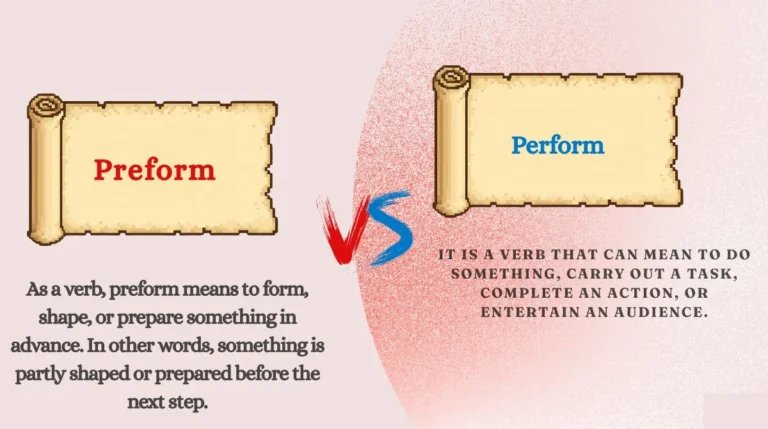
As a verb, preform means to form, shape, or prepare something in advance. In other words, something is partly shaped or prepared before the next step. Collins defines preform as shaping, constructing, or bringing something into existence in advance.
The word can also be used as a noun. A preform can be an object that has already gone through an early stage of shaping but is not yet in its final form. The American Heritage Dictionary gives this meaning and also notes a technical linguistics use for a reconstructed ancestral word or form.
When should you use “preform”?
Use preform when you are talking about making something before another process, especially when the first shape or stage is not the final one.
This word is more common in technical or specialized contexts than in everyday conversation.
For example:
- A factory may preform a piece of plastic before heating it.
- Engineers may create a preform before making the final product.
- A material can be preformed into a rough shape before further processing.
- In specialized writing, something may be preformed before it reaches its final stage.
The basic idea is:
preform = form beforehand
The prefix pre- usually carries the idea of “before.” That makes the meaning easier to understand: preform means to form something before the final process.
Grammar rule for “preform”
Preform is mainly used as a verb when an action of shaping or forming happens ahead of another stage.
Common forms include:
- preform — present/base form
- preforms — third-person singular
- preformed — past tense and past participle
- preforming — -ing form
Dictionary sources confirm these verb forms.
Examples of “preform”
- The manufacturer preforms the plastic before heating it.
- The workers preformed the material into a basic shape.
- The machine can preform the parts before final assembly.
- The glass was preformed before it was processed into fiber.
- Engineers tested the preformed material before production began.
- The factory uses special equipment to preform each component.
- The technician carefully preformed the soft material into the required shape.
- The bottle begins as a plastic preform before it is expanded into its final shape.
Notice that these examples all involve a stage that comes before the finished result.
A common confusion with “preform”
Many learners see preform and think it must be the correct spelling whenever they hear a word that sounds like “perform.” That is not true.
For everyday meanings such as doing a task, carrying out an action, acting on stage, singing, or showing how well something works, the correct word is usually perform, not preform.
For example:
She will perform at the school concert.
Not:
She will preform at the school concert.
The first sentence is correct because the person is entertaining an audience. Cambridge and Oxford both use perform for this meaning.
So, do not choose preform just because it contains the familiar word form. Look at the meaning first.
What Does “Perform” Mean?
Perform is the much more common word in everyday English.
It is a verb that can mean to do something, carry out a task, complete an action, or entertain an audience. It can also describe how well a person, machine, product, company, or system works. Cambridge and Oxford both give these major uses.
When should you use “perform”?
Use perform when someone does a task or action, especially when the action is planned, formal, or specific.
We often use it with words such as:
- perform a task
- perform an operation
- perform a duty
- perform an experiment
- perform a role
- perform a ceremony
- perform a function
It is also common when talking about entertainment:
- perform a song
- perform a dance
- perform a play
- perform on stage
- perform live
Another important use is talking about performance or results:
- The car performed well.
- The computer performed badly.
- The team performed better today.
- The company is performing well.
Cambridge specifically gives perform well/badly for describing satisfactory or poor functioning.
Grammar rule for “perform”
Perform is a verb.
Its common forms are:
- perform
- performs
- performed
- performing
Oxford lists these standard forms.
Depending on the meaning, perform can be transitive or intransitive.
A transitive use has an object:
The surgeon performed the operation.
An intransitive use does not need a direct object:
The singer performed beautifully.
It can also be followed by words such as well, badly, poorly, better, or successfully:
The new machine performed well during the test.
Examples of “perform”
- The doctor will perform the operation tomorrow.
- Our class will perform a short play at the festival.
- She can perform the song without any help.
- The students were asked to perform a simple experiment.
- He always performs his duties carefully.
- The new computer performs much better than the old one.
- The band will perform live tonight.
- The team performed well in the final match.
These are all normal uses of perform.
Common learner confusion with “perform”
A frequent mistake is to write preform when the intended meaning is “do” or “carry out.”
For example:
The nurse will perform the test.
This is correct.
The nurse will preform the test.
This is normally incorrect because there is no idea of forming something in advance. The sentence is about carrying out a procedure.
The same problem appears in sentences about music:
The singer will perform tonight.
Not:
The singer will preform tonight.
One small spelling difference changes the word and therefore changes the meaning.
Difference Between Preform and Perform
The easiest way to understand the difference is to focus on their central ideas.
Preform is connected with forming something beforehand.
Perform is connected with doing, carrying out, entertaining, or functioning.
Comparison Table
| Word | Part of Speech | Main Meaning | Common Use | Example |
|---|---|---|---|---|
| Preform | Verb / Noun | Form or shape beforehand | Technical, manufacturing, specialized contexts | The factory will preform the material. |
| Perform | Verb | Do, carry out, entertain, or function | Everyday, academic, business, medical, entertainment | The doctor will perform the operation. |
Usage difference
The biggest difference is the action being described.
When the action is about creating an early shape, use preform.
The plastic is preformed before heating.
When the action is about doing a task, use perform.
The technician will perform the test.
When the action is about entertaining an audience, use perform.
The musicians will perform tonight.
When you describe how well something works, use perform.
This engine performs well in cold weather.
Grammar logic
The prefix pre- is a useful clue.
Words beginning with pre- often contain the idea of before, such as:
- preview = view before
- prepay = pay before
- preheat = heat before
- pretest = test before
- preform = form before
So preform has a logical structure:
pre + form = form before
That does not explain the history of every English word perfectly, but it is a useful memory aid for learners.
Perform, however, has its own established meaning. It is not simply preform without the “r.” It is the word we use for carrying out actions, entertaining, and describing how something works.
Sentence-structure difference
Because perform is common in general English, you will often see it followed by a task or action:
Subject + perform + object
The doctor performed the procedure.
The students performed the experiment.
She performed the song.
You can also use it without a direct object:
Subject + perform + adverb
The machine performed well.
He performed poorly.
With preform, the structure usually focuses on something being shaped or prepared before another process:
Subject + preform + object
The machine preforms the material.
Or in passive form:
Object + be + preformed
The material was preformed before production.
Meaning comparison
Think of the two words this way:
Preform → shape it first.
Perform → do it or carry it out.
That one distinction solves most everyday questions.
Grammar Rules You Must Remember
Rule 1: Use “perform” for tasks and actions
When you mean do or carry out, choose perform.
The technician will perform the safety check.
The students performed the experiment carefully.
Do not use preform in these ordinary situations.
Rule 2: Use “perform” for entertainment
When someone sings, acts, dances, or entertains an audience, use perform.
The children will perform a play.
The singer performed in front of thousands of people.
Oxford specifically lists performing music and acting as a major meaning of the verb.
Rule 3: Use “preform” when something is shaped beforehand
When you mean form or shape in advance, use preform.
The workers preformed the material before the final process.
The parts are preformed before assembly.
This is a specialized use, so you are less likely to see it in simple daily conversation. Dictionary sources define it specifically around advance shaping or forming.
Rule 4: “Perform well” means work or function well
When talking about the quality or operation of something, perform is the correct word.
The new phone performs well in low light.
The car performed badly during the test.
She performed well in the examination.
Cambridge gives perform well/badly as a standard use for how successfully someone or something operates or does something.
Common Mistakes Students Make
The main reason learners make this mistake is simple: the words look and sound very similar.
Another reason is that preform is a genuine English word. This means spell-checkers or dictionaries may not always mark it as completely meaningless. A person can accidentally type preform in a sentence where perform is needed, and the word may still look like a valid word.
Mistake 1: Using “preform” for a performance
Wrong:
The children will preform at the school event.
Correct:
The children will perform at the school event.
Why? They are entertaining an audience. They are not forming something beforehand.
Mistake 2: Using “preform” for a task
Wrong:
The doctor will preform the operation.
Correct:
The doctor will perform the operation.
Why? The doctor is carrying out the operation.
Mistake 3: Using “perform” when something is shaped first
Wrong in a technical context:
The factory will perform the plastic before molding.
Correct:
The factory will preform the plastic before molding.
Here, the action is specifically about creating an earlier shape.
Mistake 4: Thinking “preform” is always wrong
This is another mistake.
Some websites and spelling guides treat preform as a frequent misspelling of perform, but that does not mean the word has no legitimate meaning. Established dictionaries recognize preform as a verb and noun.
The better rule is:
Do not ask only, “Is preform a real word?” Ask, “Does its meaning fit this sentence?”
Easy correction tip
Look at the sentence and replace the word mentally.
If you can replace it with:
do / carry out / entertain / function
→ use perform.
If you can replace it with:
shape beforehand / form in advance
→ use preform.
Easy Trick to Remember the Difference
Here is a simple classroom trick:
PRE = BEFORE
Remember:
PREform = form before.
The word pre- gives you the clue.
Think about these examples:
- preheat = heat before
- preview = view before
- prepay = pay before
- preform = form before
So when something is made into an early shape before the final stage, preform makes sense.
Now remember:
PERFORM = DO
When someone does a job, carries out an action, or entertains people, use perform.
You can create one simple question in your mind:
“Am I forming something first, or am I doing something?”
If the answer is forming first, choose preform.
If the answer is doing or carrying out, choose perform.
For example:
The singer will ___ tonight.
Is the singer forming something beforehand? No.
Is the singer entertaining people? Yes.
So:
The singer will perform tonight.
Another example:
The machine will ___ the material before heating.
Is the machine doing a performance for people? No.
Is it shaping the material beforehand? Yes.
So:
The machine will preform the material.
This simple meaning test is much more useful than trying to memorize two spellings separately.
Daily Life Examples
Here are easy examples that show how the words work in real situations.
1. At a school event
Teacher: Are your students ready for the school show?
Teacher 2: Yes. They will perform a short play tonight.
The students are entertaining an audience, so perform is correct.
2. At a hospital
Patient: When will the doctor do the operation?
Nurse: The doctor will perform the operation tomorrow morning.
An operation is something a doctor carries out, so use perform.
3. Talking about a computer
Manager: How is the new computer working?
Employee: It performs much better than our old one.
Here, perform means “work or function.”
4. Talking about a singer
Friend: Who is singing at the festival?
Friend 2: Sara will perform with her band.
Again, this is entertainment.
5. Talking about an experiment
Teacher: What do you need to do next?
Student: We need to perform the experiment carefully.
The students are carrying out an experiment.
6. Talking about a machine
Engineer: What happens before the final manufacturing stage?
Worker: The machine preforms the material first.
This is a technical use. The material gets an early shape before the final step.
7. Talking about a plastic bottle
Worker: What is this small plastic object?
Engineer: It is a preform that will later be expanded into a bottle.
Here, preform is a noun for an object that has undergone preliminary shaping.
8. Talking about an exam
Student: How did Ali do in the test?
Teacher: He performed very well.
Here, performed very well means he did very well.
9. Talking about a ceremony
Guest: Who will lead the ceremony?
Organizer: The priest will perform the ceremony.
The ceremony is being carried out, so perform is correct.
10. Talking about production
Engineer: Why do we preform this material?
Worker: Because it needs an early shape before the final process.
This sentence clearly shows the special meaning of preform.
Practice Section
Choose the correct word: preform or perform.
1. The singer will ___ at the concert tonight.
a) preform
b) perform
2. The doctor will ___ the operation tomorrow.
a) preform
b) perform
3. The machine will ___ the material before the final stage.
a) preform
b) perform
4. The new car ___ very well on rough roads.
a) preforms
b) performs
5. The factory uses a plastic ___ before making the final bottle.
a) preform
b) perform
Answers
1. perform
The singer is entertaining an audience.
2. perform
The doctor is carrying out an operation.
3. preform
The material is shaped beforehand.
4. performs
The car is being described in terms of how well it works.
5. preform
Here, preform is a noun for an object in an earlier stage of production.
FAQs
What is the difference between preform and perform?
Perform usually means to do, carry out, entertain, or function successfully. Preform means to form or shape something beforehand. Perform is extremely common in everyday English, while preform is more specialized.
Is preform a correct English word?
Yes. Preform is a real English word. As a verb, it can mean to form or shape something in advance. As a noun, it can refer to an object that has been partly shaped before final processing.
Is “preform” a misspelling of “perform”?
Sometimes it is. In many everyday sentences, people accidentally type preform when they mean perform. However, preform itself is not an incorrect word. Its legitimate meaning is connected with forming or shaping something beforehand.
Can we use “perform” in questions?
Yes. Perform can easily be used in questions.
For example:
Will the band perform tonight?
Did the doctor perform the procedure?
How did she perform in the exam?
The word works naturally in questions just as it does in statements.
Is “perform” formal or informal?
Perform can be used in both everyday and formal English. It is common in conversations about music, school, work, sports, machines, business, medicine, and many other areas.
When should I use “preform” instead of “perform”?
Use preform when the meaning is shape or form beforehand. Use perform for doing or carrying out an action, entertaining an audience, or describing how well something works. A quick meaning check usually gives you the correct answer.
Conclusion
The difference between preform and perform becomes much easier when you focus on meaning instead of spelling.
Perform is the word you will use most often. It means to do something, carry out a task, entertain an audience, or work in a certain way. You can perform an operation, perform a task, perform a song, or perform well in an exam.
Preform, on the other hand, has a more specific meaning. It means to form or shape something beforehand. It is especially useful in technical and manufacturing contexts, and it can also be used as a noun for an object that is only partly formed.
Just remember one easy idea:
PREform = form before.
PERform = do or carry out.
Once you connect each spelling with its meaning, this confusing pair becomes much easier. Read the examples, practice making your own sentences, and soon you will naturally know which word fits.

Evan Rellmont is a writer who turns thoughtful ideas into meaningful words, creating stories and reflections that connect, inspire, and leave a lasting impression.