
Have you ever typed “loose” when you actually meant “lose”? Or perhaps you have seen someone write “I don’t want to loose my phone” and wondered whether it was correct?
You are not alone. Loose and lose are two of the most commonly confused English words. They look almost the same, and their pronunciation is also very similar.
However, they have different meanings, different grammar roles, and different sounds at the end.
The good news is that the difference is actually easy once you connect each word with its main idea.
Loose usually describes something that is not tight, not firmly attached, or not held in place.
Lose is a verb that means to no longer have something, fail to win, or be unable to find something.
Cambridge Dictionary, for example, defines loose as something “not firmly held or fastened” or “not tight,” while lose is used for situations where you no longer have something or cannot find it.
This small spelling difference can completely change a sentence. Compare:
- My shirt is loose.
- I might lose my shirt.
The first sentence talks about clothing that is not tight. The second talks about no longer having the shirt.
Understanding this difference will help you write better emails, messages, school assignments, and everyday English.
It will also make your speaking more natural because you will know exactly which word fits the situation.
What Does “Loose” Mean?
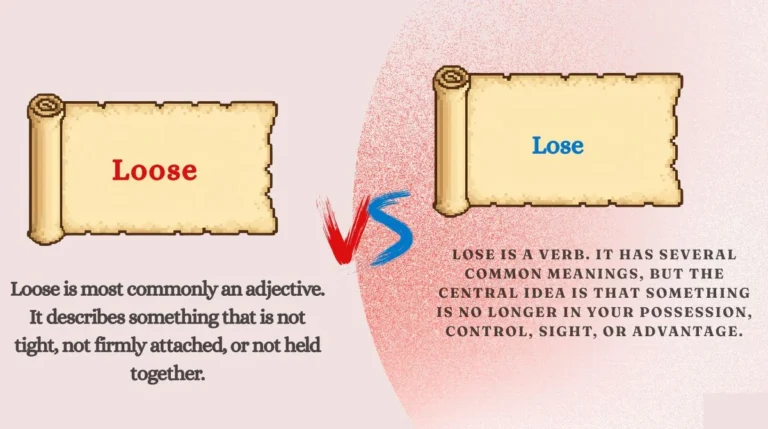
Loose is most commonly an adjective. It describes something that is not tight, not firmly attached, or not held together. It can describe clothes, wires, buttons, hair, papers, animals, and many other things.
Think of the basic idea as:
Loose = not tight or not firmly fixed
For example, when a shirt does not fit closely around your body, it is loose. When a screw is not tight, it can also be called loose. A dog that has escaped from its leash may be described as loose because it is free to move around.
When should you use “loose”?
Use loose when you are describing the condition of something.
It often answers the question:
“What is it like?”
For example:
- The dress is loose.
- The button is loose.
- My shoelace is loose.
- There is a loose wire.
- She wears loose clothing.
In these sentences, loose describes a noun. That is why it is usually working as an adjective.
Cambridge Dictionary also gives the meaning of loose for clothing that does not fit closely and for things that are not firmly attached.
Grammar rule for “loose”
The most common pattern is:
Subject + be + loose
Examples:
The rope is loose.
The knot is loose.
His shirt is loose.
You can also place loose before a noun:
a loose button
loose clothes
a loose tooth
a loose wire
Here are some everyday examples:
- My jeans are too loose around the waist.
- One of the buttons on my coat is loose.
- The dog got loose from its leash.
- There is a loose cable under the desk.
- She prefers loose shirts in hot weather.
- The knot is loose, so it may come undone.
- I found a few loose papers under the table.
- The child was running around with loose hair.
Notice that loose is connected with the idea of something being free, relaxed, separate, or not tight.
A common confusion with “loose”
Many learners accidentally use loose when they mean lose.
For example:
❌ I don’t want to loose my wallet.
✅ I don’t want to lose my wallet.
Why is the first one wrong? Because the speaker is talking about no longer having a wallet. That is the meaning of lose, not loose.
Another common mistake is:
❌ Don’t loose your keys.
✅ Don’t lose your keys.
The first sentence would suggest something very different because loose does not normally mean “misplace.”
There is one interesting detail: loose can also be a verb, although this use is much less common in everyday English. As a verb, loose can mean to release something, set something free, or make something less tight.
For example:
The rider loosed the horse.
However, beginners usually need to focus on the common adjective loose first.
What Does “Lose” Mean?
Lose is a verb. It has several common meanings, but the central idea is that something is no longer in your possession, control, sight, or advantage.
Think of:
Lose = no longer have, cannot find, or fail to win
Cambridge Dictionary lists several common uses, including not being able to find something, no longer having something, having less of something, and failing to win a game or competition.
When should you use “lose”?
Use lose when something disappears from your possession, when you cannot find it, or when you do not win.
For example:
I lose my keys all the time.
This means you often cannot find your keys.
Our team lost the game.
This means your team did not win.
She lost her job.
This means she no longer has her job.
He is trying to lose weight.
Here, lose means to have less weight.
So, although the meanings are different, they all involve the idea of something being gone, reduced, or no longer possessed.
Grammar rule for “lose”
Because lose is a verb, it can change depending on the tense.
The basic forms are:
lose → lost → lost
The present form is lose.
The past tense and past participle are lost. Cambridge Dictionary also lists lost as both the past simple and past participle form.
Examples:
I lose my keys often.
I lost my keys yesterday.
I have lost my keys.
With continuous forms, we use losing:
I am losing my patience.
Here are eight useful examples:
- I always lose my phone at home.
- She lost her wallet on the bus.
- We could lose the match if we stop trying.
- He doesn’t want to lose his job.
- I don’t want to lose touch with my old friends.
- You may lose your chance if you wait too long.
- She is trying to lose weight.
- I lost my way in the city.
Why is “lose” sometimes difficult to spell?
A major reason is pronunciation.
Lose is pronounced with a /z/ sound at the end, while loose has an /s/ sound. Cambridge gives lose as /luːz/ and loose as /luːs/.
They may sound close when spoken quickly, especially for English learners, so spelling mistakes are common.
Try saying them slowly:
lose — luːz
loose — luːs
The vowel sound is similar, but the final sound changes.
Difference Between Loose and Lose
The easiest way to understand the difference is to focus on meaning and grammar, not just spelling.
| Word | Part of Speech | Main Meaning | Common Example |
|---|---|---|---|
| Loose | Adjective | Not tight or not firmly attached | My shoes are loose. |
| Lose | Verb | No longer have, cannot find, or fail to win | I don’t want to lose my shoes. |
| Loose | Verb, less common | Release or make less tight | He loosed the rope. |
| Lose | Verb | Miss, fail to keep, or reduce | She lost her chance. |
1. Usage difference
Use loose when you are describing something.
The shirt is loose.
Use lose when something happens to something or someone.
I may lose the shirt.
The first word tells us about a condition. The second tells us about an action or result.
2. Grammar logic
This is one of the most useful grammar clues.
Loose is commonly an adjective:
The rope is loose.
Lose is a verb:
I lose the rope.
You can think of the difference like this:
Loose = description
Lose = action
This simple rule will solve many spelling problems.
3. Sentence structure difference
Because loose is often an adjective, it can appear after linking verbs such as is, are, was, were.
The button is loose.
His pants were loose.
Because lose is a verb, it can appear after a subject as the main action:
I lose my keys.
She lost her ticket.
They may lose the game.
You can also use lose after helping verbs:
I will lose it.
He might lose his job.
We could lose the match.
Notice how naturally the verb fits into an action-based sentence.
4. Meaning comparison
Compare these pairs:
The knot is loose.
The knot is not tight.
I may lose the knot.
This would mean you may no longer have it, although this is not a common sentence.
Here is a clearer pair:
My shoelace is loose.
The shoelace is not tied tightly.
I might lose my shoe.
I might no longer have my shoe.
Another pair:
The dog is loose.
The dog is not tied up or contained.
I don’t want to lose my dog.
I don’t want my dog to disappear or no longer be with me.
These examples show why one letter can make a big difference.
Grammar Rules You Must Remember
Rule 1: Use “loose” for something that is not tight
When something is relaxed, wide, or not firmly fixed, loose is usually the correct word.
Example:
This jacket is too loose for me.
Other examples:
The screw is loose.
My shoelaces are loose.
A useful question to ask is:
“Is it tight?”
If the answer is no, you may need loose.
Rule 2: Use “lose” when you no longer have something
When something is misplaced, taken away, or no longer in your possession, use lose.
Example:
Be careful not to lose your passport.
More examples:
I lost my keys.
She lost her phone.
He lost his job.
Ask yourself:
“Am I talking about no longer having something?”
If yes, choose lose.
Rule 3: Use “lose” for games, competitions, and success
When a person or team does not win, use lose.
Example:
Our team lost the final game.
You can also say:
We might lose.
They lost by two points.
He doesn’t like to lose.
The adjective loose has nothing to do with winning or losing a competition.
So this is wrong:
❌ We may loose the game.
Correct:
✅ We may lose the game.
Rule 4: Remember the different past forms
Loose is usually an adjective, so it does not become lost.
But lose is an irregular verb:
lose → lost → lost
For example:
Present: I lose my keys.
Past: I lost my keys.
Perfect: I have lost my keys.
Never write:
❌ I loosed my phone yesterday.
When you mean “I no longer had my phone,” write:
✅ I lost my phone yesterday.
There is a real verb loosed, but it has a different and much less common meaning related to releasing or making something loose.
Common Mistakes Students Make
The mistakes with these two words usually happen because they look so similar.
Mistake 1: “Loose my keys”
❌ I always loose my keys.
✅ I always lose my keys.
Keys do not become less tight. You are saying that you cannot find them or no longer have them.
Mistake 2: “Lose shirt”
❌ This shirt is lose.
✅ This shirt is loose.
The shirt is not fitting tightly, so loose is needed.
Mistake 3: “Loose the game”
❌ Our team will loose the game.
✅ Our team will lose the game.
A team can lose a game, but a game cannot normally make a team “loose.”
Mistake 4: Confusing “loose” with “loosen”
Another spelling problem is the relationship between loose and loosen.
Loose can describe a condition:
My tie is loose.
Loosen is the verb meaning to make something less tight:
Please loosen your tie.
This distinction is helpful:
loose = not tight
loosen = make less tight
Cambridge defines loosen as causing something to become loose or making something less tight.
Easy correction tip
When you are unsure, stop and ask:
Am I describing something, or am I talking about losing something?
If you are describing something that is not tight, use loose.
If you mean “no longer have,” “cannot find,” or “not win,” use lose.
Easy Trick to Remember the Difference
Here is a simple memory trick that many students find useful:
Loose has two “o”s because it has extra space.
Think about it:
loose = extra space
A loose shirt has extra space.
A loose rope has extra space.
A loose button is not held tightly.
Now remember:
lose = something goes away
You lose your keys.
You lose a game.
You lose your phone.
You lose patience.
You can also remember the final sounds:
Loose → /s/
Lose → /z/
Try saying:
loooose — the ending sounds like “s”
loooze — the ending sounds like “z”
The visual trick is probably easier for beginners:
Loose = space
Lose = gone
Imagine your shirt is hanging away from your body. It is loose.
Now imagine your phone was in your hand, but suddenly you cannot find it. You lost it.
That mental picture can help you remember the spelling much faster than memorizing a dictionary definition.
Daily Life Examples of Loose and Lose
These words appear all the time in normal conversations. Here are some simple examples you might hear at home, at school, at work, or while shopping.
1. Talking about clothes
A: How does this shirt look?
B: It looks nice, but it’s a little loose.
Here, loose describes the size of the shirt.
2. Looking for keys
A: Where are your keys?
B: I don’t know. I think I lost them.
Here, lost means you cannot find them.
3. Talking about shoes
A: Why are you walking so slowly?
B: My shoes are loose.
The shoes do not fit tightly.
4. Warning a child
A: Where is your phone?
B: It’s in my bag.
A: Keep it safe. Don’t lose it.
The speaker is warning the child not to misplace it.
5. At the dentist
A: Your tooth feels strange.
B: Yes, I think it’s loose.
A loose tooth is not firmly fixed in place.
6. During a football match
A: Are we going to win?
B: I hope so. We can’t lose this match.
Here, lose means fail to win.
7. Fixing a chair
A: This chair is moving.
B: One of the screws is loose.
The screw is not tight enough.
8. Talking about confidence
A: Why did she stop speaking?
B: She lost confidence.
Here, lost means she no longer had the same confidence.
9. Getting ready for a trip
A: Where’s your passport?
B: I hope I don’t lose it while traveling.
Again, lose means no longer have or cannot find.
10. Talking about a bag
A: Is the strap okay?
B: No, it’s loose. I need to fix it.
The strap is not firmly attached or tight enough.
These examples are worth practicing aloud. Speaking the sentences can help connect the spelling, sound, and meaning in your memory.
Practice Section: Choose the Correct Word
Choose loose or lose in each sentence.
1. I don’t want to ______ my wallet.
2. These trousers are too ______ for me.
3. Be careful, or you might ______ your phone.
4. One of the wires is ______.
5. Our team cannot afford to ______ this match.
Answers
1. lose
You may no longer have your wallet.
2. loose
The trousers are not tight.
3. lose
You might misplace or no longer have your phone.
4. loose
The wire is not firmly fixed.
5. lose
The team might fail to win the match.
A good habit is to explain the reason, not just memorize the answer. When you understand why the word is correct, you are less likely to make the same mistake later.
FAQs About Loose and Lose
What is the difference between loose and lose?
Loose usually describes something that is not tight, not firmly attached, or not held in place. Lose is a verb meaning to no longer have something, fail to find it, or fail to win. For example, “My shirt is loose” but “I don’t want to lose my shirt.”
Is “loose” a verb or an adjective?
Loose is most commonly used as an adjective, especially when describing something that is not tight or firmly attached. It can also be used as a verb, meaning to release something or make something less tight, but that use is much less common in everyday English.
Is “lose” a verb?
Yes. Lose is a verb. It can mean to misplace something, stop having something, fail to win, or have less of something. Its past tense is lost, and its past participle is also lost.
How do you pronounce loose and lose?
Loose ends with an /s/ sound, while lose ends with a /z/ sound. Their vowel sounds are similar, but the final consonant is different. Cambridge lists loose as /luːs/ and lose as /luːz/.
Is it “loose weight” or “lose weight”?
The correct expression is lose weight. Weight is something you can have less of, so the verb lose is used. For example, “She wants to lose weight.” The phrase loose weight is incorrect in standard English. Cambridge also lists lose with the meaning of having less weight.
Is it “loose your keys” or “lose your keys”?
The correct expression is lose your keys. You lose something when you can no longer find or have it. Loose does not mean “misplace.” For example, “I often lose my keys” is correct.
Conclusion
Loose and lose may look almost identical, but their meanings are very different. The easiest way to remember them is to connect each word with one simple idea.
Loose usually means not tight, not firmly attached, or free. You can have a loose shirt, loose shoelaces, a loose button, or a loose wire.
Lose is a verb. It means to no longer have something, be unable to find it, or fail to win. You can lose your keys, lose your phone, lose confidence, or lose a game.
When you are writing, ask yourself one quick question: Am I describing something that is not tight, or am I talking about something being gone? That simple question can prevent most mistakes.
Practice these words in short sentences, especially in situations you experience every day. The more you use them, the more natural the difference will feel.
Loose means “not tight.” Lose means “no longer have or fail to win.” Keep that sentence in your mind, and this common English confusion becomes much easier.

Evan Rellmont is a writer who turns thoughtful ideas into meaningful words, creating stories and reflections that connect, inspire, and leave a lasting impression.