
Choosing between Ms or Miss can be confusing, especially for English learners.
Both words are used before a woman’s name, and they can look almost the same in a sentence.
However, they do not always communicate the same information.
The confusion often comes from one simple question: Does the title tell us whether a woman is married or not? Traditionally, Miss was used for an unmarried woman, while Mrs. was linked with married women.
Ms became a useful alternative because it does not tell the reader whether a woman is married.
This small difference matters in emails, letters, job applications, school settings, official forms, and everyday conversations.
Using the right title can make your English sound more natural and respectful.
Many learners also wonder about pronunciation. Ms is usually pronounced “miz,” while Miss is pronounced “miss.” They are not pronounced in the same way.
By the end of this guide, you will understand what Ms and Miss mean, when to use each one, how their grammar works, what mistakes to avoid, and how native English speakers use these titles in real life.
What Does “Ms” Mean?
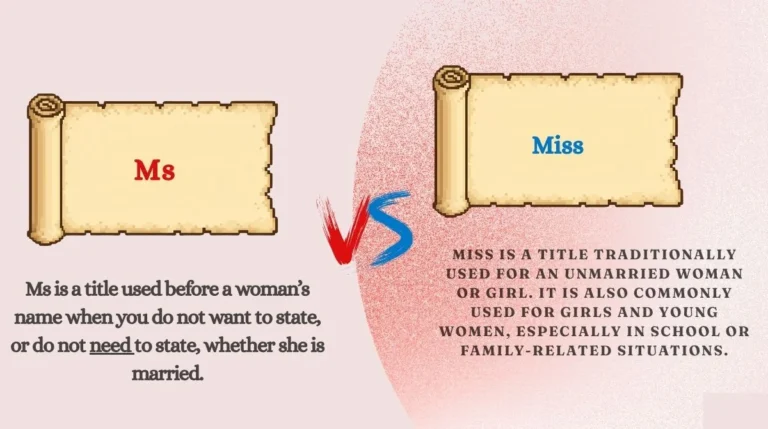
Ms is a title used before a woman’s name when you do not want to state, or do not need to state, whether she is married.
It is commonly used for adult women in modern English. It is especially common in professional, business, academic, and formal situations.
For example:
- Ms Johnson will speak at the meeting.
- I sent the email to Ms Brown.
- Please ask Ms Taylor to call me.
- Ms Ahmed is our new manager.
- I have an appointment with Ms Carter.
- The letter was addressed to Ms Wilson.
- Ms Khan teaches English at the college.
- Could you please forward this message to Ms Green?
The main idea is simple: Ms does not tell us if the woman is married, single, divorced, or widowed.
That is one reason it is often a safe choice when you are unsure which title a woman prefers.
When Should You Use Ms?
You can use Ms when:
- You do not know the woman’s marital status.
- Her marital status is not relevant.
- You are writing in a professional or formal setting.
- You want to avoid making assumptions about her personal life.
- You know she prefers the title Ms.
For example, imagine you are sending a business email to a woman named Sarah Lee. You do not know whether she is married.
You can write:
Dear Ms Lee,
This is completely natural and professional.
You do not need to know whether Sarah is married before using Ms.
Grammar Rule for Ms
Ms is normally placed before a woman’s surname or full name.
Correct patterns include:
Ms + surname
- Ms Smith
- Ms Patel
- Ms Garcia
Or:
Ms + first name + surname
- Ms Sarah Smith
- Ms Maria Patel
In formal writing, the title is usually followed by a family name rather than just a first name.
We generally do not write:
Ms Sarah
That sounds unnatural in standard formal English.
How Is “Ms” Pronounced?
Ms is usually pronounced /mɪz/, which sounds like “miz.”
This is important because many learners see the spelling and assume it is pronounced like Miss. It is not.
Compare:
- Ms = “miz”
- Miss = “miss”
- Mrs = usually “mis-iz” or a similar pronunciation depending on accent
A Common Confusion About Ms
Some students think Ms means “a married woman.”
It does not.
Other learners think it means “a single woman.”
It does not.
Ms is neutral about marital status.
That is its main purpose.
What Does “Miss” Mean?
Miss is a title traditionally used for an unmarried woman or girl. It is also commonly used for girls and young women, especially in school or family-related situations.
For example:
- Miss Adams is my teacher.
- I spoke to Miss Brown yesterday.
- Miss Lily is waiting outside.
- Miss Carter joined the school last year.
- Please give this note to Miss Wilson.
- Miss Khan is our class teacher.
- I saw Miss Taylor at the shop.
- The receptionist called Miss Green.
Traditionally, Miss gives the listener information about marital status: the woman is understood to be unmarried.
However, real-world usage can depend on age, culture, profession, and personal preference.
When Should You Use Miss?
Use Miss when:
- A woman or girl is known to prefer that title.
- You are referring to an unmarried woman in a context where that information is relevant.
- You are speaking to or about a girl or young woman, especially in some school settings.
- The title is part of a person’s preferred form of address.
For example, a teacher may be called Miss Brown by students even though students may not know anything about her marital status.
Similarly, in some countries and schools, female teachers are commonly addressed as Miss + surname.
Grammar Rule for Miss
Like Ms, Miss comes before a woman’s name.
The common structure is:
Miss + surname
Examples:
- Miss Jones
- Miss Ali
- Miss Davis
- Miss Robinson
You can also use a full name:
- Miss Emma Jones
- Miss Olivia Davis
But in formal English, Miss is normally used with the family name.
Miss as a General Form of Address
There is another use of Miss that learners should know.
In some varieties of English, especially in certain service or school situations, Miss can be used to address a woman or girl even when her name is unknown.
For example:
“Excuse me, Miss. You dropped your phone.”
Or a teacher may say:
“Miss, could you help me?”
This usage can vary by country and social setting. In other situations, using a person’s name or a neutral form of address may sound more natural.
A Common Confusion About Miss
Many students learn one simple rule:
Miss = unmarried woman
That rule is useful, but it is not the complete picture.
Modern English is more flexible. A woman may prefer Ms regardless of whether she is married. Another woman may personally prefer Miss.
So, when addressing a real person, the safest approach is often to follow the title the person uses herself.
Difference Between Ms and Miss
The biggest difference between Ms and Miss is the information they give about marital status.
Miss traditionally identifies a woman as unmarried.
Ms does not identify her marital status.
This makes Ms especially useful in professional English, where marital status usually has nothing to do with the person’s role.
Ms vs Miss Comparison Table
| Feature | Ms | Miss |
|---|---|---|
| Basic meaning | Title for a woman without stating marital status | Traditionally a title for an unmarried woman or girl |
| Pronunciation | “Miz” | “Miss” |
| Marital status | Neutral | Traditionally unmarried |
| Common use | Professional, formal, general | Girls, unmarried women, some school settings |
| Adult women | Yes | Yes, traditionally if unmarried |
| Can be used when marital status is unknown? | Yes | Traditionally less suitable |
| Example | Ms Johnson | Miss Johnson |
Usage Difference
Suppose your new manager is named Linda Brown.
You do not know whether she is married.
A natural business greeting is:
Dear Ms Brown,
Using Miss Brown may suggest that you know she is unmarried or that she uses that title.
This is why Ms is often a practical choice in modern professional communication.
Grammar Logic
Both titles work in a similar grammatical position. They come before a person’s name and function as titles of address.
Examples:
- Ms Parker
- Miss Parker
The sentence structure is the same. The meaning attached to the title is what changes.
Compare:
Ms Parker is our accountant.
This says nothing about her marital status.
Miss Parker is our accountant.
Traditionally, this suggests that Parker is unmarried.
Sentence Structure
The title normally appears directly before the surname.
Title + Surname
Examples:
- Ms Brown
- Miss Brown
- Ms Ahmed
- Miss Ahmed
You may also use:
Title + First Name + Surname
Examples:
- Ms Emma Brown
- Miss Emma Brown
In normal formal writing, however, title + surname is usually the cleaner choice.
Meaning Comparison
The difference can be remembered like this:
Ms = woman, marital status not stated
Miss = traditionally unmarried woman or girl
That is the most useful distinction for everyday English.
Grammar Rules You Must Remember
Rule 1: Use Ms When Marital Status Is Not Important
When you are writing professionally and there is no reason to discuss whether a woman is married, Ms is often the best choice.
Example:
Dear Ms Wilson,
Thank you for your message.
You do not need personal information about her marriage to write a professional email.
Rule 2: Miss Traditionally Refers to an Unmarried Woman or Girl
Use Miss when the person is unmarried and the title matches the context or the person’s preference.
Example:
Miss Adams teaches music at our school.
Traditionally, this title indicates that Adams is unmarried.
Remember, though, that people do not always follow traditional rules in exactly the same way.
Rule 3: Do Not Use “Ms” and “Miss” as If They Were Pronounced the Same
Their spellings are short, so learners often say them incorrectly.
Ms is pronounced “miz.”
Miss is pronounced “miss.”
Example:
“Good morning, Ms Clark.”
The first title has a z-like ending sound.
Rule 4: Follow a Person’s Preferred Title
Modern English gives people more choice in how they are addressed.
A woman may prefer:
- Ms
- Miss
- Mrs
- another professional or personal form of address
If you know the title she uses, follow it.
Example:
If a business contact signs her emails as “Ms Sarah Khan,” it is polite to use Ms Khan in your reply.
This is especially important in professional communication.
Common Mistakes Students Make
English learners often make mistakes with these titles because textbooks sometimes teach only the old traditional rules.
Mistake 1: Thinking Ms Means Married
Wrong idea:
Ms means a married woman.
Correct idea:
Ms does not tell us whether a woman is married.
This is the most important point to remember.
Mistake 2: Thinking Miss Is Always the Best Choice for a Young Woman
A learner may see a young woman and automatically write:
Miss Smith
But age alone does not always determine the preferred title.
Better approach:
Use the title the woman normally uses, especially in professional situations.
When you do not know her preference, Ms is often a safe neutral choice for an adult woman.
Mistake 3: Using Ms With Only a First Name
This can sound unnatural:
Ms Emma
A more standard formal form is:
Ms Emma Smith
Or simply:
Ms Smith
The title normally goes with the surname.
Mistake 4: Pronouncing Ms Like Miss
These words sound different.
Ms Smith → “Miz Smith”
Miss Smith → “Miss Smith”
Changing the pronunciation can make your meaning unclear.
Mistake 5: Assuming the Old Rule Always Applies
Learners sometimes think every woman must be labeled according to her marital status.
Modern English does not work that way.
In many professional situations, marital status is simply irrelevant. That is one reason Ms is widely useful.
Easy Correction Tip
Before choosing the title, ask yourself:
“Do I actually need to mention whether this woman is married?”
If the answer is no, Ms is often the natural choice.
Easy Trick to Remember the Difference
Here is a simple memory trick:
Think of “Ms” as “Marital Status hidden.”
The Ms title does not tell the reader whether the woman is married.
So remember:
Ms = no marital-status information
Now think of Miss as the traditional title for an unmarried woman or girl.
Miss = traditionally unmarried
You can also remember the pronunciation:
Ms = Miz
Miss = Miss
Imagine two introductions:
“This is Ms Khan, our new manager.”
You know she is a woman, but nothing about her marriage.
Now:
“This is Miss Khan, our new teacher.”
Traditionally, the title suggests she is unmarried.
One more practical trick is to think about the workplace.
At work, Ms is often easier because you usually care about the person’s job, not their marital status.
Daily Life Examples
Here are some natural examples you may hear or use in everyday English.
Example 1: At the Office
Ali: Who is leading the meeting today?
Sara: Ms Johnson is leading it.
Example 2: Sending a Business Email
Dear Ms Ahmed,
Thank you for your email. I will send the documents this afternoon.
Example 3: At School
Student: Is Miss Brown our English teacher?
Friend: Yes, she is.
Here, Miss is common in some school settings.
Example 4: Asking for Help
Excuse me, Miss. You dropped your wallet.
This is an example of Miss being used as a form of address when the woman’s name is not known.
Example 5: A Formal Invitation
We are pleased to invite Ms Taylor to the annual meeting.
This is a professional use of Ms.
Example 6: Introducing a Teacher
This is Miss Wilson. She teaches mathematics.
Example 7: Calling a Business Contact
Hello, Ms Davis. I’m calling about the appointment.
Example 8: Talking About a Student
Miss Sarah Khan won the writing competition.
In some contexts, Miss is used for girls or young women.
Example 9: Choosing a Title on a Form
A form may ask:
Title: Mr / Ms / Mrs / Miss
An adult woman can often choose Ms if she does not want her marital status indicated.
Example 10: When You Are Unsure
Ali: Should I write Miss or Ms?
Sara: Use Ms unless you know that she prefers another title.
This is a useful rule for professional writing.
Practice Section
Choose the best answer: Ms or Miss.
1. I sent the letter to ___ Brown, the company director.
A. Ms
B. Miss
2. ___ Davis is my English teacher at school.
A. Ms
B. Miss
3. I do not know whether Mrs Wilson is married, so I used ___ Wilson.
A. Ms
B. Miss
4. The school introduced ___ Taylor as a new teacher.
A. Ms
B. Miss
5. The woman signed her email as “Ms Garcia,” so I addressed her as ___ Garcia.
A. Ms
B. Miss
Answers
1. Ms
2. Miss
3. Ms
4. Miss
5. Ms
The key idea is not simply age. Look at the context and, whenever possible, use the title the person prefers.
FAQs
What is the difference between Ms and Miss?
Ms is a neutral title for a woman and does not show whether she is married. Miss traditionally refers to an unmarried woman or girl. In modern English, personal preference and context can also affect the choice.
Is Ms used for married or unmarried women?
Ms can be used for both married and unmarried women. It does not communicate marital status. This makes it useful in professional and formal situations where a woman’s marital status is not relevant.
Is Miss a formal title?
Yes, Miss is a formal title, but its traditional meaning is different from Ms. It is commonly associated with unmarried women and girls. In some schools and countries, female teachers are also addressed as Miss.
How do you pronounce Ms?
Ms is usually pronounced “miz.” It does not sound exactly like Miss. Miss has the sound “miss,” while Ms has the “miz” pronunciation.
Should I use Ms or Miss in a professional email?
Ms is usually a good choice when you are writing to an adult woman and you do not know her preferred title. It avoids making assumptions about marital status. However, if she clearly uses Miss, follow her preference.
Can Ms be used for a young woman?
Yes. Ms can be used for an adult woman regardless of whether she is married. For children and school students, Miss may be more common in certain contexts, so local usage and the person’s preferred form of address matter.
Conclusion
Understanding Ms or Miss becomes much easier once you focus on one main difference: marital status.
Ms is a neutral title for a woman. It does not tell us whether she is married or unmarried, which makes it especially useful in modern professional English.
Miss traditionally refers to an unmarried woman or girl. It is still widely used in some schools, social settings, and communities, and some women prefer it personally.
Remember the simple rule: Ms = neutral, Miss = traditionally unmarried. Also remember that the pronunciation is different: Ms sounds like “miz,” while Miss sounds like “miss.”
When speaking or writing to a real person, respect their preferred title. That small detail can make your English sound more natural, careful, and polite.
The best way to remember these words is to use them in real sentences. Try writing a few emails, introductions, and everyday conversations with both titles. With regular practice, choosing the correct form will become much easier.

Evan Rellmont is a writer who turns thoughtful ideas into meaningful words, creating stories and reflections that connect, inspire, and leave a lasting impression.