
Have you ever typed “manuel” when you actually meant “manual”? You are not alone.
These two words look very similar, and they sound close in some accents, so English learners often mix them up.
However, they do not normally have the same meaning or the same use.
The good news is that the difference is quite simple once you see it in real sentences. Manual is a common English word.
It can describe something done by hand, such as manual work, or a book that explains how to use a machine, app, or product, such as an instruction manual.
It can also be used as a noun for a vehicle with a gear system that the driver changes by hand.
Manuel, on the other hand, is usually a proper name, not the ordinary English word used for these meanings.
It is a common male given name in several languages, especially Spanish, Portuguese, and German-speaking contexts.
This small spelling difference can cause big mistakes in writing. A person may write “Please read the manuel” when the correct word is “Please read the manual.”
By the end of this guide, you will know exactly when to use manuel and manual, how their meanings differ, and how to avoid this common spelling confusion in everyday English.
What Does “Manuel” Mean?
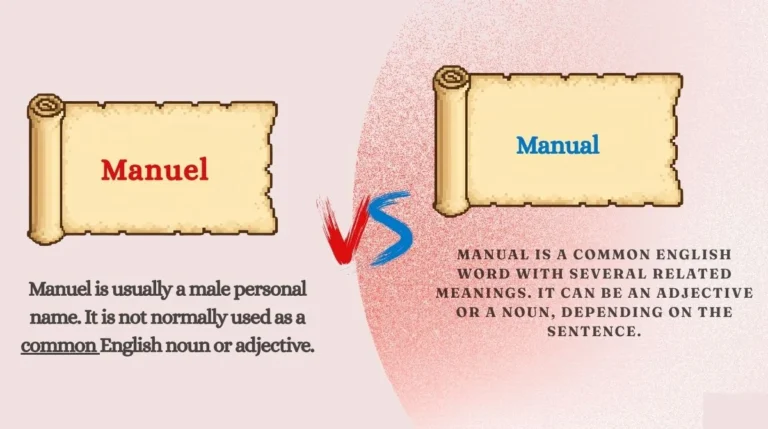
Manuel is usually a male personal name. It is not normally used as a common English noun or adjective.
The name has a long history and is used in different countries and languages. You may see it as the name of a person in English writing, but the word itself does not usually mean “instruction book,” “hand-operated,” or “done by hand.”
For example, in the sentence:
Manuel is waiting outside.
“Manuel” is simply the person’s name.
When Should You Use “Manuel”?
Use Manuel when you are referring to someone whose name is Manuel.
Because it is a person’s name, it is normally written with a capital M:
- Manuel
- not manuel
This is an important grammar point. Names are proper nouns, and proper nouns usually begin with a capital letter.
Grammar Rule for “Manuel”
Manuel is generally treated as a proper noun when it is used as a person’s name.
You can use it as the subject or object of a sentence:
- Manuel called me yesterday.
- I met Manuel at school.
- Manuel is my new neighbor.
- Did you speak to Manuel?
- We invited Manuel to the party.
You do not normally use manuela or manuels as ordinary forms in standard English just because you are changing the sentence. The name remains the person’s name.
8 Example Sentences with “Manuel”
- Manuel is my classmate.
- I saw Manuel at the library yesterday.
- Manuel works at a local restaurant.
- Did Manuel send you the message?
- We invited Manuel to our wedding.
- Manuel is learning English online.
- I asked Manuel for some help.
- Manuel arrived early for the meeting.
Notice that in every example, Manuel refers to a person.
Common Learner Confusion with “Manuel”
The biggest problem is spelling. When people hear manual, they may remember the sound but spell it as manuel.
For instance:
❌ Please check the manuel.
✅ Please check the manual.
The first sentence is incorrect when the speaker means an instruction book.
A useful question is:
“Am I talking about a person named Manuel?”
If the answer is no, you probably need manual instead.
What Does “Manual” Mean?
Manual is a common English word with several related meanings. It can be an adjective or a noun, depending on the sentence.
As an adjective, manual often means done by hand rather than by a machine or automatic system.
For example:
- manual work
- manual labor
- manual control
- manual operation
As a noun, manual can mean a book or document containing instructions. It explains how to use, operate, repair, or understand something.
For example:
Read the manual before using the machine.
There is another common meaning in everyday English, especially when talking about cars. A manual can refer to a vehicle with a manual transmission, where the driver changes gears using a clutch and gear stick.
When Should You Use “Manual”?
Use manual when you mean something related to hand work, human control, instructions, or, in some contexts, a manual-transmission vehicle.
The exact meaning depends on how the word appears in the sentence.
Meaning 1: Done by Hand
When something is done manually, a person does it by hand rather than relying completely on an automatic machine or system.
Examples:
- manual cleaning
- manual entry
- manual labor
- manual inspection
You might hear someone say:
The data must be entered manually.
This means a person has to enter the information instead of letting a computer system do it automatically.
Meaning 2: An Instruction Book
A manual is often a booklet, guide, or document that tells you how to use something.
For example:
Where is the printer manual?
The speaker is asking for the instructions for the printer.
Manuals can be supplied with:
- cars
- computers
- phones
- appliances
- machines
- software
- cameras
- tools
Meaning 3: A Manual Vehicle
In everyday speech, especially in American and British English, people may say:
I drive a manual.
Here, manual means a car with a manual transmission.
The driver usually changes gears using a clutch and gear lever instead of relying on a fully automatic transmission.
Grammar Rules for “Manual”
Manual can work as both an adjective and a noun.
As an adjective:
She prefers manual control.
As a noun:
I read the manual.
This makes the word very flexible.
8 Example Sentences with “Manual”
- Please read the manual before using the machine.
- The system needs a manual update.
- He does manual work at the factory.
- The technician checked the equipment manually.
- I lost the instruction manual for my camera.
- She prefers manual control over automatic settings.
- My brother learned to drive a manual car.
- The worker completed a manual inspection.
These examples show that manual has several useful meanings, but none of them normally refers to a person’s first name.
Difference Between Manuel and Manual
The easiest way to understand these words is to remember that they belong to different categories.
Manuel is usually a person’s name.
Manual is a normal English word that can describe hand-operated activity or refer to a set of instructions.
Comparison Table
| Feature | Manuel | Manual |
|---|---|---|
| Part of speech | Proper noun/name | Noun or adjective |
| Main meaning | A person’s name | Done by hand; an instruction guide; a manual-transmission vehicle |
| Capitalization | Usually capitalized | Usually lowercase |
| Common English word? | Usually a name | Yes |
| Example | Manuel is here. | Read the manual. |
| Refers to a person? | Usually yes | No |
| Refers to instructions? | No | Yes |
| Can describe hand work? | No | Yes |
Usage Difference
The most important difference is what you are talking about.
When you say:
Manuel called this morning.
You are talking about a person.
When you say:
The manual explains how the machine works.
You are talking about a guide or instruction book.
The meanings are completely different even though the spelling is similar.
Grammar Logic
English learners sometimes focus only on the letters. That can be misleading. It is better to look at the role of the word in the sentence.
If the word is a person’s name, Manuel can be correct.
If the word means instructions, human effort, hand operation, or manual transmission, use manual.
Compare:
Manuel opened the door.
Here, Manuel is a person and the subject of the sentence.
The manual explains how to open the door.
Here, manual is a noun meaning an instruction guide.
Changing just one letter changes the word’s identity and meaning.
Sentence Structure Difference
Because Manuel is a name, it often works like other names:
- Manuel is…
- I saw Manuel.
- We called Manuel.
- Did Manuel…?
Manual, by contrast, can appear in different grammatical positions.
As an adjective:
This machine requires manual control.
As a noun:
Where is the manual?
This difference in sentence structure gives you a strong clue about which spelling you need.
Meaning Comparison in Simple English
Think of the two words this way:
Manuel = a person
Manual = hand-based or instructions
That simple distinction will solve most spelling problems.
Grammar Rules You Must Remember
Rule 1: Use “Manuel” for a Person’s Name
When the word refers to a person named Manuel, write Manuel with a capital letter.
Example:
Manuel is coming to dinner tonight.
Here, it is a proper name, so the first letter is capitalized.
Another example:
I spoke to Manuel after class.
There is no connection to instructions or hand-operated work.
Rule 2: Use “Manual” for Instructions
When you mean a book, booklet, document, or guide that gives instructions, use manual.
Example:
Please read the manual before installing the software.
You could also say:
I cannot find the user manual.
The phrase user manual is very common.
Rule 3: Use “Manual” for Work Done by Hand
When something is done by a person rather than automatically, manual is often the correct adjective.
Example:
The company uses manual checks for important records.
Other common expressions include:
- manual labor
- manual work
- manual process
- manual entry
- manual inspection
- manual control
These phrases have nothing to do with a person named Manuel.
Rule 4: Capitalization Can Help You Choose
Manuel is normally capitalized because it is a proper name.
Manual is normally lowercase when it is a general word.
Compare:
Manuel forgot his keys.
and
I forgot the manual.
This is not the only clue you should use, but it is a helpful one.
Common Mistakes Students Make
Many learners make this mistake because the two spellings are very close.
Mistake 1: Writing “Manuel” for an Instruction Book
❌ Please send me the product manuel.
✅ Please send me the product manual.
The correct word is manual because it means a document containing instructions.
A good correction trick is to remember the phrase:
user manual
You see this phrase often on websites, products, apps, and technical documents.
Mistake 2: Writing “manuel work”
❌ He does manuel work.
✅ He does manual work.
The word describes work done mainly by hand, so manual is correct.
Mistake 3: Forgetting the Capital Letter in a Name
❌ manuel is my friend.
✅ Manuel is my friend.
When Manuel is used as a person’s name, capitalize the first letter.
Mistake 4: Assuming Similar Spelling Means Similar Meaning
English contains many words that look almost identical but have very different meanings.
That is what makes manuel vs manual confusing.
Instead of asking only:
“Which spelling looks right?”
ask:
“What do I want this word to mean?”
That question is much more useful.
Mistake 5: Confusing “Manual” with “Manually”
These words are related, but they are not identical.
Manual can be an adjective or noun:
This is a manual process.
Manually is an adverb:
The information was entered manually.
The adverb describes how something happens.
Easy Correction Tips
Before writing the word, stop for one second and identify the meaning.
If you mean:
a person’s name → Manuel
instructions → manual
done by hand → manual
a manual-transmission car → manual
This tiny check can prevent a lot of spelling mistakes.
Easy Trick to Remember the Difference
Here is a simple memory trick:
Manuel = Man + Name
Think of Manuel as the name of a man.
For example:
Manuel is at the door.
So, when the word is a person’s name, remember the capital M and the spelling Manuel.
Manual = Use a Manual
Think of a machine sitting in front of you.
You do not know how to use it, so someone tells you:
Read the manual.
That gives you a strong visual connection.
You can also connect manual with the idea of hands.
If something is done by hand, it is often called manual:
manual work
manual control
manual entry
So the memory trick is:
Manuel = person
Manual = instructions or hand work
Another easy test is to replace the word in your mind.
If your sentence could mean “a person named Manuel,” use Manuel.
If it could mean “instruction book” or “done by hand,” use manual.
Daily Life Examples
Seeing these words in natural situations can make the difference much easier to remember.
Example 1: At Work
A: How do we enter these customer details?
B: We have to do it manually.
Here, manually means by hand or by human action.
Example 2: Using a New Machine
A: I cannot figure out how this printer works.
B: Check the manual.
The manual is the instruction guide.
Example 3: Talking About a Person
A: Who is your new classmate?
B: His name is Manuel.
Here, Manuel is a person’s name.
Example 4: At a Repair Shop
A: Did you read the repair manual?
B: Yes, it shows every step.
The word refers to a guide.
Example 5: Talking About a Car
A: Is your car automatic?
B: No, it is a manual.
Here, manual means a vehicle with a manual transmission.
Example 6: Office Work
A: Does the software enter the information automatically?
B: No. We still use manual entry.
Manual describes the process.
Example 7: Meeting a Friend
A: Who was with Sarah yesterday?
B: Manuel was with her.
This is a person’s name.
Example 8: Learning to Use an App
A: Where can I find the instructions?
B: They are in the user manual.
Again, manual means instructions.
Example 9: Factory Work
A: Is this machine fully automatic?
B: No. Some parts require manual control.
The operator must control certain functions by hand.
Example 10: Sending a Message
A: Who should I send the document to?
B: Send it to Manuel.
The name refers to a person, so Manuel is correct.
Practice Section
Choose the correct option: Manuel or manual.
1. Please read the ______ before using the new device.
A. Manuel
B. manual
2. ______ is my cousin.
A. Manuel
B. manual
3. The company still uses ______ data entry.
A. Manuel
B. manual
4. Did you speak to ______ yesterday?
A. Manuel
B. manual
5. I cannot find the instruction ______ for this printer.
A. Manuel
B. manual
Answers
1. manual — It means an instruction guide.
2. Manuel — It is a person’s name.
3. manual — It describes data entry done by a person rather than automatically.
4. Manuel — It refers to a person.
5. manual — An instruction manual explains how to use the printer.
FAQs
What is the difference between Manuel and manual?
Manuel is usually a male person’s name and is written with a capital letter. Manual is a common English word that can mean a book of instructions or something done by hand. The two words may look similar, but their meanings are different.
Is “manuel” the correct spelling of “manual”?
No. When you mean an instruction book or something done by hand, the correct spelling is manual. Manuel is normally used as a person’s name.
Can I use “Manuel” for an instruction book?
No. You should use manual for an instruction book or guide. For example, “Read the user manual” is correct, while “Read the user Manuel” is incorrect unless Manuel is actually the name of the document or person.
Is manual a noun or an adjective?
Manual can be both. As a noun, it can mean an instruction guide: “Read the manual.” As an adjective, it can describe something done by hand: “This is a manual process.”
Is Manuel always a person’s name?
In normal English use, Manuel is most commonly a proper name. It is used as a male given name in several languages and countries. When used as a name, it should normally begin with a capital letter.
Why do people confuse Manuel and manual?
The two words have very similar spelling and pronunciation, so learners may type the wrong form. The best way to avoid the error is to focus on meaning: Manuel is usually a name, while manual refers to instructions, hand work, or a manual transmission.
Conclusion
The difference between Manuel and manual is much easier than it first appears. The key is to focus on meaning instead of only looking at the spelling.
Manuel is usually a person’s name, so it is normally capitalized. For example, “Manuel is my friend.”
Manual is the common English word used for things such as instruction books, hand-operated processes, and manual-transmission cars. You can say “Read the manual,” “manual work,” or “I drive a manual.”
When you are unsure, ask yourself one simple question: Am I talking about a person named Manuel, or am I talking about instructions or something done by hand? That quick check will usually give you the answer.
Spelling becomes easier when you meet words in real sentences, so try using these examples in your own writing and conversation. A little practice will make the difference feel completely natural.

Evan Rellmont is a writer who turns thoughtful ideas into meaningful words, creating stories and reflections that connect, inspire, and leave a lasting impression.