
English learners often pause when they see high quality and high-quality.
They look almost identical, so it is easy to wonder whether the hyphen is required, optional, or simply a matter of style.
The good news is that the difference is easier than it first appears.
The hyphen usually tells the reader that high and quality are working together as one adjective before a noun.
For example, we write a high-quality product because the two words combine to describe the product.
Cambridge Dictionary lists high-quality as an adjective meaning “very good” or “of a high quality.”
Without the hyphen, high quality often works as a noun phrase. You can talk about quality as a thing or standard: We always look for high quality.
This small punctuation difference matters in emails, school writing, business English, websites, reports, advertisements, and everyday communication.
A missing hyphen will not always make a sentence impossible to understand, but using the correct form makes your writing clearer and more polished.
By the end, you will know when to write high quality, when to write high-quality, why the hyphen is used, and how to avoid the most common mistakes.
What Does “High Quality” Mean?
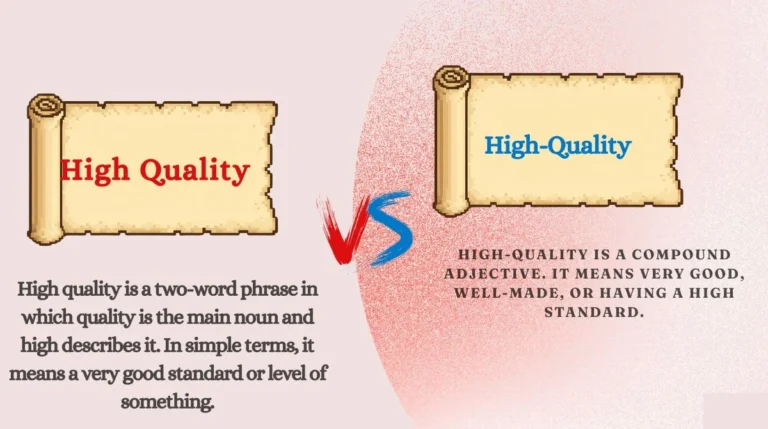
High quality is a two-word phrase in which quality is the main noun and high describes it. In simple terms, it means a very good standard or level of something.
For example:
- This furniture is high quality.
- The school provides high quality education.
- We care about high quality.
Cambridge’s thesaurus treats high quality as a noun phrase and connects it with ideas such as excellence, superiority, and very good standards.
When should you use “high quality”?
Use high quality when you are referring to the quality itself rather than using the phrase as one adjective directly before a noun.
Look at this sentence:
The hotel offers high quality.
Here, you are talking about the level or standard of what the hotel offers. Quality is functioning as a noun.
Another useful example is:
Quality is important to our customers.
You can also use the phrase after a linking verb:
The product is high quality.
Here, high quality describes the product, but it appears after is. In normal edited English, there is usually no need for a hyphen in this position. Official style guidance gives similar examples, such as the accounts are up to date rather than the accounts are up-to-date.
Grammar rule for “high quality”
A simple rule is:
Use “high quality” as two words when “quality” is acting as a noun or when the phrase comes after the noun/linking verb in a normal sentence.
Examples include:
- We expect high quality from our suppliers.
- This restaurant is known for high quality.
- The shoes are high quality.
- The company focuses on high quality.
- Customers want high quality at a fair price.
- The service was high quality and reliable.
- Good design and high quality are both important.
- The materials used in this building are high quality.
Notice something important. In each example, quality can still be understood as a noun. The phrase is about the standard of something.
Why do learners get confused?
Many learners think every adjective phrase should have a hyphen. That is not how English punctuation works.
The hyphen is not added just because two words appear next to each other. It is often used when two or more words combine to act as one modifier before a noun.
Compare:
This phone is high quality.
and
This is a high-quality phone.
The meaning is nearly the same, but the grammatical position is different.
In the first sentence, the description comes after the noun and linking verb.
In the second sentence, high-quality sits immediately before phone and works as one compound adjective.
That difference is the key to the entire topic.
What Does “High-Quality” Mean?
High-quality is a compound adjective. It means very good, well-made, or having a high standard.
Cambridge Dictionary specifically lists high-quality as an adjective and gives examples such as high-quality education, high-quality ingredients, and high-quality products.
The hyphen connects high and quality so the reader can see that the two words are working together to describe the following noun.
When should you use “high-quality”?
Use high-quality when the phrase comes before a noun and directly describes that noun.
For example:
- a high-quality product
- high-quality content
- high-quality education
- high-quality materials
- a high-quality service
- high-quality photographs
Here, the whole phrase acts like one adjective.
Consider:
We bought a high-quality camera.
What kind of camera did we buy?
A high-quality camera.
The two words work together to give one description.
Grammar rule for “high-quality”
A useful rule is:
Use “high-quality” with a hyphen when the two words work together as a compound adjective directly before a noun.
Examples:
- She bought a high-quality laptop.
- Our company produces high-quality furniture.
- He gave me a high-quality photograph.
- The school provides high-quality training.
- We need high-quality information for the report.
- They use high-quality materials in every product.
- She is looking for a high-quality winter coat.
- The website contains high-quality educational resources.
Cambridge uses the same pattern in examples such as high-quality education, high-quality ingredients, and high-quality opponents.
What does the hyphen actually do?
The hyphen joins words that have a special relationship.
Look at:
high-quality content
The writer means:
content that is of high quality
The hyphen makes the relationship clear before the noun content.
This is part of a larger English pattern. We write forms such as:
- well-known actor
- full-time job
- up-to-date information
- long-term plan
- high-quality service
Official style guidance explains that hyphens are commonly used in compound modifiers before nouns because they link the words into a single descriptive unit.
Difference Between High Quality and High-Quality
At first glance, these forms may look like two different expressions. In most cases, however, they communicate the same basic idea: something is very good or has a high standard.
The major difference is grammar and position.
| Form | Main grammatical job | Common position | Example |
|---|---|---|---|
| high quality | Noun phrase | After a verb, after a preposition, or as a noun idea | The service is high quality. |
| high-quality | Compound adjective | Directly before a noun | It is a high-quality service. |
| high quality | Quality as a standard | After words such as “of” or “about” | We care about high quality. |
| high-quality | One combined modifier | Before a noun | They sell high-quality products. |
1. The position in the sentence matters
This is the easiest way to make the right choice.
The product is high quality.
Here the phrase comes after is.
But:
It is a high-quality product.
Here the phrase comes before product.
This before-the-noun pattern is one of the most common reasons English uses hyphens in compound adjectives. Official style guidance gives the same general rule for forms such as up-to-date accounts but the accounts are up to date.
2. The grammar is different
In high quality, quality remains a noun.
For example:
We care about high quality.
The preposition about is followed by a noun phrase.
In high-quality, the two words work together as an adjective.
For example:
We sell high-quality products.
Here, high-quality modifies products.
This is why the hyphen is useful. It shows the reader that the two words should be read as one descriptive unit.
3. The meaning is closely connected
There is usually no major difference in basic meaning.
Compare:
The school provides high-quality education.
The education at the school is high quality.
Both sentences say that the education is very good.
The difference is mainly grammatical:
- high-quality education = compound adjective + noun
- education is high quality = noun + linking verb + description
4. “High quality” can stand on its own more naturally
Because high quality is a noun phrase, it can appear in places where a noun is expected.
For example:
High quality is expensive.
We always aim for high quality.
Customers appreciate high quality.
The hyphenated form does not normally perform this same noun role.
You would not normally write:
Customers appreciate high-quality.
Instead, write:
Customers appreciate high quality.
However, you could say:
Customers appreciate high-quality products.
Now the compound adjective has a noun after it.
5. Before a noun, choose “high-quality”
In careful writing, especially in edited English, high-quality is the safer choice before a noun.
For example:
✅ high-quality content
✅ high-quality food
✅ high-quality service
✅ high-quality education
A form such as high quality content may still be understood easily, especially online, but the hyphen makes the compound modifier clearer and follows common style guidance.
6. After a linking verb, use “high quality”
When the phrase comes after be, seem, look, feel, become, or a similar linking verb, the unhyphenated form is normally preferred.
Examples:
✅ The content is high quality.
✅ The food looks high quality.
✅ Their service seems high quality.
✅ The materials feel high quality.
There are style differences across dictionaries and publishing systems, so you may sometimes see high-quality in a predicate position too. Cambridge, for example, includes an example of something “becoming high-quality” in its dictionary material. Still, for learners, the practical rule is simple: hyphenate the compound adjective before a noun; normally leave it open after a linking verb.
Grammar Rules You Must Remember
Rule 1: Use “high-quality” before a noun
When high and quality work together to describe a noun immediately after them, use a hyphen.
Examples:
- a high-quality camera
- high-quality shoes
- a high-quality meal
- high-quality information
The hyphen shows that high-quality is one descriptive unit.
Example sentence:
We need a high-quality printer for the office.
Here, high-quality describes printer.
Rule 2: Use “high quality” when quality is the noun
When you are talking about quality itself, keep the words separate.
Examples:
- We expect high quality.
- They are known for high quality.
- High quality is important to us.
Example sentence:
The company is famous for high quality and excellent customer service.
Here, quality is a noun, so no hyphen is needed.
Rule 3: After a linking verb, normally write “high quality”
When the phrase comes after is, are, was, were, seems, looks, feels, and similar verbs, it normally does not need a hyphen.
Compare:
The product is high quality.
with:
It is a high-quality product.
Both are correct. The first describes the product after the linking verb. The second uses a compound adjective before the noun.
Rule 4: Do not add a hyphen simply because two words are next to each other
A common mistake is thinking that high quality must always be hyphenated.
That is not true.
The hyphen depends on the job the words are doing in the sentence, not simply on the fact that they appear together.
Compare:
✅ They sell high-quality furniture.
✅ Their furniture is high quality.
Both are correct, and the difference is clear once you look at the sentence structure.
Common Mistakes Students Make
Many learners make this mistake because spoken English does not tell us whether a hyphen is present. When we hear the phrase, high quality and high-quality sound exactly the same.
Writing is different.
Mistake 1: Always writing “high quality”
A student may write:
❌ We bought a high quality phone.
A better form in careful writing is:
✅ We bought a high-quality phone.
Why?
Because high-quality comes directly before phone and acts as one compound adjective.
Mistake 2: Always writing “high-quality”
Another student learns the hyphen rule and starts using it everywhere.
They may write:
❌ The phone is high-quality.
For most general writing, the preferred form is:
✅ The phone is high quality.
The phrase is now after the linking verb is, rather than directly before a noun.
Mistake 3: Treating “quality” like an adjective
Some learners think that quality is an adjective in high-quality product.
It is better to understand the structure as:
high + quality → compound modifier
The two words combine to describe product.
This is why the hyphen is useful.
Mistake 4: Adding spaces around the hyphen
Never write:
❌ high – quality product
or:
❌ high- quality product
The correct form is:
✅ high-quality product
A hyphen connects the words directly.
Mistake 5: Confusing “high quality” with “high-quality” in search and website writing
Website writers sometimes use high quality content because they are trying to insert keywords naturally. However, grammar still matters.
For polished content, write:
✅ high-quality content
You can also restructure the sentence:
✅ Content of high quality is easier to trust.
✅ This content is high quality.
Good SEO writing should remain natural and grammatically clear. A keyword should never force an awkward construction.
An easy correction method
Before writing the phrase, look at the word after it.
If you have:
high-quality + noun
use the hyphen.
If the phrase comes after is/are/was/were/seems/looks/feels, use high quality in normal usage.
Try this quick test:
___ product
You need:
high-quality product
But:
The product is ___
You normally need:
The product is high quality.
This simple test solves many problems.
Easy Trick to Remember the Difference
Here is a classroom trick students often find useful:
Before a noun = join the words.
After a linking verb = open the words.
Think of the hyphen as a tiny bridge.
When the two words need to travel together before a noun, the bridge connects them:
high-quality product
But when the sentence already has a linking verb and the phrase is simply describing the subject, the bridge is usually not needed:
The product is high quality.
Think about the question “What kind?”
If the sentence answers “What kind?”, a hyphenated form is often needed before the noun.
What kind of product?
A high-quality product.
What kind of education?
High-quality education.
What kind of materials?
High-quality materials.
Now try the sentence:
The education is ______.
You are not answering “What kind of education?” You are simply describing the education.
So:
The education is high quality.
Real-life logic
Imagine a shop owner talking to a customer.
Customer: Is this a good laptop?
Shopkeeper: Yes. It is high quality.
Then the customer asks:
What kind of laptop is it?
Shopkeeper: It is a high-quality laptop.
Same basic meaning. Different grammar.
That is why the hyphen changes with sentence structure.
Daily Life Examples
These examples show how the two forms work in normal conversations, messages, websites, schoolwork, and business English.
1. At a clothing store
Customer: Are these shoes good?
Shop assistant: Yes, they are high quality and very comfortable.
Here, high quality follows are.
2. Describing the shoes
Customer: What kind of shoes are these?
Shop assistant: They are high-quality shoes made from strong material.
Here, high-quality comes before shoes.
3. Talking about a website
User: Why do you like this website?
Friend: It has high-quality content and easy explanations.
The compound adjective comes before content.
4. Giving an opinion
Teacher: What do you think of the student’s work?
Teacher: The work is high quality, especially the writing.
The phrase follows is.
5. At a restaurant
Customer: Is the food fresh?
Waiter: Yes. We use high-quality ingredients every day.
The hyphenated adjective comes before ingredients.
6. Talking about the ingredients
Customer: How are the ingredients?
Waiter: They are high quality and locally sourced.
No hyphen is normally needed after are.
7. In a business meeting
Manager: What do our customers want?
Employee: They want high-quality service at a reasonable price.
8. Talking about a product
Friend: Would you buy it again?
Customer: Probably. The product is high quality, and it lasts a long time.
9. In school
Student: Why did I get a good grade?
Teacher: Because you submitted a high-quality assignment with clear examples.
10. Talking about the assignment
Student: Was my work good enough?
Teacher: Yes, your work was high quality. Keep practicing.
These examples show an important point: the meaning stays almost the same, but the grammar changes according to the position of the phrase.
Practice Section
Choose the correct form in each sentence: high quality or high-quality.
1. We bought a ______ camera for our trip.
A. high quality
B. high-quality
2. The camera is ______ and easy to use.
A. high quality
B. high-quality
3. This company provides ______ customer service.
A. high quality
B. high-quality
4. They are known for ______.
A. high quality
B. high-quality
5. She wants to buy a ______ laptop.
A. high quality
B. high-quality
Answers
1. B — high-quality
The phrase comes before camera, so it acts as a compound adjective.
2. A — high quality
It comes after the linking verb is.
3. B — high-quality
It directly describes customer service before the noun phrase.
4. A — high quality
Here, quality is being treated as a noun or standard.
5. B — high-quality
It comes directly before laptop.
A helpful way to practice is to make your own pairs:
The product is high quality.
It is a high-quality product.
Do this with words such as service, education, food, furniture, content, materials, and equipment. After a few examples, the rule starts to feel natural.
FAQs
What is the difference between high quality and high-quality?
High quality is usually a two-word noun phrase, while high-quality is a compound adjective. Use high-quality before a noun, as in high-quality food. Use high quality when talking about the quality itself or when the phrase follows a linking verb, as in The food is high quality.
Is “high-quality” always correct?
No. It is correct when the two words work together as a compound adjective, especially before a noun. For example, a high-quality product is correct. After a linking verb, The product is high quality is normally preferred in general edited English.
Can I use “high quality” before a noun?
You may see high quality without a hyphen before a noun, especially in informal or less carefully edited writing. However, high-quality is the clearer and more standard choice when the two words form one compound modifier before a noun, such as high-quality service.
Is “high-quality” formal or informal?
High-quality is perfectly normal in both formal and informal English. It is widely used in education, business writing, websites, reports, advertising, and everyday speech. Cambridge Dictionary lists it as a standard adjective.
Can we use “high-quality” in questions?
Yes. You can use it before a noun in a question:
Is this a high-quality product?
But if it follows a linking verb without a noun immediately after it, normally write:
Is this product high quality?
The position determines the usual form.
Which is correct: high quality content or high-quality content?
High-quality content is the better choice in careful writing. The two words work together to describe the noun content, so the hyphen makes the compound adjective clear. For example: Our website provides high-quality content for English learners.
Conclusion
The difference between high quality and high-quality is mainly about grammar, not meaning. Both forms describe something that is very good or has a strong standard.
Use high-quality when the phrase comes before a noun and works as one compound adjective:
a high-quality product
high-quality education
high-quality service
Use high quality when quality is functioning as a noun or when the phrase normally comes after a linking verb:
We expect high quality.
The product is high quality.
Their service seems high quality.
The easiest rule to remember is simple: before a noun, use the hyphen; after a linking verb, normally leave it open.
Do not worry if this feels confusing at first. Hyphens are often easier to understand when you look at sentence structure instead of trying to memorize every example. Practice a few pairs such as high-quality food / the food is high quality, and the pattern will quickly become familiar.

Evan Rellmont is a writer who turns thoughtful ideas into meaningful words, creating stories and reflections that connect, inspire, and leave a lasting impression.