
Have you ever typed “messege” and then stopped to wonder whether it is actually correct? You are not alone.
This is a very common spelling mistake, especially when people are writing quickly, texting on a phone, or trying to spell a word from the way it sounds.
The correct spelling is message. Messege is not the standard spelling of the English word.
The word message is used for a piece of information that is written, spoken, or sent electronically to another person.
It can also mean the main idea that a book, film, speech, or advertisement communicates. Cambridge Dictionary lists message as both a noun and a verb.
This small spelling difference matters because message is used every day. You see it in text messages, emails, phone calls, social media, schoolwork, office communication, and even computer notifications.
By the end of this guide, you will know exactly why message is correct, why messege is wrong, how to use message in a sentence, and how to remember its spelling without hesitation.
You will also see common mistakes and simple everyday examples that make the difference easy to understand.
What Does “Messege” Mean?
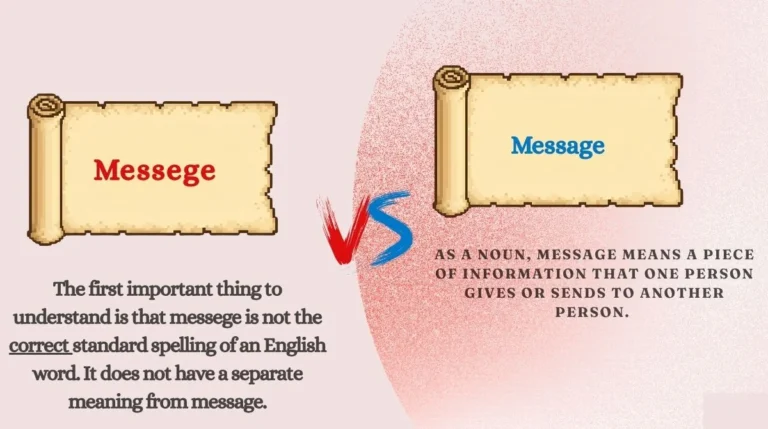
The first important thing to understand is that messege is not the correct standard spelling of an English word. It does not have a separate meaning from message.
When someone writes messege, they normally mean message, but they have spelled it incorrectly.
For example:
- ❌ I sent you a messege.
- ✅ I sent you a message.
The intended meaning is clear in the first sentence, but the spelling is wrong.
Why do people write “messege”?
The mistake usually happens because English spelling does not always match pronunciation perfectly. When people hear the word message, the middle vowel can be difficult to identify. A learner may remember the sound and guess that the word should be written as messege.
This is especially easy to do when typing quickly.
Think about these two forms:
message ✅
messege ❌
They look very similar, and they sound very similar when spoken. That is why the mistake can be easy to make.
However, there is no grammar situation in standard English where you should choose messege instead of message.
When should you use “messege”?
You should not use messege in standard English writing.
Avoid it in:
- School assignments
- Exams
- Emails
- Job applications
- Reports
- Websites
- Business writing
- Social media posts
- Formal documents
Even though readers may understand what you mean, the spelling still appears incorrect.
Grammar rule for “messege”
There is no normal grammar rule that allows messege as a standard English word.
The practical rule is simple:
When you mean a piece of communication, spell the word M-E-S-S-A-G-E.
Examples of the incorrect spelling
Here are some examples of how messege may appear by mistake:
- ❌ Did you get my messege?
- ❌ Please send me a messege.
- ❌ I left a messege for you.
- ❌ She read my messege this morning.
- ❌ Your messege was very helpful.
- ❌ I received your messege yesterday.
- ❌ He sent a short messege before the meeting.
- ❌ Can you check the messege again?
Every sentence above should use message instead.
So, the most useful lesson is not how to use messege, but how to stop writing it.
What Does “Message” Mean?
Message is the correct spelling.
As a noun, message means a piece of information that one person gives or sends to another person. It may be written, spoken, typed, recorded, or sent electronically. Cambridge Dictionary defines it as a short piece of information given or sent to someone, and it also recognizes the word in meanings related to the main idea of a book, film, or other work.
For example:
I sent you a message.
This means you sent information to another person.
A message can be a text on a mobile phone, an email, a note, a voicemail, or even something said through another person.
When do we use “message”?
We use message whenever we talk about communication or information being passed from one person to another.
It is very common in everyday English.
You can:
- send a message
- receive a message
- leave a message
- read a message
- write a message
- answer a message
- reply to a message
- forward a message
- delete a message
The word is also used when talking about the central idea of something.
For example:
The message of the movie was very powerful.
Here, message does not mean a text on a phone. It means the main idea or lesson communicated by the movie. Cambridge gives this meaning as the important idea that a writer, artist, speaker, or group wants to communicate.
Grammar rule for “message”
Message can work as both a noun and a verb.
As a noun:
I received your message.
Here, message is a thing—the information that was received.
As a verb:
I will message you tonight.
Here, message means to send someone a message, usually by phone or computer. Cambridge Dictionary also lists this verb use.
8 correct example sentences
- I sent my friend a message this morning.
- Did you get my message?
- Please leave a message after the beep.
- She received an important message from her teacher.
- I will message you when I arrive.
- He messaged me last night.
- The book has an important message about kindness.
- Your message was clear and easy to understand.
Notice that the spelling stays message in all of these examples.
The word can change its grammatical form, but it does not change into messege.
Difference Between Messege and Message
The difference is actually very simple:
Message is correct. Messege is incorrect.
These are not two words with different meanings. One is the standard English spelling, while the other is a spelling mistake.
Comparison table
| Feature | Messege | Message |
|---|---|---|
| Correct spelling | ❌ No | ✅ Yes |
| Standard English word | ❌ No | ✅ Yes |
| Meaning | No separate standard meaning | Information communicated to someone |
| Noun | ❌ Incorrect | ✅ Correct |
| Verb | ❌ Incorrect | ✅ Correct |
| Used in formal writing | ❌ No | ✅ Yes |
| Used in texts and emails | ❌ No | ✅ Yes |
| Used in schoolwork | ❌ No | ✅ Yes |
| Used in business English | ❌ No | ✅ Yes |
| Correct example | ❌ Send a messege. | ✅ Send a message. |
Usage difference
There is no real usage difference because messege is not an alternative form of message.
You do not choose between them based on American English, British English, formal English, or informal English.
The same spelling, message, is used in standard English.
For example:
I sent a message to my manager.
This is correct in everyday English.
I sent a messege to my manager.
This is simply a spelling error.
Grammar logic
The grammar itself is not difficult.
The confusion is mainly about spelling.
Message can be a noun:
Your message was helpful.
It can also be a verb:
Please message me later.
Its plural form is:
messages
Its past tense as a verb is:
messaged
Its -ing form is:
messaging
None of these forms become messege.
Sentence structure
The sentence structure depends on how message is used.
As a noun:
Subject + verb + message
I received your message.
Or:
Subject + verb + object + message
She sent me a message.
As a verb:
Subject + message + object
I will message you later.
So, the same word can have different jobs in a sentence.
The spelling, however, remains message.
Meaning comparison
Messege: no standard meaning; it is a misspelling.
Message: a piece of information communicated to someone, or the main idea that something communicates.
That is the whole difference.
Grammar Rules You Must Remember
Knowing four simple rules can help you avoid this spelling mistake in the future.
Rule 1: Use “message” for information sent to someone
When you are talking about a text, note, voicemail, email, or other communication, use message.
Correct:
I got your message.
Incorrect:
I got your messege.
The word refers to the information itself.
Rule 2: “Message” can be a noun
When message names a thing or piece of information, it acts as a noun.
Examples:
The message was short.
I read the message.
Her message made me happy.
We received three messages.
The plural form is messages, not messeges.
So remember:
message → messages
Not:
messege → messeges
Rule 3: “Message” can also be a verb
Modern English often uses message as a verb, especially for digital communication. Cambridge Dictionary includes this use for sending someone a message by phone or computer.
Examples:
Message me when you get home.
She messaged her brother.
I am messaging my teacher now.
The verb forms include:
message → messaged → messaging
The correct spelling remains connected to the base word.
Rule 4: Do not spell the word according to the wrong vowel you hear
One reason learners make this mistake is that pronunciation can make spelling less obvious.
Message is pronounced approximately MES-ij. Cambridge gives the pronunciation /ˈmes.ɪdʒ/ for both British and American English.
The final part of the word does not sound exactly like the separate word age.
That is why hearing the word alone may not make the spelling obvious.
Try to remember the written form visually:
message
not:
messege
Common Mistakes Students Make
Spelling mistakes often happen because students write words the way they sound. Other times, they type quickly and do not notice that a vowel has changed.
With message, the most common mistake is replacing a with e.
Mistake 1: Writing “messege”
❌ I left a messege for Sarah.
✅ I left a message for Sarah.
Correction tip: Remember that the correct middle vowel is a.
Mistake 2: Using “messeges” as the plural
❌ I have five messeges.
✅ I have five messages.
The plural is made by adding -s to the correct spelling.
message → messages
Mistake 3: Writing “messaged” incorrectly
❌ He messeged me yesterday.
✅ He messaged me yesterday.
The correct verb comes from message.
Mistake 4: Confusing message with another similar word
Students sometimes confuse message with massage.
These are completely different words.
A message is information you communicate.
A massage is a treatment in which someone rubs or moves the muscles of your body.
Compare:
I sent her a message.
I booked a massage.
Changing one letter can change the meaning completely.
Mistake 5: Thinking “messege” is an informal spelling
Some learners assume that messege might be accepted in texting or casual English.
It is better to avoid this idea.
People may understand a spelling mistake in a quick text, but that does not make the spelling standard.
Use message in both casual and formal writing.
Easy Trick to Remember the Difference
Here is a simple trick that many learners find useful.
Remember: “message” has “sage”
Look carefully:
mes + sage = message
The important part to remember is:
SAGE
So think:
message ends with “sage,” not “sege.”
This is just a spelling memory trick. It does not mean the modern word was formed by simply joining mes and sage.
Another useful trick is to write the word several times:
message
message
message
Then say:
“A message has information.”
This connects the spelling with the meaning.
You can also learn the related forms together:
message
messages
messaged
messaging
Seeing the correct word family makes the spelling easier to recognize.
Most importantly, do not try to guess the spelling every time you write it. Learn the shape of the word as a whole.
Daily Life Examples
The word message appears constantly in everyday communication. These examples show how naturally it fits into spoken and written English.
Example 1: Talking about a text
Ali: Did Sara call you?
Hina: No, but she sent me a message.
Here, message means written information sent by phone.
Example 2: Asking someone to text you
Message me when you get home.
This is a very natural sentence in everyday English.
Here, message is being used as a verb.
Example 3: Leaving information
I called your office, but no one answered, so I left a message.
A message can be recorded when someone is unavailable.
Example 4: School communication
The teacher sent a message to all the students.
The information was given electronically.
Example 5: Workplace communication
I received a message from my manager about tomorrow’s meeting.
This is common in professional English.
Example 6: Social media
I saw your message, but I was busy and forgot to reply.
Here, the word simply means a private digital communication.
Example 7: Family conversation
Mom, did Dad message you?
Again, message is being used as a verb.
Example 8: A voicemail
She left me a message while I was driving.
The communication may be spoken rather than typed.
Example 9: Meaning or lesson
The main message of the story is to be honest.
Here, message means the main idea or lesson, not a phone text. Cambridge recognizes this second important meaning.
Example 10: Checking a message
Please read the message before you reply.
This sentence is useful in both casual and professional settings.
These examples show why it is worth learning the correct spelling. You may need this word in many different situations.
Practice Section
Choose the correct option in each sentence.
1. I sent you a ______ this morning.
A. messege
B. message
2. Did you get my ______?
A. message
B. messege
3. Please ______ me when you arrive.
A. messege
B. message
4. She left a ______ for her teacher.
A. message
B. messege
5. The movie has a powerful ______ about friendship.
A. messege
B. message
Answers
- B — message
- A — message
- B — message
- A — message
- B — message
Here is an easy challenge: write your own sentence using message as a noun and another sentence using it as a verb.
For example:
I received a message.
I will message you later.
That small exercise helps you remember both the spelling and the grammar.
FAQs
1. What is the difference between messege and message?
Message is the correct English spelling. Messege is a spelling mistake.
Message can mean information sent or given to someone, and it can also mean the main idea communicated by a book, film, speech, or similar work.
2. Is “messege” a correct English word?
No. Messege is not the standard spelling of the word.
If you mean a piece of communication, use message instead. This is the spelling you should use in school, work, emails, websites, and everyday writing.
3. Why do people spell message as messege?
The main reason is that the pronunciation does not clearly tell every learner which vowel to write.
When people hear the word quickly, they may choose e instead of a. Fast typing can make the mistake even more common.
4. Can “message” be used as a verb?
Yes. Message can be a verb meaning to send someone a message, especially by phone or computer. Cambridge Dictionary includes this use.
For example:
I will message you tonight.
Its past form is messaged.
5. Is “message” formal or informal?
Message is suitable for both informal and formal English.
You can say:
I sent my friend a message.
You can also write:
I received your message regarding the meeting.
The word itself is not limited to casual communication.
6. Is the spelling “message” the same in British and American English?
Yes. The standard spelling is message in both British and American English. The pronunciation shown by Cambridge is also based on the same standard spelling.
There is no British-versus-American spelling choice between message and messege.
Conclusion
The answer to “Messege or message?” is easy: message is correct, and messege is incorrect.
A message is a piece of information that you give, send, or communicate to another person. You can send a message, receive a message, leave a message, or even message someone as a verb. The word can also describe the main idea or lesson of a book, movie, speech, or other form of communication.
The main spelling problem is the middle vowel. Many learners write messege because they are trying to spell the word from its sound. The easiest solution is to remember the correct written form:
message
A useful memory trick is to notice that it ends with “sage,” not “sege.”
So, the next time you write an email, text, assignment, or social media post, choose message with confidence. A few minutes of spelling practice can save you from making the same mistake again.

Evan Rellmont is a writer who turns thoughtful ideas into meaningful words, creating stories and reflections that connect, inspire, and leave a lasting impression.