
Have you ever stopped while writing a sentence because you could not decide between snuck and sneaked? You are not alone.
These two forms confuse many English learners because they come from the same verb, sneak, and they describe the same basic action: going somewhere quietly or doing something secretly.
For example, you may hear someone say, “He sneaked out of the house,” while another person says, “He snuck out of the house.” Both sentences can sound natural to English speakers.
The real question is not simply whether one is correct and the other is wrong.
The more useful question is when each form is normally used and which one is better for your situation.
According to Oxford Learner’s Dictionaries, sneaked is the usual past form of sneak, while snuck is now very common in informal speech in North American English.
Oxford also notes that some speakers use snuck in British English, although many people still consider it unsuitable for formal writing.
Cambridge similarly lists sneaked or US also snuck and describes snuck as mainly US.
By the end of this guide, you will know exactly what both forms mean, how their grammar works, where each one is commonly used, and which choice is safest in formal English.
What Does “Snuck” Mean?
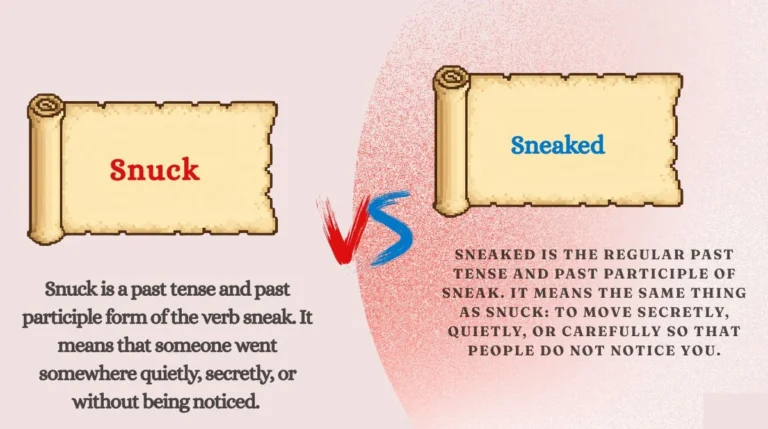
Snuck is a past tense and past participle form of the verb sneak. It means that someone went somewhere quietly, secretly, or without being noticed. It can also describe doing or taking something secretly.
For example:
- I snuck out of the house early.
- She snuck into the kitchen.
- He snuck a look at the clock.
- We snuck past the sleeping dog.
The word snuck has exactly the same basic meaning as sneaked. The main difference is usage and variety of English, not the basic action being described.
Oxford lists snuck as the past tense and past participle of sneak. Its American dictionary also treats snuck as an established American English form.
When Should You Use “Snuck”?
You will most often see snuck in informal English, especially in American English.
It is very common in:
- Casual conversations
- Text messages
- Informal online writing
- Everyday American speech
- Informal stories and personal writing
For example:
I snuck out after everyone went to bed.
That sentence sounds completely natural in casual American English.
You can also use snuck as a past participle:
She has snuck into my office before.
However, some speakers prefer sneaked in careful or formal writing.
Grammar Rule for “Snuck”
The basic pattern is:
Subject + snuck + complement
Examples:
- He snuck into the room.
- She snuck away quietly.
- They snuck through the back door.
It can also be used in a perfect tense:
Subject + has/have/had + snuck
Examples:
- He has snuck out before.
- They had snuck away before we arrived.
Because snuck is used as both a past tense and past participle in varieties that accept it, you may hear both:
He snuck out.
and:
He has snuck out.
The meaning remains closely connected to secrecy or quiet movement.
8 Examples of “Snuck”
- I snuck out of bed because I was thirsty.
- The cat snuck into the bedroom.
- She snuck a cookie before dinner.
- He snuck into the meeting without anyone noticing.
- We snuck away before the rain started.
- Tom snuck a quick look at his phone.
- The children snuck downstairs after midnight.
- Someone had snuck into the garden during the night.
Common Learner Confusion About “Snuck”
Many students think snuck must be incorrect because it does not follow the regular -ed pattern.
That is understandable. English has many irregular verbs:
- go → went
- take → took
- see → saw
- speak → spoke
So students sometimes assume that sneak → snuck must be the only correct form.
But that is not the case.
Sneaked is the standard regular past form, while snuck is also an established form, particularly in American informal English.
What Does “Sneaked” Mean?
Sneaked is the regular past tense and past participle of sneak. It means the same thing as snuck: to move secretly, quietly, or carefully so that people do not notice you.
Examples include:
- We sneaked out through the back door.
- She sneaked into the room.
- He sneaked a look at the answer.
- They sneaked past us.
Oxford identifies sneaked as the usual past form of sneak. Cambridge also gives sneaked as the standard past tense and past participle, with snuck as another form, especially in US English.
When Should You Use “Sneaked”?
Sneaked is the safest choice when you want broadly accepted English, especially in formal or academic writing.
You can use it in:
- School assignments
- Exams
- Formal emails
- Academic writing
- Professional writing
- General English used internationally
For example:
The boy sneaked out of the classroom during the break.
This sentence is clear and grammatically acceptable across major varieties of English.
Grammar Rule for “Sneaked”
The normal past-tense structure is:
Subject + sneaked + complement
Examples:
- She sneaked into the house.
- We sneaked past the guard.
- He sneaked away quietly.
For perfect tenses:
Subject + has/have/had + sneaked
Examples:
- She has sneaked out already.
- They had sneaked into the building.
- He has sneaked a look at the answers.
The important point is simple: sneaked is completely normal as both a past tense and a past participle.
8 Examples of “Sneaked”
- I sneaked into the kitchen for some water.
- She sneaked out while everyone was sleeping.
- He sneaked a glance at his watch.
- The dog sneaked into the house.
- We sneaked through the side entrance.
- They sneaked away before the meeting ended.
- Sarah sneaked a piece of cake from the table.
- The students sneaked into the room after lunch.
Common Learner Confusion About “Sneaked”
A common mistake is believing that sneaked sounds strange because many learners hear snuck in movies, TV shows, and American conversations.
Remember this:
Hearing “snuck” often does not make “sneaked” wrong.
Both forms are used. The important difference is that sneaked is the usual form, while snuck is especially common in informal North American English.
Difference Between Snuck and Sneaked
The biggest point to remember is that snuck and sneaked usually have the same meaning. They are both past forms of sneak.
The main difference is style, region, and formality.
| Feature | Snuck | Sneaked |
|---|---|---|
| Base verb | sneak | sneak |
| Past tense | snuck | sneaked |
| Past participle | snuck | sneaked |
| Meaning | Went or did something secretly | Went or did something secretly |
| Common in | Informal North American English | Broad international English |
| Formal writing | Less preferred by some speakers | Safer choice |
| Informal conversation | Very common in US English | Also completely correct |
| Grammar | Past and past participle where accepted | Past and past participle |
Usage Difference
If you are having a casual conversation with an American speaker, snuck may sound very natural:
I snuck out for a few minutes.
In a formal school essay, however, sneaked is generally the safer choice:
The student sneaked out of the classroom without permission.
Oxford specifically says that snuck is now very common in informal North American speech but notes that some people consider it incorrect and do not recommend it in formal writing.
Grammar Logic
The interesting thing about this verb is that English has allowed two past forms to exist side by side.
Sneaked follows the regular English pattern:
sneak + ed = sneaked
Snuck does not follow that pattern. It is an irregular form.
This is similar to how English sometimes develops different forms because speakers use them over many years. The important thing for learners is not to force every verb into one pattern.
You do not need to think:
“One must be right and the other must be wrong.”
A better approach is:
“Which form fits the type of English I am using?”
Sentence-Structure Difference
There is almost no difference in sentence structure.
You can replace one with the other in many sentences:
He snuck out of the room.
He sneaked out of the room.
Both describe the same event.
Similarly:
She snuck a look at the paper.
She sneaked a look at the paper.
The verb structure remains the same.
Meaning Comparison
Both forms can describe:
- Moving quietly
- Entering or leaving secretly
- Doing something without permission
- Taking something secretly
- Looking at something secretly
Cambridge defines sneak as going somewhere secretly or taking someone or something somewhere secretly, and its US usage examples include both sneaked and snuck.
So, in most sentences:
snuck = sneaked in meaning
The choice mainly depends on regional usage and formality.
Grammar Rules You Must Remember
Rule 1: Use “Sneaked” as the safest standard choice
When you are unsure, sneaked is a good choice.
It is the usual past form listed by Oxford and is accepted across a wide range of English usage.
Example:
We sneaked out before anyone noticed.
This is especially useful in school or professional writing.
Rule 2: “Snuck” is common in informal American English
If you are reading or speaking American English, you will often hear snuck.
Example:
I snuck into the kitchen after dinner.
Cambridge identifies snuck as mainly US, while Oxford says it is very common in informal North American speech.
Rule 3: Both forms can be past tense and past participle
Both can describe a completed action.
Past tense:
He sneaked out.
He snuck out.
Past participle:
He has sneaked out.
He has snuck out.
The second pattern is more strongly associated with the variety of English that accepts snuck.
Rule 4: Do not change the base form
In the present tense, use sneak, not snuck or sneaked.
Correct:
I sneak out early on Fridays.
Correct:
She sneaks into the kitchen quietly.
Past:
She sneaked into the kitchen.
Or, in informal American English:
She snuck into the kitchen.
Do not say:
She snuckes into the kitchen.
The present form is simply sneak / sneaks.
Common Mistakes Students Make
Mistake 1: Thinking “snuck” is always wrong
Some learners are taught that only sneaked is correct. This creates confusion when they later hear native speakers use snuck.
Wrong idea:
“Snuck is never correct.”
Better understanding:
“Snuck is an established form, especially in informal American English.”
Major dictionaries recognize it, although usage guidance differs by region and level of formality.
Mistake 2: Thinking “sneaked” is outdated
The opposite mistake also happens.
A student hears snuck so often that they think sneaked sounds old-fashioned or incorrect.
That is also wrong.
She sneaked out of the room.
is perfectly acceptable.
In fact, sneaked is the usual past form according to Oxford.
Mistake 3: Mixing the forms in one phrase
Students sometimes create forms such as:
He has snucked out.
That is not correct.
Do not combine snuck with -ed.
Use:
He has snuck out.
or:
He has sneaked out.
Mistake 4: Using “snuck” in every kind of writing
Because snuck is common in casual American English, students may use it in formal essays without thinking about tone.
For formal writing, sneaked is often the safer option, especially for international learners. Oxford specifically warns that some people do not consider snuck appropriate in formal writing.
Easy Correction Tip
Ask yourself:
“Am I writing casually or formally?”
Casual American conversation:
I snuck out.
Formal or broadly international writing:
I sneaked out.
That simple question can help you choose confidently.
Easy Trick to Remember the Difference
Here is a very easy memory trick:
SNEAKED = SAFE
SNUCK = SPOKEN, especially US casual English
Think of sneaked as the form that is safest when you are writing for school, work, or a general audience.
Think of snuck as the form you are especially likely to hear in relaxed American conversation.
For example, imagine two friends talking:
“I snuck into the kitchen and grabbed some cookies.”
That sounds natural and casual.
Now imagine a student writing an essay:
“The child sneaked out of the house during the night.”
That sounds more neutral and formal.
One more useful trick is to remember that snuck is short and informal-looking, while sneaked follows the normal -ed pattern.
You do not need to memorize complicated grammar here.
Just remember:
Both are used, but sneaked is the safer standard choice.
Daily Life Examples
Real conversations make this difference much easier to understand.
Example 1: Leaving the house
Ali: When did you leave?
Sam: I sneaked out at around midnight.
This is a neutral choice.
An American speaker might naturally say:
Sam: I snuck out at around midnight.
Example 2: Looking at a phone
Mia: Did you check your phone during the meeting?
John: Yes, I snuck a quick look at it.
This sounds casual and natural.
Example 3: Getting food
Mom: Who ate the cake?
Ben: I snuck a small piece.
The sentence is informal and playful.
You could also say:
I sneaked a small piece.
Example 4: Entering quietly
Sara: How did you get inside?
Tom: I sneaked in through the back door.
This is a clear, neutral sentence.
Example 5: Avoiding attention
David: Where did Emma go?
Lisa: She snuck away before the guests arrived.
Again, snuck sounds especially natural in casual American speech.
Example 6: School
Teacher: Who sneaked out of the classroom?
Student: I did. I needed some water.
A teacher or writer may prefer sneaked in a more formal setting.
Example 7: Surprise
Mark: How did you surprise me?
Peter: I snuck up behind you!
The phrase sneak up on someone is very common in English. Cambridge gives this as a common use of the verb.
Example 8: Pet
Anna: Where is the cat?
Mike: She sneaked into my room again.
Example 9: Family conversation
Dad: Did you leave your room after bedtime?
Son: I snuck downstairs for a glass of water.
Example 10: Formal report
The suspect sneaked through the rear entrance.
Here, sneaked may sound more appropriate because the context is formal and neutral.
Practice Section
Choose the best answer in each sentence.
1. He ______ out of the house before sunrise.
A. snucked
B. sneaked
C. sneaken
2. She ______ into the room without making a sound.
A. sneaked
B. snuck
C. Both A and B
3. They had ______ away before we arrived.
A. sneaked
B. snuck
C. Both A and B
4. Which form is generally safer for formal writing?
A. Snuck
B. Sneaked
5. Which form is especially common in informal North American English?
A. Snuck
B. Sneaked only
Answers
1. B — sneaked
“Snucked” is not the correct form.
2. C — Both A and B
Both forms are used, although snuck is especially common in informal American English.
3. C — Both A and B
Both can work as past participles in varieties that use snuck.
4. B — Sneaked
It is the safer choice for formal and broadly international writing.
5. A — Snuck
Snuck is especially common in informal North American English.
FAQs
What is the difference between “snuck” and “sneaked”?
Both are past forms of the verb sneak, and they usually have the same meaning. Sneaked is the usual past form, while snuck is especially common in informal North American English.
Can we use “snuck” in questions?
Yes. You can use snuck in questions when the variety of English you are using accepts it.
For example:
Did he snuck out?
is incorrect because questions with did use the base form.
The correct sentence is:
Did he sneak out?
The same rule applies to sneaked.
Is “snuck” formal or informal?
Snuck is generally more informal. It is very common in informal North American speech, especially American English. Some speakers still avoid it in formal writing.
Is “sneaked” grammatically correct?
Yes. Sneaked is grammatically correct and is the usual past form given by Oxford. It is a safe choice in school, professional, and formal writing.
Which is correct: “I sneaked out” or “I snuck out”?
Both can be correct.
“I sneaked out” is the standard regular form and is widely accepted.
“I snuck out” is also established, especially in informal American English.
Can “snuck” be used as a past participle?
Yes. In varieties that use snuck, it can function as both the simple past and past participle.
For example:
She snuck away.
She has snuck away.
Oxford and Cambridge both recognize this usage.
Conclusion
The difference between snuck and sneaked is much easier once you stop treating them as two completely different words. They are both forms of the verb sneak, and they usually describe the same action: moving quietly, secretly, or without being noticed.
The main point is usage. Sneaked is the usual past form and is the safer choice for formal, academic, and international English. Snuck is also a real and widely used form, especially in informal North American English.
So, when you are writing a school assignment or formal piece of English, sneaked is a smart choice. When you are listening to American English or having a casual conversation, do not be surprised by snuck.
Both forms are useful. The key is knowing the situation. With a little practice, you will quickly recognize which one sounds right for your sentence and your audience.

Evan Rellmont is a writer who turns thoughtful ideas into meaningful words, creating stories and reflections that connect, inspire, and leave a lasting impression.