
English spelling can be confusing, especially when two spellings look almost exactly the same. Piece vs peice is a good example.
The letters are nearly identical, but only one spelling is correct in standard English.
The correct spelling is piece. The spelling peice is a common spelling mistake.
Many learners write peice because they remember the sound /piːs/ but are unsure about the order of the vowels.
This happens quite often with English words because English spelling does not always follow simple pronunciation rules.
The word piece is very common in everyday English. We use it when talking about a part of something, a single item, food, information, advice, art, music, clothing, furniture, and many other things.
For example, we can say, “I ate a piece of cake,” “She gave me a piece of advice,” or “I need one more piece of paper.” Cambridge Dictionary lists these common uses of piece and also shows that it can be used as a countable noun.
By the end of this guide, you will know why piece is correct, why peice is wrong, how to use piece naturally, and how to remember the spelling without guessing.
You will also see common mistakes, everyday examples, grammar rules, and a short practice test.
4. What Does “Piece” Mean?
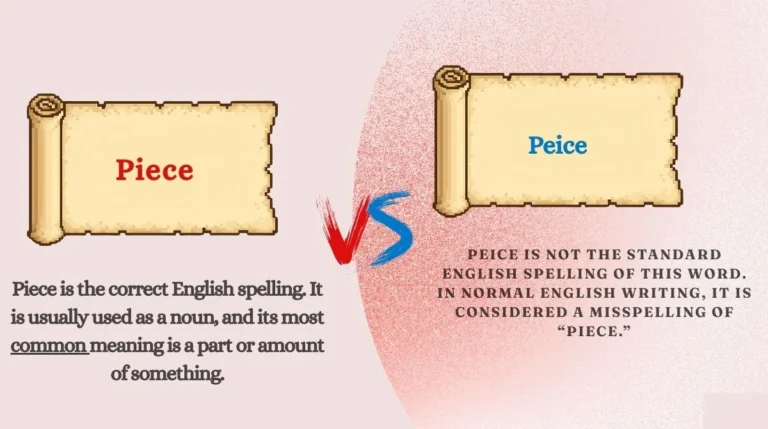
Piece is the correct English spelling. It is usually used as a noun, and its most common meaning is a part or amount of something.
For example, if you cut a cake, each part can be called a piece. You can also call one item from a group a piece, such as a piece of furniture or a piece of equipment. Cambridge Dictionary gives piece several common meanings, including a part of something, a single object of a particular type, and a work created by an artist, musician, or writer.
Common meanings of “piece”
The easiest meaning is “one part of a whole.”
- I want a piece of cake.
- He broke the chocolate into small pieces.
- There is a piece of glass on the floor.
However, piece can be used in several other ways.
We often say a piece of information, a piece of advice, and a piece of news. These nouns are normally uncountable, so piece helps us talk about one unit of them. Cambridge’s grammar guidance specifically describes piece as a “piece word” used with uncountable nouns.
For example:
- She gave me a useful piece of advice.
- I have an interesting piece of information.
- He told us a strange piece of news.
We can also use piece for an item:
- a piece of furniture
- a piece of equipment
- a piece of clothing
- a piece of paper
This is especially useful because some of these nouns are uncountable in English. Saying “two pieces of furniture” is correct, while “two furnitures” is normally incorrect.
Grammar rule for “piece”
Piece is a countable noun.
That means we can say:
- one piece
- two pieces
- several pieces
- many pieces
The plural form is pieces, with -s added to the word.
Notice the spelling:
piece → pieces
The pronunciation of piece is /piːs/, as shown by Cambridge Dictionary.
8 example sentences with “piece”
- Can I have a piece of cake?
- She found a small piece of paper under the desk.
- He broke the toy into three pieces.
- I need a piece of advice from you.
- We bought a new piece of furniture.
- This puzzle has one missing piece.
- She wrote a beautiful piece of music.
- Please give me one piece of information about the meeting.
In each sentence, piece is spelled with ie, not ei.
A common learner confusion
The biggest problem is that many students remember the word by sound. Since piece sounds like “pees,” they may not immediately remember whether the spelling is piece or peice.
Another reason is that English contains words with different vowel patterns. Learners sometimes see words such as receive and ceiling and then assume that ei could work in piece too.
It does not.
For this word, the correct spelling is always:
P-I-E-C-E → piece
5. What Does “Peice” Mean?
Peice is not the standard English spelling of this word. In normal English writing, it is considered a misspelling of “piece.”
So, when you want to talk about a part of something, a single item, or a unit of information or advice, you should not write peice. Write piece.
For example:
❌ I ate a peice of cake.
✅ I ate a piece of cake.
The meaning you are trying to express is still clear in many cases, but the spelling is incorrect. A spelling checker may underline peice and suggest piece. English learners can also use dictionary search tools or spell-check suggestions to identify the correct form when they are unsure. Oxford Learner’s Dictionaries notes that its search system can suggest possible words when a learner does not know the exact spelling.
Why do people write “peice”?
The mistake usually comes from putting the vowels in the wrong order.
The incorrect form is:
p-e-i-c-e
The correct form is:
p-i-e-c-e
Only the positions of i and e have been switched, but that small change creates a spelling error.
Examples of the incorrect spelling
These sentences contain a spelling mistake:
- ❌ Give me a peice of paper.
- ❌ I want another peice of chocolate.
- ❌ This is the last peice of the puzzle.
- ❌ He broke the plate into peices.
- ❌ I read a peice of useful information.
The corrected versions are:
- ✅ Give me a piece of paper.
- ✅ I want another piece of chocolate.
- ✅ This is the last piece of the puzzle.
- ✅ He broke the plate into pieces.
- ✅ I read a piece of useful information.
Is “peice” ever correct?
For ordinary English vocabulary, no. When you mean the common word pronounced /piːs/, use piece.
That makes this comparison quite simple:
Piece = correct
Peice = incorrect spelling
Unlike some confusing word pairs, these two are not different words with different meanings. They are not two acceptable spellings. One is the standard spelling, and the other is a misspelling.
6. Difference Between Piece and Peice (Detailed)
The difference between piece and peice is mainly a matter of spelling.
| Feature | Piece | Peice |
|---|---|---|
| Standard English spelling | ✅ Correct | ❌ Incorrect |
| Meaning | A part, amount, item, or work | No standard meaning in this comparison |
| Pronunciation | /piːs/ | Usually intended to mean piece |
| Used in formal writing | Yes | No |
| Used in school writing | Yes | No |
| Used in professional writing | Yes | No |
| Example | a piece of paper | a peice of paper ❌ |
Usage difference
There is no normal meaning difference between the two forms. If someone writes peice, they usually mean piece.
For example:
❌ Please give me a peice of bread.
✅ Please give me a piece of bread.
The writer is trying to express exactly the same idea, but the second sentence uses the correct spelling.
Grammar logic
Piece functions as a real English noun. It can be singular or plural.
- one piece
- a piece
- two pieces
- many pieces
It can also be used in the structure piece + of + noun:
- a piece of cake
- a piece of paper
- a piece of advice
- a piece of information
- a piece of furniture
- a piece of clothing
This structure is especially important for English learners. Cambridge explains that piece words allow speakers to refer to units of nouns that are normally treated as uncountable.
Peice, on the other hand, is not a standard noun spelling to use in these structures.
Sentence structure difference
Because piece is a countable noun, you can use normal determiners and numbers with it:
- a piece of cake
- one piece of cake
- two pieces of cake
- several pieces of cake
But you cannot simply replace it with peice:
- ❌ two peices of cake
- ✅ two pieces of cake
The spelling of the plural form is also important:
piece → pieces
not:
peice → peices
Meaning comparison
The meaning is not actually different.
When a person searches for piece vs peice, they are usually asking which spelling is correct. The answer is piece.
The word can describe a physical part:
I dropped the plate, and it broke into pieces.
It can describe an amount:
Can I have another piece of cake?
It can describe a single item:
We bought a new piece of equipment.
It can describe written, artistic, or musical work:
She wrote a lovely piece of music.
Cambridge Dictionary documents these different uses of piece, including physical parts, individual items, information, advice, and creative work.
7. Grammar Rules You Must Remember
Rule 1: Always spell the word as “piece”
The first and most important rule is simple:
Use PIECE, not PEICE.
Example:
✅ I need a piece of paper.
❌ I need a peice of paper.
This is a spelling rule rather than a complicated grammar rule, but learning it will prevent many common mistakes.
Rule 2: Use “piece of” with many uncountable nouns
English often uses piece of when talking about one unit of something that is normally uncountable.
Examples include:
- a piece of advice
- a piece of information
- a piece of furniture
- a piece of equipment
- a piece of news
Example:
✅ She gave me two pieces of advice.
Not:
❌ She gave me two advices.
Cambridge’s grammar reference specifically explains this “piece word” pattern for nouns such as information, news, furniture, and clothing.
Rule 3: Use “pieces” for more than one piece
The plural form of piece is pieces.
Example:
✅ The glass broke into several pieces.
Remember that the final e stays in the word before the plural s:
piece → pieces
A very common spelling mistake is:
❌ peices
✅ pieces
Rule 4: Remember that “piece” is pronounced /piːs/
Cambridge gives the UK and US pronunciation as /piːs/.
Example:
That piece of cake looks delicious.
Knowing the pronunciation can help you recognize the word when listening, but pronunciation alone does not tell you where to put the i and e. That is why a memory trick is useful.
8. Common Mistakes Students Make
Mistake 1: Writing “peice”
This is the most common error in this word pair.
❌ I found a peice of paper.
✅ I found a piece of paper.
Students often make this mistake because they remember the word by sound and accidentally switch the vowels.
Mistake 2: Writing “peices”
When learners know that the plural should end in -s, they sometimes add it to the wrong spelling.
❌ The puzzle has five peices.
✅ The puzzle has five pieces.
The correct base word must come first:
piece + s = pieces
Mistake 3: Using “piece” with the wrong plural structure
Some learners treat uncountable nouns like information as if they were ordinary countable nouns.
❌ I have three informations for you.
✅ I have three pieces of information for you.
The same idea applies to advice:
❌ She gave me two advices.
✅ She gave me two pieces of advice.
This is why learning the phrase a piece of is more useful than memorizing the spelling alone.
Mistake 4: Forgetting that “piece” has several meanings
A beginner may think piece only means a broken part of something.
But it can have many meanings.
For example:
- a piece of cake = part of a cake
- a piece of furniture = one item of furniture
- a piece of advice = one bit of advice
- a piece of music = a musical work
- a chess piece = one chess-playing object
These uses are all standard English.
Easy correction tips
Whenever you feel unsure, stop and look at the middle of the word.
Do you see:
PIE
That is the beginning of piece.
A useful visual reminder is:
PIE + CE = PIECE
You can also type the word into a dictionary or spell-checker before submitting school or work writing.
9. Easy Trick to Remember the Difference
Here is a simple trick that works well for beginners:
Think of “PIE” inside “PIECE”
Look at the word:
PIECE
It starts with:
PIE
Think about a real pie.
PIE + CE = PIECE
So whenever you mean a part of something, remember:
A PIE is a real word, and PIE comes at the beginning of PIECE.
Do not switch the letters around.
PIECE ✅
PEICE ❌
You can make the trick even stronger by creating a tiny mental picture. Imagine a delicious pie cut into several pieces.
One pie → many pieces.
That connects the spelling to the meaning.
You can also remember this sentence:
“A PIE has PIECES.”
Both PIE and PIECES begin with PIE.
This is not a grammar rule, but it is a helpful spelling memory aid. The goal is to make the correct spelling feel familiar rather than forcing yourself to remember it every time.
10. Daily Life Examples
The word piece appears constantly in normal conversation. Here are some simple examples you can use in daily English.
Example 1: At breakfast
A: Would you like some toast?
B: Yes, please. Give me one piece.
Example 2: Eating cake
A: Do you want another piece of cake?
B: No, thanks. I’m full.
Example 3: Asking for paper
A: Do you have some paper?
B: Yes. Here’s a piece for you.
Example 4: Giving advice
A: Can I give you a piece of advice?
B: Sure. I’m listening.
Example 5: Sharing information
A: I have an important piece of information for you.
B: What is it?
Example 6: Talking about furniture
A: Which piece of furniture should we move first?
B: Let’s move the table.
Example 7: Breaking something
A: What happened to the glass?
B: I dropped it, and it broke into pieces.
Example 8: Talking about music
A: What are you listening to?
B: A beautiful piece of music.
Example 9: Working on a puzzle
A: We’re missing one piece.
B: Check under the table.
Example 10: Talking about an article
A: Did you read that piece in the newspaper?
B: Yes. It was very interesting.
These examples show why piece is an important everyday word. It works with food, objects, information, advice, art, writing, and many other things.
11. Practice Section
Choose the correct spelling: piece or peice.
1. Can I have another ___ of bread?
A. piece
B. peice
2. She gave me a useful ___ of advice.
A. peice
B. piece
3. The toy broke into three ___.
A. pieces
B. peices
4. I found a small ___ of glass on the floor.
A. piece
B. peice
5. We need one more ___ for the puzzle.
A. peice
B. piece
Answers
- A — piece
- B — piece
- A — pieces
- A — piece
- B — piece
A good way to improve your spelling is to notice the word repeatedly in real sentences. Do not only memorize piece by itself. Practice phrases such as a piece of cake, a piece of advice, a piece of paper, and two pieces of information.
FAQs
What is the difference between piece and peice?
Piece is the correct English spelling. Peice is a common misspelling and should not be used in standard English. The word piece can mean a part of something, a single item, or a unit of something such as advice or information.
Is “peice” a correct English word?
No. In ordinary English, peice is not the correct spelling of the word you are looking for. When you mean a part, item, or unit, write piece.
How do you spell piece correctly?
The correct spelling is P-I-E-C-E.
A useful memory trick is to notice the word PIE at the beginning:
PIE + CE = PIECE
Do not reverse the i and e.
Can “piece” be used in questions?
Yes. Piece is often used in questions.
For example:
- Can I have a piece of cake?
- Would you like a piece of bread?
- Did you find the missing piece?
- Can you give me a piece of advice?
It is a normal everyday English word.
Is “piece” formal or informal?
Piece is a neutral English word. It can be used in casual conversation, school assignments, business writing, and formal communication.
For example, a piece of information and a piece of advice are natural in both spoken and written English.
Why do people confuse piece and peice?
The main reason is spelling. Both forms look very similar, and piece is pronounced /piːs/. Learners may remember the sound correctly but place the i and e in the wrong order.
The best solution is to memorize the correct visual pattern: PIECE.
Conclusion
The piece vs peice question is easy to solve once you remember one important point: piece is correct, while peice is a misspelling.
The word piece is very common in everyday English. It can mean a part of something, a single item, or one unit of something that is normally uncountable. You can talk about a piece of cake, a piece of paper, a piece of advice, a piece of information, a piece of furniture, or a piece of music.
The easiest spelling trick is to remember PIE at the start of PIECE. When writing, avoid peice and peices.
A little practice can make this spelling automatic. Write a few sentences using piece today, and pay attention whenever you see the word while reading. The more often you see and use piece, the easier it becomes to spell it correctly without thinking twice.

Evan Rellmont is a writer who turns thoughtful ideas into meaningful words, creating stories and reflections that connect, inspire, and leave a lasting impression.