
English has many words that look almost the same but can confuse even good learners. Digitalize and digitize are a perfect example.
Both words are related to digital technology, and both can be used when talking about changing information into a digital form.
Because their meanings overlap, it is easy to wonder which one is correct.
The good news is that both digitalize and digitize are real English words. Major dictionaries list them as related words, and some dictionaries even use one as a synonym for the other.
However, there is a useful difference in how they are commonly understood, especially in business, technology, education, and everyday writing.
Usually, digitize focuses on changing something from a physical, analog, or non-digital form into digital data.
For example, you can digitize old photographs, paper records, maps, or audio recordings. Cambridge defines digitize as putting information into digital form so that computers or electronic equipment can process it.
Digitalize, on the other hand, can describe that same conversion, but it can also refer more broadly to starting to use digital technology in a process or activity.
By the end of this guide, you will know when to use each word, how their grammar works, what sounds most natural, and how to avoid common mistakes.
What Does “Digitalize” Mean?
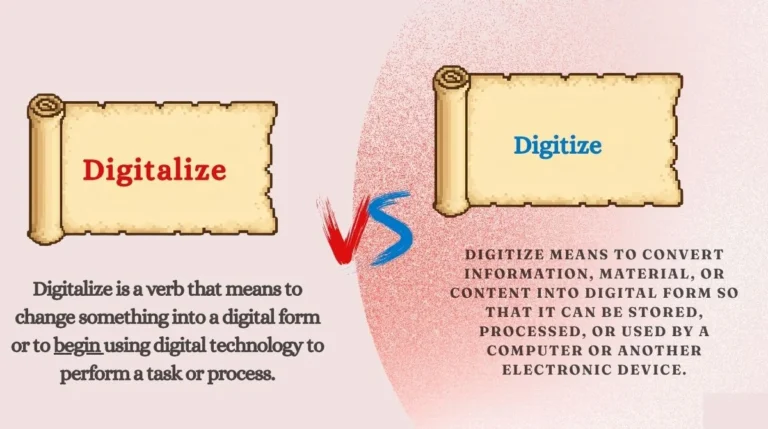
Digitalize is a verb that means to change something into a digital form or to begin using digital technology to perform a task or process.
In simple English, think of digitalize as:
make something digital or introduce digital technology into something
Cambridge gives two closely related meanings. First, digitalize can mean changing something such as a document into a digital form that can be stored and read by computers. Second, it can mean beginning to use digital technology, such as computers and the internet, to do something.
This wider meaning is important. Suppose a company has always used paper forms, manual records, and face-to-face processes. It decides to move those activities into an online system. You could say that the company is digitalizing its operations.
When should you use “digitalize”?
Use digitalize when you are talking about making something digital, especially when the idea includes a wider change in the way a person, company, school, or organization works.
For example, a school may digitalize its records by moving paper files into a computer system. A business may digitalize its customer service by introducing online forms and digital communication.
The word is particularly common in discussions about technology, business, communication, education, and organizational change.
Grammar rule for “digitalize”
Digitalize is a regular transitive verb in many common uses.
That means it can take a direct object:
Subject + digitalize + object
For example:
- The company digitalized its old records.
- The school is digitalizing its library.
- We plan to digitalize the application process.
Its common forms are:
- Base form: digitalize
- He/She/It: digitalizes
- Past: digitalized
- Past participle: digitalized
- -ing form: digitalizing
Oxford lists these verb forms and gives digitalize something for changing data into a digital form.
Examples of “digitalize”
- The museum plans to digitalize its collection.
- Our school is digitalizing old student records.
- The company wants to digitalize its customer service.
- They digitalized thousands of paper documents.
- The library is digitalizing its historical records.
- Many businesses are digitalizing their operations.
- We need to digitalize these forms before storing them online.
- The government is working to digitalize public services.
Notice that these examples do not all mean exactly the same thing. Some refer to converting information into digital form, while others suggest adopting digital technology as part of a larger process.
A common confusion about “digitalize”
A learner may see a sentence such as:
We need to digitalize our old photographs.
That is understandable. But many speakers, especially in technical contexts, would more naturally say:
We need to digitize our old photographs.
Why? Because digitize is especially associated with the direct conversion of information into digital data. Oxford and Collins both define digitize around this idea of turning information into a digital form that a computer can process.
So digitalize is not wrong. It is simply not always the most precise or natural choice when you mean a direct conversion from physical or analog material to digital data.
What Does “Digitize” Mean?
Digitize means to convert information, material, or content into digital form so that it can be stored, processed, or used by a computer or another electronic device.
A simple way to remember it is:
Digitize = turn information into digital data
Cambridge explains that to digitize information is to put it into a form made up of digital numbers, usually so a computer can understand and use it. Collins similarly defines digitize as turning information into a form that can be easily read by a computer.
This is the word you will often see with things such as:
- documents
- photographs
- books
- maps
- sound recordings
- video
- archives
- records
- collections
- paper files
When should you use “digitize”?
Use digitize when the main idea is conversion into digital form.
Imagine that you have a box full of old family photographs. You scan the photographs and save them as image files on your computer. You have digitized the photographs.
Or imagine a library with thousands of old paper documents. Workers scan them and save them in a digital archive. The library has digitized the documents.
The focus is on the change in form.
Grammar rule for “digitize”
Like digitalize, digitize is a regular verb.
Its common forms are:
- Base form: digitize
- He/She/It: digitizes
- Past: digitized
- Past participle: digitized
- -ing form: digitizing
Oxford lists digitize something as the standard verb pattern and gives the example of a digitized map.
The normal structure is:
Subject + digitize + object
Examples:
- They digitized the records.
- We are digitizing the photographs.
- She wants to digitize the documents.
Examples of “digitize”
- The library digitized its oldest books.
- We need to digitize these paper records.
- The museum has digitized thousands of photographs.
- The team is digitizing historical maps.
- They digitized the old audio recordings.
- The company plans to digitize all its files.
- The archive is being digitized for online access.
- Researchers digitized the handwritten documents.
These examples have one clear idea in common: something already exists in a non-digital form, and it is being converted into digital form.
A common confusion about “digitize”
Some learners think that digitize means simply “use a computer.”
That is too broad.
For example, if a shop starts accepting online payments, that does not automatically mean the shop is digitizing the payment. The phrase digitize the payment may be possible in some contexts, but the stronger idea is usually about converting information or a process into digital form.
So ask yourself:
Am I converting something into digital data?
If the answer is yes, digitize is often the clearest word.
Difference Between Digitalize and Digitize
The two words are very close. In fact, dictionaries recognize their overlap. Oxford lists digitalize as another form related to digitize, while Cambridge gives digitize as a synonym for one meaning of digitalize.
Still, there is a useful practical distinction.
Comparison Table
| Point | Digitalize | Digitize |
|---|---|---|
| Part of speech | Verb | Verb |
| Basic idea | Make digital or introduce digital technology | Convert into digital form |
| Main focus | Can be broad | Usually more specific |
| Often used with | Processes, systems, operations, services | Data, documents, photos, recordings, maps |
| Example | Digitalize the business process | Digitize the paper records |
| Meaning overlap | Yes | Yes |
| Best choice for direct conversion | Possible | Usually the clearest choice |
1. Usage difference
The biggest difference is focus.
Digitize usually focuses on the information itself.
Digitalize can focus on the information or on a wider process involving digital technology.
Compare these:
The museum digitized its photographs.
This clearly means the photographs were converted into digital files.
The museum digitalized its services.
This sounds broader. It can suggest that the museum started using digital systems, online services, electronic tools, or other technology.
That broader use of digitalize is recognized by Cambridge, which includes the idea of starting to use digital technology to do something.
2. Grammar logic
Both words are verbs and normally follow the same basic grammar pattern:
Subject + verb + object
For example:
The library digitized the documents.
The library digitalized the documents.
Both sentences are grammatically possible.
The issue is not mainly grammar. It is meaning and natural usage.
When the object is something that is being converted into digital information, digitize is often the more direct choice.
When you are talking about changing a system, operation, strategy, or activity through digital technology, digitalize may express the wider idea better.
3. Sentence-structure difference
The sentence structure is almost identical.
Digitize:
The company + digitized + its paper files.
Digitalize:
The company + digitalized + its customer service.
The first sentence focuses on files being converted.
The second focuses on a service becoming more digital.
Again, these are tendencies rather than absolute rules. English dictionaries show that the two verbs can overlap.
4. Meaning comparison
Think about these four examples:
A. We digitized the old photographs.
The photographs were changed into digital files.
B. We digitalized the old photographs.
This is understandable and dictionary-supported, but digitized sounds more natural for this direct conversion.
C. The company digitalized its customer service.
The company introduced digital technology into the service.
D. The company digitized its customer service.
This may be understandable, but it can sound less precise if the intended meaning is a broad transformation of the service.
A useful rule of thumb
When talking about conversion, choose digitize.
When talking about a broader move toward digital technology, digitalize can be a good choice.
But remember that real English usage does not always keep these words in separate boxes.
Grammar Rules You Must Remember
Rule 1: Use “digitize” for direct conversion into digital form
When paper, photos, audio, maps, records, or other information are converted into digital data, digitize is usually the clearest verb.
Example:
The archive digitized its paper records.
The records were converted into digital form.
Oxford and Collins both connect digitize directly with converting information into digital form for computer processing.
Rule 2: Use “digitalize” when the meaning is broader
When the subject is a process, organization, business activity, or service that is becoming more digital, digitalize can describe the wider change.
Example:
The company is digitalizing its operations.
This can include online tools, digital communication, software, electronic records, and other technology-based changes.
Cambridge specifically includes the meaning of starting to use digital technology to do something.
Rule 3: Both words are grammatically correct
Do not assume that digitalize is incorrect just because digitize is more natural in a certain sentence.
Both are established English verbs.
Oxford lists digitalize as an alternative related to digitize, while Cambridge gives overlapping definitions for both words.
Example:
The library digitalized its records.
The library digitized its records.
Both can be understood as saying that the records were changed into digital form.
Rule 4: British English often uses “-ise”
There is another spelling issue that can confuse learners.
In British English, you may see:
- digitize → digitise
- digitalize → digitalise
Cambridge and Oxford both list these British spellings.
So these are spelling variations, not completely different words:
digitize = digitise
digitalize = digitalise
American English commonly uses -ize.
For an English-learning website, it is useful to recognize both forms, especially when reading British websites, books, or news.
Common Mistakes Students Make
These two words create mistakes mainly because their forms and meanings are so close.
Mistake 1: Thinking “digitalize” is always wrong
Some learners believe that digitize is correct and digitalize is incorrect.
That is not true.
Major dictionaries recognize digitalize as a real verb. Cambridge gives both the conversion meaning and the broader “use digital technology” meaning. Oxford also lists it as a valid verb related to digitize.
Wrong idea:
Never use digitalize.
Better understanding:
Digitalize is correct, but digitize is often the more natural choice for direct conversion.
Mistake 2: Using “digitize” for every technology change
A learner may write:
We need to digitize our whole business.
This sentence can be understood, but it may not clearly express a broad business transformation.
A more natural choice in that context could be:
We need to digitalize our whole business.
Here, the meaning is bigger than converting files. It suggests changing the way the business works through digital technology.
Mistake 3: Using “digitalize” when “digitize” is more precise
Consider:
The museum digitalized 50,000 photographs.
There is nothing fundamentally wrong with this sentence. However, if the main point is that the photographs were scanned or converted into digital files, many writers would choose:
The museum digitized 50,000 photographs.
That sentence immediately communicates the conversion.
Mistake 4: Confusing the nouns
The related nouns can also cause problems.
You may see:
- digitization
- digitalization
Both are established nouns. Oxford lists digitalization as another term alongside digitization.
However, digitization is especially common when discussing the process of converting information into digital form.
Example:
The digitization of old newspapers took five years.
That sounds natural because the newspapers were converted into digital form.
Mistake 5: Forgetting the British spelling
A student may see digitise and think it is a spelling error.
It is not.
Digitise is a standard British spelling of digitize, and digitalise is a British spelling of digitalize.
So:
The library digitised its records.
and
The library digitized its records.
can communicate the same basic idea, with the spelling depending on the English variety.
Easy correction tip
Before choosing the word, ask one simple question:
“Am I changing information into digital form, or am I changing a wider process by using digital technology?”
For direct conversion, digitize is usually your safest choice.
For a broader technological transformation, digitalize may fit better.
Easy Trick to Remember the Difference
Here is a simple classroom trick.
Think: “Digit = data”
The word digitize starts with digit.
So connect it with digital data.
When you convert:
paper → computer file
photo → image file
cassette → digital audio
old map → digital map
think:
Digitize = turn it into digital data.
Now think about digitalize as a wider change.
You are not just changing one file. You may be changing the whole way something is done.
For example:
paper forms + manual records + face-to-face service
may become:
online forms + digital records + online service
That bigger change can be described as digitalizing a process or organization.
Real-life memory example
Imagine a school.
The school scans 10,000 old paper records.
You can say:
The school digitized its records.
Then the school starts using online registration, digital attendance, electronic communication, and an online learning system.
You can say:
The school digitalized its administrative processes.
The first action is mainly about conversion.
The second is about wider technological change.
That is the easiest difference to keep in your memory.
Daily Life Examples
Here are some simple examples that show how these words may appear in real conversations.
Example 1
A: What are you doing with all those old papers?
B: We’re digitizing them so we can store them on the computer.
Example 2
A: Why is the company changing its website?
B: The company is digitalizing its customer service.
Example 3
A: Did you save the old family pictures?
B: Yes. I digitized them last weekend.
Example 4
A: Why does the library have fewer paper files now?
B: It has digitized most of its records.
Example 5
A: Are you still using paper forms?
B: Not anymore. We are digitalizing the whole application process.
Example 6
A: What happened to those old recordings?
B: We digitized them and saved them as audio files.
Example 7
A: Is the hospital still using paper records?
B: It is working to digitalize its record system.
Example 8
A: Can I see the old map online?
B: Yes. The museum digitized it last year.
Example 9
A: Why do I have to use the website now?
B: The company is digitalizing many of its services.
Example 10
A: What are you doing with those old books?
B: We are digitizing them for the online library.
These examples show why context matters. In everyday technology language, digitize is often the best word when a physical or analog item becomes digital. Digitalize becomes especially useful when the meaning is wider and includes adopting digital systems or technology.
Practice Section
Choose the correct word: digitalize or digitize.
1. The library wants to ______ its old documents.
2. The company is trying to ______ its customer service.
3. We need to ______ these paper photographs.
4. The school plans to ______ its administrative system.
5. Researchers are ______ thousands of historical maps.
Answers
1. digitize
The documents are being converted into digital form.
2. digitalize
The sentence suggests a broader change in how customer service operates through digital technology.
3. digitize
The photographs are being converted into digital files.
4. digitalize
The administrative system is undergoing a broader digital transformation.
5. digitizing
Historical maps are being converted into digital form.
Do not worry if some examples feel flexible. That is normal because the meanings of digitalize and digitize overlap in modern English. Major dictionaries explicitly recognize this overlap.
FAQs
What is the difference between digitalize and digitize?
Digitize usually means converting information into digital form, such as turning paper records or photographs into computer files.
Digitalize can also mean this, but it can additionally mean using digital technology to change or improve a wider process, service, or activity.
Is “digitalize” a correct English word?
Yes. Digitalize is a correct English verb and is included in major dictionaries such as Cambridge and Oxford.
It can mean changing something into digital form or starting to use digital technology for a task or process.
Is digitize more common than digitalize?
For the specific idea of converting information into digital form, digitize is often the clearer and more widely preferred choice.
For broader discussions about digital transformation, digitalize is also used. The two words are not completely separate, and dictionary definitions overlap.
Can I use “digitalize” instead of “digitize”?
Sometimes, yes.
For example, both digitalize the records and digitize the records can be understood as changing records into digital form.
However, digitize is often the more precise choice when you are talking specifically about converting information, documents, photographs, sound, or other material into digital data.
Is “digitalize” formal or informal?
Digitalize is neither simply informal nor incorrect. It is a standard verb used in technology, business, and general writing.
Its usefulness depends on context. It is especially helpful when you are describing a broader move toward using digital technology. Cambridge includes this broader business and technology use.
What is the British spelling of digitize and digitalize?
British English commonly uses:
digitise for digitize
and
digitalise for digitalize
Oxford and Cambridge both recognize these British spelling forms.
Conclusion
Digitalize and digitize are both correct English words, but they often carry a slightly different focus.
Use digitize when you mean converting information into digital form. This is the natural choice for things like paper documents, photographs, recordings, books, maps, and old records.
Use digitalize when you want to describe a broader move toward digital technology, especially when a business, school, service, or process is being changed.
The two words can overlap, so you may sometimes see them used interchangeably. Major dictionaries confirm that overlap.
A simple memory trick can help: digitize = digital data, while digitalize = a broader digital change.
Once you understand that small difference, choosing the right word becomes much easier. Pay attention to real examples, practice writing your own sentences, and remember that context is often more important than trying to force the two words into completely separate meanings.

Evan Rellmont is a writer who turns thoughtful ideas into meaningful words, creating stories and reflections that connect, inspire, and leave a lasting impression.