
English has many words that look almost the same but make learners stop and think.
Lunchtime vs lunch-time is one of those small spelling questions that can cause unnecessary confusion.
Should you write lunchtime as one word? Is lunch-time correct with a hyphen? What about lunch time as two separate words?
The good news is that this is easier than it first appears. In modern English, lunchtime is the normal and most widely preferred spelling.
Major dictionaries use lunchtime as the main form. Some dictionaries also recognize lunch time as an alternative open form, while lunch-time can still be found as an alternative form, especially in older or less common usage.
For everyday writing, school assignments, emails, websites, and professional communication, lunchtime is the safest choice.
Once you understand how the word works as a compound noun, the confusion becomes much easier to handle.
You will also learn how to use it naturally with prepositions such as at, around, and during, how to form the plural lunchtimes, and why lunch-time is usually not the best choice today.
What Does “Lunchtime” Mean?
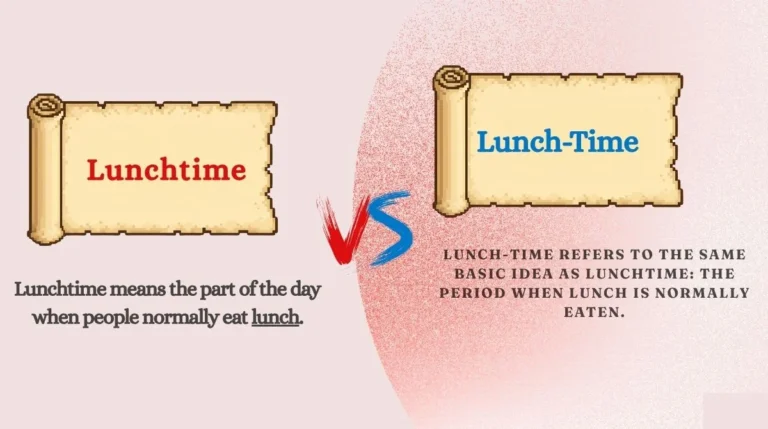
Lunchtime means the part of the day when people normally eat lunch.
Cambridge Dictionary defines lunchtime as the time in the middle of the day when most people eat a meal, while its learner dictionary gives the simple meaning “the time when lunch is eaten.”
So, if someone says:
“I’ll call you at lunchtime.”
they mean they will call you around the usual time people have lunch.
When Should You Use “Lunchtime”?
Use lunchtime when you are talking about the general period of the day connected with lunch.
For example:
- I usually get hungry at lunchtime.
- We can meet at lunchtime.
- The children eat together at lunchtime.
- I’ll finish this work before lunchtime.
- The restaurant becomes very busy at lunchtime.
It is a very common word in everyday English. You may hear it at school, at work, at home, in shops, and in ordinary conversations.
The Grammar Rule for “Lunchtime”
Lunchtime is normally written as one word.
It is a compound noun, formed from lunch + time. Like other familiar compound words such as mealtime, bedtime, and dinnertime, the two parts have joined together to create one established word. Cambridge also lists mealtime as one word, and Collins lists lunchtime as the main form.
It can be used as a noun:
Lunchtime is usually busy here.
It can also be used before another noun:
We have a lunchtime meeting today.
In that second example, lunchtime helps describe the meeting. Collins gives examples such as a lunchtime meeting and lunchtime news.
8 Examples of “Lunchtime”
- I usually take a short walk at lunchtime.
- The school cafeteria is crowded at lunchtime.
- Let’s talk about it after lunchtime.
- I was very hungry by lunchtime.
- She always brings fruit for lunchtime.
- We have a lunchtime meeting on Monday.
- The shop is usually quiet before lunchtime.
- I like to read during my lunch break at lunchtime.
A Common Learner Confusion
Many students think the word should stay separated because lunch and time are two different words.
That sounds logical, but English compound words do not always follow the pattern learners expect. Some combinations stay open, some become hyphenated, and others become one word over time.
For example:
- lunch + time → lunchtime
- meal + time → mealtime
- bed + time → bedtime
- dinner + time → dinnertime
You do not need to invent a new rule every time. When a common compound has an established dictionary spelling, follow that spelling.
What Does “Lunch-Time” Mean?
Lunch-time refers to the same basic idea as lunchtime: the period when lunch is normally eaten.
The important point is spelling and modern usage.
The hyphenated form lunch-time does exist. Wiktionary lists it as an alternative form of lunchtime, which means readers may still come across it.
However, that does not mean it is the best choice for ordinary modern writing.
If you are writing a school essay, business email, blog post, website page, or social media post, lunchtime is the more natural choice.
Why Does “Lunch-Time” Appear?
English spelling changes over time.
Words made from two separate words have often moved through different stages. A combination may first appear as two words, later be written with a hyphen, and eventually become one closed compound.
That is one reason learners may see different forms in old books, archived texts, or online material.
So, when you see lunch-time, there is no need to assume that the writer means a completely different thing. It generally means the same thing as lunchtime.
Is “Lunch-Time” Grammatically Wrong?
It is better to say that lunch-time is uncommon in modern standard usage, rather than treating every appearance of it as an absolute grammatical error.
Modern dictionaries such as Collins recognize lunchtime and also give lunch time as an alternative form. Wiktionary records lunch-time as an alternative spelling.
Still, for learners who want one clear rule:
Use “lunchtime” in normal modern English.
That simple choice will work well in almost every everyday situation.
8 Examples Showing the Meaning
The following sentences use the meaning associated with lunch-time, but in modern writing you would usually spell the word lunchtime:
- We usually go outside at lunchtime.
- The office gets noisy around lunchtime.
- I will see you at lunchtime.
- The children are allowed to play after lunch at lunchtime.
- She called me during lunchtime.
- He was tired before lunchtime.
- The restaurant offers a special lunchtime menu.
- We have a short lunchtime break at school.
Notice something important: the meaning does not change just because the spelling changes.
The Main Problem Learners Have
The biggest problem is often not meaning. It is choosing the modern spelling.
A student may see lunch-time in one source and lunchtime in another and wonder whether one means something different.
Usually, it does not.
Think of lunchtime as the standard everyday form. That is the form you should normally write.
Difference Between Lunchtime and Lunch-Time
Now we can make the difference much clearer.
The two forms are connected in meaning, but they are not equally common in modern English.
Comparison Table
| Point | Lunchtime | Lunch-time |
|---|---|---|
| Spelling | One word | Two parts joined by a hyphen |
| Meaning | Time when lunch is eaten | Same basic meaning |
| Modern usage | Standard and common | Uncommon / alternative |
| Everyday writing | Recommended | Usually avoided |
| Formal writing | Recommended | Not the usual choice |
| Dictionary status | Main dictionary form | Alternative form in some sources |
| Plural | Lunchtimes | Lunch-times |
| Example | We met at lunchtime. | We met at lunch-time. |
Cambridge and Collins use lunchtime as the main dictionary form. Collins also records lunch time as an alternative, while Wiktionary records lunch-time as an alternative spelling.
Usage Difference
The simplest usage difference is this:
Lunchtime is the normal modern form.
Lunch-time is a less common alternative.
So, compare:
We can talk at lunchtime. ✅
We can talk at lunch-time. ⚠️ Less common
The first sentence will sound more natural to most modern readers.
Grammar Logic
Why is lunchtime one word?
Because English often combines frequently used words into compound words. Over time, a familiar combination can become a standard single word.
Compare:
- lunch + time = lunchtime
- meal + time = mealtime
- bed + time = bedtime
- play + time = playtime
This does not mean every word ending in time must be joined. English has many exceptions. But established dictionary forms should be learned as they are.
Sentence Structure
The sentence structure is basically the same because the meaning is the same.
For example:
I’ll call you at lunchtime.
Here, lunchtime is a noun referring to a period of the day.
You can also put it before another noun:
We had a lunchtime meeting.
This is a useful pattern for learners. The word does not suddenly become incorrect just because it describes another noun.
Meaning Comparison
There is almost no practical meaning difference between the two forms.
Both point to the time around which lunch is normally eaten.
The real difference is spelling, frequency, and modern style.
That is why it is not helpful to spend too much time trying to find a hidden difference in meaning.
Lunchtime vs Lunch Time: What About Two Words?
There is another form that learners sometimes ask about:
lunch time
This is different from lunch-time, because there is no hyphen.
Collins explicitly lists lunch time as an alternative form of lunchtime.
So, you may sometimes see:
What time is lunch time?
However, in most ordinary sentences, lunchtime is smoother:
What time is lunchtime?
Or, even more naturally:
What time do you have lunch?
For a grammar website aimed at learners, teaching lunchtime as the main spelling is the clearest approach.
Grammar Rules You Must Remember
Rule 1: Use “lunchtime” as the standard spelling.
When you mean the normal period when lunch is eaten, write lunchtime as one word.
Example:
I’ll finish the report before lunchtime.
This is the safest form for everyday and formal writing.
Rule 2: Use “at lunchtime” for a general point in the day.
The preposition at is very common with lunchtime.
Examples:
We usually eat together at lunchtime.
Can you call me at lunchtime?
You are not talking about one exact minute. You are referring to the general lunch period.
Rule 3: Use “around lunchtime” when the time is approximate.
When you do not know the exact time, around lunchtime sounds very natural.
Examples:
I should arrive around lunchtime.
She called me around lunchtime.
This is useful in spoken English because lunch does not always happen at exactly 12:00.
Rule 4: “Lunchtime” can describe another noun.
Because it can work as a modifier, you can place it before another noun.
Examples:
lunchtime meeting
lunchtime menu
lunchtime break
lunchtime concert
Collins gives examples such as lunchtime meeting and lunchtime news, showing how the word is commonly used as a modifier.
This is an important pattern because learners sometimes think the word can only be used after at.
Common Mistakes Students Make
The confusion usually comes from a simple reason: English has many different types of compound words.
Students may know expressions such as part-time, full-time, and long-term, so they naturally expect lunch-time to need a hyphen too.
But English spelling is not perfectly predictable.
Mistake 1: Always Writing “Lunch-time”
Wrong choice for normal modern writing:
We will meet at lunch-time.
Better:
We will meet at lunchtime.
The hyphenated spelling can be found, but it is not the form you should normally choose today.
Mistake 2: Writing “Lunch Time” Every Time
Some learners think two words must be more grammatically correct.
That is not true.
Less natural as the default:
I will see you at lunch time.
More standard:
I will see you at lunchtime.
Remember that dictionaries can recognize alternative forms without making them equally common. Collins gives lunch time as an alternative, but lunchtime is the main headword.
Mistake 3: Thinking “Lunchtime” Means Exactly Noon
It does not.
Lunchtime means the period when lunch is normally eaten. Cambridge describes it as the middle-of-the-day period when lunch is eaten, not a fixed minute on the clock.
For example:
We eat lunch at 12:30.
That is a specific time.
But:
We eat lunch at lunchtime.
That refers to the general lunch period.
Mistake 4: Confusing “Lunchtime” With “Lunch Break”
These expressions are related, but they are not always identical.
Lunchtime focuses on the time of day when lunch is eaten.
Lunch break focuses more on a break from work, school, or another activity.
For example:
I usually eat at lunchtime.
I have a one-hour lunch break at work.
Cambridge defines lunch hour as the period in the middle of the day when people stop work to have lunch.
Easy Correction Tip
When you are unsure, ask yourself:
“Am I naming the normal lunch period?”
If yes, choose lunchtime.
That one habit will solve most of the confusion.
Easy Trick to Remember the Difference
Here is a simple memory trick:
“Lunch + time = lunchtime”
Think of familiar words like:
bedtime
mealtime
dinnertime
They are written as one word.
So when you think about the period for lunch, remember:
Lunch has its own time — lunchtime.
Another easy trick is to imagine that the two words have been friends for a very long time. They are used together so often that English normally writes them as one word.
You do not write:
bed-time
when you mean the normal period for going to bed.
You usually write:
bedtime
In the same way, write:
lunchtime
This is not a rule that works for every compound in English, but it is a helpful memory shortcut for this word.
A Real-Life Logic Trick
Imagine your office schedule:
9:00 – Start work
11:00 – Coffee
1:00 – Lunchtime
2:00 – Back to work
Here, lunchtime is the name of that part of the day.
That picture makes the word easier to remember.
Daily Life Examples
You are most likely to use this word in simple everyday sentences. Here are natural examples you may hear at home, school, or work.
1. Talking about plans
“Are you free at lunchtime?”
“Yes, I should be free around one.”
2. Talking about school
“What do you usually do at lunchtime?”
“I eat with my friends.”
3. Talking about work
“Can we have the meeting before lunchtime?”
“Sure. Ten thirty works for me.”
4. Talking about food
“What are you having for lunch?”
“I’m not sure yet. I’ll decide at lunchtime.”
5. Talking about a phone call
“Can I call you later?”
“Yes, call me around lunchtime.”
6. Talking about a busy restaurant
“Why is this restaurant so crowded?”
“It always gets busy at lunchtime.”
7. Talking about a schedule
“The doctor is available until lunchtime.”
“Okay, I’ll try to go before then.”
8. Talking about a meeting
“We have a lunchtime meeting today.”
“I hope it doesn’t last too long!”
9. Talking about travel
“When will you arrive?”
“Probably around lunchtime.”
10. Talking about daily habits
“I usually go for a walk at lunchtime.”
These examples show that lunchtime is a very flexible word. You can use it with plans, schedules, work, school, food, travel, and conversations.
Practice Section
Choose the best form in each sentence.
1. I usually get hungry around ______.
A. lunch-time
B. lunchtime
C. both are equally preferred in modern writing
2. We can meet ______ tomorrow.
A. at lunchtime
B. at lunch-time
C. at the lunchtime
3. The restaurant is very busy at ______.
A. lunchtime
B. lunch-time
C. both are common modern dictionary headwords
4. We have a ______ meeting today.
A. lunchtime
B. lunch-time
C. lunch time
5. I will call you ______.
A. around lunchtime
B. around lunch-time
C. around the lunch
Answers
1. B — lunchtime
This is the normal modern spelling.
2. A — at lunchtime
This is the most natural standard form.
3. A — lunchtime
Use the one-word form in ordinary modern writing.
4. A — lunchtime
It can be used before another noun, as in lunchtime meeting.
5. A — around lunchtime
This is a common and natural expression when the exact time is not known.
FAQs
What is the difference between lunchtime and lunch-time?
Both forms refer to the time when lunch is usually eaten. However, lunchtime is the standard and much more common modern spelling. Lunch-time is an alternative form that readers may still encounter.
Is lunchtime one word or two?
Lunchtime is one word. It is the normal spelling used by major dictionaries such as Cambridge and Collins. Some dictionaries also recognize lunch time as an alternative form.
Is lunch-time correct English?
It can be found as an alternative spelling, so it is not meaningless or impossible to understand. However, it is not the normal modern spelling. For school, work, websites, and everyday writing, lunchtime is the better choice.
Should I use lunchtime in formal writing?
Yes. Lunchtime is a safe and standard choice for formal and informal writing. You can use it in emails, reports, articles, assignments, notices, and professional communication without needing a hyphen.
Can I say “at lunchtime”?
Yes. At lunchtime is one of the most common ways to use the word.
For example:
I usually eat with my coworkers at lunchtime.
You can also say around lunchtime when you mean approximately that period.
Is “lunch time” also correct?
It can be used as an alternative open form, and Collins lists lunch time alongside lunchtime. Still, when you want the simplest and most standard modern form, choose lunchtime.
Conclusion
The choice between lunchtime vs lunch-time looks more difficult than it really is. In modern English, lunchtime is the clearest and safest spelling to use in everyday, academic, and professional writing. It is a standard compound noun meaning the period when people usually eat lunch. Cambridge and Collins both use lunchtime as the main dictionary form.
You may still see lunch-time or lunch time in some sources, and these forms can be understood. However, learners do not need to choose the less common forms when one simple standard form works so well.
Remember the easy rule: lunch + time = lunchtime.
Use phrases such as at lunchtime, around lunchtime, and a lunchtime meeting. With a little practice, the spelling will soon feel natural.
Good English is often about learning small patterns and using them confidently. Once you remember this one, you can stop worrying about the hyphen and focus on expressing your ideas clearly.

Evan Rellmont is a writer who turns thoughtful ideas into meaningful words, creating stories and reflections that connect, inspire, and leave a lasting impression.