
English learners often see both in person and in-person and wonder which one is correct. The good news is that both forms are correct.
The difference is mainly about how the words work in a sentence, not about a different basic meaning.
Both expressions describe something that happens with someone physically present, rather than through a phone call, email, video call, or another form of technology.
Cambridge Dictionary lists in person as a phrase meaning that you do something yourself or are physically present.
It also lists in-person as an adjective used before a noun, such as in-person meeting or in-person classes.
This small hyphen creates confusion because learners may think it changes the meaning completely. It usually does not.
Instead, the hyphen helps readers see that in-person is acting as one adjective that describes a noun.
For example, compare these two sentences:
- I met my teacher in person.
- I had an in-person meeting with my teacher.
The first sentence tells us how the meeting happened. The second describes what kind of meeting it was.
Once you understand this simple grammar pattern, the choice becomes much easier. You will know when to write in person, when to write in-person, and why the hyphen belongs in one sentence but not the other.
What Does “In Person” Mean?
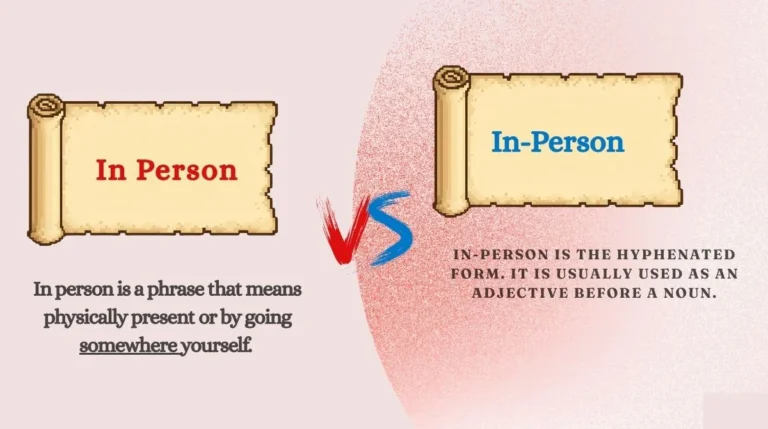
In person is a phrase that means physically present or by going somewhere yourself. It is commonly used when someone does something personally instead of doing it online, by phone, through email, or through another person.
Cambridge Dictionary describes in person as a phrase used when you do something yourself or are physically present. It gives examples such as applying for something in person, meeting someone in person, and appearing in person.
In many sentences, in person works like an adverbial phrase. It gives extra information about the action. It answers a question such as How? or In what way?
Look at this sentence:
I spoke to the manager in person.
Here, in person tells us how I spoke to the manager. I did not send an email or make a phone call. I physically spoke to the manager.
Another useful point is that in person is written without a hyphen when it is not directly acting as an adjective before a noun. Major usage guides explain the same distinction: use in person when the phrase is separate in the sentence, and use in-person when it forms a compound adjective before a noun.
When should you use “in person”?
Use in person when you are talking about an action done physically or directly.
It is especially common with verbs such as:
- meet
- see
- speak
- talk
- apply
- visit
- appear
- deliver
- attend
Examples of “in person”
- I would like to meet you in person.
- She came to the office in person.
- We spoke in person after the class.
- You need to apply for the job in person.
- I finally saw the painting in person.
- He apologized to me in person.
- The principal asked the parents to attend in person.
- They had never met in person before the conference.
Notice something important in all these examples: in person is not directly describing a noun. It is connected to what someone does.
For example:
She met me in person.
Here, in person explains the verb met.
It is not describing me. Therefore, there is no need for a hyphen.
Common confusion about “in person”
A very common mistake is adding a hyphen everywhere:
❌ I met my friend in-person.
✅ I met my friend in person.
The second sentence is the standard form because in person comes after the verb and explains how the meeting happened.
Another mistake is assuming that the two forms have completely different meanings. They usually express the same basic idea. The main difference is grammar and sentence position.
What Does “In-Person” Mean?
In-person is the hyphenated form. It is usually used as an adjective before a noun.
Its job is to tell us that something involves physical presence rather than communication or participation through technology.
For example:
We have an in-person class tomorrow.
Here, in-person describes the noun class. It tells us what kind of class it is.
Cambridge Dictionary specifically labels in-person as an adjective and gives examples such as in-person classes, in-person therapy, in-person teaching, and in-person interview.
The hyphen connects the words so that readers understand them as one descriptive unit.
When should you use “in-person”?
Use in-person before a noun when you want to describe the type or nature of an activity, event, service, meeting, class, visit, interview, or similar thing.
Common combinations include:
- in-person meeting
- in-person class
- in-person interview
- in-person appointment
- in-person visit
- in-person training
- in-person event
- in-person consultation
- in-person service
- in-person discussion
Examples of “in-person”
- We have an in-person meeting on Monday.
- The company offers in-person training.
- I have an in-person interview tomorrow.
- Our school has started in-person classes again.
- She prefers in-person communication.
- The doctor offers both online and in-person appointments.
- They organized an in-person event for new students.
- I need an in-person consultation with the manager.
In each example, in-person comes before a noun and describes it.
Common confusion about “in-person”
Learners sometimes write:
❌ We have an in person meeting.
The more standard form is:
✅ We have an in-person meeting.
The hyphen makes the relationship between the words clear. In-person works as a single compound adjective describing meeting.
A simple way to think about this is:
in-person + noun
For example:
in-person + meeting
in-person + class
in-person + interview
That pattern is easy to remember.
Difference Between In Person and In-Person
The biggest difference is not meaning. It is grammatical function.
Both expressions refer to physical presence. The main question is:
Are the words describing a noun, or are they explaining how an action happens?
If they describe a noun directly, use in-person.
If they explain an action and are not functioning as a compound adjective before a noun, use in person.
Comparison Table
| Point | In person | In-person |
|---|---|---|
| Form | Two words | Hyphenated compound |
| Main role | Phrase, often adverbial | Adjective |
| Usually used | With or after a verb | Before a noun |
| Main idea | Physically or personally | Describes something physical rather than online |
| Example | We met in person. | We had an in-person meeting. |
| Hyphen | No | Yes, before a noun |
| Common use | meet, speak, visit, apply | meeting, class, interview, event |
Usage difference
Compare these sentences:
I talked to Sarah in person.
I had an in-person conversation with Sarah.
The meaning is almost the same. However, the grammar is different.
In the first sentence, in person explains how I talked to Sarah.
In the second sentence, in-person describes conversation.
This is the key difference you need to remember.
Grammar logic
A hyphen often helps connect words that work together as one modifier before a noun. General English punctuation guidance recommends hyphenating compound adjectives when they come before a noun, such as well-known idea.
The same pattern appears with in-person:
in-person meeting
The two words act together to describe meeting.
But look at:
We met in person.
There is no noun immediately after the phrase that needs this compound modifier. So the phrase stays open:
in person
The University of Arizona Libraries style guide gives the same practical rule and contrasts examples such as in-person meeting with visit us in person.
Sentence structure difference
A useful formula is:
Verb + in person
Examples:
I met her in person.
We spoke in person.
He applied in person.
Now compare:
in-person + noun
Examples:
an in-person meeting
an in-person interview
an in-person class
This structure is one of the easiest ways for beginners to make the correct choice.
Meaning comparison
The basic idea stays the same: physical presence.
The difference is only in the job the expression is doing.
Think of it like this:
in person = how something happens
in-person = what kind of thing it is
For example:
She attended the meeting in person.
This tells us how she attended.
She attended an in-person meeting.
This tells us what kind of meeting she attended.
Both are natural and correct.
Grammar Rules You Must Remember
Rule 1: Use “in-person” before a noun
When the phrase directly describes a noun, use the hyphenated form.
Example:
✅ We scheduled an in-person interview.
Here, in-person describes interview.
More examples:
in-person lesson
in-person appointment
in-person discussion
A simple test is to look at the word immediately after the expression. If it is a noun being described, in-person is usually the right choice.
Rule 2: Use “in person” when it explains an action
When the phrase tells us that an action is done physically or personally, do not use the hyphen.
Example:
✅ I spoke to the manager in person.
The expression explains how I spoke to the manager.
Other examples:
✅ Please come in person.
✅ I want to thank her in person.
✅ They met in person last week.
Rule 3: Do not add the hyphen just because the phrase appears in the middle of a sentence
Sentence position alone does not decide the answer. Its grammatical job matters.
Compare:
✅ The teacher talked to us in person.
and
✅ The teacher gave us an in-person lesson.
The first uses the phrase after the action. The second uses the compound adjective before lesson.
Rule 4: Ask yourself one simple question
Before writing the phrase, ask:
“Am I describing a noun?”
If yes:
in-person
If no, and you are describing how someone does something:
in person
For example:
an in-person interview → describes interview
She interviewed me in person → explains how the interview happened
This quick test works in most everyday writing.
Common Mistakes Students Make
Many learners make mistakes with this expression because English contains many compound adjectives. Students often see the hyphen in in-person meeting and then start using it everywhere.
Mistake 1: Using “in-person” after a verb
❌ I met my teacher in-person.
✅ I met my teacher in person.
Why?
Because in person is explaining how the meeting happened. It is not directly describing a noun.
Mistake 2: Removing the hyphen before a noun
❌ We have an in person interview.
✅ We have an in-person interview.
Why?
Because in-person acts as one adjective before interview.
Mistake 3: Thinking one form is informal and the other is formal
The difference is not mainly about formal versus informal English.
Both forms are normal in everyday English, business English, education, and professional writing. Cambridge, for example, uses both in person and in-person in its dictionary examples and definitions.
Mistake 4: Thinking the hyphen changes the basic meaning
The hyphen does not normally change the central idea of physical presence.
Compare:
I talked to him in person.
I had an in-person talk with him.
The wording and grammar differ, but both point to physical interaction.
Easy correction tip
When you are unsure, look for the noun.
If you have:
in-person + noun
the hyphen is usually needed.
If you have:
verb + in person
the phrase normally stays open.
Easy Trick to Remember the Difference
Here is a very simple memory trick:
Before a noun → use the hyphen.
After or around the action → no hyphen.
Think of in-person as a small label attached to a noun.
For example:
in-person class
The phrase acts like one label telling you what kind of class it is.
Now think of in person as answering the question “How?”
How did you attend the class?
I attended in person.
How did you meet her?
I met her in person.
There is also a useful real-life connection:
Online meeting and in-person meeting are opposites in many modern contexts.
You can say:
- online class
- in-person class
- online interview
- in-person interview
- online appointment
- in-person appointment
But when talking about the action itself, you usually say:
- attend in person
- meet in person
- speak in person
- apply in person
So remember:
The hyphen belongs to the label, not the action.
That one idea can help you avoid most mistakes.
Daily Life Examples
Here are some natural examples you may hear or use in school, work, shopping, travel, and everyday conversation.
1. At school
A: Are we having class online tomorrow?
B: No. It will be an in-person class.
Here, in-person describes the noun class.
2. Meeting a friend
A: Have you ever met him?
B: Yes, but I only knew him online before. I finally met him in person last week.
Here, in person explains how the meeting happened.
3. At work
A: Can we discuss this by email?
B: I think this issue is easier to discuss in person.
The phrase explains how the discussion should happen.
4. Job interview
A: Is the interview online?
B: No, it is an in-person interview at our main office.
The phrase describes the type of interview.
5. Doctor’s appointment
A: Can I see the doctor through video?
B: Yes, or you can book an in-person appointment.
Here, in-person describes appointment.
6. Customer service
A: Can I solve this problem online?
B: You can, but you may need to visit the office in person.
The phrase explains how the customer must visit.
7. Family event
A: Will you join the wedding online?
B: No, I will be there in person.
It means the speaker will physically attend.
8. Business meeting
A: Do we need another video call?
B: Maybe not. An in-person meeting might be better.
The hyphenated form describes meeting.
9. Applying for something
A: Can I submit the form online?
B: No. You have to submit it in person.
The phrase tells us how the action must be completed.
10. Seeing something for yourself
A: Did you like the museum?
B: Yes. The building is even more impressive in person.
Here, the speaker is talking about personal physical experience.
Practice Section
Choose the correct option in each sentence.
1. I want to meet my new teacher __________.
A. in-person
B. in person
2. We have an __________ workshop next Saturday.
A. in person
B. in-person
3. She apologized to him __________.
A. in person
B. in-person
4. The company offers both online and __________ training.
A. in person
B. in-person
5. You must appear __________ at the office.
A. in-person
B. in person
Answers
1. B — in person
It explains how the speaker wants to meet the teacher.
2. B — in-person
It describes the noun workshop.
3. A — in person
It explains how she apologized.
4. B — in-person
It describes the noun training.
5. B — in person
It explains how the person must appear.
A quick check can help: before a noun, use in-person; for the action itself, use in person.
FAQs
What is the difference between in person and in-person?
Both refer to physical presence, but they have different grammatical jobs. In person is a phrase commonly used to explain how an action happens. In-person is a hyphenated adjective used before a noun, such as in-person meeting.
Can we use “in person” in questions?
Yes. It is very common in questions.
For example:
Have you met her in person?
Do I need to apply in person?
Will you attend the event in person?
The phrase is used normally without a hyphen because it explains the action.
Is “in-person” formal or informal?
In-person is neither simply formal nor informal. It is standard English and is common in education, business, healthcare, and everyday writing. The important issue is its grammatical position, especially when it comes before a noun.
Is “in person” always written without a hyphen?
Not always. When the expression functions as a compound adjective before a noun, the usual form is in-person. For example, an in-person interview. When it is used as a phrase describing an action, write in person, as in I met her in person.
Which is correct: “in person meeting” or “in-person meeting”?
In-person meeting is the standard form. The compound adjective in-person directly describes the noun meeting, so the hyphen connects the words as one modifier.
Example:
✅ We scheduled an in-person meeting.
Which is correct: “I met him in person” or “I met him in-person”?
The standard form is:
✅ I met him in person.
Here, in person explains how the meeting happened. It is not directly modifying a noun before it, so no hyphen is needed.
Conclusion
The difference between in person and in-person is much easier once you focus on grammar instead of trying to memorize two separate meanings. Both forms are connected to the same basic idea: being physically present rather than communicating or participating through technology.
Use in person when the phrase explains how an action happens: I met her in person, Please apply in person, or We talked in person. Use in-person when it comes before a noun and acts as an adjective: an in-person meeting, an in-person class, or an in-person interview. This is the standard distinction supported by major English usage references.
The easiest rule is simple: before a noun, use in-person; when talking about the action, use in person.
Once you start noticing this pattern in emails, schoolwork, websites, and conversations, the choice will feel natural. A little practice is usually all it takes to make the difference automatic.

Evan Rellmont is a writer who turns thoughtful ideas into meaningful words, creating stories and reflections that connect, inspire, and leave a lasting impression.