
Many English learners understand the word whether, but they still feel unsure when they see whether or not.
Sometimes both forms seem to work, so it is natural to wonder: Is or not necessary? Does it change the meaning? Can we use whether or not in questions? And is it better to say whether or if?
These questions come up often in everyday English. You may hear someone say, “I don’t know whether he is coming,” or “I don’t know whether or not he is coming.” Both can be correct, but there are situations where the longer form gives a clearer meaning.
Whether is commonly used to talk about uncertainty, a choice between possibilities, or an indirect yes-or-no question.
Whether or not can also show that the answer does not change what happens next.
This small grammar point matters because it appears in conversation, emails, school writing, business English, and formal writing.
Once you understand the basic idea, it becomes much easier to choose the right form.
By the end of this guide, you will understand what whether means, what whether or not means, how they differ, which grammar patterns are correct, and how native speakers use them in real-life sentences.
What Does “Whether” Mean?
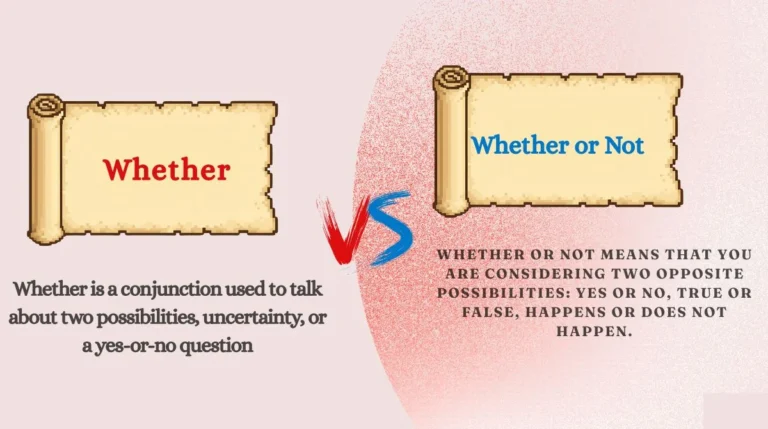
Whether is a conjunction used to talk about two possibilities, uncertainty, or a yes-or-no question. In simple terms, it means something like “which of two possibilities is true” or “if something is true or not.”
For example:
I don’t know whether he is at home.
This means you do not know if he is at home or not.
Another example is:
She can’t decide whether to stay or leave.
Here, there are two choices: stay and leave.
When should you use “whether”?
You usually use whether when there is some doubt or a choice between alternatives. It is especially common after verbs such as:
- know
- decide
- ask
- wonder
- find out
- discuss
- consider
- remember
- discover
For example:
We need to decide whether we should go.
I wonder whether Tom knows the answer.
She asked whether I wanted tea or coffee.
Oxford notes that whether can express doubt or a choice between possibilities. It is also commonly used in reported questions that expect a yes-or-no answer.
The basic grammar pattern
A very common pattern is:
whether + subject + verb
Examples:
I don’t know whether she is busy.
We need to find out whether the store is open.
He asked whether I liked the movie.
You can also use:
whether + to + verb
This is especially useful when the subject of the main clause is the same as the subject of the choice. Cambridge gives the pattern whether to stay, for example.
Examples:
I can’t decide whether to go.
She is thinking about whether to buy a new phone.
We don’t know whether to wait.
“Whether … or” for two choices
Another important pattern is:
whether + option A + or + option B
For example:
I don’t know whether to take the bus or the train.
She hasn’t decided whether to study medicine or law.
He couldn’t decide whether he was laughing or crying.
The word whether is very useful when you are presenting alternatives. Oxford also describes it as a word used to express a choice between two possibilities.
8 examples with “whether”
- I don’t know whether John is coming.
- She asked whether I needed any help.
- We need to decide whether to stay or leave.
- Can you find out whether the bank is open?
- He is not sure whether the plan will work.
- I wonder whether they know about the meeting.
- They discussed whether the project should continue.
- She couldn’t decide whether to wear the blue dress or the black one.
Common learner confusion with “whether”
One of the biggest problems is confusing whether with weather.
They sound similar, but they are completely different words.
Whether is connected with choices or uncertainty:
I don’t know whether he will come.
Weather is about the condition of the air outside:
The weather is very cold today.
Another common mistake is using if before a to-infinitive. In standard grammar, we say:
I don’t know whether to go.
Not:
I don’t know if to go.
Cambridge specifically identifies whether, rather than if, before a to-infinitive as a common grammar point.
What Does “Whether or Not” Mean?
Whether or not means that you are considering two opposite possibilities: yes or no, true or false, happens or does not happen.
For example:
I don’t know whether or not she will come.
This means:
I don’t know if she will come or if she will not come.
In many sentences, whether or not simply makes both possibilities explicit.
Cambridge explains that whether or not can be used to give an opposite alternative. It can also mean that something is true regardless of the result.
When should you use “whether or not”?
There are two especially useful situations.
1. When you want to make both possibilities clear
For example:
We need to know whether or not the door is locked.
You are considering both possibilities:
- The door is locked.
- The door is not locked.
Another example:
She hasn’t decided whether or not to apply for the job.
The possibilities are:
- She will apply.
- She will not apply.
2. When the result does not matter
This is a very important use.
Sometimes whether or not means “regardless of whether” or “it does not matter if.” Cambridge and Oxford both describe this use.
For example:
I will go whether or not you come.
The meaning is:
I will go. Your decision does not change mine.
Another example:
Whether or not it rains, we will play the game.
The game will happen in either case.
Here, or not is important because it clearly shows the second possibility.
The grammar pattern
You can use:
whether or not + clause
Example:
Whether or not he agrees, we will continue.
You can also use:
main clause + whether or not + clause
Example:
We will continue whether or not he agrees.
Both structures are correct.
8 examples with “whether or not”
- I don’t know whether or not she is coming.
- Tell me whether or not you need help.
- She is unsure whether or not to accept the offer.
- We will leave whether or not they are ready.
- Whether or not it rains, the event will continue.
- He will support you whether or not you agree with him.
- I need to know whether or not the package has arrived.
- Whether or not you like the idea, you must make a decision.
Common learner confusion with “whether or not”
Some learners think or not must always follow whether.
That is not true.
In many sentences, whether alone is enough:
I don’t know whether she is at home.
There is no need to add or not because the meaning is already clear.
However, when the sentence means “regardless of whether something happens”, the or not idea becomes important.
Compare:
I don’t know whether he will come.
This is simply uncertainty.
I will go whether or not he comes.
This means his coming does not affect my decision.
The Language Portal of Canada makes the same useful distinction: when a clause expresses only one stated possibility in this special “regardless of whether” structure, or not supplies the opposite possibility.
Difference Between Whether and Whether or Not
At first glance, the difference may look very small. The only added words are or not, but those words can affect the focus and meaning of the sentence.
Comparison table
| Feature | Whether | Whether or not |
|---|---|---|
| Basic idea | Uncertainty or choice | Yes/no alternatives or “regardless” |
| Talks about possibilities | Yes | Yes |
| Can introduce an indirect question | Yes | Yes |
| Can show two choices | Yes | Yes |
| Always needs “or not” | No | It already includes both ideas |
| Can mean “it doesn’t matter if” | Sometimes with a following alternative | Yes, very clearly |
| Used before “to + verb” | Yes | Yes |
| Formal writing | Common | Common |
| Daily conversation | Very common | Very common |
1. Usage difference
Use whether when you are talking about a question, doubt, or choice.
I don’t know whether she is ready.
Use whether or not when you want to make the negative alternative explicit.
I don’t know whether or not she is ready.
The two sentences are often very close in meaning. The second one simply puts stronger attention on the two possibilities.
2. Grammar logic
Think of whether as opening the door to possibilities.
I don’t know whether he will come.
The listener understands that coming and not coming are possible.
Adding or not says the second possibility directly:
I don’t know whether or not he will come.
This can be especially useful when you want to remove any doubt about what the two alternatives are.
3. Sentence structure
You can use whether in several patterns:
Whether + clause
We don’t know whether the shop is open.
Whether + to + verb
I can’t decide whether to stay.
Whether + A + or + B
She can’t decide whether to walk or drive.
You can also use whether or not:
Whether or not + clause
Whether or not he calls, I’ll be here.
Whether + clause + or not
I don’t know whether he will call or not.
These structures can be very similar. The exact choice depends on what you want to emphasize.
4. Meaning comparison
Compare these sentences:
I don’t know whether she will join us.
This is a simple statement of uncertainty.
I don’t know whether or not she will join us.
This makes the yes/no alternatives more explicit.
Now compare:
Whether she joins us or leaves early, we’ll finish the work.
This gives two stated alternatives.
Whether or not she joins us, we’ll finish the work.
This means the same basic result will happen regardless.
Cambridge specifically notes that whether … or not is often used to mean that it is not important if something happens.
Does “whether or not” always change the meaning?
Not always.
In many indirect questions, whether and whether or not can both be grammatical:
I don’t know whether he is home.
I don’t know whether or not he is home.
The meaning is almost the same.
That is why adding or not is not always necessary. Sometimes it is simply an extra way of making the two possible answers clear. The Language Portal of Canada notes that in many structures or not is unnecessary and can be omitted.
Grammar Rules You Must Remember
Rule 1: Use “whether” for indirect yes-or-no questions
When you report a question instead of asking it directly, whether is a natural choice.
Direct question:
Is Sara coming?
Reported question:
I don’t know whether Sara is coming.
You can often use if in this type of sentence too:
I don’t know if Sara is coming.
Oxford explains that both if and whether can be used for reported yes-or-no questions, although whether is often more natural in certain formal contexts.
Rule 2: Use “whether” before a to-infinitive
This is one of the most useful rules for learners.
Correct:
I can’t decide whether to go.
She doesn’t know whether to call him.
Incorrect in standard English:
I can’t decide if to go.
Cambridge specifically lists whether to + infinitive as the correct pattern.
A simple way to remember this is:
whether to go, whether to stay, whether to buy, whether to wait
Rule 3: Use “whether … or …” for two alternatives
When two possible choices are stated, whether fits naturally with or.
Examples:
I don’t know whether to call or text.
She is deciding whether to study at home or at the library.
We must discuss whether to leave now or later.
The two alternatives do not always have to be single words. They can be full clauses:
I don’t know whether he is joking or speaking seriously.
Cambridge describes whether … or as a structure for introducing two options or alternatives.
Rule 4: Use “whether or not” when the result is true in both cases
This is the rule that many students need most.
Example:
Whether or not you agree, the decision has been made.
The meaning is:
You may agree, or you may not agree. The decision stays the same.
Another example:
We’ll go whether or not it rains.
It may rain.
It may not rain.
Either way, the speaker plans to go.
This use is close to regardless of whether.
Common Mistakes Students Make
Many mistakes with this topic happen because learners understand the individual words but not the sentence pattern.
Mistake 1: Using “if” before “to”
Wrong:
I don’t know if to take the job.
Correct:
I don’t know whether to take the job.
Tip: When to + verb comes immediately after the word, use whether.
Mistake 2: Using “either” instead of “whether”
Wrong:
I don’t know either he is coming or not.
Correct:
I don’t know whether he is coming or not.
Cambridge specifically warns that either should not replace whether in indirect questions or in the “it doesn’t matter” meaning.
Mistake 3: Forgetting the second possibility
Compare:
Whether I go, you can start.
This sounds incomplete if the intended meaning is “whether I go or not.”
Better:
Whether I go or not, you can start.
Or:
Whether or not I go, you can start.
The Language Portal of Canada explains that this special sentence-adverb use needs two possibilities, so or not is needed when the opposite possibility is not otherwise stated.
Mistake 4: Confusing “whether” and “weather”
Wrong:
I don’t know weather he will come.
Correct:
I don’t know whether he will come.
Remember:
weather = rain, wind, sunshine, temperature
whether = choice or uncertainty
Mistake 5: Adding “or not” when it adds nothing
This is not always a grammar error, but it can make a sentence unnecessarily longer.
I don’t know whether she likes it.
This is perfectly clear.
I don’t know whether or not she likes it.
Also correct, but the extra words are not always needed.
A good writer avoids extra words when they do not add meaning or emphasis. In many ordinary indirect questions, whether alone is enough.
Easy Trick to Remember the Difference
Here is a simple classroom trick.
Think of whether as a question or choice word.
Think of whether or not as a two-door phrase.
One door says:
YES
The other door says:
NO
When you are simply unsure which door is correct, whether is often enough:
I don’t know whether he is coming.
When you want to show both doors clearly:
I don’t know whether or not he is coming.
Now use a second trick for sentences like:
Whether or not you like it, you must finish your homework.
Ask yourself:
“Does the result change?”
If the answer is no, whether or not is a very natural choice.
For example:
Whether or not she agrees, we will start.
Her agreement does not change the result.
Whether or not it rains, the match will continue.
The rain does not change the decision.
You can remember it like this:
Whether = Which possibility?
Whether or not = This possibility or its opposite — either way.
That simple idea will help you in most everyday situations.
Daily Life Examples
These examples sound natural in conversation and show how people actually use the expression.
Example 1: Making plans
A: Are you going to the party tonight?
B: I’m not sure whether I can go.
Here, the speaker is uncertain.
Example 2: Talking about the future
We will travel tomorrow whether or not the weather improves.
The trip will happen in both situations.
Example 3: Asking for information
Can you check whether the package has arrived?
The speaker wants to know if the package is there.
Example 4: Making a decision
I can’t decide whether to buy this phone or save my money.
There are two choices.
Example 5: Showing that something does not matter
Whether or not you like the movie, please be respectful.
The listener’s opinion does not change the speaker’s request.
Example 6: Talking about work
My manager wants to know whether I finished the report.
This is an indirect yes-or-no question.
Example 7: Giving advice
You should apply whether or not you think you are ready.
The advice remains the same.
Example 8: Talking about a friend
I don’t know whether or not Ahmed has heard the news.
The speaker is unsure about both possibilities.
Example 9: Making a personal decision
She is thinking about whether to move to another city.
She is considering a choice.
Example 10: Strong determination
I’m going to finish this course whether or not it gets difficult.
Difficulty will not change the plan.
These examples show an important point: whether and whether or not are not rare grammar forms. They are useful in normal conversation, school English, work situations, and everyday decisions.
Practice Section
Choose the correct option in each sentence.
1. I can’t decide ______ to accept the offer.
A. if
B. whether
C. weather
2. We will go ______ or not you are ready.
A. whether
B. if
C. either
3. She asked me ______ I wanted coffee.
A. whether
B. weather
C. either
4. I don’t know ______ or not he has finished the task.
A. either
B. whether
C. weather
5. They must decide whether ______ at home or go out.
A. to stay
B. stay to
C. staying
Answers
- B — whether
The correct structure is whether to accept. - A — whether
Whether or not you are ready means the result is the same in both cases. - A — whether
This is an indirect yes-or-no question. - B — whether
The correct phrase is whether or not. - A — to stay
The structure is whether + to + verb.
FAQs
1. What is the difference between whether and whether or not?
Whether usually introduces uncertainty, an indirect question, or a choice between possibilities. Whether or not makes the two opposite possibilities more explicit and can also mean regardless of whether. In many indirect questions, the two forms are very close in meaning.
2. Can we use “whether or not” in questions?
Yes. It can appear inside an indirect question:
I need to know whether or not he is coming.
It is usually not used as a replacement for the simple direct question itself. For example, instead of changing word order incorrectly, use a normal direct question such as “Is he coming?” and use whether or not when reporting or discussing that question.
3. Is “whether or not” formal or informal?
It is used in both everyday and formal English. You can hear it in conversation and see it in reports, emails, school writing, and professional communication. Whether may sound especially useful in formal writing when discussing choices or uncertainty. Oxford notes that whether is often considered more formal in some alternative-choice structures.
4. Is it wrong to say “whether” without “or not”?
No. In fact, whether alone is very common and completely correct.
I don’t know whether she is ready.
You do not have to add or not unless you want to state or emphasize the opposite possibility, or you are using a structure where the “regardless” meaning is intended.
5. Can I say “if” instead of “whether”?
Often, yes. If and whether can both introduce many indirect yes-or-no questions:
I don’t know if he is coming.
I don’t know whether he is coming.
However, whether is required before a to-infinitive:
I don’t know whether to go.
Not:
I don’t know if to go.
Cambridge specifically highlights this difference.
6. Should I say “whether or not” or “whether … or not”?
Both patterns are possible.
I don’t know whether or not she will come.
I don’t know whether she will come or not.
They often have the same basic meaning. The position can change the rhythm and emphasis of the sentence. For a “regardless” meaning, both whether or not at the beginning and whether … or not around the clause can be used.
Conclusion
Whether and whether or not are easy to confuse because they look almost identical. The good news is that the basic idea is simple.
Use whether when you are talking about uncertainty, an indirect yes-or-no question, or a choice between two possibilities. You can also use whether to + verb when someone is deciding what action to take.
Use whether or not when you want to make the opposite possibility clear or when the final result stays the same in both situations. For example, “Whether or not it rains, we will go” means the rain does not change the plan.
You do not need to add or not every time you use whether. In many sentences, whether is already complete. At the same time, or not is useful when you want stronger emphasis on the two possible outcomes.
The best way to learn this grammar point is to notice it in real conversations and then use it in your own sentences. With a little practice, choosing between whether and whether or not will become much more natural.

Evan Rellmont is a writer who turns thoughtful ideas into meaningful words, creating stories and reflections that connect, inspire, and leave a lasting impression.