
English has many words that sound almost exactly the same but have completely different meanings. Tern vs turn is one of those confusing word pairs.
When you hear these words in a conversation, they can sound very similar, especially because their vowel sounds are closely related.
That can make spelling difficult for learners.
The good news is that the meanings are very different. Tern is a noun used for a type of bird, especially a sea bird with long pointed wings and a forked or divided tail.
Turn, on the other hand, is a very common English word.
It can be a verb or a noun and is used for ideas such as changing direction, moving something around, becoming something different, or having an opportunity to do something. Cambridge and Oxford dictionaries both list these meanings separately.
This difference matters because one wrong letter can change your whole sentence. For example, “It is your tern” is incorrect when you mean that it is someone’s chance to act. The correct sentence is “It is your turn.”
By the end of this guide, you will know what each word means, how to use it correctly, how they differ in grammar, and how to remember the spelling without confusion.
What Does “Tern” Mean?
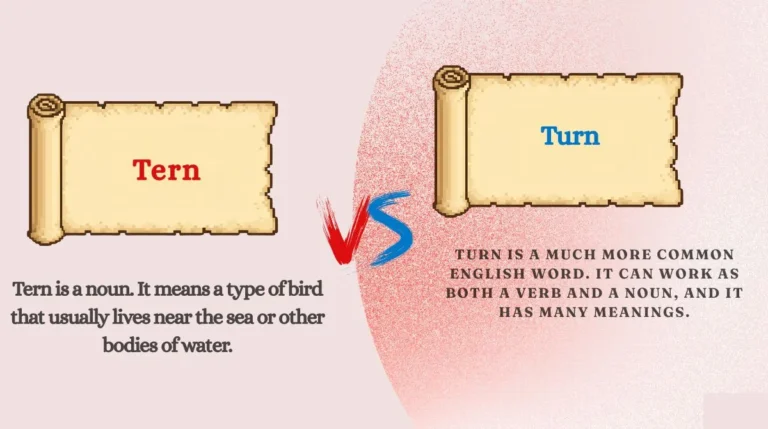
Tern is a noun. It means a type of bird that usually lives near the sea or other bodies of water. Terns are known for their long, pointed wings and their divided or forked-looking tails. Oxford describes a tern as a bird with long pointed wings and a tail with two points that lives near the sea. Cambridge gives a similar definition.
This is a specific vocabulary word, so you will usually see tern in writing about birds, wildlife, oceans, beaches, nature, fishing areas, or bird watching.
The word is a countable noun. You can say:
- a tern
- one tern
- several terns
- many terns
The plural form is terns.
When should you use “tern”?
Use tern when you are talking about the bird.
For example, a sentence about wildlife can use the word naturally:
A tern flew over the lake.
Here, tern is the name of the bird. It has nothing to do with changing direction or taking a person’s chance.
Grammar rule for “tern”
Because tern is a noun, it normally appears as the subject or object of a sentence.
You can use an article before a singular countable noun:
- a tern
- the tern
- one tern
You can also use a plural form:
- terns
- the terns
- many terns
You would not normally use tern as a common English verb.
Examples of “tern”
- A tern landed on the wooden post near the water.
- We saw a white tern flying above the beach.
- The photographer waited quietly for the tern to return.
- Several terns were searching for fish near the shore.
- The children learned about terns during their nature lesson.
- A tern suddenly flew across the boat.
- The guide pointed to a tern resting on the rocks.
- We watched the terns move quickly over the sea.
In each example, tern refers to the bird.
Common confusion with “tern”
The biggest problem is not the meaning. It is the sound.
When someone says tern, many learners may expect to hear a word spelled turn. The words are pronounced the same or very similarly in standard British and American English dictionary transcriptions: Cambridge gives tern as /tɜːn/ in British English and /tɝːn/ in American English, while turn has the corresponding pronunciations.
That means context is extremely important.
If you hear:
“A tern was flying over the water.”
you know the speaker is talking about a bird.
If you hear:
“It’s your turn.”
the meaning is about an opportunity or someone’s place in an order.
What Does “Turn” Mean?
Turn is a much more common English word. It can work as both a verb and a noun, and it has many meanings.
As a verb, turn can mean to change direction, move something around, face a different way, change into another state, switch something on or off, or reach a particular age. Oxford lists several of these uses, including moving around a central point, changing direction, changing position, turning pages, and becoming something different.
As a noun, turn can mean a change in direction, an opportunity to do something, a movement around a point, or a change in a situation.
When should you use “turn”?
Use turn when you are talking about movement, direction, change, opportunity, rotation, or many common expressions.
For example:
- Turn left.
- Turn the key.
- Turn the page.
- It is my turn.
- The leaves turned brown.
- Turn off the light.
Because this word has many uses, it appears constantly in daily English.
Grammar rules for “turn”
As a verb, it can be used in several sentence patterns.
Turn + adverb/preposition
Turn left at the corner.
Turn + object
Turn the handle slowly.
Turn + adjective
The leaves turned yellow.
Turn + noun
She turned a difficult situation into a useful lesson.
As a noun, it can refer to someone’s opportunity:
It is your turn to speak.
Or a change in direction:
Take the next turn on the right.
Examples of “turn” as a verb
- Turn left after the supermarket.
- Please turn the key slowly.
- He turned and looked at me.
- She turned the page and continued reading.
- The sky turned dark before the storm.
- Turn off the fan before you leave.
- The road turns sharply near the bridge.
- My nephew turned ten last month.
These sentences show why turn is such a flexible word. Cambridge also lists uses related to changing direction, moving the body, moving pages, becoming different, switching equipment, and reaching an age.
Examples of “turn” as a noun
- It is your turn to answer the question.
- We missed the last turn and had to go back.
- Take a right turn at the next street.
- Please wait your turn.
- The story took an unexpected turn.
- Give the handle one more turn.
- Each player gets a turn.
- The road has several sharp turns.
Oxford specifically identifies turn as a noun for someone’s time or opportunity, a change in vehicle direction, a place where a road branches away, a bend or corner, a physical movement, and an unexpected change in events.
Difference Between Tern and Turn
The easiest way to understand tern vs turn is to focus on their meanings rather than only their pronunciation.
| Word | Part of speech | Main meaning | Common use | Example |
|---|---|---|---|---|
| tern | Noun | A type of bird | Nature, wildlife, sea birds | A tern flew over the lake. |
| turn | Verb / Noun | Change direction, move, change, or have a chance | Everyday English | It is your turn. |
1. The meanings are completely different
Tern names a bird.
Turn usually expresses an action, movement, change, or opportunity.
Compare:
We saw a tern near the shore.
Here, tern is an animal.
We turned toward the shore.
Here, turned describes movement or a change in direction.
The two words may sound alike, but they are not interchangeable.
2. Their grammar is different
Tern is used as a noun.
The tern is flying.
Turn can be a noun:
It is my turn.
It can also be a verb:
I turn the handle.
This makes turn grammatically much more flexible.
3. Their sentence structures are different
With tern, common structures include:
a/the + tern
A tern landed nearby.
plural noun
Terns were flying above the water.
With turn, you can use many structures:
turn + direction
Turn right.
turn + object
Turn the knob.
turn + adjective
The milk turned sour.
someone’s turn + to-infinitive
It is Maria’s turn to speak.
4. Their everyday frequency is very different
Turn is part of everyday English. You hear it in classrooms, homes, offices, directions, games, conversations, and instructions.
Tern is much more specialized. You are more likely to encounter it in a nature documentary, a bird guide, a science lesson, or a discussion about sea birds.
That difference can help you guess the intended word from context.
5. Pronunciation can cause the problem
The spelling looks different:
tern
turn
But standard dictionary pronunciations are the same in the forms listed by Cambridge.
So this is primarily a spelling and vocabulary confusion, not a difference you can always hear.
Grammar Rules You Must Remember
Rule 1: Use “tern” only when you mean the bird
When the sentence is about a sea bird with long pointed wings and a divided tail, tern is the correct spelling.
Example:
The tern disappeared behind the rocks.
Do not write:
The turn disappeared behind the rocks.
That changes the word into something different and makes the sentence incorrect if you mean the bird.
Rule 2: Use “turn” for direction and movement
When someone changes direction or makes something move in another direction, use turn.
Example:
Turn left at the traffic lights.
Another example:
She turned her head when she heard the noise.
Cambridge and Oxford both list changing direction and changing position among the core meanings of turn.
Rule 3: Use “turn” when someone has a chance or opportunity
The noun turn is very common when people do something one after another.
Common patterns include:
- my turn
- your turn
- his turn
- her turn
- their turn
- wait your turn
- take turns
Example:
It is your turn to read.
You can also say:
The children took turns using the computer.
Cambridge and Oxford both describe this use of turn as a person’s time or opportunity to do something.
Rule 4: Use “turn” for change or transformation
Turn can show that something becomes different.
Examples:
The leaves turned brown.
The weather turned cold.
The small shop turned into a busy café.
Oxford lists turn as a linking verb meaning to change into a particular state or condition, while Cambridge also gives examples of something becoming a different color or state.
Common Mistakes Students Make
The confusion usually starts because students learn words by sound. That works well for many simple words, but it can cause trouble with homophones and near-homophones.
Mistake 1: Writing “tern” for “turn”
Wrong:
Wait for your tern.
Correct:
Wait for your turn.
Why? Because the sentence is about someone’s opportunity to act, not a bird.
Mistake 2: Writing “turn” when talking about the bird
Wrong:
We saw a turn near the beach.
Correct:
We saw a tern near the beach.
Here, the noun needs to be the name of the bird.
Mistake 3: Confusing “turn” with a direction
Wrong:
Tern right at the corner.
Correct:
Turn right at the corner.
A direction requires the verb turn.
Mistake 4: Thinking “tern” is another form of the verb “turn”
It is not.
For the verb turn, common forms include:
- turn
- turns
- turned
- turning
Oxford gives these verb forms explicitly in its dictionary entry.
There is no ordinary verb pattern in everyday English where tern replaces one of these forms.
Easy correction tip
Whenever you are unsure, ask yourself one simple question:
“Am I talking about a bird?”
If the answer is yes, use tern.
If the answer is no, and you mean changing direction, taking a chance, moving something, or becoming different, turn is probably the word you need.
Easy Trick to Remember the Difference
Here is a simple memory trick:
TERN = TERN is a BIRD
Think:
Tern → bird
You might imagine a bird flying over the sea. The unusual spelling with e can remind you that tern is the special nature word.
Now think:
TURN = CHANGE or MOVE
The word turn contains U, and you can connect it with everyday actions:
- turn left
- turn right
- turn around
- turn the page
- turn on the light
- your turn
So remember:
TERN = a bird
TURN = an action, movement, change, or opportunity
This trick is useful because it focuses on meaning rather than pronunciation.
There is another helpful clue. If the sentence contains words such as left, right, page, key, light, chance, time, age, around, into, off, on, you are very likely dealing with turn.
For example:
Turn left.
Turn off the light.
It is my turn.
She turned sixteen.
The context makes the answer clear.
Daily Life Examples
Here are natural examples you may hear in ordinary conversation.
1. Asking for directions
A: How do I get to the bank?
B: Turn right after the pharmacy.
The word is turn because it describes a change of direction.
2. Taking turns in a classroom
Teacher: Please wait your turn to answer.
Again, turn means someone’s opportunity to act.
3. Playing a game
Ali: Whose turn is it?
Sara: It’s my turn.
This is one of the most common everyday uses of turn.
4. Using a light switch
Dad: Can you turn off the kitchen light?
Here, turn off means switch something off.
5. Reading a book
Mina: Turn the page, please.
The verb describes moving one page so you can continue reading.
6. Talking about age
Tom: How old is your brother?
Sam: He turned twelve last week.
Cambridge confirms that turn is used with ages to show that someone reaches a particular age.
7. Talking about nature
Guide: Look carefully. There’s a tern on that rock.
This time tern is correct because the speaker is identifying a bird.
8. Talking about birds at the beach
We spent the morning watching terns fly over the water.
The plural terns refers to more than one bird.
9. Changing direction while walking
Nadia: Did you turn left?
Hassan: No, I kept walking straight.
The action is changing direction, so the correct word is turn.
10. Talking about a change
The weather turned cold in the evening.
Here, turned means became different.
These examples show why context matters so much. The pronunciation may not help, but the meaning usually does.
Practice Section
Choose the correct word: tern or turn.
1. Please ___ right at the next street.
a) tern
b) turn
2. We saw a beautiful ___ flying above the sea.
a) tern
b) turn
3. It is your ___ to clean the room.
a) tern
b) turn
4. Several ___ were resting on the rocks.
a) terns
b) turns
5. The leaves began to ___ yellow in autumn.
a) tern
b) turn
Answers
1. turn — It is a direction or movement.
2. tern — The sentence refers to a bird.
3. turn — It means someone’s opportunity or time to do something.
4. terns — The plural refers to several birds.
5. turn — Here it means “become” or “change into a different state.”
FAQs About Tern vs Turn
What is the difference between tern and turn?
Tern is a noun meaning a type of bird that usually lives near the sea. Turn is a common noun and verb that can describe changing direction, movement, change, or someone’s opportunity to act.
Are tern and turn pronounced the same?
In standard British and American dictionary pronunciation, they are represented with the same basic vowel and consonant pattern, so they can sound the same in normal speech. Cambridge gives /tɜːn/ for British English and /tɝːn/ for American English for tern, with corresponding pronunciations for turn.
Is tern a verb or a noun?
Tern is a noun. It names a type of bird. Its plural form is terns. You normally use it when talking about wildlife or birds near the sea.
Can I use turn as both a noun and a verb?
Yes. Turn is both a noun and a verb. As a verb, it can mean to change direction, move something, or become different. As a noun, it can mean a direction change, a movement, or someone’s chance to do something.
Is “your tern” correct?
Usually, no. When you mean someone’s opportunity to do something, the correct phrase is “your turn.”
For example:
It is your turn to play.
Use tern only when you are talking about the bird.
Why do people confuse tern and turn?
People often confuse them because they sound the same or very similar in ordinary speech. Since the spelling cannot always be heard, learners need to use the meaning and sentence context to choose the correct form.
Conclusion
The difference between tern vs turn becomes simple once you connect each word to its meaning.
Tern is a noun for a particular kind of bird, especially one associated with the sea. Turn is a very common English word that can be a verb or a noun. It can describe changing direction, moving something, becoming different, switching something, or having a chance to do something.
The biggest challenge is pronunciation. Because the two words can sound the same, you cannot always rely on what you hear. Instead, look at the meaning of the sentence.
Remember this simple rule:
TERN = a bird
TURN = change, movement, or a chance
A few minutes of practice can make this difference automatic. When you read or write English, notice which meaning the sentence needs. Once you connect the spelling with the idea, you will be much less likely to confuse these two words.

Evan Rellmont is a writer who turns thoughtful ideas into meaningful words, creating stories and reflections that connect, inspire, and leave a lasting impression.