
Have you ever seen both sulfur and sulphur and wondered whether one of them is wrong? You are not alone.
Many English learners notice this difference in school books, science websites, dictionaries, product labels, and newspapers. The two spellings look different, but the meaning is the same.
The confusion mainly happens because English has different spelling traditions in different countries.
American English usually uses sulfur, while British English commonly uses sulphur. Other varieties of English may use one spelling more often than the other.
Oxford lists sulfur as the US form and sulphur as the British form, while noting that sulphur remains usual in British, Irish, South African, and Indian English.
Both spellings are also found in Canadian, Australian, and New Zealand English.
There is another interesting point. In modern chemical naming, the International Union of Pure and Applied Chemistry, or IUPAC, uses sulfur as the standard spelling of the element.
So, which one should you use? The answer depends on your audience, your English variety, and the kind of writing you are doing. Once you understand that, the choice becomes very easy.
What Does “Sulfur” Mean?
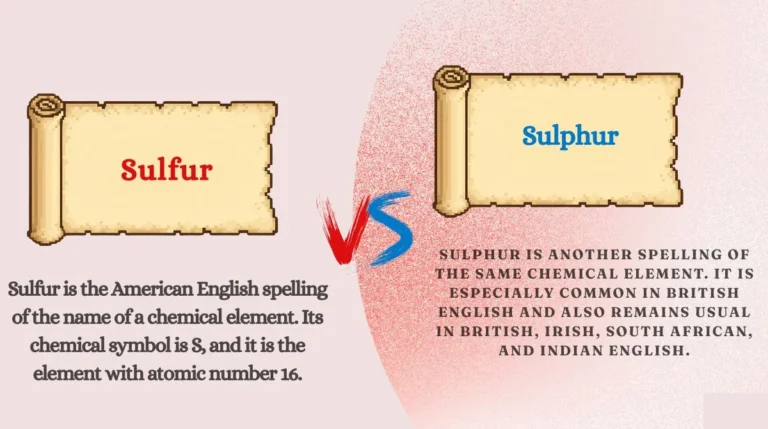
Sulfur is the American English spelling of the name of a chemical element. Its chemical symbol is S, and it is the element with atomic number 16.
Sulfur is a naturally occurring element. In its pure form, it is commonly described as a pale yellow substance. It is also used in many areas of industry, agriculture, medicine, and chemistry. When sulfur burns, it can produce a strong and unpleasant smell.
The important thing for an English learner is that sulfur is a noun, and it is normally used as an uncountable noun when talking about the substance in general.
For example, we say:
Sulfur is found in many natural materials.
We usually do not say a sulfur when we simply mean the chemical element. Instead, we can talk about some sulfur, sulfur compounds, or a sample of sulfur.
When should you use “sulfur”?
Use sulfur when you are following American English spelling or a scientific style that uses the IUPAC form.
It is especially common in American textbooks, American websites, and scientific writing that follows modern international chemical naming. IUPAC uses sulfur, not sulphur, for element 16.
If your audience is American, sulfur is usually the natural choice.
Grammar rule for “sulfur”
Because sulfur is generally an uncountable noun, use it without a plural ending when you are talking about the substance generally.
Correct:
Sulfur is important in some industrial processes.
Also correct:
The soil contains sulfur.
For separate amounts, use a counting expression such as:
two samples of sulfur
rather than:
two sulfurs
Examples of “sulfur”
- Sulfur has the chemical symbol S.
- The laboratory stores sulfur in a safe container.
- Sulfur is a yellow chemical element.
- Some plants need sulfur to grow properly.
- The scientist studied sulfur compounds.
- This soil contains very little sulfur.
- Sulfur is used in several industrial processes.
- The textbook uses the spelling sulfur throughout the chapter.
Common learner confusion with “sulfur”
A common mistake is thinking that sulfur and sulphur have different meanings. They do not. The difference is mainly one of spelling tradition.
Another mistake is thinking that the spelling with -ph- must be more formal because it looks older or more complicated. That is not a reliable rule. Sulfur is actually the standardized spelling used by IUPAC for the chemical element.
So do not think:
sulfur = one chemical
sulphur = another chemical
Think:
sulfur and sulphur = the same chemical element, different spellings
What Does “Sulphur” Mean?
Sulphur is another spelling of the same chemical element. It is especially common in British English and also remains usual in British, Irish, South African, and Indian English.
The meaning does not change.
A British English speaker can write:
Sulphur is present in the sample.
An American English speaker can write:
Sulfur is present in the sample.
Both sentences are talking about exactly the same element.
When should you use “sulphur”?
Use sulphur when you are following a variety of English where this spelling is common, especially British English.
This spelling can also appear in older books, traditional educational materials, newspapers, and writing from regions where British spelling conventions are widely used.
It is important to understand that sulphur is not simply a spelling mistake. It is a well-established English spelling. Oxford specifically records sulphur as the British English form.
Grammar rule for “sulphur”
The grammar is exactly the same as for sulfur.
It is normally an uncountable noun when referring to the substance generally.
Correct:
Sulphur is an important element.
Correct:
The sample contains sulphur.
When you want to count separate portions, say:
three samples of sulphur
not normally:
three sulphurs
Examples of “sulphur”
- Sulphur is used in some medicines and industrial products.
- The farmer checked the sulphur level in the soil.
- Sulphur is represented by the symbol S.
- The teacher explained the properties of sulphur.
- This plant needs sulphur and other nutrients.
- The old science book spells the element sulphur.
- The report discusses sulphur emissions.
- The laboratory tested the sample for sulphur.
Common learner confusion with “sulphur”
The biggest confusion is deciding whether sulphur is “wrong” because American English often uses sulfur.
It is not wrong in British English. The better question is:
Which spelling matches the English variety or style I am using?
There is also a special scientific issue to remember. IUPAC adopted sulfur as the standard spelling for the element, even though sulphur continues to be common in everyday British English.
That means you may see sulphur in an ordinary British sentence and sulfur in an international chemistry document without either writer misunderstanding the other.
Difference Between Sulfur and Sulphur
The easiest way to understand the difference is to remember that this is mainly a spelling difference, not a meaning difference.
Both words refer to the same chemical element.
| Feature | Sulfur | Sulphur |
|---|---|---|
| Meaning | Chemical element | Same chemical element |
| Chemical symbol | S | S |
| Grammar | Usually uncountable noun | Usually uncountable noun |
| Common in | American English | British English |
| Scientific standard | IUPAC spelling | Traditional English spelling |
| Pronunciation | Same basic pronunciation | Same basic pronunciation |
| Meaning changes? | No | No |
| Plural normally used? | No, not for the substance | No, not for the substance |
1. Usage difference
The main usage difference is regional.
In American English, sulfur is the usual spelling.
In British English, sulphur remains the usual spelling in general English according to Oxford. Oxford also notes that both forms occur in Canadian, Australian, and New Zealand English.
So imagine two students writing the same sentence:
The soil contains sulfur.
The soil contains sulphur.
The first sentence fits American English more naturally. The second fits traditional British English more naturally.
2. Grammar logic
There is no major grammar difference between the two spellings.
Both are nouns.
Both can be the subject or object of a sentence.
For example:
Sulfur is a chemical element.
and
Sulphur is a chemical element.
The grammar pattern stays the same.
This is why calling the topic “sulfur vs sulphur grammar” can be a little misleading. The question is really about spelling and English variety, rather than two different grammatical forms.
3. Sentence structure difference
There is no special sentence structure that belongs only to one spelling.
You can use either form in the same grammatical positions.
As a subject:
Sulfur is found in nature.
Sulphur is found in nature.
As an object:
The scientist studied sulfur.
The scientist studied sulphur.
After a preposition:
The test was carried out on sulfur.
The test was carried out on sulphur.
The only thing changing is the spelling.
4. Meaning comparison
The meaning is identical.
Both terms refer to the same element, which has the chemical symbol S. Oxford defines both forms as the chemical element and distinguishes them mainly by English variety.
That means there is no situation where choosing sulfur gives one chemical meaning and choosing sulphur gives another.
A learner may see the two forms in different sources and think the sources disagree. Usually, they do not. They are simply following different spelling conventions.
A useful point about scientific writing
In chemistry, sulfur has an important advantage because it is the spelling adopted by IUPAC. IUPAC’s recommendations specify sulfur, not sulphur, for the element’s name.
This is one reason modern scientific material may use sulfur even when it comes from a British institution.
At the same time, general British English has not simply erased sulphur. Oxford still identifies it as the usual British spelling.
So the safest lesson is this:
General English can use either according to regional convention, while modern international chemical nomenclature uses sulfur.
Grammar Rules You Must Remember
Rule 1: Both spellings have the same meaning
Never treat sulfur and sulphur as two different words with different meanings.
They name the same chemical element.
Example:
The report discusses sulfur levels.
The report discusses sulphur levels.
Both sentences refer to the same substance.
Rule 2: Choose the spelling that matches your English variety
American English generally prefers sulfur.
British English generally uses sulphur in ordinary usage. Oxford also records sulphur as usual in several other English varieties.
Example:
The American newspaper wrote about sulfur pollution.
The British newspaper wrote about sulphur pollution.
The difference is one of spelling style.
Rule 3: Use “sulfur” in modern IUPAC chemical naming
For formal chemical naming, sulfur is the spelling standardized by IUPAC.
This is especially useful when writing chemistry assignments, scientific notes, research material, or international technical documents.
Example:
Sulfur dioxide contains sulfur and oxygen.
IUPAC publications use sulfur in element names and chemical nomenclature.
Rule 4: Treat the word as an uncountable noun when talking about the substance
Usually, you do not add -s simply because you are talking about a quantity of the element.
Say:
The soil contains sulfur.
Not normally:
The soil contains sulfurs.
To talk about separate quantities, use a noun such as samples, amounts, or types where appropriate.
Example:
The lab tested three samples of sulfur.
Common Mistakes Students Make
Mistake 1: Thinking “sulphur” is always wrong
This is one of the most common misunderstandings.
A student may learn American spelling and then see sulphur in a British dictionary or school book. They may assume there is a spelling error.
Wrong idea:
“Sulphur is incorrect English.”
Better understanding:
“Sulphur is a traditional and widely used English spelling, especially in British English.”
Oxford confirms that sulphur remains usual in British English, while sulfur is the US form.
Mistake 2: Thinking “sulfur” is only an American word
This is also too simple.
Although sulfur is strongly associated with American English, it is also the spelling adopted by IUPAC for scientific chemical naming.
So you can see sulfur in international scientific writing even when the writer is not American.
Mistake 3: Mixing spellings in the same piece of writing
Suppose your essay starts with:
Sulphur is an important element.
Later, you write:
Sulfur compounds are widely studied.
This is not a serious meaning error, but it can make your writing look inconsistent.
How to fix it
Pick one spelling system for your general writing and stay consistent.
For American English:
sulfur
For traditional British English:
sulphur
For chemical nomenclature based on IUPAC:
sulfur
Consistency makes your writing cleaner and easier to read.
Mistake 4: Assuming the “ph” version sounds different
The pronunciation is essentially the same.
The letters ph in sulphur do not create a new meaning or a different word.
Do not try to give the two spellings completely different pronunciations just because they are written differently.
Mistake 5: Using a plural form unnecessarily
Learners sometimes write:
There are many sulfurs in the soil.
That is usually not the natural way to talk about the substance.
Better:
There is a lot of sulfur in the soil.
Or:
The soil contains several sulfur compounds.
The second sentence uses compounds, which are countable things that can be discussed individually.
Easy Trick to Remember the Difference
Here is a simple memory trick:
US English → sulfur
British English → sulphur
Think of the extra “ph” in sulphur as the traditional British spelling.
You can also connect it with other common spelling differences:
color → colour
flavor → flavour
sulfur → sulphur
This is not a perfect rule for every English word, but it can help you remember the pattern.
There is one extra fact worth keeping in your memory:
Chemistry standard → sulfur
IUPAC uses sulfur as the standard spelling for the element.
So your quick mental note can be:
American = sulfur
British = sulphur
IUPAC = sulfur
That three-part memory trick makes the choice much easier.
Daily Life Examples
The difference becomes clearer when you see the words in normal sentences.
Example 1
Student: Which spelling should I use in my American English assignment?
Teacher: Use sulfur.
Example 2
Student: My British textbook says sulphur. Is that wrong?
Teacher: No. Sulphur is a usual British spelling.
Example 3
Scientist: The sample contains sulfur.
Here, sulfur fits modern scientific naming.
Example 4
Teacher: Please write the chemical symbol for sulphur.
Student: The symbol is S.
The spelling changes, but the chemical symbol does not.
Example 5
Friend: Why does this British website write sulphur?
You: Because sulphur is commonly used in British English.
Example 6
Student: Should I write “sulfur compound” or “sulphur compound”?
Teacher: Either may be appropriate, depending on the spelling system you are following. In IUPAC-style chemical writing, sulfur compound is the standard form.
Example 7
Teacher: The soil contains sulphur.
This sentence is natural in a British English context.
Example 8
Student: I found “sulfur dioxide” in one book and “sulphur dioxide” in another.
Teacher: They refer to the same chemical substance. The spelling reflects different conventions.
Example 9
Researcher: This paper follows IUPAC terminology and uses sulfur throughout.
Here, the choice is connected to scientific naming conventions.
Example 10
Student: Do I need to learn both spellings?
Teacher: It is useful to recognize both, but you can normally choose one according to your audience and writing style.
Practice Section
Choose the correct option in each sentence.
1. The chemical symbol of ______ is S.
A. sulfur
B. sulphur
2. This American textbook uses ______ throughout the chapter.
A. sulphur
B. sulfur
3. The British science book refers to ______ dioxide.
A. sulphur
B. sulfur
4. IUPAC uses the spelling ______ for the element.
A. sulphur
B. sulfur
5. The soil contains a small amount of ______.
A. sulfur
B. sulfurs
Answers
1. sulfur or sulphur — Both spellings name the same element. The expected choice may depend on the style of the source.
2. sulfur — This matches the usual American spelling.
3. sulphur — This fits traditional British English usage.
4. sulfur — IUPAC uses sulfur as the standard spelling of the element.
5. sulfur — The substance is normally treated as an uncountable noun in this sentence.
FAQs
1. What is the difference between sulfur and sulphur?
There is no difference in meaning. Both spellings refer to the same chemical element, with the symbol S. Sulfur is common in American English, while sulphur remains usual in British English.
2. Is sulfur or sulphur correct?
Both are established spellings. Use sulfur in American English and in modern IUPAC chemical nomenclature. Use sulphur when following traditional British English spelling.
3. Is sulphur a British spelling?
Yes. Sulphur is the usual British English spelling according to Oxford. It is also commonly seen in Irish, South African, and Indian English.
4. Is sulfur the American spelling?
Yes. Sulfur is the usual American English spelling. It is also the spelling used by IUPAC for the chemical element in modern chemical nomenclature.
5. Can I use sulphur in a science assignment?
You can use sulphur if your school, textbook, or English variety follows that spelling tradition. However, if the assignment follows IUPAC chemical nomenclature or specifically requires modern international chemical naming, sulfur is the standard form.
6. Do sulfur and sulphur have different pronunciations?
No meaningful pronunciation difference is intended. The two spellings name the same element and are generally pronounced the same way. The important difference is the spelling convention, not the meaning or grammar.
Conclusion
The choice between sulfur and sulphur is much easier once you stop thinking of them as two different words. They are two spellings of the same chemical element.
Sulfur is the usual American English form and is also the spelling adopted by IUPAC for modern chemical nomenclature. Sulphur remains a normal and widely used spelling in British English and several other English varieties.
For everyday English, match your spelling to your audience. For American writing, choose sulfur. For traditional British writing, sulphur is natural. For formal chemical naming, sulfur is the standardized choice.
Most importantly, do not worry when you see both forms. Seeing sulphur in one book and sulfur in another does not mean that one source is necessarily wrong. Learn to recognize both, then use the form that matches your writing style and purpose.
A little practice with regional spelling differences will make confusing words like this much easier to handle.

Evan Rellmont is a writer who turns thoughtful ideas into meaningful words, creating stories and reflections that connect, inspire, and leave a lasting impression.