
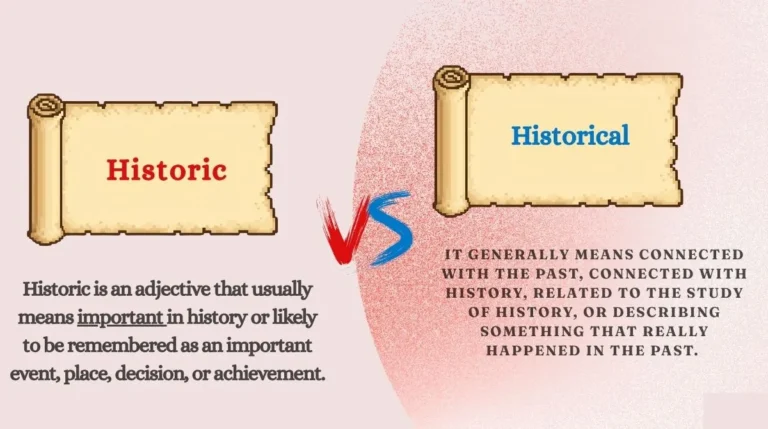
Historic vs historical is a common English confusion because both words come from the same root, history.
They also look and sound very similar, so it is easy to use one when you really need the other.
The good news is that the difference is simple once you focus on the meaning.
Historic usually describes something important, memorable, or likely to be remembered as an important part of history.
Historical, on the other hand, usually describes something connected with the past, the study of history, or something that actually happened in the past.
Major English dictionaries make this same basic distinction.
For example, a historic moment is an important moment that may be remembered for years. A historical document is simply a document connected with the past or useful for studying history.
This difference matters in everyday English, school writing, news reports, books, and conversations about famous people, places, events, and old records.
Once you understand the idea of importance vs connection to history, these two adjectives become much easier to choose.
You will also see why we say historical facts, historical research, and historic victory, and why some nouns can work with both words but change slightly in meaning.
4. What Does “Historic” Mean?
Historic is an adjective that usually means important in history or likely to be remembered as an important event, place, decision, or achievement.
Cambridge defines historic as something “important or likely to be important in history,” while Oxford describes it as something important in history or likely to be thought important in the future.
The key idea is importance.
When you call something historic, you are not only saying that it belongs to the past. You are suggesting that it has special importance or significance.
For example:
- The country celebrated a historic victory.
- It was a historic day for the school.
- The leaders reached a historic agreement.
- This is a historic moment in science.
- The old castle is a historic landmark.
- The team made a historic achievement.
- The city is famous for its historic buildings.
- The president visited the historic site.
Notice how historic can describe both events and places.
A historic event is generally an event considered important enough to stand out in history. A historic building may be an old building with special importance, fame, cultural value, or a strong connection to an important period.
When Should You Use “Historic”?
Use historic when you want to show that something has special importance in history or may be remembered as significant.
Compare these two sentences:
The country signed a historical agreement.
This can mean the agreement is connected with a past period or belongs to history.
The country signed a historic agreement.
This suggests that the agreement was especially important and may be remembered for its impact.
That small change in meaning is the heart of the difference.
Grammar Rule for “Historic”
Historic is an adjective. It normally comes before a noun or after a linking verb such as be, become, or seem.
Examples:
It was a historic decision.
The building is historic.
She witnessed a historic event.
It does not change for singular or plural nouns:
a historic moment
two historic moments
A Common Learner Confusion
Many learners think historic simply means “old.”
That is not always true.
An old chair in someone’s house may be old, but that does not automatically make it historic. Something can be old without having much historical importance.
Likewise, something can be historic even when it is happening today. A major decision, scientific breakthrough, record, or public event can be called historic because people believe it is important enough to be remembered.
So remember:
Historic = important in history.
5. What Does “Historical” Mean?
Historical is also an adjective, but its meaning is broader.
It generally means connected with the past, connected with history, related to the study of history, or describing something that really happened in the past. Oxford and Cambridge both give examples involving historical context, documents, research, facts, novels, and figures.
The key idea is connection to history or the past.
Examples:
- We studied the historical background of the war.
- The museum contains many historical documents.
- She enjoys reading historical novels.
- The students researched the historical facts.
- This building has great historical value.
- We need more historical evidence.
- The book gives a historical account of the event.
- They examined the city’s historical development.
Here, the word does not necessarily say that something is especially important.
A historical document is a document from or connected with the past. It does not have to be famous.
A historical novel is a novel about people or events from the past. Again, it does not have to describe an especially important event. Oxford specifically lists historical novel and historical setting as common uses.
When Should You Use “Historical”?
Use historical when you mean:
- related to history
- connected with the past
- used for studying the past
- about people or events from an earlier time
- describing information, records, facts, research, or context from the past
For example:
The professor is doing historical research.
The research is connected with the study of history.
We found a historical record.
The record relates to the past.
The movie has a historical setting.
The story takes place in a past period.
Grammar Rule for “Historical”
Like historic, historical is an adjective.
It usually appears before a noun:
historical evidence
historical records
historical research
historical context
historical figures
historical events
It can also come after a linking verb:
The document is historical.
A Common Learner Confusion
One mistake is believing that historical always means “less important” and historic always means “important.”
That is a useful beginner rule, but real English has some overlap.
For example, historic buildings can simply mean buildings that are important or notable because of their connection to history. At the same time, historical can appear in expressions such as historical importance or historical significance.
So the words are not perfect opposites. The best way to choose between them is to ask what you want to emphasize.
6. Difference Between Historic and Historical
The easiest way to understand historic vs historical is this:
Historic focuses on importance.
Historical focuses on connection to the past or history.
Both words are adjectives, and both can describe things connected with history. The difference is mainly in the meaning you want to communicate.
Comparison Table
| Word | Main Meaning | Main Idea | Common Examples |
|---|---|---|---|
| Historic | Important in history | Importance or significance | historic event, historic victory, historic moment |
| Historical | Connected with the past or history | Connection or description | historical facts, historical research, historical records |
| Historic | Often describes memorable events or notable places | Likely to be remembered | historic decision, historic landmark |
| Historical | Often describes information or material about the past | Useful for understanding history | historical evidence, historical context |
| Historic | Can describe something happening now | Future historical importance | historic announcement |
| Historical | Can describe fiction set in the past | Past setting or subject | historical novel, historical drama |
Usage Difference
Consider this pair:
The scientists made a historic discovery.
This tells us the discovery is extremely important and may become part of scientific history.
Now compare:
The scientists studied historical discoveries.
This means they studied discoveries from the past. The sentence does not tell us that those discoveries were especially important.
Another useful pair is:
We visited a historic castle.
The castle has special importance, fame, or significance in history.
We studied the castle’s historical background.
The background explains its connection to the past.
Grammar Logic
There is no major grammar difference between the two words. Both are adjectives.
The difference is semantic, meaning it comes from what the word tells us.
You use:
historic + noun
a historic decision
a historic moment
a historic victory
You also use:
historical + noun
historical research
historical evidence
historical records
Both forms are grammatically correct. The important question is what you mean.
Sentence Structure Difference
Both words commonly come before a noun:
It was a historic event.
It was a historical event.
Grammatically, both sentences are correct, but the meaning is slightly different.
A historic event = an event considered important or memorable in history.
A historical event = an event that belongs to or relates to the past.
This is a useful example because it shows that the same noun can sometimes work with both adjectives.
Meaning Comparison
Think about these expressions:
historic victory
A victory that is especially important or memorable.
historical victory
A victory being discussed as part of history or a past record.
historic building
A building considered notable or important in history.
historical building
A building discussed in connection with history or the past. This form is possible, but historic building is more natural when the speaker wants to stress the building’s historical importance.
historical research
Research about history.
historic research
Much less common when you simply mean research about history. Usually, historical research is the natural choice.
That is why learners should not choose a word simply because the noun sounds related to “history.” Think about the exact meaning first.
7. Grammar Rules You Must Remember
Rule 1: Use “historic” for something important or memorable in history.
When an event, decision, achievement, or occasion has special significance, historic is often the right choice.
The team won a historic final.
The word historic tells us that the win was especially important.
It was a historic moment for the company.
The moment may be remembered because of its importance.
Rule 2: Use “historical” for things connected with the past or the study of history.
When you are talking about records, facts, research, context, evidence, literature, or events from the past, historical is usually the natural choice.
We studied historical records.
The professor explained the historical context.
She is interested in historical research.
These examples focus on the study or description of the past.
Rule 3: “Historic” does not simply mean “old.”
This is one of the most important rules.
Something can be old without being historic.
My grandfather has an old wooden chair.
The chair is old, but nothing in the sentence says that it is historically important.
Compare:
The museum protects a historic chair used by a famous leader.
Now the chair has special historical importance.
Rule 4: Both words can describe the same noun, but the meaning can change.
Sometimes both forms are possible.
It was a historic event.
This stresses importance.
It was a historical event.
This stresses the fact that the event belongs to history or concerns the past.
The best choice depends on your message, not just the noun.
8. Common Mistakes Students Make
Learners often make mistakes because the two words share the same root and look almost identical.
Another reason is that in many languages, there may not be separate words for these two ideas. Students therefore translate both into one familiar word and use them interchangeably.
Mistake 1: Using “historical” for an important new event
Wrong or less precise:
This is a historical moment for our team.
The sentence is understandable, but if you want to emphasize that the moment is important and likely to be remembered, historic is stronger and more natural.
Better:
This is a historic moment for our team.
Mistake 2: Using “historic” for academic study
Less natural:
She is doing historic research.
Better:
She is doing historical research.
Research about the past is normally called historical research. Oxford specifically lists this expression.
Mistake 3: Thinking every old place is historic
We found a historic box in the garage.
This may be correct only if the box has historical importance.
If you simply mean that the box is old, say:
We found an old box in the garage.
Mistake 4: Thinking “historical” always means famous
It does not.
The archive contains historical letters.
The letters may be valuable to researchers, but they do not have to be famous.
Historical is broad. It tells us about a connection with the past.
An Easy Correction Tip
Before choosing the word, ask yourself one question:
Am I talking about importance, or am I talking about connection to history?
If the answer is importance, think historic.
If the answer is connection to the past or study of history, think historical.
That one question will solve many common mistakes.
9. Easy Trick to Remember the Difference
Here is a simple memory trick:
Historic = Huge importance
Think of the first part of historic as pointing you toward a history-making moment.
A historic moment is a moment that may be remembered.
A historic victory is a victory that stands out.
A historic decision is a decision with major importance.
Now think:
Historical = History-related
Anything connected with history can be historical.
Historical:
- facts
- records
- documents
- research
- context
- novels
- figures
- data
- evidence
You can remember it like this:
Historic = important in history.
Historical = connected with history.
Here is another quick comparison:
A historic day
= an important day
A historical book
= a book about history or the past
A historic achievement
= an important achievement
A historical record
= a record from or about the past
When you are speaking, this difference becomes easier with practice. You do not need to think about a complicated grammar rule. Just listen for the meaning you want.
10. Daily Life Examples
These examples show how historic and historical naturally appear in everyday English.
1. Talking about an important event
Ali: Did you watch the final?
Sara: Yes. What a historic match! Everyone will remember it.
Here, historic means the match was unusually important or memorable.
2. Talking about school
Teacher: Why are you reading that book?
Student: It explains the historical background of the country.
Here, historical means connected with the past.
3. Talking about a famous place
Tourist: Is this an old building?
Guide: Yes. It is a historic building and has been part of the city’s story for many years.
The word highlights the building’s historical importance.
4. Talking about research
Student: What does your professor study?
Friend: She does historical research on ancient trade routes.
The research is about history.
5. Talking about a major decision
News Reporter: The two countries have signed a historic agreement.
The agreement is described as important and likely to be remembered.
6. Talking about documents
Teacher: Where did these letters come from?
Student: They are historical documents from the nineteenth century.
They are connected with a past period.
7. Talking about a personal achievement
Coach: Your team has reached the final for the first time.
Player: This is a historic achievement for our school.
The achievement is important and memorable.
8. Talking about a movie
Friend: What kind of movie are you watching?
You: It is a historical drama about life in the 1700s.
The movie is about a past period.
9. Talking about a museum
Child: Why are these papers kept behind glass?
Parent: They contain historical information about the city.
The information relates to the past.
10. Talking about something happening today
Reporter: People are calling today’s announcement historic.
Viewer: Why?
Reporter: Because it could change the country’s future and may be remembered for many years.
This example shows an important point: something does not have to be old to be historic.
11. Practice Section
Choose historic or historical in each sentence.
1. The museum has a large collection of ______ documents.
a) historic
b) historical
2. The scientists made a ______ discovery.
a) historic
b) historical
3. We learned about the ______ background of the conflict.
a) historic
b) historical
4. The team celebrated a ______ victory.
a) historic
b) historical
5. She is writing a paper about ______ research methods.
a) historic
b) historical
Answers
1. historical — The documents are connected with the past.
2. historic — The discovery is presented as highly important and memorable.
3. historical — The background relates to the past.
4. historic — The victory is described as especially important.
5. historical — Research connected with the study of history is historical research.
A useful way to practice is to explain why your answer is correct. That helps you understand the meaning instead of simply memorizing a word.
12. FAQs
What is the difference between historic and historical?
Historic usually means important in history or likely to be remembered as important. Historical usually means connected with the past, history, or the study of history.
For example, a historic victory is especially important, while historical research is research about the past.
Can we use “historic” for something happening today?
Yes. Historic can describe a present event when the speaker believes it is important enough to be remembered in history.
For example: “Today is a historic day for our school.” The event is happening now, but its importance gives it the word historic.
Is “historical” formal or informal?
Historical is a normal standard English adjective. It is common in both everyday and formal English.
You can use it in conversations, school assignments, academic writing, news reports, and books: historical facts, historical records, and historical research.
Is it “a historic” or “an historic”?
Today, a historic is very common because the h in historic is normally pronounced. Oxford notes that some speakers use an when they do not pronounce the initial h, but this usage can sound old-fashioned.
So for most learners, a historic event is the safest modern form.
Can “historic” and “historical” both describe the word “event”?
Yes. Both can be grammatically correct, but they can emphasize different meanings.
A historic event suggests an important or memorable event. A historical event means an event connected with the past or discussed as part of history.
Is a historic building the same as a historical building?
They can overlap, but historic building is common when the building has special importance or significance in history.
Historical is broader and can describe something connected with the past. The choice depends on whether you want to stress historical importance or simply the connection to history.
Conclusion
The difference between historic vs historical becomes much easier when you remember the main idea behind each word.
Historic usually describes something important, memorable, or likely to be remembered in history. You can talk about a historic moment, historic victory, historic decision, or historic achievement.
Historical usually describes something connected with the past or the study of history. Common examples include historical facts, historical records, historical research, historical evidence, and historical novels.
Do not worry if these words still feel a little confusing at first. Read real examples, listen to how native speakers use them, and practice making your own sentences.
The easiest memory line is:
Historic = important in history.
Historical = related to history.
With a little practice, choosing the right word will start to feel natural.

Evan Rellmont is a writer who turns thoughtful ideas into meaningful words, creating stories and reflections that connect, inspire, and leave a lasting impression.