
Have you ever written “a large amount of people” and then wondered whether it should be “a large number of people”? You are not alone.
Amount and number both talk about quantity, so they can seem interchangeable.
This grammar point appears in everyday questions, emails, school writing, work conversations, and reports.
We say things like “How much money do you need?” and “How many students are absent?” Choosing the right word makes your English clearer and more natural.
The basic rule is simple: amount goes with uncountable nouns, while number goes with countable nouns. Cambridge gives the same distinction and explains that the noun after “number of” is plural.
Examples of uncountable nouns include time, money, water, information, and advice. Countable nouns include books, students, cars, and questions.
Once you learn to ask, “Can I count these as separate items?”, the choice becomes much easier.
You will also see why “the number of” uses a singular verb, why “a number of” usually uses a plural verb, and why money can take either form depending on what you are counting.
4. What Does “Amount” Mean?
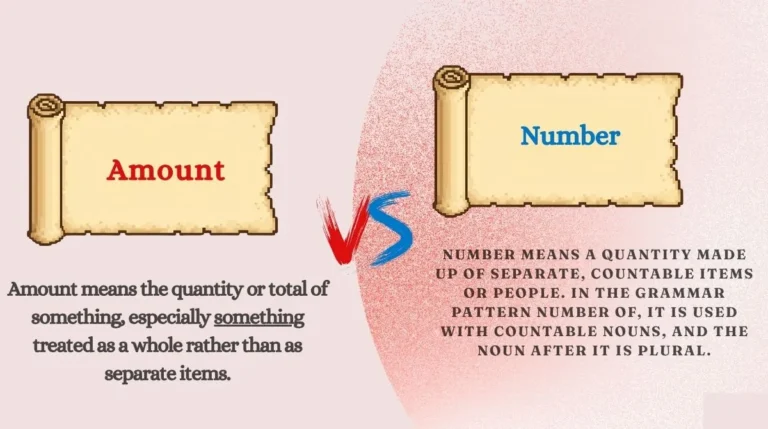
Amount means the quantity or total of something, especially something treated as a whole rather than as separate items. It is most commonly used with uncountable nouns. Cambridge defines it as a quantity of something that cannot normally be counted as individual units, while Oxford says it is especially used with uncountable nouns.
Think about water. You can count bottles or glasses, but you do not normally count water itself as one, two, or three. You measure it. That is why we say the amount of water.
When should you use “amount”?
Use amount when you are talking about how much of something there is.
Common patterns are:
- an amount of + uncountable noun
- a large amount of + uncountable noun
- a small amount of + uncountable noun
- the amount of + uncountable noun
- the right amount of + uncountable noun
Grammar rule for “amount”
The main learner rule is:
Amount + uncountable noun
Common uncountable nouns include water, money, time, rice, sugar, information, advice, homework, traffic, furniture, and patience. English treats these as masses, substances, ideas, or general quantities rather than separate countable units.
Examples of “amount”
- I need a small amount of water.
- She spends a large amount of money on books.
- We have only a small amount of time.
- Please add the right amount of sugar.
- The amount of traffic was surprising this morning.
- He gave me a useful amount of information.
- The amount of work is too much for one person.
- Try to reduce the amount of salt in the soup.
A common learner error is adding unnecessary words. We usually say “We do not have much time”, not “We do not have much amount of time.” We can say “We do not have a large amount of time,” but the simple “much time” form is more natural in everyday English.
Common confusion with “amount”
A frequent mistake is:
Wrong: a large amount of students
Correct: a large number of students
Students are separate people, so they are countable.
Money causes another interesting problem. We normally say “an amount of money” because money is uncountable. But you can say “a number of dollars” when you are counting dollar units.
5. What Does “Number” Mean?
Number means a quantity made up of separate, countable items or people. In the grammar pattern number of, it is used with countable nouns, and the noun after it is plural.
If you can count something as one, two, three, four, and so on, number is usually the right choice.
For example:
one chair → two chairs
one student → five students
one idea → ten ideas
one phone → three phones
When should you use “number”?
Use number when you are talking about how many separate people or things there are.
Common patterns are:
- a number of + plural countable noun
- a large number of + plural countable noun
- a small number of + plural countable noun
- the number of + plural countable noun
- the total number of + plural countable noun
Grammar rule for “number”
The main rule is:
Number + plural countable noun
So we say:
- number of students
- number of cars
- number of questions
- number of books
- number of mistakes
Cambridge specifically states that the noun after “number of” is plural in this pattern.
Examples of “number”
- A large number of students joined the club.
- We received a number of complaints.
- The number of visitors has increased.
- A small number of people stayed after the meeting.
- What is the number of chairs in the room?
- The number of accidents has fallen this year.
Common confusion with “number”
The biggest trap is thinking that amount and number simply mean “a lot.” They do not. The noun decides which word fits.
You would say:
a large number of books
a large amount of paper
Books are separate items. Paper, when we mean the material, is uncountable.
Another important point is the difference between “a number of” and “the number of.”
A number of students are absent.
Here, “a number of” means several or many, so the verb is plural.
The number of students is increasing.
Here, “the number” means the total count. The subject is singular, so the verb is singular.
6. Difference Between Amount and Number
The easiest way to understand the difference is to ask whether the noun can be counted as separate units.
| Point | Amount | Number |
|---|---|---|
| Main idea | Quantity or how much | Count or how many |
| Usually used with | Uncountable nouns | Countable nouns |
| Noun after “of” | Usually uncountable | Plural countable |
| Example | amount of water | number of bottles |
| Question | How much? | How many? |
| Focus | A mass or general quantity | Separate people or things |
Usage difference
Use amount for things such as water, money, time, information, advice, sugar, traffic, patience, and work.
Use number for things such as students, cars, books, chairs, questions, emails, houses, mistakes, and visitors.
Compare:
The amount of water is low.
The number of bottles is low.
She spent a huge amount of money.
She bought a huge number of books.
The amount of time available is limited.
The number of hours available is limited.
Grammar logic
The choice is not about whether the quantity is large or small. It is about grammar.
Ask:
Can I count the noun one by one?
If yes, number is usually right.
If no, and you mean the quantity of a mass, substance, idea, or other uncountable noun, amount is usually right.
For example:
- people → countable → number of people
- furniture → uncountable → amount of furniture
- coins → countable → number of coins
- money → uncountable → amount of money
Cambridge explains that countable nouns can have singular and plural forms and can be used with numbers, while uncountable nouns are normally treated as masses and are not used directly with numbers.
Sentence structure difference
The most common patterns are:
Amount of + uncountable noun
“The amount of information is useful.”
Number of + plural countable noun
“The number of questions is high.”
Then remember this pair:
A number of + plural noun + plural verb
“A number of students are waiting.”
The number of + plural noun + singular verb
“The number of students is growing.”
Meaning comparison
Amount answers the idea of how much.
Number answers the idea of how many.
For example:
How much water? → amount of water
How many bottles? → number of bottles
How much money? → amount of money
How many coins? → number of coins
How much time? → amount of time
How many hours? → number of hours
7. Grammar Rules You Must Remember
Rule 1: Use “amount” with uncountable nouns
Say:
The amount of water in the tank is low.
Water is uncountable, so amount is the natural choice.
Other examples include amount of time, amount of money, amount of work, and amount of information.
Rule 2: Use “number” with plural countable nouns
Say:
The number of students in the class is thirty.
Students are separate people and can be counted.
You can also say “a large number of students,” “a small number of mistakes,” or “the number of visitors.”
Rule 3: “The number of” takes a singular verb
This rule surprises many learners.
The number of emails is increasing.
Even though “emails” is plural, the subject is the number, which is singular.
Compare:
The number of cars is rising.
Not: The number of cars are rising.
Rule 4: “A number of” usually takes a plural verb
“A number of” means several or many.
A number of students are waiting outside.
Compare:
The number of students is fifty.
A number of students are absent.
The change from the to a changes the meaning and the verb.
8. Common Mistakes Students Make
Mistake 1: “A large amount of people”
Wrong: A large amount of people attended the event.
Correct: A large number of people attended the event.
People are countable because we can say one person, two people, three people.
Mistake 2: “A big number of money”
When money means the general quantity, say:
Wrong: a big number of money
Correct: a large amount of money
Money is normally uncountable in this meaning.
But “a large number of dollars” is possible because dollars are countable units.
Mistake 3: Forgetting the plural noun after “number of”
Wrong: the number of student
Correct: the number of students
After “number of,” the countable noun is plural.
Mistake 4: Using the wrong verb
Wrong: The number of visitors are growing.
Correct: The number of visitors is growing.
Remember: the number = one total.
Mistake 5: Choosing the word because the quantity is large
Do not think:
“Big quantity = amount” or “small quantity = number.”
Both can be large or small:
- a small amount of water
- a huge amount of water
- a small number of cars
- a huge number of cars
The noun decides.
Easy correction tips
Look at the noun after of.
If you can naturally count it one by one, choose number.
If it is normally treated as a mass or general quantity, choose amount.
You can also use the question test:
How many? → number
How much? → amount
9. Easy Trick to Remember the Difference
Use this simple classroom trick:
NUMBER = NUMBERS
The word number reminds you of counting: 1, 2, 3, 4.
So think:
Number → count the items
- number of students
- number of chairs
- number of apples
- number of messages
Now remember:
AMOUNT = MASS
Think of something you cannot easily count as separate units:
- amount of water
- amount of milk
- amount of time
- amount of money
- amount of patience
Then imagine five glasses. Now you can count the glasses, so you need number of glasses.
A second memory trick is even shorter:
How many? → Number
How much? → Amount
10. Daily Life Examples
- “How much money do you need?”
“I only need a small amount.” - “How many people came to the meeting?”
“A large number of people came.” - “Can you add more sugar?”
“Only a small amount. It is already sweet.” - “Why are we late?”
“There was a huge amount of traffic.” - “How many emails did you receive?”
“I received a surprising number of emails.” - “Do we have enough rice?”
“Yes, we have a good amount of rice.” - “How many chairs do we need?”
“We need enough for all the guests.” - “You gave me too much information at once.”
“Sorry. I will give you a smaller amount next time.” - “The number of customers has increased.”
“Yes, the shop is much busier now.” - “A number of students are waiting outside.”
“Please ask them to come in.”
Notice the contrast in this sentence:
A large number of customers bought a huge amount of food.
Customers are countable, so number fits. Food is uncountable, so amount fits.
11. Practice Section
Choose amount or number.
- We need a large ___ of water for the trip.
a) amount
b) number - A huge ___ of students joined the competition.
a) amount
b) number - The ___ of mistakes in this report is worrying.
a) amount
b) number - Please use the correct ___ of flour.
a) amount
b) number - A small ___ of people understood the instructions immediately.
a) amount
b) number
Answers
- amount — water is uncountable.
- number — students are countable.
- number — mistakes are countable.
- amount — flour is uncountable.
- number — people can be counted.
12. FAQs
What is the difference between amount and number?
Amount is mainly used with uncountable nouns to talk about how much of something there is. Number is used with countable nouns to talk about how many separate items or people there are. For example, “amount of water” but “number of bottles.”
Can we use “amount” in questions?
Yes. You can ask, “What is the amount of money needed?” In everyday English, how much is often more natural: “How much money do you need?” Both forms can be correct, depending on the sentence.
Can “number” be used with uncountable nouns?
Usually not when you mean the general quantity. We say “the amount of information,” not “the number of information.” You can count related units, though, such as “the number of pieces of information” or “the number of liters of water.”
Is “amount” formal or informal?
Amount is normal in both everyday and formal English when it is used with the right noun. Expressions such as “the amount of time,” “the amount of money,” and “a large amount of data” are common. Oxford notes that amount is most often used with uncountable nouns.
Is “a number of” singular or plural?
“A number of” normally means several or many, so it takes a plural verb: “A number of students are absent.” By contrast, “the number of” refers to one total and takes a singular verb: “The number of students is small.”
Can “amount” be used with countable nouns?
In careful standard English, number is normally preferred with countable nouns. Oxford notes that amount is sometimes used with countable nouns in spoken or informal English, although some speakers consider that usage incorrect. For learners, the safest rule is: amount + uncountable, number + countable.
Conclusion
The difference between amount and number becomes much easier when you focus on the noun instead of the size of the quantity.
Use amount mainly with uncountable nouns when you mean how much of something there is: amount of water, amount of money, amount of time, amount of information.
Use number with countable nouns when you mean how many separate people or things there are: number of students, number of books, number of cars, number of questions.
Also remember two important patterns: “the number of” takes a singular verb, while “a number of” usually takes a plural verb.
When you are unsure, ask yourself: “How much or how many?” How much usually points you toward amount. How many points you toward number.
A little practice with everyday nouns will make this difference automatic. Soon, phrases such as “a large number of people” and “a large amount of money” will feel natural when you speak and write.

Evan Rellmont is a writer who turns thoughtful ideas into meaningful words, creating stories and reflections that connect, inspire, and leave a lasting impression.