
Weather and whether are two of those English words that can make learners stop and think, “Which one should I use here?” The problem is easy to understand: they sound very similar, and in many accents they are pronounced the same or almost the same.
However, their meanings and grammar are completely different.
Weather is connected with the air around us. We use it when we talk about sunshine, rain, wind, heat, cold, snow, storms, and other conditions outside.
Whether, on the other hand, is mainly used when we talk about a choice, a possibility, or uncertainty.
It often has the meaning of “if” or “if … or not.”
This small spelling difference matters a lot in writing. You might say, “The weather is cold today,” but you cannot write, “The whether is cold today.” Likewise, “I don’t know whether she will come” is correct, while “I don’t know weather she will come” is wrong.
The good news is that the difference becomes much easier once you connect each word with its job.
By the end of this guide, you should be able to tell these words apart, use them correctly in everyday sentences, avoid common spelling mistakes, and remember the difference without having to guess.
What Does “Weather” Mean?
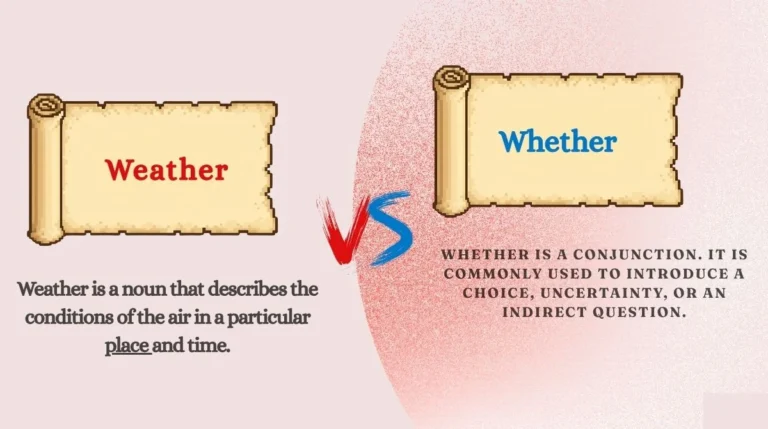
Weather is a noun that describes the conditions of the air in a particular place and time. It can include things such as rain, sunshine, wind, snow, clouds, storms, humidity, and temperature. Cambridge Dictionary defines weather as the conditions in the air, such as wind, rain, or temperature, especially at a certain time and place.
We use weather when we are talking about what is happening outside.
For example:
- The weather is beautiful today.
- What is the weather like in Lahore?
- The weather looks bad this morning.
- We stayed home because of the cold weather.
- I hope the weather improves tomorrow.
- The weather was rainy during our trip.
- The weather changed very quickly.
- Bad weather delayed our flight.
Grammar rule for “weather”
As a noun, weather is normally uncountable. That means we usually do not say “a weather” or “weathers.” We say:
- The weather is nice.
- The weather is terrible.
- We had good weather.
- The weather was cold yesterday.
Cambridge Grammar specifically notes that weather is an uncountable noun. Instead of saying “a beautiful weather,” we would normally say “beautiful weather” or “a beautiful spell of weather.”
This is an important point for learners because adding a before weather is a common mistake.
Weather can also be a verb
Although beginners usually learn weather as a noun, it can also work as a verb. As a verb, it can mean to survive or successfully get through a difficult situation. It can also describe something being changed by exposure to sun, wind, rain, or other outdoor conditions.
For example:
- The company weathered the difficult year.
- The old building has been weathered by years of rain and wind.
- They managed to weather the crisis.
Still, in everyday beginner English, the noun use is much more common.
Common confusion with “weather”
The easiest way to remember weather is to think about outside conditions.
Ask yourself:
“Am I talking about rain, sun, wind, heat, cold, or the sky?”
If the answer is yes, you probably need weather.
For example:
The weather is too hot today.
Here, you are talking about temperature outside, so weather is correct.
What Does “Whether” Mean?
Whether is a conjunction. It is commonly used to introduce a choice, uncertainty, or an indirect question. In simple terms, it often means “if” or “if something is true or not.” It can also introduce two or more possibilities.
For beginners, think of whether as a word connected to choices and uncertainty, not the sky.
Look at these examples:
- I don’t know whether he is coming.
- She asked whether I needed help.
- I can’t decide whether to buy it.
- We are not sure whether the shop is open.
- Do you know whether they arrived?
- He wondered whether she was telling the truth.
- I haven’t decided whether to stay or leave.
- It depends on whether we have enough money.
In these sentences, there is no rain, sunshine, or temperature. Instead, the speaker is unsure about something or is considering different possibilities.
Grammar rule for “whether”
A very useful pattern is:
whether + clause
For example:
- I don’t know whether she will come.
- We need to find out whether he is ready.
- She asked whether I was busy.
Another common pattern is:
whether + to + verb
For example:
- I don’t know whether to go.
- She is deciding whether to stay.
- He hasn’t decided whether to accept the offer.
Cambridge notes that whether, rather than if, is used before a to-infinitive.
You can also use:
whether … or
Examples:
- I don’t know whether to call or wait.
- Tell me whether you want tea or coffee.
- We must decide whether to stay or leave.
And:
whether … or not
Examples:
- I don’t know whether or not he will come.
- She will go whether you agree or not.
- We need to decide whether or not to continue.
Common confusion with “whether”
Learners often choose whether when they are actually talking about the weather.
For example:
❌ Whether is very cold today.
✅ The weather is very cold today.
Another common mistake is spelling weather when the sentence needs a choice or uncertainty.
❌ I don’t know weather she is coming.
✅ I don’t know whether she is coming.
A simple question can help:
“Is this sentence about outdoor conditions, or about a choice/possibility?”
Outdoor conditions = weather
Choice or possibility = whether
Difference Between Weather and Whether
The biggest difference is their meaning and grammatical role.
Weather is mainly a noun referring to conditions in the atmosphere. Whether is a conjunction used to express uncertainty, possibilities, or choices.
Comparison table
| Word | Part of Speech | Main Meaning | Common Use | Example |
|---|---|---|---|---|
| Weather | Noun | Conditions outside | Rain, sun, wind, heat, cold | The weather is lovely today. |
| Whether | Conjunction | Choice, possibility, uncertainty | Indirect questions and alternatives | I don’t know whether he will come. |
Usage difference
Use weather when you are describing what is happening in the atmosphere.
The weather is rainy today.
Use whether when you are unsure about something or talking about two possibilities.
I don’t know whether it will rain.
Notice something interesting in the second example. The sentence mentions rain, but the correct word is still whether because the main idea is uncertainty.
That is why you should not choose the word simply by looking at nearby vocabulary. You must understand the job of the word in the sentence.
Grammar logic
The two words belong to different grammar categories.
Weather behaves like a noun:
- the weather
- bad weather
- cold weather
- warm weather
- good weather
Whether behaves like a conjunction:
- whether he comes
- whether she knows
- whether to stay
- whether or not it happens
This difference gives you a strong clue.
If the blank needs a noun about outdoor conditions, choose weather.
If the blank connects an idea to a possibility or choice, choose whether.
Sentence structure difference
Compare these:
The weather is terrible.
Structure:
The weather + verb + description
Now compare:
I don’t know whether the weather is terrible.
Here, whether introduces the clause “the weather is terrible.”
This shows why both words can appear in the same sentence:
I don’t know whether the weather will improve.
The two words are doing completely different jobs.
- whether = introduces uncertainty
- weather = refers to outdoor conditions
That distinction is one of the best ways to stop mixing them up.
Meaning comparison
Think of these two ideas:
Weather = What is happening outside?
Whether = Which possibility is true?
For example:
The weather is cold.
You are describing outside conditions.
I’m not sure whether the weather will stay cold.
You are expressing uncertainty about those conditions.
Both words are useful, but they are not interchangeable.
Grammar Rules You Must Remember
Rule 1: Use “weather” for conditions outside
Use weather for rain, sunshine, wind, snow, temperature, storms, and similar atmospheric conditions.
Example:
The weather is very hot today.
You are describing the conditions outside, so weather is correct.
Another example:
We stayed home because of the bad weather.
The phrase “bad weather” describes unpleasant outdoor conditions.
Rule 2: Use “whether” for choices and uncertainty
Use whether when you are discussing whether something is true, whether something will happen, or which possibility is correct.
Example:
I don’t know whether he will come.
The speaker is uncertain. There is no meaning related to the atmosphere.
Another example:
She is deciding whether to take the job.
There are different possibilities, so whether is the right word.
Rule 3: Use “whether” before “to + verb” when showing a choice
A very common structure is:
whether + to + verb
Examples:
I don’t know whether to call him.
She hasn’t decided whether to stay.
We are discussing whether to move.
Using weather in these sentences would be completely wrong.
❌ I don’t know weather to call him.
✅ I don’t know whether to call him.
This rule is especially useful in writing because the incorrect spelling is easy to miss when you are typing quickly. Cambridge specifically identifies whether, not if, before to-infinitives as a typical grammar point.
Rule 4: “Whether or not” means the choice does not change the result
The expression whether or not is used when something is true in either case.
For example:
I’m going whether you come or not.
This means the speaker will go in both situations.
Another example:
We have to finish the work whether or not we feel tired.
The work must be finished regardless of being tired.
Cambridge gives whether or not as a common construction for expressing an alternative or opposite possibility.
Common Mistakes Students Make
The main reason learners confuse these words is simple: they sound alike or very similar.
English has many pairs called homophones or commonly confused words. Homophones are words that have the same pronunciation but different meanings or spellings.
Because weather and whether sound similar, students often choose a spelling based on sound alone.
Mistake 1: Using “whether” for outdoor conditions
❌ The whether is beautiful today.
✅ The weather is beautiful today.
Why?
Beautiful is describing the conditions outside. You need the noun weather.
Mistake 2: Using “weather” for uncertainty
❌ I don’t know weather she is ready.
✅ I don’t know whether she is ready.
Why?
The sentence means you are not sure if she is ready. That requires whether.
Mistake 3: Writing “a weather”
❌ We had a beautiful weather yesterday.
✅ We had beautiful weather yesterday.
Because weather is normally uncountable, we do not usually put a before it.
Mistake 4: Using “weather” before “to + verb”
❌ I can’t decide weather to go.
✅ I can’t decide whether to go.
The phrase whether to go is a standard structure for showing a choice.
Mistake 5: Forgetting the “or not” pattern
Some learners think that whether can only be followed by “or.”
That is not true.
You can say:
I don’t know whether he is coming.
You can also say:
I don’t know whether or not he is coming.
Both are possible, depending on the sentence and the meaning you want to emphasize.
Easy correction tip
Before typing either word, stop for one second.
Ask:
“Can I replace this word with ‘the conditions outside’?”
If yes → weather
Ask:
“Can I replace this word with ‘if’ or ‘if … or not’?”
If yes → whether
For example:
I don’t know ___ she is home.
Try “if”:
I don’t know if she is home.
That works, so whether also makes sense.
Now:
The ___ is cold.
“Could I replace it with ‘the conditions outside’?”
Yes. Therefore:
The weather is cold.
This small mental test is surprisingly effective.
Easy Trick to Remember the Difference
Here is a simple memory trick that works well for students:
WEATHER = WET
Look at the first part:
WEATher
Think of WET.
Rain is wet. Snow can be wet. Storms can bring wet weather.
So when your sentence is about rain, sun, wind, clouds, heat, or cold, think:
WEATHER = outside conditions
Example:
The weather is wet and rainy.
Now remember:
WHETHER = WHICH
Think of whether as a word that helps you think about which possibility is true.
For example:
I don’t know whether to take the bus or the train.
There is a choice between two possibilities.
Another easy association is:
Weather = the sky
Whether = a choice
You do not need a complicated grammar trick. Just connect each word with one clear idea.
When you see weather, picture an umbrella.
When you see whether, picture two roads and a person choosing one.
That mental picture can help you remember the spellings much faster.
Daily Life Examples
These examples show how the two words appear in normal spoken English.
1. Talking about the day
A: What is the weather like today?
B: It is sunny but a little windy.
Here, weather describes the outdoor conditions.
2. Making weekend plans
A: Are you going to the park tomorrow?
B: I’m not sure whether I’ll have time.
Here, whether introduces uncertainty.
3. Checking rain
A: Should I take an umbrella?
B: Yes. The weather looks rainy.
The subject is the outside conditions, so weather is correct.
4. Choosing food
A: Have you decided whether to order pizza or burgers?
B: I think I’ll order pizza.
The word whether introduces a choice.
5. Talking about travel
A: Do you know whether the train is on time?
B: No, I haven’t checked yet.
The speaker is asking about a possibility or fact, so whether fits.
6. Talking about a trip
A: Did you enjoy the trip?
B: Yes, although the weather was very cold.
The sentence is about temperature and outdoor conditions.
7. Asking about plans
A: Are you going to the party?
B: I haven’t decided whether to go.
The person is choosing between going and not going.
8. During a storm
A: The weather is getting worse.
B: We should probably go home.
Again, weather is about the conditions outside.
9. Making a decision
A: Do you know whether Sarah wants to join us?
B: I’ll ask her.
The speaker does not know which possibility is true.
10. Accepting either result
A: Will you come whether it rains or not?
B: Yes, I’ll still be there.
Here, whether … or not means the result does not change.
Practice Section
Choose the correct word: weather or whether.
1. I don’t know ___ he will call me tonight.
A. weather
B. whether
2. The ___ is very cold this morning.
A. weather
B. whether
3. She hasn’t decided ___ to study at home or at the library.
A. weather
B. whether
4. We canceled the picnic because of the bad ___.
A. weather
B. whether
5. Do you know ___ the shop is open today?
A. weather
B. whether
Answers
1. whether — The sentence shows uncertainty about whether he will call.
2. weather — The sentence describes outdoor temperature.
3. whether — The structure is whether + to + verb and shows a choice.
4. weather — Bad weather can cause a picnic to be canceled.
5. whether — The sentence asks about a possibility or an indirect yes/no question.
FAQs
What is the difference between weather and whether?
Weather is about conditions outside, such as rain, wind, sunshine, and temperature. Whether is a conjunction used for choices, possibilities, uncertainty, and indirect questions. They sound similar, but their meanings are completely different.
Can we use “whether” in questions?
Yes. Whether can appear in indirect questions, such as: “Do you know whether he is coming?” It is often used when the speaker wants to know if something is true or which possibility is correct.
Is “weather” a noun or a verb?
Weather is most commonly a noun referring to atmospheric conditions. It can also be a verb meaning to survive a difficult situation or to become changed by exposure to outdoor conditions.
Is “weather” countable or uncountable?
Weather is normally an uncountable noun. We usually say “good weather,” “bad weather,” or “cold weather,” not “a good weather.” Cambridge Grammar specifically identifies weather as uncountable.
Can I use “whether” and “if” in the same way?
Sometimes, yes. Whether and if can both introduce many indirect yes/no questions. However, whether is needed in some structures, especially before to + verb, and it is also commonly used with alternatives such as whether … or.
Is “whether or not” correct?
Yes. Whether or not is a standard expression. It means that there are two possible situations, but the result or decision applies in either case. For example: “I’ll go whether or not you come.”
Conclusion
The difference between weather and whether may look small, but understanding it can make your English writing much clearer.
Remember the easiest rule:
Weather = conditions outside.
Whether = choice, possibility, or uncertainty.
Use weather when you talk about rain, sunshine, wind, snow, temperature, or storms. Use whether when you are deciding between possibilities, reporting a question, or saying that you are not sure about something.
For example, compare these two sentences:
The weather is getting colder.
I don’t know whether the weather will get colder.
Once you notice the different jobs of these words, the confusion becomes much easier to handle. Keep practicing them in short sentences, especially in your everyday writing and messages. A few correct examples can help the spelling become natural.
English has many confusing word pairs, but you do not need to memorize everything at once. Learn the meaning, notice the grammar, and practice a little each day. That is usually the fastest path to better English.

Evan Rellmont is a writer who turns thoughtful ideas into meaningful words, creating stories and reflections that connect, inspire, and leave a lasting impression.