
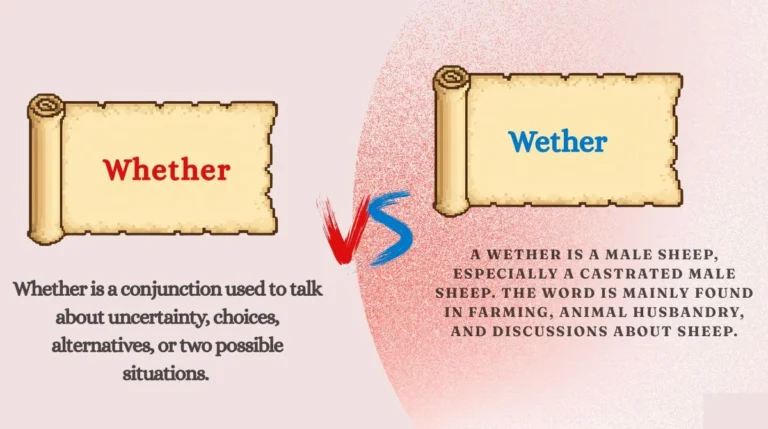
English has many words that sound the same but have completely different meanings. Whether and wether are a good example.
They are pronounced almost the same, so even careful learners sometimes mix them up when writing.
The confusion becomes stronger because whether is a very common word, while wether is a real English word that most people rarely see.
When you hear a sentence such as “I don’t know whether he will come,” you need to remember the correct spelling.
Writing “wether” in that sentence would be incorrect.
The word whether is mainly used to talk about choices, possibilities, doubts, and indirect yes-or-no questions.
It appears often in everyday speech, emails, school writing, conversations, and formal English.
Cambridge and Oxford both describe it as a conjunction used for choices, uncertainty, and reported questions.
On the other hand, wether is a noun connected with farming and sheep. It means a male sheep, especially a castrated male sheep.
It is a correct word, but it is uncommon in normal daily English.
By the end of this guide, you will know exactly when to use whether and when wether is appropriate.
You will also learn simple grammar rules, common mistakes, memory tricks, and real-life examples that make the difference easy to remember.
What Does “Whether” Mean?
Whether is a conjunction used to talk about uncertainty, choices, alternatives, or two possible situations. In simple words, it often means “if” or “which of two possibilities is true.” Cambridge defines it as a word used especially for reporting questions and expressing doubt, while Oxford describes it as expressing a doubt or a choice between possibilities.
You will often see whether in sentences where someone is not sure about something.
For example:
I don’t know whether she is at home.
This means:
I don’t know if she is at home.
It can also introduce a choice:
I can’t decide whether to stay or leave.
Here, the speaker has two possible choices: stay or leave.
When Should You Use “Whether”?
Use whether when you are talking about:
- uncertainty
- a yes-or-no possibility
- two or more choices
- indirect questions
- alternatives
- situations where the result is the same either way
One very common pattern is whether…or.
We must decide whether to walk or take a taxi.
Another common form is whether or not.
I am going whether you agree or not.
This means the speaker will go in either situation.
Grammar Rule for “Whether”
Whether is a conjunction, so it normally connects a main clause with another clause or phrase.
Common structures include:
whether + clause
I don’t know whether he is ready.
whether + to + verb
She is deciding whether to apply.
whether + clause + or + clause
I don’t know whether he will call or whether he will text.
whether or not + clause
We will go whether or not it rains.
Cambridge specifically notes that whether, rather than if, is used before a to-infinitive. For example, “I’m not sure whether to go” is correct, while “I’m not sure if to go” is not standard English.
Examples of “Whether”
- I don’t know whether he will come tonight.
- She asked me whether I needed any help.
- We need to decide whether to buy a new car.
- He is wondering whether the shop is still open.
- I can’t remember whether I locked the door.
- They are discussing whether the plan will work.
- I will support you whether you win or lose.
- She couldn’t decide whether to study at home or at the library.
These sentences all deal with uncertainty, choices, alternatives, or two possible situations.
A Common Confusion With “Whether”
Many learners confuse whether with weather because both sound alike. They may also accidentally type wether.
Remember that whether is connected with a choice or possibility.
I don’t know whether he is coming.
The word wether has nothing to do with uncertainty. And weather refers to conditions such as rain, wind, sunshine, or temperature.
A useful question to ask yourself is:
“Am I talking about a choice or possibility?”
If the answer is yes, whether is usually the word you need.
What Does “Wether” Mean?
Wether is a real English word, but it is very different from whether.
A wether is a male sheep, especially a castrated male sheep. The word is mainly found in farming, animal husbandry, and discussions about sheep. Dictionary.com gives this meaning directly and notes that the word is uncommon in ordinary modern conversation.
So, if a farmer says:
The farmer sold three wethers.
the sentence is talking about sheep.
This word is not used to express uncertainty, ask a question, or describe a choice.
When Should You Use “Wether”?
Use wether only when you are talking about the specific animal described above.
You may find it in:
- farming books
- sheep-breeding information
- agricultural writing
- older literature
- animal science texts
- discussions about livestock
For most English learners, this word is not something you will need in everyday conversation.
Grammar Rule for “Wether”
Wether is a noun.
Because it is a noun, it can be used as the subject or object of a sentence.
For example:
The wether is in the field.
Here, “wether” is the subject.
The farmer moved the wether to another pen.
Here, “wether” is the object.
The plural form is wethers.
The farmer has five wethers.
Examples of “Wether”
- The farmer bought a young wether.
- That wether is standing near the gate.
- The shepherd separated the wether from the other animals.
- Several wethers were resting in the field.
- The farmer checked each wether carefully.
- The old wether stayed close to the flock.
- The book explains how to care for a wether.
- The farm keeps several wethers for livestock purposes.
These examples show the important point: wether is about an animal, not a grammar choice.
Common Learner Confusion
The biggest problem is pronunciation.
Whether and wether can sound very similar. If you only hear them, you may not know which spelling is intended.
That is why the meaning of the sentence is important.
Compare:
I don’t know whether he will arrive.
Here, the word connects an idea of uncertainty.
But:
The wether is in the barn.
Here, the word names an animal.
The difference becomes clear once you look at the sentence instead of relying only on sound.
Difference Between Whether and Wether
The easiest way to understand the difference is to remember that these words have different parts of speech and completely different jobs.
| Word | Part of Speech | Meaning | Common Use | Example |
|---|---|---|---|---|
| Whether | Conjunction | Shows uncertainty, choice, or alternatives | Everyday English, questions, writing | I don’t know whether he will come. |
| Wether | Noun | A male sheep, especially a castrated male sheep | Farming and livestock | The wether is in the field. |
Usage Difference
Whether is common and useful in everyday English.
You might use it when making a decision:
I don’t know whether to go.
You might use it in an indirect question:
She asked whether I was ready.
You might also use it to show that something is true in either situation:
I will go whether you come or not.
Cambridge explains that whether…or introduces alternatives and that whether or not can show that it does not matter which possibility is true.
Wether, by contrast, is a specific noun related to sheep. It is not a replacement for whether.
Grammar Logic
The words have different grammatical roles.
Whether joins ideas:
We need to decide whether we should leave.
It introduces another idea or possibility.
Wether names something:
The wether is eating grass.
Since it is a noun, it can have articles such as a or the.
You can say:
a wether
the wether
several wethers
You cannot use whether this way.
It would be wrong to write:
a whether
because whether is not the name of an animal.
Sentence Structure Difference
A sentence containing whether often looks like this:
Subject + verb + whether + clause
I don’t know whether she is home.
Or:
Subject + verb + whether + to + verb
He hasn’t decided whether to stay.
A sentence containing wether often looks like a normal noun sentence:
The + wether + verb
The wether is sleeping.
Or:
Subject + verb + a/the + wether
The farmer bought a wether.
Meaning Comparison
The meanings are completely different:
Whether = possibility, choice, or uncertainty
I wonder whether she knows.
Wether = male sheep
The wether is healthy.
There is no situation where you should write wether as a spelling of the conjunction whether.
Grammar Rules You Must Remember
Rule 1: Use “Whether” for a Choice or Possibility
When a sentence talks about two possibilities or asks indirectly about something, use whether.
I don’t know whether he is coming.
The sentence expresses uncertainty.
Another example:
She can’t decide whether to study medicine or law.
The speaker is thinking about two choices.
Rule 2: Use “Whether” Before “To + Verb”
A very useful grammar pattern is:
whether + to + verb
Examples:
I haven’t decided whether to stay.
He is wondering whether to call her.
We must choose whether to accept the offer.
Cambridge specifically identifies whether, not if, as the standard choice before a to-infinitive.
So avoid:
I don’t know if to go.
Use:
I don’t know whether to go.
Rule 3: Use “Whether or Not” When Both Possibilities Lead to the Same Result
Whether or not is useful when you mean that something will happen regardless of which possibility is true.
We are going whether or not it rains.
This means rain will not change the decision.
Another example:
She will finish the project whether or not she gets help.
The result is the same in either case.
Cambridge explains this use as meaning that it is not important which of the two possibilities is true.
Rule 4: Use “Wether” Only for the Animal
The word wether should be reserved for its specific noun meaning.
The wether was moved into another field.
Do not use it in sentences about choices or uncertainty.
Wrong:
I don’t know wether she will come.
Correct:
I don’t know whether she will come.
Common Mistakes Students Make
Many errors happen because these words sound similar. When speaking, a learner may know the meaning but later choose the wrong spelling while writing.
Mistake 1: Using “Wether” for “Whether”
Wrong:
I don’t know wether I should call him.
Correct:
I don’t know whether I should call him.
Why does the mistake happen? Because wether is a real English word, so spell-checking may not always make the error obvious.
The simple correction is to check the meaning. If you are talking about a choice, doubt, or possibility, use whether.
Mistake 2: Thinking “Wether” Is Just a Wrong Spelling
It is important to know that wether is not a made-up word. It is a real noun related to sheep.
So this sentence is possible:
The farmer has a large wether.
The spelling is correct because the sentence is about a sheep.
Mistake 3: Confusing “Whether” With “Weather”
This is another very common spelling problem.
Wrong:
I don’t know weather she will come.
Correct:
I don’t know whether she will come.
But weather is correct in a sentence about rain, wind, or temperature:
The weather is beautiful today.
A quick check can help:
choice or possibility = whether
rain, sun, wind, temperature = weather
male sheep = wether
Mistake 4: Using “If” Before a To-Infinitive
Learners sometimes write:
I don’t know if to stay.
Standard English normally uses:
I don’t know whether to stay.
This is one of the most helpful rules to remember because it appears frequently in writing and formal English.
Easy Correction Tip
Before choosing the spelling, ask:
What am I talking about?
If it is a choice, doubt, or possibility, choose whether.
If it is a sheep, choose wether.
If it is rain or sunshine, choose weather.
That three-word check will prevent many spelling mistakes.
Easy Trick to Remember the Difference
Here is a simple memory trick:
Whether = “Which one?”
Think of whether as a word for which possibility.
I don’t know whether to go or stay.
You are choosing between possibilities.
You can mentally connect:
WHETHER = CHOICE
Now remember:
Wether = Woolly Animal
The word wether contains the letters “weth”, and you can connect it in your mind with a woolly sheep.
You do not need a complicated trick. Just picture a sheep standing in a field.
Whether → choice
Wether → sheep
There is also a third word worth remembering:
Weather → sky and conditions
Imagine these three pictures:
Whether → two roads to choose from
Wether → sheep in a field
Weather → clouds and sunshine
That visual connection makes the spellings much easier to remember.
Daily Life Examples
Here are everyday examples using whether naturally.
Example 1
Ali: Are you going to the party tonight?
Sam: I don’t know whether I have enough time.
Example 2
Sara: Which dress will you buy?
Mina: I’m not sure whether to buy the blue one or the black one.
Example 3
Teacher: Have you decided on your topic?
Student: Not yet. I’m still thinking about whether to choose history or science.
Example 4
Brother: Are you coming with us?
Sister: Yes. I’m going whether it rains or not.
Example 5
Friend: Did John say he was coming?
You: He didn’t tell me whether he would come.
Example 6
Parent: Did you check the door?
Child: I can’t remember whether I locked it.
Example 7
Coworker: Should we email them now?
You: Let’s discuss whether we should wait until tomorrow.
Example 8
Student: I don’t know whether I can finish this homework tonight.
Example 9
Friend: Are you going by bus or train?
You: I’m deciding whether to take the bus or the train.
Example 10
Farmer: What animals are in that pen?
Worker: Those are wethers.
Notice how different the last example is. The word wethers refers to sheep, while the earlier examples use whether to express choices or uncertainty.
Practice Section
Choose the correct word: whether or wether.
1. I don’t know ______ she is coming today.
a) whether
b) wether
2. The farmer moved the ______ to another field.
a) whether
b) wether
3. We must decide ______ to leave now or later.
a) whether
b) wether
4. I will help you ______ you win or lose.
a) whether
b) wether
5. The shepherd counted the ______ before closing the gate.
a) whether
b) wether
Answers
- whether
- wether
- whether
- whether
- wethers would be the natural plural form if more than one animal is meant.
Try reading each sentence aloud. Then ask what the word is doing. Is it showing a possibility or naming an animal? That small habit can make the difference much easier to remember.
FAQs
What is the difference between whether and wether?
Whether is a conjunction used for choices, uncertainty, alternatives, and indirect questions. Wether is a noun meaning a male sheep, especially a castrated male sheep. The two words may sound similar, but their meanings and grammar are completely different.
Can we use whether in questions?
Yes. Whether is commonly used in indirect questions and questions involving alternatives.
Do you know whether she is home?
It can also be used with choices:
I don’t know whether to stay or leave.
Cambridge notes that whether is widely used in indirect yes-or-no questions and with alternatives.
Is whether formal or informal?
Whether works in both everyday and formal English. It is very common in conversation, emails, school writing, business communication, and academic English. Oxford also notes that whether can sound more formal than if in some choice-based constructions.
Is wether a real word?
Yes, wether is a real English word. It refers to a male sheep, particularly a castrated male sheep. However, it is uncommon in normal everyday English and is mainly associated with farming or livestock.
Should I write whether or if?
Both whether and if can introduce many indirect yes-or-no questions.
I don’t know if he is coming.
I don’t know whether he is coming.
However, use whether before to + verb:
I don’t know whether to go.
Not:
I don’t know if to go.
Whether is also especially useful when alternatives are clearly stated.
Is whether the same as weather or wether?
No. These are three different words.
Whether = choice or possibility
Weather = conditions such as rain, wind, and sunshine
Wether = a male sheep
They can sound alike or very similar, but their meanings are completely different. Checking the meaning of the sentence is the best way to choose the correct spelling.
Conclusion
The difference between whether and wether is much easier once you focus on meaning instead of sound. Whether is the word you will use in normal English when you are talking about a choice, uncertainty, possibility, or an indirect question. You will often see it in patterns such as whether to, whether…or, and whether or not.
Wether, on the other hand, is a real but uncommon noun for a male sheep, especially a castrated one.
For everyday writing, the key rule is simple: choice or uncertainty = whether; sheep = wether. And remember that weather is the word for rain, sunshine, wind, and other conditions outside.
The best way to remember these words is to practice them in short sentences. Write a few examples of your own, read them aloud, and check the meaning each time. After a little practice, these confusing spellings will start to feel natural.

Evan Rellmont is a writer who turns thoughtful ideas into meaningful words, creating stories and reflections that connect, inspire, and leave a lasting impression.