
Have you ever stopped while writing an email and wondered whether you should write onsite or on-site? You are not alone.
Even fluent English speakers sometimes hesitate because both forms are used in modern English, and the rules are not always presented in a simple way.
The good news is that onsite and on-site have the same basic meaning.
They describe something that happens, exists, or is available at a particular place rather than somewhere else. For example, you might talk about onsite training, on-site training, or on-site support.
Major dictionaries recognize both forms, although their preferred entries and style choices can differ. Cambridge lists onsite as both an adjective and an adverb, while Merriam-Webster lists on-site as an adjective or adverb.
This is why the question is not simply “Which spelling is correct?” The more useful question is: Which form should I use in my sentence, and which form is best for my style of writing?
By the end of this guide, you will understand the difference between onsite, on-site, and the related phrase on site.
You will also know where the hyphen comes from, how dictionaries treat these forms, which mistakes to avoid, and how to choose the safest form in everyday English.
What Does “Onsite” Mean?
Simple definition of onsite
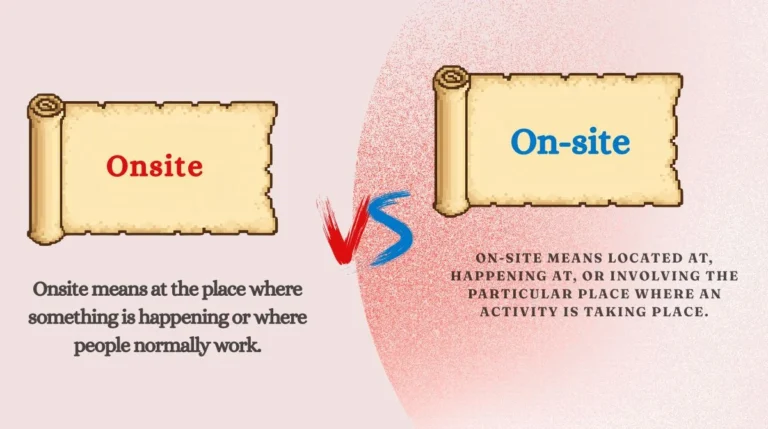
Onsite means at the place where something is happening or where people normally work.
It is especially common in workplace, business, education, construction, technology, and service-related English. Cambridge Business English uses onsite as an adjective for something available or happening where people work, and as an adverb for something done in that same place.
For example:
- onsite training = training provided at the workplace
- onsite support = support provided at the location
- onsite parking = parking available at the place
- onsite staff = staff who work at the location
- onsite inspection = an inspection done at the location
The word usually contrasts with offsite, which means away from the workplace or main location. Cambridge recognizes onsite and uses off-site as its contrasting form in the same workplace context.
When should you use onsite?
You can use onsite when it works as a single adjective or adverb.
As an adjective, it usually describes a noun:
The company offers onsite training.
Here, onsite tells us what kind of training it is.
As an adverb, it tells us where an action happens:
The technician will repair the machine onsite.
Here, onsite tells us where the technician will repair it.
Grammar rule for onsite
A simple rule is:
Use “onsite” as one word when your chosen style guide or dictionary allows the modern unhyphenated form.
Cambridge specifically lists onsite as a workplace adjective and adverb. The American Heritage Dictionary also recognizes onsite as an adjective and adverb.
However, this is where learners need to be careful. English spelling conventions are not identical in every dictionary or style guide. Some style guides still prefer on-site, especially for formal writing. The University of Delaware IT Style Guide, for example, recommends on-site when used as an adjective and on site as a phrase.
So onsite is a real and accepted form, but it is not the only form you may see.
Examples of onsite
- The company provides onsite training for new employees.
- We have an onsite manager who can answer your questions.
- The engineer will check the equipment onsite.
- Our school has an onsite library for students.
- The hotel offers onsite parking for guests.
- The doctor provides onsite medical services.
- The company hired an onsite technician to maintain the computers.
- All repairs can be completed onsite.
Common confusion about onsite
Many students think that onsite must be wrong because they learned that words beginning with on are usually separate.
That is not always true.
English often turns phrases into compound words over time. Words such as online, onscreen, and offline are now commonly written as single words. The same development has happened with onsite in many modern uses.
Still, spelling preferences can vary. That means seeing on-site does not automatically mean the writer made a mistake.
What Does “On-site” Mean?
Simple definition of on-site
On-site means located at, happening at, or involving the particular place where an activity is taking place.
The meaning is essentially the same as onsite.
Merriam-Webster defines on-site as being at a particular place, especially a place of business, and gives examples such as on-site day care, on-site inspections, and on-site parking. Cambridge also lists on-site as an adjective and adverb meaning something existing or happening where people are working or involved in an activity.
When should you use on-site?
The hyphenated form is especially useful when the expression acts as a compound modifier.
For example:
We need an on-site technician.
The words on-site work together to describe the noun technician.
You can also find the hyphenated form after a verb:
The technician will work on-site.
Many dictionaries recognize this use too. Merriam-Webster lists on-site as both an adjective and an adverb, while Cambridge does the same.
Grammar rule for on-site
A useful classroom rule is:
Use “on-site” when you want the phrase to function as a compound adjective, especially before a noun.
Examples:
- on-site support
- on-site training
- on-site inspection
- on-site childcare
- on-site services
The hyphen joins the words so the reader can quickly understand that they work together as one modifier.
For example:
We hired an on-site support team.
The phrase on-site describes the support team.
Examples of on-site
- The hotel has on-site restaurants.
- We provide on-site technical support.
- The company offers on-site training to its employees.
- An on-site inspection is required before approval.
- The school has on-site childcare for staff.
- The technician is working on-site today.
- We need on-site security during the event.
- The project includes an on-site medical center.
Common confusion about on-site
The biggest confusion is that writers often think the hyphen changes the meaning.
Usually, it does not.
In most everyday situations, onsite and on-site mean the same thing. The difference is mainly one of spelling and style.
The University of Delaware style guide gives a useful example: it prefers on-site when the term acts as an adjective, but on site when it works as a location phrase.
That means the larger question is not simply whether the hyphen exists. You should also consider how the words function in your sentence.
Difference Between Onsite and On-site
Now we can make the comparison much easier.
The first important point is this:
Onsite and on-site usually have the same meaning.
The main difference is spelling preference and style.
| Feature | Onsite | On-site |
|---|---|---|
| Spelling | One word | Hyphenated |
| Meaning | At the place where something happens | At the place where something happens |
| Common use | Workplace and modern business English | Formal, edited, and traditional style |
| Part of speech | Adjective and adverb | Adjective and adverb |
| Example adjective | onsite training | on-site training |
| Example adverb | work onsite | work on-site |
| Accepted form? | Yes, in many dictionaries and styles | Yes, in major dictionaries and styles |
Cambridge currently recognizes onsite as a workplace adjective and adverb. Merriam-Webster recognizes on-site as an adjective or adverb. This shows that both forms are established in English.
Usage difference
Consider these sentences:
We offer onsite training.
We offer on-site training.
The meaning is almost exactly the same.
The difference is the writer’s preferred spelling convention.
Some organizations prefer onsite because it follows the modern tendency to close familiar compounds into one word.
Other organizations prefer on-site because the hyphen clearly shows that on and site form a compound modifier.
For example, the University of Delaware style guide says “onsite” has not entered standard style sheets as one word for its style system and recommends on-site for an adjective.
At the same time, the University of Delaware is not speaking for all English writers. Other style references accept or prefer onsite, and the Cambridge Business English Dictionary explicitly gives that form.
Grammar logic
There is a useful distinction between:
The technician is on site.
and:
We need an on-site technician.
In the first sentence, on site works as a phrase telling us where the technician is.
In the second sentence, on-site acts as a compound adjective describing technician.
This traditional distinction is very useful because it helps explain why the three forms can appear:
- onsite
- on-site
- on site
However, actual dictionaries and style guides are not completely uniform. Cambridge uses on-site and onsite in different entries, while other references allow more than one form.
Sentence structure difference
Compare these examples:
The workers are on site.
This emphasizes location.
The workers are on-site.
This is also used in modern English, particularly in dictionary examples.
The company has on-site workers.
Here, the compound modifies workers.
The company has onsite workers.
This has the same basic meaning but uses the closed form.
So sentence structure can guide your choice, but it does not create a universal rule that every English dictionary follows.
Meaning comparison
There is no major meaning difference between onsite and on-site.
Both can describe:
- something located at a workplace
- something happening at a particular location
- a service provided at the location
- a person working at the location
- an activity performed where the main activity is taking place
The real issue is style consistency.
Grammar Rules You Must Remember
Rule 1: Onsite and on-site usually mean the same thing
Do not assume that the hyphen changes the meaning.
The company offers onsite support.
The company offers on-site support.
Both tell us that the support is available at the location.
Rule 2: Use on-site as a compound adjective in styles that prefer hyphenation
When a style guide recommends the hyphenated form, use it before a noun:
We need an on-site engineer.
The hyphen helps connect the two words into one modifier.
This is especially helpful in formal business or technical writing. Merriam-Webster lists examples such as on-site inspections and on-site parking.
Rule 3: On site can be written as two words when it works as a location phrase
A traditional pattern is:
The engineer is on site.
Here, the phrase tells us where the engineer is.
This distinction is recommended by some style guides. The University of Delaware gives “The vendor arrived on site at 8 a.m.” as its example of the two-word form.
Rule 4: Follow one style consistently
This is one of the most important rules for professional writing.
Suppose your company website uses onsite throughout its pages. Suddenly changing to on-site in one section can make the writing look inconsistent.
Choose a preferred style and keep it consistent.
For example:
onsite training
onsite support
onsite services
onsite inspection
Or:
on-site training
on-site support
on-site services
on-site inspection
Both systems can work. Consistency is more important than switching back and forth without a reason.
Common Mistakes Students Make
Mistake 1: Thinking only one form is correct
Many learners search for a single “correct” spelling and become confused when different dictionaries show different forms.
Wrong idea: “Onsite is always wrong.”
That is not accurate. Cambridge and American Heritage both recognize onsite.
Better understanding: Both onsite and on-site are established forms, but individual style guides may prefer one.
Mistake 2: Adding a hyphen everywhere
Some students learn on-site and then use it mechanically in every sentence.
For example:
The manager arrived on-site.
This may be acceptable because dictionaries such as Merriam-Webster recognize the adverbial use.
But another style guide may prefer:
The manager arrived on site.
So do not treat the hyphen as a universal grammar rule.
Mistake 3: Using “onsite” and “on site” randomly
Consider:
We offer onsite training.
The technician works on site.
Our on-site team handles repairs.
The inspection happens onsite.
A reader can understand all of these, but the mixed style may look messy.
Choose a house style for your website, school paper, company documents, or blog.
Mistake 4: Confusing site with sight
This is a different problem but a common one.
Site means a place or location.
Sight means something that you see or a view.
Compare:
The construction site is closed.
The mountain is an amazing sight.
A simple test is to ask: Am I talking about a place or something I see?
Place = site
Something seen = sight
Mistake 5: Writing “on-site” because it looks more professional
A hyphen does not automatically make writing more formal or more correct.
In reality, style choices depend on the dictionary, organization, publication, and context.
For example, Cambridge uses the closed form onsite in its workplace entry, while Merriam-Webster uses on-site as its headword.
Easy Trick to Remember the Difference
Here is a simple trick that works well for beginners.
Think of the word site as a place.
Now imagine three ways of talking about that place:
ON SITE = at the place
ON-SITE = describing something connected with that place
ONSITE = the modern one-word version used by many dictionaries and organizations
For example:
The technician is on site.
He is physically at the place.
We need an on-site technician.
The phrase describes the kind of technician we need.
We provide onsite support.
This uses the modern closed spelling.
A second memory trick is even easier:
Place → site.
Then ask yourself whether your organization’s style prefers:
on site, on-site, or onsite.
That one question will solve most problems.
Daily Life Examples
Here are some examples you may hear or use at work, school, hotels, shops, events, and service centers.
1. At the office
A: Is the IT technician here today?
B: Yes, he is working onsite.
2. Training at work
The company provides on-site training for new employees.
3. Hotel services
The hotel has an onsite restaurant and a small gym.
4. Construction
The engineer will inspect the building on site tomorrow.
5. Computer support
We have on-site technical support during office hours.
6. Medical services
The event will have onsite medical staff.
7. Parking
Guests can use the on-site parking area.
8. Equipment repair
The machine cannot be moved, so the technician will fix it onsite.
9. School services
The college offers onsite counseling services for students.
10. Business meeting
The project manager will be on site before the team arrives.
Notice how natural all three forms can sound depending on the writer and style.
Practice Section
Choose the best option for each sentence.
1. The company provides ______ support for its employees.
A. onsite
B. on-site
C. Both can be correct
2. The engineer is working ______ today.
A. on site
B. onsite
C. Both may be used depending on style
3. We hired an ______ technician.
A. onsite
B. on-site
C. Both can be correct
4. The hotel offers ______ parking.
A. onsite
B. on-site
C. Both can be correct
5. The workers are already ______.
A. on site
B. onsite
C. Both may be acceptable depending on the style guide
Answers
1. C — Both can be correct.
You may see onsite support or on-site support.
2. C — Both may be used depending on style.
Traditional style may prefer on site, while dictionaries also recognize onsite/on-site as adverbial forms.
3. C — Both can be correct.
On-site technician and onsite technician have the same basic meaning.
4. C — Both can be correct.
Both spellings are used in modern English.
5. C — Both may be acceptable depending on the style guide.
When referring simply to location, on site is a common traditional choice.
FAQs
What is the difference between onsite and on-site?
Usually, there is no important difference in meaning. Both mean something is at or happening at a particular place. The main difference is spelling and style preference. Cambridge recognizes onsite, while Merriam-Webster uses on-site as its main dictionary form.
Is onsite one word or two words?
Onsite is one word. It is a recognized form in modern English, especially in workplace and business English. Cambridge lists it as both an adjective and an adverb.
Is on-site grammatically correct?
Yes. On-site is a recognized adjective and adverb. Merriam-Webster and Cambridge both list the hyphenated form. It is especially common in phrases such as on-site training, on-site support, and on-site parking.
Should I write onsite training or on-site training?
Both forms are used. The best choice depends on the style guide you are following. For example, some organizations prefer on-site training, while Cambridge Business English uses onsite training. The most important thing is to use one style consistently throughout your document.
Is “on site” different from “onsite”?
The meaning is generally the same, but on site is traditionally treated as a two-word phrase meaning “at the location.” For example, The engineer is on site. Some modern dictionaries also accept onsite as an adverb, so you may see both forms.
Which form is best for formal writing?
There is no single answer for every organization. A safe approach is to check the style guide used by your school, company, publisher, or website. If no style guide exists, on-site is a widely recognized dictionary form, while onsite is also accepted in major modern references.
Conclusion
The choice between onsite and on-site looks harder than it really is. Both forms describe something that happens, exists, or is available at a particular place. The main difference is not meaning but spelling preference and style.
Onsite is a recognized modern form, especially common in workplace and business English. On-site is also fully established and appears as the main form in dictionaries such as Merriam-Webster. The two-word phrase on site is also widely used, especially when talking about someone’s location.
The easiest way to avoid mistakes is to think about your sentence and then check the style you are following. More importantly, do not switch between forms randomly in the same document.
Once you understand that these are mostly style variations, the confusion becomes much smaller. Keep practicing, pay attention to how reliable dictionaries and professional websites use the term, and soon choosing the right form will feel natural.

Evan Rellmont is a writer who turns thoughtful ideas into meaningful words, creating stories and reflections that connect, inspire, and leave a lasting impression.