
English has many words that look almost the same but make learners stop and wonder which spelling is correct.
Requester and requestor are a good example. You may see one spelling in a dictionary, another in software documentation, and a third in a business email. That can make a simple word feel surprisingly confusing.
The good news is that this is not a case where one word has a completely different meaning from the other.
Both requester and requestor are nouns used for a person, group, or sometimes a system that makes a request. Cambridge lists requester as the main entry and notes requestor as an alternative spelling. Merriam-Webster also gives requester or requestor for the noun.
Still, there is a useful difference in how common the two spellings are. Requester is generally the safer and more familiar choice for ordinary English.
Requestor is also correct, but it appears more often in certain technical, legal, administrative, or system-related contexts, and some dictionaries describe it as a less common or rare spelling.
Collins, for example, calls requestor a rare spelling of requester.
By the end, you will know what each spelling means, which one to choose in everyday writing, how grammar works with both, and why you sometimes see requestor in technical documents.
What Does “Requester” Mean?
Simple definition
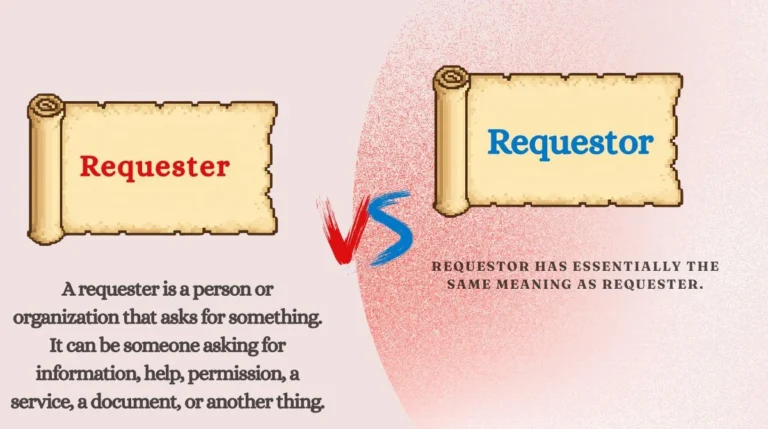
A requester is a person or organization that asks for something. It can be someone asking for information, help, permission, a service, a document, or another thing.
Cambridge defines requester as a person who asks to see or have something, such as an official record or document. The dictionary also lists requestor as another spelling.
The easiest way to remember the meaning is:
Requester = a person or thing that requests something.
For example:
- Sarah asked the office for a copy of the report.
- Sarah is the requester.
The word simply gives a name to the person who made the request.
When should you use “requester”?
Use requester when you want to identify the person or party making a request.
It can be used in many situations:
- A customer asking for a refund
- A student asking for extra information
- A worker asking for leave
- A person asking for public records
- A client asking for a service
- A computer or application sending a request to another system
The word is especially useful when the person making the request needs to be described as a role.
For example:
The requester must provide a valid email address.
Here, requester means the person who made the request.
Grammar rule for “requester”
Requester is a countable noun. You can use it as a singular noun or make it plural.
Singular:
The requester submitted the form.
Plural:
The requesters submitted their forms.
With an article:
A requester called the office.
With the:
The requester is waiting for a response.
The word is formed from the verb request plus the noun-forming ending -er.
A simple pattern is:
request + er = requester
English often uses -er to describe someone who performs an action.
For example:
- teach → teacher
- write → writer
- drive → driver
- work → worker
- request → requester
This pattern makes requester very easy to understand.
Examples of “requester”
- The requester must complete all sections of the application.
- The library contacted the requester for more information.
- Each requester will receive an email confirmation.
- The customer was the original requester of the service.
- The requester asked for a copy of the contract.
- We need to verify the identity of the requester.
- The requester is waiting for a reply from the support team.
- The form allows the requester to track the status of the application.
Notice that the meaning stays the same in every sentence. The requester is simply the one making the request.
Common learner confusion
A common mistake is thinking that requester means the person who receives a request. It does not.
Compare these two roles:
- Requester = the one who asks
- Recipient = the one who receives something or receives the request
For example:
Maria requested the document from David.
Maria is the requester because she asked for the document.
David may be the person who receives her request, and if he sends the document, he becomes the provider or sender of the document.
This distinction is important in emails, forms, customer service, and workplace communication.
It is also useful to remember that requester is not the same as questioner. A questioner asks a question, while a requester asks for something. Cambridge defines questioner as a person who asks a question.
What Does “Requestor” Mean?
Simple definition
Requestor has essentially the same meaning as requester.
A requestor is a person, organization, or system that makes a request.
For example:
The requestor must provide proof of identity.
This means:
The person making the request must provide proof of identity.
Merriam-Webster lists requester or requestor as the noun form connected with request. Dictionary.com describes requestor as a variation of requester.
So, from a meaning point of view:
Requester = Requestor
When should you use “requestor”?
You can use requestor when it is the spelling used by a company, organization, software system, legal document, or technical standard.
It is not an incorrect word.
However, it is not usually the first spelling most learners should choose for normal English writing. Collins describes requestor as a rare spelling of requester in British English.
That makes requester the more natural general-purpose choice.
Still, technical fields sometimes use requestor as an established term. For example, IETF technical documents use requestor in specialized networking terminology, where a requestor is the side or node that sends a request.
You may also see requestor in software and business systems where it is part of a specific field name or product vocabulary. Microsoft Graph documentation, for instance, uses a requestor property for a request-related object.
So the choice is not simply about “right” versus “wrong.” Context matters.
Grammar rule for “requestor”
Requestor is also a countable noun.
You can use:
a requestor
the requestor
several requestors
Examples:
- A requestor submitted the application.
- The requestor received a confirmation message.
- Several requestors are waiting for approval.
- We contacted the requestor yesterday.
The grammar is exactly the same as with requester.
The main difference is the spelling, not the basic grammar.
Examples of “requestor”
- The requestor must sign the form before submitting it.
- The requestor will be notified when the request is approved.
- We cannot identify the requestor from the information provided.
- The requestor asked for access to the records.
- The system sends an alert to the requestor after each update.
- Only the requestor can cancel the application.
- The requestor must provide a valid account number.
- The requestor contacted customer support for help.
Again, the meaning is clear: the requestor is the person or entity making the request.
Common learner confusion
Many learners see -or and assume that it must be more formal or more correct than -er.
That is not a reliable rule.
English has many pairs and patterns involving -er and -or, but you cannot always choose one just by guessing from the meaning.
For example:
- teacher, not teachaor
- writer, not writor
- actor, not acter
- editor, not editer
With request, both spellings exist:
- requester
- requestor
So this is a word that must be learned by actual usage and dictionary evidence rather than by a simple rule saying “use -or for formal words.”
Difference Between Requester and Requestor
The most important point is this:
Requester and requestor have the same basic meaning.
Both refer to the person, organization, or system that makes a request.
The main difference is spelling preference and frequency, not meaning.
| Feature | Requester | Requestor |
|---|---|---|
| Basic meaning | One who makes a request | One who makes a request |
| Part of speech | Noun | Noun |
| Grammar | Countable noun | Countable noun |
| Common in everyday English | Yes | Less common |
| Used in technical writing | Yes | Yes |
| Used in legal/administrative settings | Yes | Yes |
| Safe general choice | Yes | Yes, but less common |
| Meaning difference | None in ordinary use | None in ordinary use |
Usage difference
If you are writing an email, school assignment, blog post, general business message, or ordinary explanation, requester is usually the better choice.
For example:
The requester should check their email.
This sounds natural and clear.
Requestor is also possible:
The requestor should check their email.
The sentence is grammatically correct, but the spelling may feel more specialized or less familiar to some readers.
Grammar logic
Both words come from the verb request.
The verb request means to ask for something, often politely or formally. Cambridge describes it as a verb meaning to ask for something politely or officially.
A noun naming the person who performs that action can be formed from the verb.
Thus:
request → requester
and also:
request → requestor
The two noun forms point to the same basic role.
Sentence structure difference
There is no major sentence-structure difference between the two.
You can replace one with the other in many sentences without changing the grammar.
The requester submitted the form.
The requestor submitted the form.
Both are correct.
Another example:
We contacted the requester.
We contacted the requestor.
Again, the sentence structure is the same.
This is one reason the choice can be confusing for learners. You are not choosing between two different grammatical structures. You are choosing between two spellings of the same noun.
Meaning comparison
The meaning is also essentially the same.
A requester or requestor may be:
- a person asking for information
- a customer asking for help
- a student asking for permission
- a worker asking for leave
- an organization requesting records
- a computer system sending a request
The difference becomes more noticeable in style and context than in meaning.
In general English, requester is the stronger default because it is more familiar. In specialized technical vocabulary, requestor may be the established form.
Grammar Rules You Must Remember
Rule 1: Both words are nouns
Requester and requestor name the person or entity that makes a request.
The requester is waiting for an answer.
The requestor is waiting for an answer.
Both sentences use a noun as the subject.
Rule 2: Both can be singular or plural
Use the singular form for one requester:
The requester called us.
Use the plural form for more than one:
The requesters called us.
For requestor:
The requestor called us.
The requestors called us.
Do not forget the plural -s.
Rule 3: Use “requester” as your normal default
When you are unsure which spelling to choose, requester is usually the safest option in general English.
Cambridge gives requester as its main dictionary entry and places requestor as the alternative.
This does not mean requestor is wrong. It simply means that requester is a strong everyday choice.
Rule 4: Follow established terminology in specialized writing
If you are working with a technical system, a legal form, an API, a company database, or a professional standard that specifically uses requestor, keep that spelling.
Changing it just because requester is more common could make your terminology inconsistent.
For example, IETF documents use requestor in some specialized networking definitions, while other IETF documents use requester.
The lesson is simple: common English favors requester, but a specific field may have its own established vocabulary.
Common Mistakes Students Make
Mistake 1: Thinking “requestor” is wrong
This is the most common misunderstanding.
Some learners see requester in a dictionary and assume requestor must be a spelling mistake.
That is not correct.
Merriam-Webster recognizes both forms, while Cambridge lists requestor as an alternative spelling.
Wrong idea:
Requestor is always incorrect.
Better understanding:
Requestor is a valid alternative spelling, although requester is usually the more familiar general-English choice.
Mistake 2: Thinking the two words have different meanings
They normally do not.
Incorrect idea:
A requester asks politely, but a requestor asks formally.
There is no general grammar rule supporting this distinction.
Both can refer to the one making a request.
Mistake 3: Calling the receiver the requester
Suppose Ali sends a request to Sara.
Ali is the requester.
Sara receives the request.
So:
Ali is the requester.
Not:
Sara is the requester.
The same logic applies to requestor.
Mistake 4: Assuming “-or” always means “more formal”
This is a tempting guess, but English does not work that neatly.
A spelling can become common in a particular profession simply because organizations in that field adopted it.
For example, specialized computer networking documents may use requestor as a defined technical role.
That does not make it automatically more formal in every situation.
Mistake 5: Using the noun when you need the verb
Remember the difference:
- request = verb or noun
- requester/requestor = noun
Correct:
The customer requested a refund.
Correct:
The customer is the requester.
Incorrect:
The customer requester a refund.
The word requester names the person. It does not replace the verb requested.
Easy Trick to Remember the Difference
Here is the easiest memory trick:
Think “requester = the one who requests.”
The ending -er often names the person who performs an action:
- run → runner
- teach → teacher
- work → worker
- request → requester
So when you are writing ordinary English and need this word, requester is the easiest spelling to reach for.
Now remember the second point:
Requestor is an alternative spelling, not a different role.
You can think of it like this:
REQUESTER = everyday default
REQUESTOR = alternative/specialized spelling
Imagine you are writing a school assignment:
The requester asked for more information.
That is a safe and natural choice.
Now imagine you are reading technical documentation that repeatedly says requestor. In that situation, do not assume the writer made a mistake. The field may simply prefer that spelling.
The goal is not to memorize that one form is “good” and the other is “bad.” The better lesson is to understand common usage versus specialized terminology.
Daily Life Examples
Here are some natural situations where you may see or use these words.
1. Asking for a document
The requester asked for a copy of the birth certificate.
The requester is the person who asked for the document.
2. Customer service
The support team called the requester to confirm the problem.
The customer made the request, so the customer is the requester.
3. A workplace request
The requester should receive a response within two business days.
The word refers to the employee or person who submitted the request.
4. Asking for information
We need the requester’s email address before sending the report.
The person asking for the report is the requester.
5. School administration
The requester must sign the permission form.
The requester is the student, parent, or other person making the request.
6. Online services
The system sends a confirmation message to the requester.
The requester may be a person using the website.
7. Technical systems
The server records the identity of the requestor.
Here, requestor may be used as a technical term for the system, application, or node that sends a request.
Technical standards demonstrate that this specialized use is real. For example, an IETF document defines a requestor as the side that sends a request.
8. Legal or official records
The requester must provide identification before accessing the records.
This is a natural use because official information requests often need to identify the person making the request.
9. Software documentation
The requestor can view the status of the submitted request.
In software documentation, either spelling may appear depending on the product’s terminology.
10. A simple conversation
“Who asked for the report?”
“John did. He’s the requester.”
This is a natural way to explain the word in everyday English.
Practice Section
Choose the better answer for each sentence.
1. The ________ asked for a copy of the report.
A) requester
B) request
2. The company contacted the ________ for more information.
A) requestor
B) requesting
3. Which spelling is usually the safer choice in general English?
A) requester
B) requestorr
4. In a technical document, you may see:
A) requestor
B) requster
5. The person who makes a request is called the:
A) requester
B) receiver
Answers
1. A) requester
The sentence needs a noun for the person making the request.
2. A) requestor
Requestor is a valid alternative spelling of requester.
3. A) requester
It is the more familiar general-English form.
4. A) requestor
Requestor is sometimes used as a specialized technical term.
5. A) requester
The requester is the person or entity making the request.
FAQs
What is the difference between requester and requestor?
In most cases, there is no difference in meaning. Both mean a person, organization, or system that makes a request. Cambridge lists requestor as an alternative to requester, and Merriam-Webster recognizes both forms.
Is requester or requestor the correct spelling?
Both spellings are valid. Requester is generally the better default for everyday English because it is more familiar and is the main dictionary form in Cambridge. Requestor is an accepted alternative spelling.
Is requestor a real word?
Yes. Requestor is a real English noun. Dictionary.com describes it as a variation of requester, while Merriam-Webster lists requester or requestor.
Is requester more correct than requestor?
It is better to say that requester is more common or more standard for general use, rather than saying requestor is wrong. Collins describes requestor as a rare spelling of requester in British English.
Is requestor formal or informal?
It is not simply a “formal” version of requester. Requestor is used in some professional and technical settings, but the choice often depends on the terminology of that field. Some IETF technical documents use requestor as a defined technical role.
Can a computer be a requester or requestor?
Yes. In technical writing, a requester/requestor can be a computer, application, device, or network node that sends a request. For example, networking standards use these terms for technical entities rather than only human users.
Conclusion
The spelling question requester or requestor looks more difficult than it really is. Both words describe the same basic role: the person, organization, or system that makes a request.
For most everyday English, requester is the best choice. It is familiar, clear, and recognized as the main dictionary form by sources such as Cambridge. Requestor is also correct, but it is less common in general English and may appear more often in specialized technical, legal, administrative, or software contexts.
The most useful rule is simple: use requester when you are writing normal English and have no special reason to choose another form. When a company, software system, or professional field consistently uses requestor, keep that spelling for consistency.
Once you remember that the two words normally have the same meaning, the confusion disappears. You are not choosing between two different ideas. You are mainly choosing between two spellings of the same noun.

Evan Rellmont is a writer who turns thoughtful ideas into meaningful words, creating stories and reflections that connect, inspire, and leave a lasting impression.