
Have you ever typed “succesfully” and stopped because it did not look quite right? You are not alone.
This is a very common spelling mistake, especially for English learners.
The two forms successfully and succesfully look almost identical, so it is easy to miss one letter when writing quickly.
The good news is that this is not a difficult grammar problem. There is a simple spelling rule behind it. The correct word is successfully, with two c’s and two s’s in the middle pattern: success + fully = successfully.
The form succesfully is a misspelling and should not be used in standard English.
The word successfully is an adverb. It tells us that an action was done in a successful way or that a desired result was achieved.
Cambridge Dictionary defines it as doing something “in a way that achieves the results wanted or hoped for.”
Understanding this word matters because you will often see it in emails, school writing, work reports, applications, instructions, and everyday conversation.
By the end of this guide, you will know exactly why successfully is correct, why succesfully is wrong, how to spell the word without hesitation, and how to use it naturally in sentences.
What Does “Successfully” Mean?
Successfully is the correct English word.
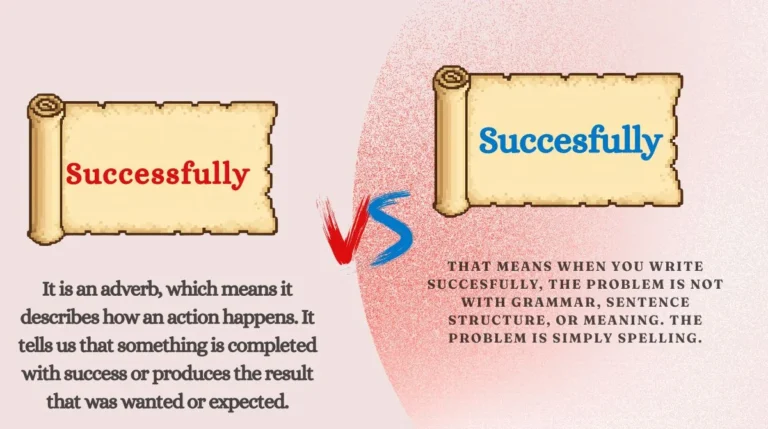
It is an adverb, which means it describes how an action happens. It tells us that something is completed with success or produces the result that was wanted or expected.
The word comes from successful, which is an adjective. Cambridge Dictionary defines successful as achieving the results wanted or hoped for, and successfully is the adverb form.
Simple meaning of successfully
Successfully = in a successful way; with the desired result
For example:
- She completed the project successfully.
- The doctor treated the patient successfully.
- He passed the exam successfully.
- We successfully solved the problem.
In each sentence, the word explains the result of the action.
When should you use “successfully”?
Use successfully when you want to say that an action was completed well or that something achieved its intended result.
You can use it with many different verbs:
- complete successfully
- finish successfully
- solve successfully
- pass successfully
- launch successfully
- manage successfully
- repair successfully
- operate successfully
The word is especially useful when you are talking about achievements, tasks, plans, projects, attempts, or results.
Grammar rule for “successfully”
Because successfully is an adverb, it usually modifies a verb or sometimes a whole clause.
For example:
The team successfully completed the task.
Here, completed is the verb, and successfully tells us how the task was completed.
You can also place it after the main verb:
The team completed the task successfully.
Both forms are correct.
Another common structure is:
successfully + past participle
For example:
- successfully completed
- successfully repaired
- successfully delivered
- successfully tested
- successfully installed
This structure is very common in formal and professional English.
Examples of “successfully”
- She successfully passed her driving test.
- The company successfully launched its new product.
- We successfully finished the project on time.
- He successfully solved the difficult problem.
- The engineers successfully repaired the machine.
- They successfully completed the training program.
- The operation was successfully performed.
- She managed to successfully combine work and study.
The word is useful in both everyday English and formal writing. It does not sound strange or overly formal. It is a normal English adverb used in many situations. Cambridge examples also show it being used with verbs such as treat, combine, manage, disarm, and bomb.
A common learner confusion
Many learners know the words success, successful, and successfully, but they become unsure about the spelling when moving from one word to another.
Look at the family:
- success — noun
- successful — adjective
- successfully — adverb
The important point is that the base spelling success stays visible in all three forms.
So:
success → successful → successfully
The two c’s in success do not disappear.
What Does “Succesfully” Mean?
Succesfully is not the correct spelling in standard English.
This is a misspelling of “successfully.” It is not a separate word with its own meaning.
That means when you write succesfully, the problem is not with grammar, sentence structure, or meaning. The problem is simply spelling.
The correct form is:
successfully ✅
The incorrect form is:
succesfully ❌
Why does “succesfully” look tempting?
The mistake is understandable because the word is long, and English spelling is not always easy to predict from pronunciation.
When people say successfully, they often think of the word in sound rather than in individual letters. This can make the middle part feel confusing.
There is also a natural temptation to write:
succes + fully
instead of:
success + fully
But the base word is success, which already has two c’s at the end.
The spelling problem
Compare the two forms carefully:
successful
successfully
The second word is formed by adding -ly to successful:
successful + ly = successfully
The spelling remains connected to the word success.
The incorrect spelling drops one s from the important success part:
succesfully ❌
That missing s is what makes the word wrong.
Why “succesfully” should be avoided
You may sometimes see this spelling in online posts, informal messages, student writing, or typing mistakes. The fact that people use it does not make it standard English.
For school assignments, professional emails, websites, resumes, reports, and formal writing, always use:
successfully
Examples of the wrong and correct spelling
❌ She completed the exam succesfully.
✅ She completed the exam successfully.
❌ The team succesfully finished the work.
✅ The team successfully finished the work.
❌ He succesfully repaired the computer.
✅ He successfully repaired the computer.
❌ We succesfully solved the issue.
✅ We successfully solved the issue.
The meaning of the sentence does not change. Only the spelling does.
Difference Between Successfully and Succesfully
The biggest difference is very simple: successfully is correct, while succesfully is incorrect.
| Word | Correct? | Part of Speech | Meaning | Use |
|---|---|---|---|---|
| successfully | ✅ Yes | Adverb | In a successful way | Standard English |
| succesfully | ❌ No | — | No standard meaning of its own | Misspelling |
Usage difference
There is no real usage choice between the two words.
You do not choose one based on formality, context, region, or sentence type.
Instead:
- Use successfully every time.
- Avoid succesfully every time.
This is different from confusing pairs such as affect/effect or advice/advise, where both words are correct but have different meanings. With this pair, only one spelling is standard.
Grammar logic
The correct word is an adverb formed from the adjective successful.
The word family looks like this:
success → successful → successfully
Here is the pattern:
success = noun
successful = adjective
successfully = adverb
For example:
Her project was a success.
Her project was successful.
She completed the project successfully.
Notice how the part of speech changes, but the core spelling remains connected.
Sentence structure difference
Because successfully is an adverb, it can appear in several places.
Before the main verb
They successfully completed the task.
After the verb
They completed the task successfully.
With another adverb or verb phrase
The technician successfully managed to repair the system.
The incorrect spelling does not have its own grammar pattern.
Meaning comparison
Successfully means that something happened with a good or desired result.
For example:
The meeting ended successfully.
This suggests that the meeting achieved what was expected.
But succesfully has no separate meaning. A reader who sees it will normally understand that you meant successfully.
Grammar Rules You Must Remember
Rule 1: Remember the base word “success”
The easiest way to spell the word is to start with:
success
Then build the word:
success + ful + ly = successfully
Example:
She successfully completed the assignment.
Do not remove a letter from success.
Rule 2: “Successfully” is an adverb
An adverb often tells us how an action happens.
Compare:
He is a successful student.
Here, successful describes the noun student, so it is an adjective.
Now:
He completed the course successfully.
Here, successfully describes the action completed, so it is an adverb.
A useful question is:
How did he complete the course?
Answer:
Successfully.
Rule 3: Keep both c’s in “success”
The noun success is spelled:
s-u-c-c-e-s-s
That means it contains two c’s and two s’s in the key ending.
When you build the longer form, these letters stay.
success → successful → successfully
A common mistake is to remember only one part of the spelling and accidentally write:
succesfully
Instead, think:
success + fully
That mental picture makes the correct spelling easier to remember.
Rule 4: “-ly” turns the adjective into an adverb
The adjective is:
successful
The adverb is:
successfully
Example:
The event was successful.
The event was organized successfully.
The first word describes the event.
The second word describes the action of organizing.
This is an important grammar difference, not just a spelling difference.
Common Mistakes Students Make
Why do learners make this mistake so often?
The main reason is that successfully is a long word. When we write long words quickly, our eyes and fingers sometimes skip letters.
Another reason is that learners may know success and successful, but they do not notice that the full spelling needs to remain connected to the original word.
Mistake 1: Dropping one “s”
❌ The project was completed succesfully.
✅ The project was completed successfully.
Correction tip: Think of the word as:
success + fully
Not:
succes + fully
Mistake 2: Thinking pronunciation controls spelling
English pronunciation can change our spelling choices.
A learner may hear the word and spell it according to the sounds they notice.
But spelling is not always a perfect copy of pronunciation.
The safest method is to remember the word family:
success → successful → successfully
Mistake 3: Confusing “successful” and “successfully”
❌ She is a successfully student.
✅ She is a successful student.
Why?
Because student is a noun, and we need an adjective to describe it.
Now compare:
✅ She completed her course successfully.
Here, successfully describes the verb completed.
Mistake 4: Adding the wrong form after “be”
Learners sometimes write:
❌ The event was successfully.
✅ The event was successful.
With the linking verb was, we usually need the adjective when describing the event itself.
Compare:
The event was successful.
The organizers ran the event successfully.
Both words come from the same family, but they perform different grammar jobs.
Mistake 5: Trusting spell-check too late
A spell-check tool can catch succesfully, but it is better to know the spelling yourself.
When you learn the word family, you become less dependent on correction tools.
A good habit is to slow down for words that contain several repeated letters.
Easy Trick to Remember the Difference
Here is a simple memory trick:
Think: “SUCCESS comes first.”
The word successfully begins with success.
Say it mentally like this:
SUCCESS + FULLY
Look at the important part:
SUCCESS
Then add:
FULLY
Together:
SUCCESSFULLY
This is easier than trying to memorize all twelve letters separately.
Another easy trick
Remember this sentence:
Success comes before fully.
That means:
success + fully = successfully
When you are typing quickly and you are not sure whether to write successfully or succesfully, stop for one second and find the word success inside it.
Can you see:
successfully?
Yes.
That is the correct spelling.
Real-life logic
Imagine you have the word success written on a card.
You want to turn it into an adverb.
You do not throw away part of the word. You build on it:
success
↓
successful
↓
successfully
Keeping the base word in your mind makes the spelling much easier.
Daily Life Examples
The word successfully is common in everyday English, school English, and workplace English. Here are some natural examples.
1. School
A: Did you finish your science project?
B: Yes, I successfully completed it last night.
2. Exam
She successfully passed her final exam.
3. Work
Our team successfully completed the project before the deadline.
4. Technology
I successfully installed the new software on my laptop.
5. Travel
They successfully reached the airport before the storm began.
6. Business
The company successfully launched its new website.
7. Repair
The mechanic successfully fixed my car.
8. Cooking
She successfully made the cake for the first time.
9. Personal goal
He successfully finished his first marathon.
10. Everyday conversation
A: Did you get the job?
B: Yes! I successfully completed the interview process.
These examples show why the word is so useful. Whenever you want to express the idea of completing something with the desired result, successfully can often fit naturally.
Practice Section
Choose the correct word in each sentence.
1. She ______ completed the training course.
a) succesfully
b) successfully
2. The team ______ solved the problem.
a) successfully
b) succesfully
3. He ______ repaired the broken machine.
a) succesfully
b) successfully
4. We ______ finished the project on time.
a) successfully
b) succesfully
5. The company ______ launched its new service.
a) succesfully
b) successfully
Answers
- successfully ✅
- successfully ✅
- successfully ✅
- successfully ✅
- successfully ✅
There is one answer pattern here because this spelling pair is not a matter of choosing between two valid words. Successfully is the correct standard spelling in every case.
FAQs
What is the difference between successfully and succesfully?
Successfully is the correct spelling and is an adverb meaning “in a successful way” or “with the desired result.”
Succesfully is simply a misspelling. It is not a separate standard English word.
Is “succesfully” a correct word?
No. Succesfully is not the standard spelling.
The correct form is successfully, with the full spelling of success kept inside the word. When writing for school, work, or a website, always use successfully.
How do you spell successfully correctly?
A useful way to remember it is:
success + fully = successfully
Start with the word success, then continue with ful and ly.
The correct spelling is:
s-u-c-c-e-s-s-f-u-l-l-y
What part of speech is successfully?
Successfully is an adverb.
It normally describes an action and tells us that something was done with a successful result.
Example:
She completed the task successfully.
Here, the adverb describes how she completed the task.
Is successfully formal or informal?
Successfully can be used in both everyday and formal English.
You can use it in conversation:
I successfully fixed the problem.
You can also use it in formal writing:
The project was successfully completed ahead of schedule.
So there is no need to avoid the word in normal conversation.
Is “successful” different from “successfully”?
Yes. Successful is an adjective, while successfully is an adverb.
Compare:
She is a successful business owner.
She successfully grew her business.
Successful describes a person, thing, or situation. Successfully describes an action or result.
Conclusion
The spelling choice between successfully and succesfully is actually very simple once you know the word family. Successfully is the correct standard English spelling, while succesfully is a common spelling mistake.
The easiest way to remember the correct form is to keep the base word success in your mind:
success → successful → successfully
The adverb successfully means that something was done in a successful way or that the desired result was achieved. It is commonly used with action verbs such as complete, finish, solve, repair, launch, and manage. Cambridge Dictionary also identifies it as an adverb used for actions that achieve wanted or hoped-for results.
Whenever you are unsure, look for success inside the word. That one small habit can help you avoid the missing-letter mistake.
Keep practicing, read the correct spelling often, and soon successfully will become a word you can write without thinking twice.

Evan Rellmont is a writer who turns thoughtful ideas into meaningful words, creating stories and reflections that connect, inspire, and leave a lasting impression.